US Taxpayer Backlash Grows: Why Washington’s Israel Policy—and AIPAC’s Clout—Are Suddenly on the Defensive
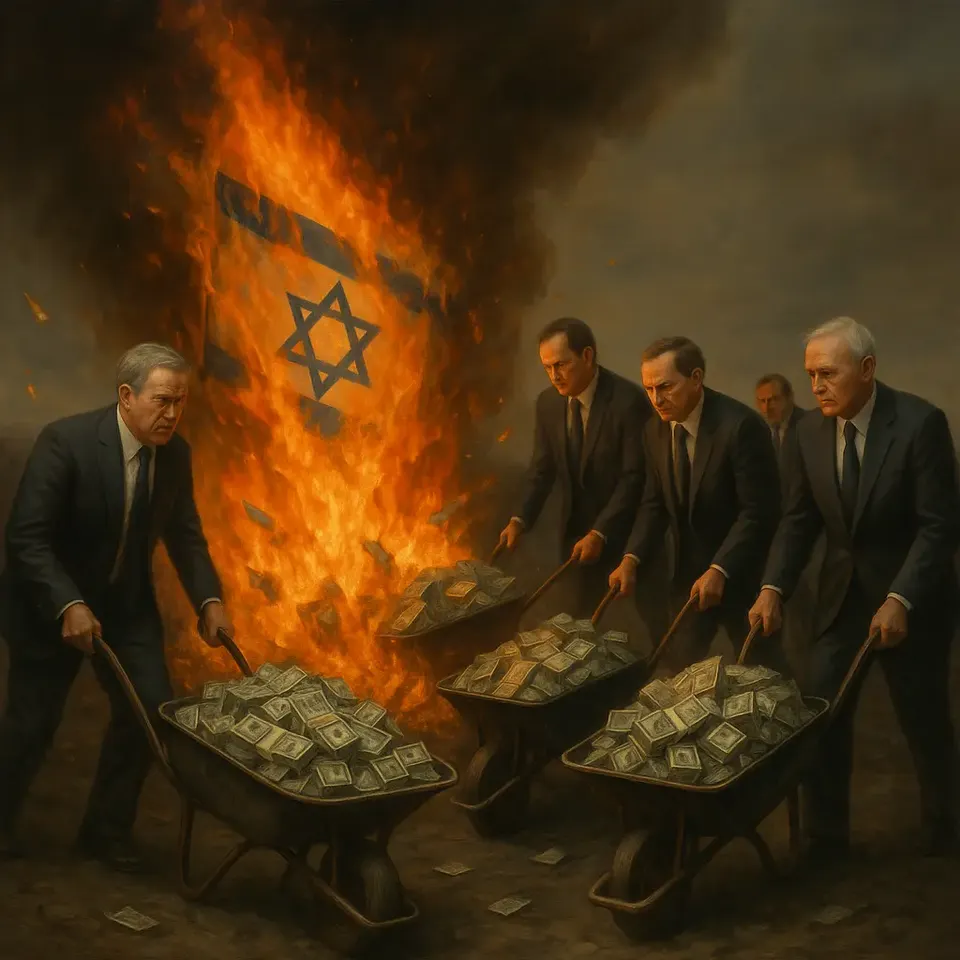
With public support eroding, Senate votes tightening, global opinion hardening, and Israel scrambling to censor online criticism, a once-untouchable consensus on unconditional aid faces its stiffest U.S. challenge in decades.
Americans are souring on the blank-check approach to Israel—and they’re starting to say the quiet part out loud: stop sending billions in taxpayer dollars and stop letting AIPAC police Capitol Hill. The polling trend is unmistakable. By spring 2025, more U.S. adults held an unfavorable view of Israel than not—a sharp turn from pre-war attitudes. By mid-summer, support for Israel’s military campaign in Gaza had collapsed to record lows as voters recoiled from the civilian toll. By September, national sympathies had effectively crossed over—with more Americans siding with Palestinians than Israel for the first time in modern polling history.
This shift is being accelerated by new media moments that bypass traditional gatekeepers. Millions of people in the U.S. and around the world have watched and shared Tucker Carlson’s viral interview with economist Jeffrey Sachs. Within just 48 hours of publication, clips had been viewed more than 20 million times across X, TikTok, and YouTube, dwarfing the reach of most nightly newscasts. On some platforms, hashtags linked to the video surged into the top ten worldwide.
The scale of engagement is a story in itself. While mainstream news organizations continue to avoid the core issue or divert coverage into side debates, this conversation is exploding online. Tens of thousands of Americans are debating it in real time in comment threads, podcasts, and livestreams. In the absence of legacy coverage, social media has become the primary arena for the kind of blunt discussion that many voters say they never hear on television.
“We’re devoting all of our time…”
Carlson opened his monologue with a line that captured the frustration of many Americans: “We’re devoting all of our time to a boutique conversation about a tiny country on the other side of the world. It’s humiliating.” He argued that the United States, a nation of 350 million people, had allowed its political life to be consumed by a single client state’s demands: “Israel is consuming our bandwidth. We can’t think about our own interests because we’re told every day our duty is to theirs.”
The financial cost was central to his point. As Carlson noted, Israel has been given around a third of a trillion dollars of U.S. taxpayer money, money it will never have to repay: “We have written them a check for hundreds of billions, and they don’t owe us a cent. It’s not aid, it’s tribute.”
The contrast with other allies is stark. Ukraine, facing an existential war, has been structured to repay much of its U.S. military assistance over time. Britain, America’s closest partner in World War II, carried its wartime debt for half a century, finally completing repayments to Washington in 2006. Only Israel has enjoyed the extraordinary privilege of limitless gifts with no strings attached.
Sachs: “The most lawless state in the world”
Jeffrey Sachs located the current crisis in a deliberate strategy dating back to the 1990s. He cited the infamous 1996 policy paper “A Clean Break”, drafted by U.S. neoconservatives for then-prime minister Benjamin Netanyahu, which urged Israel to abandon the Oslo peace process, confront Syria, and push for regime change in Iraq. Sachs said this worldview—one of permanent conflict and no compromise with Palestinians—became enshrined in U.S. policy: “For thirty years, Washington has danced to Netanyahu’s tune. And what has it brought? War after war, and Israel today standing as the most lawless state in the world.”
On Gaza, Sachs was equally direct. Echoing what genocide scholars and UN investigators have concluded, he stated flatly: “What Israel is doing is genocide. The world sees it clearly. Only Washington pretends not to.”
A viral debate the media won’t touch
The Carlson–Sachs exchange has caught fire precisely because it broaches what mainstream outlets avoid. Viewers flooded the comments to thank the pair for “saying what no one on CNN or MSNBC will dare.” Millions of Americans are engaging with the discussion online, while the nightly news still treats the subject as off-limits, offering instead stories about “humanitarian aid convoys” or “regional tensions” that obscure the central fact: U.S. taxpayer money is enabling Israel to act with impunity.
Carlson himself underscored this media silence: “You notice how the New York Times won’t even run the numbers? They don’t want Americans asking why we’re broke at home while funding endless war abroad.” Sachs added: “The mainstream press is complicit. They’ve normalized a level of lawlessness by Israel that would never be tolerated from any other country on Earth.”
Israel’s war on independent media
Israel’s growing isolation has left it increasingly dependent on propaganda and censorship. Netanyahu recently spelled out this strategy in startlingly candid terms. Speaking on camera, he praised U.S. moves to force the sale of TikTok—not as a national security measure against China, but as a step designed to serve Israel’s interests. “The most important purchase going on right now is TikTok,” Netanyahu said. “Number one. If that goes through, it will be consequential.” He added that Israel’s government must “talk to Elon” Musk to pressure X into silencing dissent, boasting that online narratives about Israel could be controlled more tightly with American help.
In other words, the U.S. government’s push to restructure global social media giants was, by Netanyahu’s own admission, done in no small part to protect Israel from criticism. Carlson called it “a foreign leader bragging about censoring Americans—Americans, in the last country on earth with guaranteed free speech.”
The stakes could not be clearer. Independent journalism and social platforms are now the last space where Americans can question the U.S.–Israel relationship without filter. Which is precisely why Israel and its lobbyists are working so hard to shut that space down.
The world turns against Israel
Outside U.S. borders, the picture is even starker. At the UN, the overwhelming majority of states now back Palestinian statehood and denounce Israel’s conduct. Netanyahu’s annual address to the General Assembly triggered a mass walkout, with diplomats leaving en masse as he denounced recognition of Palestine as “sheer madness.” European allies once deferential to Washington—including France, Spain, and the UK—have formally recognized Palestine, while Latin America, Africa, and Asia already long since did so. In diplomatic terms, it is two nations and a scattering of islands versus nearly the entire planet.
The isolation is profound. For most of the world, Israel’s impunity is seen not as strength but as proof of U.S. corruption. And the question is now squarely in American living rooms: Why are we paying for it?
The bottom line
For years, Israel policy in Washington survived on momentum, muscle, and moral memory. In 2025, momentum has stalled, muscle is contested, and public patience is running out. The numbers tell the story: unfavorable views rising, sympathy margins shrinking, and Senate Democrats willing—finally—to cast votes that would have been career-ending a decade ago.
Carlson and Sachs didn’t create that shift; they’re surfing it. Millions are watching because the conversation is finally breaking through the media firewall. And the question now isn’t whether the debate has changed—it has—but whether Congress will translate voter unease into enforceable guardrails on aid, and whether AIPAC’s unrivaled leverage can withstand an era of receipts, reporting, and restraint.
With the world condemning Israel as a rogue state committing genocide, and American taxpayers asking why their money flows unconditionally to a foreign government that never has to pay it back, the era of automatic support is ending. Unlike Ukraine or even wartime Britain, which carried the burden of repayment, Israel has been uniquely indulged. That exceptionalism is becoming indefensible.
And now, with Israel openly lobbying to silence Americans on their own social media platforms, the backlash is no longer just about dollars—it’s about democracy itself.