Empty Skies: How the World Is Turning Away from America’s Airports
They say if you want to understand a country’s strength, look up at its skies. In 2025, America’s skies are telling a troubling story: international airlines are retreating from U.S. routes at a pace not seen in modern aviation history.
What might seem like routine airline strategy is, in fact, a coordinated pullback with consequences that reach far beyond empty departure gates. From Reykjavik to Frankfurt, from Toronto to Sydney, carriers are cutting service to the United States, redirecting their aircraft, their crews, and their customers elsewhere. The results are reshaping not only global travel, but also the economic heartbeat of American communities that rely on tourism and connectivity.
The End of $99 Transatlantic Dreams
Just a few years ago, U.S. airports were buzzing with budget travelers. Icelandic carriers had pioneered the $99 transatlantic ticket — a golden age for students and backpackers.
That era ended abruptly in March 2025 when Iceland’s budget airlines announced the suspension of all North American routes. By October, flights were gone, and with them the flow of bargain-hunting Europeans. Within twelve months, visitors from Northern Europe to the U.S. dropped by 60%, according to the U.S. Travel Association.
“They didn’t stop flying,” said Jónas Helgason, director of a Reykjavik travel agency. “They just stopped choosing America. Tokyo, Seoul, Vancouver — those are the new gateways. The U.S. has priced itself out of the conversation.”
Canada Turns Away
Perhaps the most telling sign comes from across the northern border. For decades, Canadians viewed the U.S. as their backyard vacation spot — beaches in Florida, shopping in New York, sunshine in California.
Now, for the first time, Canadians are choosing to stay home. Data from Statistics Canada shows that cross-border travel to the U.S. fell 35% year-on-year, even as Canadian domestic travel grew 18%.
Air Canada and WestJet have cut nearly 40% of their U.S. routes, eliminating direct links to cities once considered staples, including Los Angeles, Orlando, and New York.
“The money is still there,” said Megan O’Donnell, an aviation analyst with the Centre for North American Travel. “But Canadians are spending it in Banff and British Columbia, not Buffalo and Boston. America has simply become less competitive.”
Lufthansa Leaves, Asia Rises
The departure that shocked industry veterans most came from Lufthansa. For 40 years, the German flag carrier’s golden crane was a familiar sight at U.S. airports. In 2025, without ceremony, Lufthansa eliminated multiple American routes, reallocating aircraft to Asia.
In its March earnings report, Lufthansa reported Asia-Pacific revenues up 27%, while North American revenues fell 18%. The company cited “prohibitively high operating costs in the United States” and “declining traveler satisfaction.”
“Landing in America today doesn’t feel like arriving in a top global destination,” one Lufthansa flight attendant told Der Spiegel. “It feels like stepping into a checkpoint.”
Air France and KLM have followed suit, cutting 30–45% of their transatlantic service. Routes that once embodied the cultural bond between Europe and the U.S. — Paris to New York, Amsterdam to Miami — are quietly disappearing, replaced by fuller schedules to East Asia.
America’s New Barrier: Politics at the Border
But costs and logistics aren’t the whole story. Travelers increasingly cite America’s political climate and immigration enforcement as reasons to stay away. Under President Trump, new executive orders have expanded the definition of security threats, allowing border agents and ICE officers to deny entry to travelers based on ideology, social media content, or political associations.
The results are chilling. In February 2025, CBP officers stopped 135 people deemed “inadmissible” at U.S. ports of entry; in March that number rose to 194. While some were blocked over paperwork or criminal histories, others were turned back for political reasons.
- A Norwegian tourist said he was denied entry at Newark airport after CBP agents confronted him over a meme about Vice President J.D. Vance. Officials later claimed drug-use evidence justified the refusal.
- An Australian tourist was deported after agents questioned him about online posts supporting Palestinian rights. He described the ordeal as “traumatic.”
- Rasha Alawieh, a Brown University professor with a valid H-1B visa, was denied re-entry after agents found photos on her phone deemed sympathetic to Hezbollah, even though she insisted they were for research.
- By mid-2025, nearly 2,000 international student visas had been revoked, many linked to pro-Palestinian activism on U.S. campuses.
Immigration lawyers warn this constitutes “political litmus testing.” “It’s no longer about whether you meet the legal entry requirements,” said one attorney. “It’s about whether your politics match the administration’s expectations.”
For foreign travelers, the prospect of being interrogated over personal beliefs — and having their phones searched for memes, tweets, or photos — is enough to push them toward safer, friendlier destinations.
Tourism & Immigration: A Cooling Climate
The political chill at the border is matched by broader shifts in U.S. tourism and immigration policy that are making America a less attractive destination:
- Decline in International Tourism
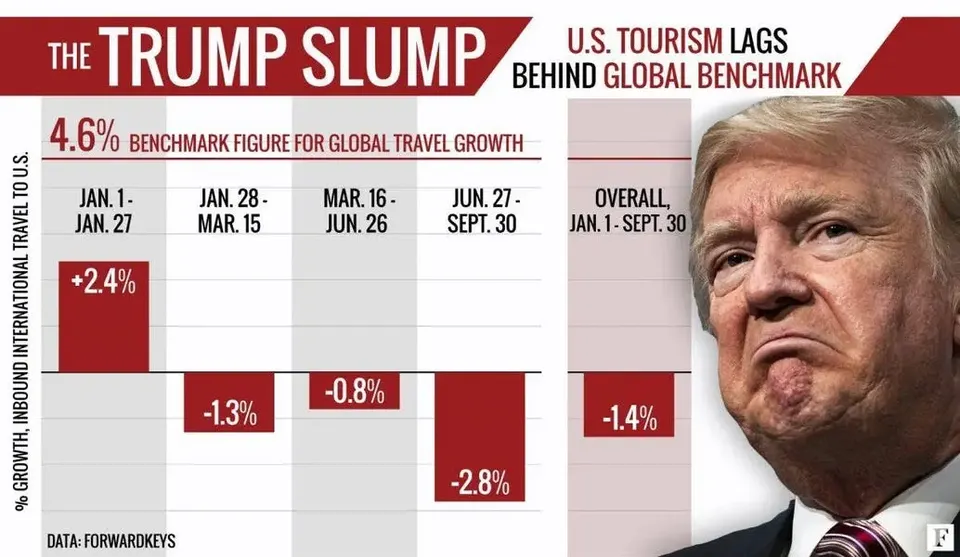
- The U.S. is the only one among 184 countries projected to see a decline in international tourism spending in 2025, with arrivals forecast to fall 8.2%.
- Spending by overseas visitors is expected to decline by 7% to under $169 billion, representing a loss of $25–29 billion, driven by tighter immigration rules, tariffs, and hostile political rhetoric.
- New Fees Making Travel More Costly
- A new $250 “visa integrity fee”, effective October 1, 2025, raises total visa costs to $442 for many travelers, among the highest worldwide. This is expected to hit visitors from Mexico, India, China, Brazil, and Argentina hardest.
- Proposals also include requiring bonds up to $15,000 for some tourists and business travelers from countries with high overstay rates.
- Crackdowns, Raids & Perception Issues
- Expanded ICE raids in cities such as Chicago have sparked local backlash and politicized response. In Washington, D.C., enforcement actions have left immigrant workers fearful to leave home, crippling restaurants and hotels.
- Las Vegas has reported international travel down 11% and hotel occupancy down 15%, trends union leaders blame on immigration crackdowns.
- Nationwide, international arrivals fell 6.6% in June 2025, with notable declines from Canada, South Korea, Germany, and France. Domestic tourism also softened, with shorter stays and reduced spending.
- Local Offsets & Domestic Resilience
- Some regions, like San Francisco, are offsetting international losses with domestic tourism. Despite a 3.2% decline in foreign visitors, major events like the NBA All-Star Game and 2026 World Cup preparations have kept hotels full.
- New Immigration Policies Taking Effect
- Executive Order 14159 (Jan 2025) expanded deportation tools, increased ICE and CBP staffing, defunded sanctuary cities, and imposed new penalties for undocumented immigrants.
- Proclamation 10949 (June 2025) imposed a new travel ban restricting entry from 12 countries, effective June 9, though exemptions apply for major international events.
Even Burning Man Can’t Escape
If any U.S. cultural event symbolized international allure, it was Burning Man, the annual desert gathering that for years attracted visitors from across the globe. From 2011 to 2023, tickets sold out every single year, often within minutes of release.
But in 2024, for the first time in over a decade, tickets did not sell out — even with less than two weeks before the festival, thousands were still available. The slump continued into 2025, with tickets still unsold as of mid-August.
For analysts, Burning Man’s stall isn’t just about changing tastes. It’s a sign of how global interest in U.S. destinations — even iconic countercultural gatherings — is waning in the face of higher costs, political hostility, and travel uncertainty.
American Airlines Retreat at Home
The irony is that even American carriers are shrinking service within their own borders. JetBlue has eliminated routes to 15 U.S. airports, leaving mid-sized cities like Syracuse, Worcester, and Fresno without reliable air connections.
Nationwide, 38% of small airports lost more than half of their flights in the past year, according to the Regional Airline Association. These cuts aren’t just inconveniences; they are economic body blows.
“Air service is lifeblood,” said Faye Maloney, mayor of Worcester, Massachusetts. “When you lose connections, you lose business investment, medical access, and family ties. It’s not just a flight — it’s a lifeline.”
The Domino Effect
In Chicago, Lufthansa’s withdrawal left hotels with unfilled rooms and restaurants with empty tables. The Illinois Hotel & Lodging Association reported a 22% drop in international bookings since the route cuts.
“Each flight supports an entire ecosystem,” said Robert Mann, an independent aviation consultant. “When it disappears, the ripple effects are immediate — and devastating. One canceled daily flight can mean millions lost to the local economy.”
Why America Is Losing the World
Airline executives point to rising fuel costs, staff shortages, and currency fluctuations, but those challenges affect every country. The deeper problem is perception: America is seen as expensive, stressful, and politically hostile.
A 2025 survey by the International Air Transport Association (IATA) found that 68% of European respondents considered the U.S. “expensive and stressful” compared to Asian destinations, where 72% reported feeling “welcomed and secure.”
From surprise visa fees to ideological interrogations at airports, the U.S. is now viewed less as the land of opportunity and more as a gamble.
A Wake-Up Call in the Skies
For ordinary Americans, the collapse of inbound tourism and shrinking domestic service translates into fewer affordable flights, lost jobs, and declining economic opportunities. For the country as a whole, it raises an uncomfortable question: what does it say about America’s place in the world when planes no longer want to land here?
“The empty skies are a mirror,” said Dr. Elaine Kim, professor of global tourism at NYU. “They reflect how the world sees us — and whether we still deserve to call ourselves a destination.”
The empty skies above the United States are not just a transportation problem. They are a reflection of America’s standing on the global stage. And whether you fly or not, that affects all of us.