
Born Ján Ludvík Hyman Binyamin Hoch and later known legally as Ian Robert Maxwell, the publishing tycoon built his fortune by controlling information. Decades after his death, an allegation that he helped Israel market compromised government software still sits at the border between documented scandal and espionage folklore.
When Robert Maxwell was buried on Jerusalem’s Mount of Olives on November 10, 1991, the British newspaper proprietor received a farewell normally reserved for a national statesman.
Israeli Prime Minister Yitzhak Shamir and President Chaim Herzog attended. Herzog delivered the eulogy. Government ministers, political leaders and senior figures from Israel’s security establishment joined a funeral crowd reported in the thousands. Shamir praised Maxwell in terms that appeared to hint at services beyond newspaper ownership, saying that he had done more for Israel than could then be disclosed.
The spectacle was extraordinary. Maxwell had been a Labour member of the British Parliament and one of Britain’s most recognisable businessmen, yet no comparable procession of British power followed his coffin. Israel gave him what the Washington Post described at the time as a farewell fit for a hero.
Five days earlier, the 68-year-old proprietor had disappeared from his yacht, the Lady Ghislaine, near the Canary Islands. His body was recovered from the Atlantic. A British inquest returned a verdict of accidental death after evidence of serious heart disease and drowning, although disagreement among pathologists and the strangeness of the circumstances ensured that speculation never stopped.
Within weeks, a more earthly explanation for Maxwell’s final crisis emerged. His companies were buckling under enormous debts, and hundreds of millions of pounds had been taken from employee pension funds to keep the empire standing. The celebrated rescuer of the New York Daily News had died on the brink of financial exposure.
Yet the money scandal did not explain the Israeli honours. Nor did it settle a second, darker question that had begun circulating before his death: had Maxwell helped Israeli intelligence sell foreign governments a compromised version of PROMIS, an American database program capable of linking people, cases and intelligence across otherwise incompatible computer systems?
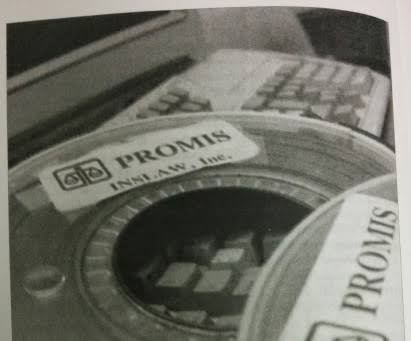
Parts of that story are established. PROMIS existed. Its developer, Inslaw, became locked in an extraordinary legal conflict with the United States Department of Justice. A version of the program was supplied to an Israeli representative in 1983. Congressional investigators found substantial reason to suspect wrongdoing by Justice Department officials. The FBI later opened a classified inquiry touching Maxwell-linked companies and a United States nuclear laboratory.
The central charge, however, remains unproved: no publicly authenticated source code, forensic examination, sales ledger or declassified operational record demonstrates that Israel inserted a secret access mechanism into PROMIS and used Maxwell to distribute it. The PROMIS affair endures because the proven facts carry a reader to the threshold of the allegation, then stop.
The boy before Robert Maxwell
The name Robert Maxwell was itself a construction. He was born Ján Ludvík Hyman Binyamin Hoch on June 10, 1923, in Slatinské Doly, a poor settlement in Carpathian Ruthenia, then part of Czechoslovakia and now Solotvyno in Ukraine. Many accounts shorten the birth name to Ján Ludvík Hoch. He grew up in an impoverished, Yiddish-speaking Orthodox Jewish family.
Hoch left home as a teenager while Europe closed around its Jewish population. Most of the family members he left behind, including his parents, were murdered in the Holocaust. The scale of that loss became one of the few stable facts beneath a life of repeated reinvention. Biographical accounts describe a young refugee shedding languages, allegiances and names as he crossed wartime Europe.
He served first with Czechoslovak forces in exile and then with the British Army, where he adopted English aliases, became an officer and won the Military Cross for gallantry in 1945. He was naturalised after the war and eventually became Ian Robert Maxwell. His later life encouraged the image that he had simply willed “Bob Maxwell” into existence: a booming, upper-class English voice laid over a Central European childhood he rarely allowed others to examine closely.
There were troubling episodes amid the heroism. A letter Maxwell wrote during the war described shooting the mayor of a German town after a tank fired on his unit. British police examined allegations about his conduct decades later, but the inquiry closed in 1992 without charges. That is an important distinction. The episode belongs to the record of allegations surrounding him; it was not a judicial finding of a war crime.
After victory in Europe, Maxwell worked in occupied Berlin, where his language skills and military connections placed him at the junction of Allied administration, German science and publishing. He secured distribution rights for the German academic house Springer-Verlag, then turned a small British operation into Pergamon Press.
Pergamon was where Maxwell learned the economics of controlled information.
The business of owning what cannot be substituted
Scientific publishing offered an unusually powerful model. Researchers generally wrote papers without being paid by the journal. Other academics reviewed the work, also usually without payment. Universities then paid publishers for access to the finished product. A particular research result could not simply be replaced by a cheaper competing article because each paper contained unique information.
Maxwell understood the opportunity earlier and more aggressively than most. He launched journals in rapidly multiplying specialist fields, cultivated scientists and institutions, and treated every new branch of knowledge as a potential subscription market. Pergamon expanded from a modest list into a global publishing machine. A history of the scientific publishing business credits Maxwell with helping create the commercial journal system that later delivered exceptional profit margins to large publishers.
The insight mattered beyond academia: whoever organised scarce information could make the people who needed it pay repeatedly. Maxwell’s later empire applied variations of that principle to encyclopaedias, newspapers, financial information and electronic databases. This does not prove that he became an intelligence broker. It does explain why a sophisticated information-retrieval system such as PROMIS would have sat naturally within his commercial world.
His rise was never smooth. After an attempted American takeover of Pergamon collapsed in 1969, British inspectors examined the company’s accounts. Their 1971 report acknowledged Maxwell’s ability and energy but concluded that he was not a man who could be relied upon for the proper stewardship of a publicly quoted company.
He recovered anyway. Maxwell regained control of Pergamon, bought the British Printing Corporation in 1981 and acquired Mirror Group Newspapers in 1984. He added Macmillan in the United States, the Official Airline Guides, the pan-European newspaper The European and, in 1991, the New York Daily News. The acquisitions made him a transatlantic rival to Rupert Murdoch, but they were financed by a web of borrowing that became harder to sustain as asset prices fell and lenders demanded repayment.
The official investigation published after his death described a structure designed so that only Maxwell possessed the complete picture. Private companies, public companies, trusts and offshore entities shifted cash and securities among themselves. Pension assets were used as collateral for borrowing and as emergency liquidity. By April 1991, according to the inspectors, pension funds had made £100 million in cash loans and supplied shares worth far more as collateral.
After his death, approximately £450 million was found missing from pension funds, placing the retirement savings of about 32,000 people at risk. The scandal produced years of litigation, settlements and public rescue efforts. It also transformed the meaning of the Maxwell name. The information magnate buried as a hero in Jerusalem was exposed in Britain as a proprietor who had treated workers’ retirement assets as if they belonged to him.
A program built to connect the dots
PROMIS stood for Prosecutors Management Information System. It was developed in the 1970s by the Institute for Law and Social Research, the organisation that later became Inslaw, under grants from the United States Law Enforcement Assistance Administration.
At its simplest, PROMIS was case-management software. Its larger promise was the ability to bring together records stored in incompatible systems and allow users to find relationships among cases, suspects, witnesses, dates, evidence and events. In an era of isolated mainframes and incompatible databases, that was a formidable capability. It offered something intelligence organisations still prize: the power to query scattered information as though it belonged to one system.
William and Nancy Hamilton, who ran Inslaw, said their company later developed an enhanced, privately owned version. In 1982, the Justice Department contracted with Inslaw to install PROMIS in United States attorneys’ offices. A dispute over the enhanced version, licensing and payment escalated into bankruptcy, litigation and allegations that officials had deliberately forced the company into financial distress so the government could seize its product.
In 1987, a federal bankruptcy judge found that the Justice Department had taken the enhanced PROMIS through “trickery, fraud and deceit.” A federal district judge affirmed the central factual findings. But the victory did not survive. In 1991, the United States Court of Appeals for the District of Columbia Circuit vacated the judgment because the bankruptcy court lacked jurisdiction over the contract claim. The appellate judges stressed that the alleged conduct, if it occurred, was inexcusable; they did not decide that it had occurred.
That procedural reversal created a lasting ambiguity. Inslaw could point to detailed judicial findings in its favour, while the government could point to the fact that the judgment no longer stood. A later Court of Federal Claims trial rejected Inslaw’s ownership and bad-faith arguments, concluding that the government possessed the relevant rights. The Justice Department presented that ruling as confirmation that the foundational theft allegation had failed.
Congress was far less reassuring.
The Israeli transfer that did happen
In September 1992, the House Judiciary Committee issued The Inslaw Affair, the product of a three-year investigation. The committee said there appeared to be strong evidence that Justice Department officials had acted wilfully and fraudulently in the handling of enhanced PROMIS. It also found that the department had failed to cooperate fully with congressional inquiries.
Most significantly for the Israel story, the committee established that a copy of PROMIS had been supplied in May 1983 to a man recorded as “Dr Ben Orr,” described as a representative of the Israeli government. The available paperwork referred to an older, public-domain version created under federal funding. But the committee could not determine with confidence what was actually on the tape, what happened to it after delivery or whether a more advanced version travelled by another route.
The House report did not prove a backdoor operation. It did something more limited but still consequential: it moved the Israeli connection out of the realm of pure invention. A transfer occurred. Its purpose and ultimate use were inadequately explained.
Documents released years later deepened the identity problem. A 2017 review of Justice Department memoranda by MuckRock reported that passport records placed the real Israeli official identified as Ben Orr outside the United States at the time. Inslaw personnel later said the visitor resembled Rafi Eitan.
Eitan was not a peripheral civil servant. He had participated in the capture of Nazi official Adolf Eichmann and later headed Lakam, Israel’s secret scientific-intelligence bureau. He also directed the Israeli operation involving American naval intelligence analyst Jonathan Pollard. Eitan’s documented career, summarised in accounts published after his death, gives the disputed identification obvious weight. It still does not establish which version of PROMIS Israel received or whether anyone altered it.
How the backdoor story formed
The fullest allegation took shape through a small and controversial group of witnesses.
Michael Riconosciuto, a programmer with connections to the Cabazon Indian reservation and figures involved in defence contracting, told investigators that he had modified PROMIS for intelligence applications. He claimed that a covert access mechanism had been added and that the software was prepared for overseas distribution. Some of his claimed relationships and movements could be corroborated; the technical heart of his account could not.
Ari Ben-Menashe, a former employee of Israeli military intelligence, offered another strand. He alleged that Israel obtained PROMIS, modified it and used Robert Maxwell as an international salesman. In this version, foreign ministries, intelligence services, banks and strategic facilities believed they were purchasing a powerful record-management system. The hidden feature allegedly allowed the supplier to read their information.
Authors Gordon Thomas and Martin Dillon later built those claims into an expansive account of Maxwell as an Israeli intelligence asset. They alleged that he marketed the compromised software around the world and helped place it near highly sensitive American nuclear research. Their account has been repeated so frequently that it is often presented online as settled history. It is not. It is an allegation sourced heavily to intelligence insiders and disputed witnesses, without the public technical evidence needed to close the case.
Maxwell was alive when related claims entered mainstream reporting. In 1991, he and the Daily Mirror sued the publisher of Seymour Hersh’s book The Samson Option, which alleged close links between Maxwell and Israeli intelligence. Maxwell called the claims false and outrageous. The contemporary dispute is important because it records his denial before his death, rather than treating silence afterward as implied confirmation.
Technically, a backdoor is possible in many forms: a secret credential, a concealed communications routine, a manipulated update or a function known only to the operator. Possibility is not evidence. No authenticated PROMIS build has been publicly examined and shown to contain such a mechanism. There is no publicly available forensic report establishing that information was covertly extracted from a customer. Nor is there a complete, verified list of foreign installations linked to Maxwell.
What the FBI’s Maxwell file proves, and what it does not
One of the most frequently cited pieces of evidence is an FBI file released under the Freedom of Information Act. The surviving pages show that in 1984 the bureau opened a foreign-counterintelligence inquiry involving Maxwell, Pergamon Press and Information on Demand, a database-services company connected to the Maxwell business orbit. Agents interviewed personnel associated with Sandia National Laboratories in New Mexico. Portions concerning what the company had supposedly learned and why the matter worried investigators remain redacted.
That is significant. It demonstrates that American counterintelligence officials had a real concern about Maxwell-linked information businesses and a sensitive national laboratory. The classification and redactions are not inventions added by later writers.
But the released FBI file does not say in unredacted text that Maxwell sold PROMIS to Sandia or Los Alamos. It does not identify a discovered backdoor. It does not prove that laboratory data reached Israel. Even the later title attached to the Freedom of Information release is broader and more suggestive than some of the underlying pages.
This is the recurring pattern of the affair. The documentary record supplies a suspicious setting, an intelligence interest and missing information. Secondary accounts fill the gaps with a complete operation. The first part is evidence; the second remains an inference.
A family business in information
The supplied history of Maxwell’s family points to a broader legacy that is real but easily sensationalised. Several of his children went into information technology. Christine and Isabel Maxwell helped create Magellan, one of the early human-curated guides to the World Wide Web, which was sold to Excite in 1996. Isabel later led CommTouch, an Israeli-American email technology company that floated on Nasdaq in 1999. A 1999 Wired profile portrayed the venture as her attempt to establish an identity outside her father’s collapsed empire.
Christine co-founded Chiliad, whose search technology became one component of the FBI’s Investigative Data Warehouse after the September 11 attacks. The warehouse allowed authorised users to search across previously separate intelligence and law-enforcement sources. The Electronic Frontier Foundation’s review of FBI records names Chiliad among several contractors, alongside SAIC and Convera. By 2006, the FBI said the system held hundreds of millions of records.
Those facts make for a striking historical echo: the daughter of a man accused of trafficking a system that joined disconnected government databases later co-founded a company whose legitimate search tools helped the FBI query a vast data warehouse.
The echo is not evidence of continuity. Magellan, CommTouch and Chiliad were publicly visible commercial ventures. Their work does not substantiate the claim that the Maxwell family operated an inherited intelligence network, and it would be irresponsible to imply criminality from occupation or kinship. What it does show is that the family’s long association with the organisation and sale of information did not end with Pergamon or the Mirror.
Death, exposure and the stories left behind
In early 1991, Maxwell’s purchase of the New York Daily News was presented as a dramatic rescue of a famous paper. His yacht, named for his youngest daughter, became the floating headquarters of a proprietor still performing immense wealth. Eight months later, the Lady Ghislaine was drifting without him.
His death came at the precise moment when banks were tightening their grip and the hidden use of pension assets was becoming impossible to sustain. That timing inevitably produced theories of suicide and murder. Thomas and Dillon later alleged that Israeli intelligence killed him after he threatened to expose secrets. Other writers have suggested that he jumped rather than face ruin. Neither account has been proved. The official verdict remains accidental death.
What happened next requires no conspiracy. Inspectors and liquidators found a corporate empire carrying billions in debt, its finances obscured by transfers and pledged assets. Maxwell’s public reputation collapsed almost as quickly as his companies. The funeral language, however, remained. Israel’s leaders had spoken as though they were burying someone who had rendered extraordinary service.
There were non-secret reasons for Israeli gratitude. Maxwell had invested heavily in the country, including in the Maariv newspaper, the Keter publishing house and the technology company Scitex. He visited frequently, spoke with senior politicians and used his newspapers to defend Israel. These relationships could account for much of the funeral. They do not necessarily account for every carefully chosen phrase uttered at the grave.
Why the scandal survives
The PROMIS story persists because it contains three different cases that are often collapsed into one.
The first is a documented government-contract scandal. Inslaw and the Justice Department fought over software rights, payment and official conduct. A bankruptcy judge condemned the department, an appellate court erased the judgment on jurisdictional grounds, a later court rejected Inslaw’s case, and Congress found the government’s behaviour sufficiently troubling to demand an independent investigation.
The second is a documented but unresolved Israeli transfer. A copy of PROMIS went to a purported Israeli representative. The identity of that visitor and the precise version delivered became matters of serious dispute. Rafi Eitan’s reported presence gives the episode an intelligence dimension, but no public record shows what Israel did with the software afterward.
The third is the alleged espionage operation: a backdoor inserted into enhanced PROMIS, installations sold to governments around the world, and secret data channelled to Israeli and perhaps American intelligence through Robert Maxwell. That is the most explosive case and the least conclusively demonstrated.
The Justice Department’s final review in 1994 said it found no credible evidence that officials stole PROMIS, distributed it abroad or joined Maxwell in a United States-Israeli conspiracy. It dismissed Ben-Menashe and Riconosciuto as unreliable. Critics replied that the department had investigated accusations against itself and that documentary gaps remained. The later Court of Federal Claims decision strengthened the government’s legal position but did not explain every intelligence lead or disputed identity.
The disciplined conclusion is therefore less cinematic than the legend.
There is credible evidence of grave misconduct and institutional evasion in the wider PROMIS affair. There is proof that a version reached an Israeli representative. There is proof that the FBI investigated Maxwell-linked information businesses in a counterintelligence context. There are witnesses who described a backdoor and named Maxwell as its salesman.
There is not public proof of the backdoor itself.
That distinction does not make the story unimportant. It makes it a case study in how modern intelligence controversies are built: a foundation of real secrecy and official wrongdoing, followed by testimony that extends beyond what the surviving documents can bear. Maxwell’s biography intensifies the effect. Ján Ludvík Hoch was a Holocaust survivor, decorated soldier, scientific publisher, politician, media proprietor, financial criminal and intimate of Israeli power. His life already exceeded the scale of ordinary explanation.
The final mystery is not whether every story told about Robert Maxwell is true. Many plainly are not. It is why so many institutions gave the stories room to grow — through redactions, contradictory findings, missing records, evasive witnesses and official inquiries that answered one question while leaving the next untouched.
At the centre sits a piece of software designed to connect fragments of information. Four decades later, the fragments surrounding PROMIS still do not connect cleanly enough to deliver a verdict.