'He Should Resign': Why Mouin Rabbani Says ICC Prosecutor Karim Khan Has Failed Gaza
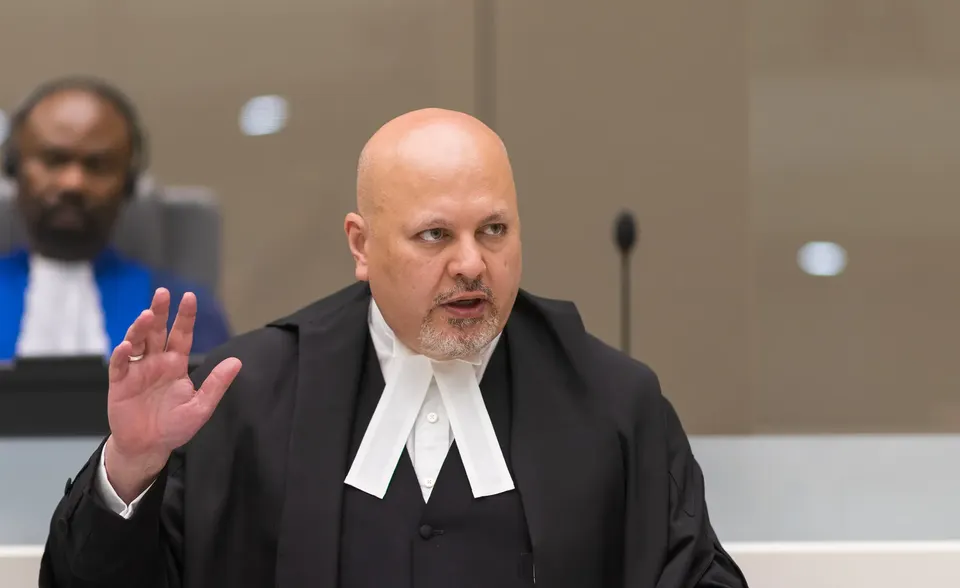
Reports that the International Criminal Court may be preparing additional arrest warrants for senior Israeli officials have renewed attention on the international legal campaign surrounding Israel's war in Gaza. Yet according to Palestinian analyst Mouin Rabbani, the bigger question is not whether more warrants are coming, but whether the prosecutor leading the investigation should remain in office at all.
Earlier this month, the Israeli newspaper Haaretz reported that ICC prosecutors were seeking judicial approval for arrest warrants against Israeli Finance Minister Bezalel Smotrich, National Security Minister Itamar Ben Gvir, another Israeli official and two military officers. While the court has not publicly confirmed the reports, its procedures allow arrest warrants to remain under seal until judges decide they should be made public.
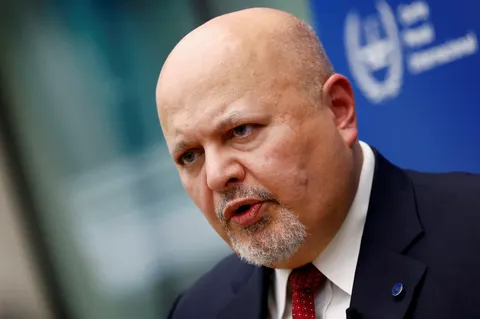
The reports come as ICC Chief Prosecutor Karim Khan is expected to return to his duties after reportedly being cleared of criminal wrongdoing following allegations of sexual misconduct. Khan has consistently denied the allegations.
For many observers, Khan's tenure will be remembered for securing the first arrest warrants ever sought against Israeli leaders over crimes committed against Palestinians. Yet Rabbani, a non-resident senior fellow at the Middle East Council on Global Affairs and one of the most respected Palestinian political analysts, believes that record is not enough.
"Now that Karim Khan has apparently been cleared of criminal conduct, he should do the honorable thing, resign and make room for a prosecutor genuinely committed to the job, one who will pursue war criminals rather than appease the powerful," Rabbani said during a recent interview with The Electronic Intifada.
His criticism is not based on the misconduct allegations. Rather, Rabbani argues that Khan's entire tenure demonstrates a pattern of political caution and selective justice that has undermined the credibility of the court during one of the gravest humanitarian catastrophes of the modern era.
The Prosecutor Israel Wanted?
According to Rabbani, concerns about Khan began long before the current Gaza war.
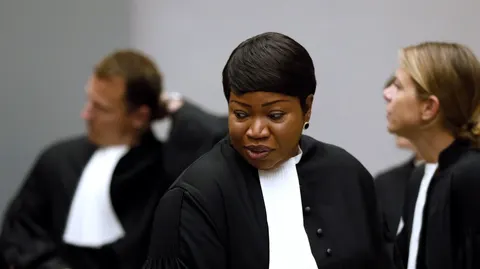
When former ICC prosecutor Fatou Bensouda left office, member states of the court elected Khan as her successor. Rabbani argues that Khan's candidacy received particularly strong support not only from Britain but also from the United States and Israel, neither of which are members of the court.
"They left no stone unturned to ensure that Khan would be elected," Rabbani said.
In his view, that support was not accidental.
Rabbani points to Khan's early statements after assuming office, particularly comments indicating that he would prioritise cases referred by the United Nations Security Council. Such an approach would effectively deprioritise politically sensitive investigations such as Palestine and Afghanistan, neither of which reached the court through Security Council referral.
"One doesn't have to read particularly carefully between the lines to understand that Khan was providing assurances to Washington in particular that they no longer needed to worry about progress in the case concerning Afghanistan and crimes committed by US forces in that country, and particularly about the ongoing investigation into Israeli crimes in Palestine," Rabbani argued.
Ukraine and Palestine
For Rabbani, the clearest evidence of double standards lies in the contrast between the ICC's response to Ukraine and its handling of Palestine.
Following Russia's invasion of Ukraine in February 2022, Khan rapidly established a large investigative operation and secured arrest warrants against senior Russian officials, including Russian President Vladimir Putin, within roughly a year.
The Palestine investigation, by contrast, had already been open for years.
"It took him less than a year to indict the head of state of a permanent member of the Security Council," Rabbani observed. "The investigation into Palestine was lagging very far behind that into Russian conduct in Ukraine even though it was years older."
The comparison has become increasingly contentious as critics of the court question whether international justice is being applied evenly across geopolitical conflicts.
Gaza Forced His Hand
Rabbani does not dispute that Khan eventually sought arrest warrants against Israeli Prime Minister Benjamin Netanyahu and former Defence Minister Yoav Gallant. What he disputes is the motivation behind that decision.
According to Rabbani, the scale of Israel's actions in Gaza after October 2023 made continued inaction impossible.
"The genocide was so public, so visible, so brazen," he said. Israeli leaders, military officers and soldiers were openly making statements that many legal experts viewed as evidence of genocidal intent. At the same time, pressure mounted from Global South governments, Palestinian organisations and legal professionals demanding accountability.
Rabbani argues that Khan acted not because he suddenly embraced the Palestine case, but because failure to act would have destroyed what remained of his credibility.
"He only issued the indictments against Netanyahu and Yoav Gallant really kicking and screaming because he would have had no credibility left if he didn't."
Even then, Rabbani notes, Khan simultaneously sought warrants against Palestinian leaders, a move critics viewed as an attempt to shield himself from accusations of bias.
Cleared of Misconduct, Not of Failure
Rabbani is careful to distinguish between the allegations against Khan and his performance as prosecutor.
He acknowledges that investigations reportedly cleared Khan of criminal wrongdoing. He also believes Israel played a role in the political campaign surrounding the allegations.
Nevertheless, he argues that the prosecutor has brought the office into disrepute through his handling of politically sensitive cases.
"Khan has dragged his feet," Rabbani said. "He has refused to energetically pursue his mandate for transparently political reasons."
His criticism goes further than the current warrants.
Nearly three years into what Rabbani repeatedly describes as a genocide in Gaza, the ICC has publicly confirmed warrants against only two Israeli officials. Rabbani argues that the court has ample grounds to pursue a much wider range of Israeli political and military leaders.
While genocide proceedings are also being considered at the International Court of Justice, Rabbani notes that the ICJ determines state responsibility rather than individual criminal liability.
"The ICC can and does have plausible grounds to seek arrest warrants against a whole range of Israeli leaders and commanders for the crime of genocide," he said.
Pressure on the Court
The difficulties facing ICC prosecutors were highlighted recently by comments from former prosecutor Fatou Bensouda.
According to Rabbani, Bensouda has begun speaking publicly about years of alleged Israeli efforts to intimidate, pressure and undermine court officials involved in the Palestine investigation.
He recounted allegations of surveillance, intimidation and attempted coercion directed at Bensouda and other ICC personnel.
"She talks about efforts at bribery, at blackmail, at intimidation," Rabbani said.
Such claims reinforce a wider argument increasingly heard among Palestinian advocates: that international legal institutions face extraordinary political pressure whenever they attempt to challenge Israeli actions.
The issue has become even more acute as the United States has imposed sanctions and other measures targeting individuals associated with investigations into Israeli conduct.
Why International Law Still Matters
Despite his frustration with the ICC, Rabbani rejects the idea that international law has become irrelevant.
Instead, he argues that many critics misunderstand its purpose.
"The Palestinian struggle for freedom and liberation is a fundamentally political struggle," he said. "It's not a legal case that's going to be adjudicated by a judge or a court of law."
International law, he argues, should not be judged solely by whether it immediately changes realities on the ground. Its value lies in shaping political conditions, influencing public discourse and eroding the legitimacy of oppressive systems.
He points to South Africa's genocide case against Israel at the International Court of Justice as a watershed moment.
When the court ruled that Israel was plausibly committing genocide, discussions that had previously been confined to activists and specialists suddenly entered mainstream political debate.
"All of a sudden the floodgates open and it becomes perfectly legitimate and normal and acceptable to talk about genocide in the Israeli-Palestinian context."
For Rabbani, that shift represents a significant political achievement, even if it has not yet halted the destruction of Gaza.
An Irreversible Change
The interview concluded with a broader reflection on how Gaza has transformed global perceptions of Israel.
While Western governments continue to provide diplomatic and military support, Rabbani believes Israel has suffered lasting damage in the court of public opinion.
He argues that decades of carefully cultivated international legitimacy have been severely undermined by the images emerging from Gaza and by growing legal scrutiny from international institutions.
"Israel has suffered definitive irreversible decline in its public image," he said.
For critics of the Gaza war, that decline represents evidence that international legal efforts, however imperfect, are not meaningless.
For Rabbani, the significance of ICC warrants, ICJ rulings and human rights investigations lies not merely in their immediate legal consequences, but in their cumulative contribution to a political struggle that is reshaping how Israel is viewed around the world.
Whether that shift eventually produces accountability remains uncertain. But as new reports of additional arrest warrants emerge, the debate over the ICC's role in Gaza is likely to intensify, along with questions about whether Karim Khan was the prosecutor willing to pursue justice, or the one who arrived at it only when he could no longer avoid it.