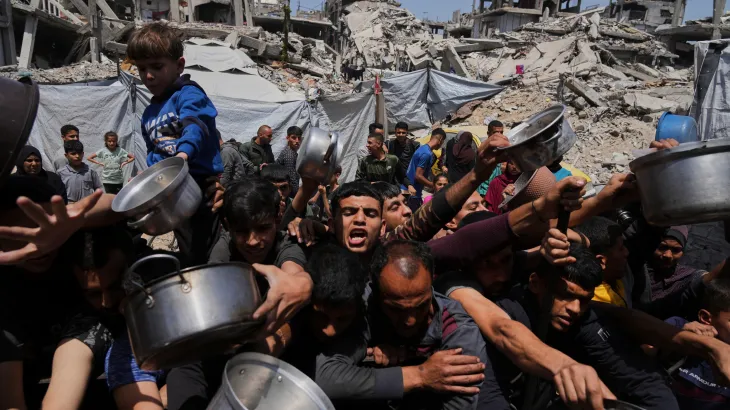
A second security contractor has come forward with detailed allegations that Israeli forces repeatedly opened fire on Palestinian civilians seeking humanitarian aid in Gaza, adding to growing scrutiny of operations coordinated by the U.S.-backed Gaza Humanitarian Foundation (GHF) and its private partners.
In testimony published this week, former British Royal Marine David McIntosh described what he called routine and indiscriminate shootings of unarmed civilians at aid distribution points, including the killing of a young boy collecting food. His account, supported by internal reports, video footage, and corroborating witness statements, raises fresh questions about the role of the Israel Defense Forces (IDF) and private contractors in what critics increasingly describe as a militarized aid system.
According to McIntosh, the boy—estimated to be around 12 years old—was shot by Israeli snipers after receiving food and playing near a distribution site in central Gaza. “There was no reason they shot him,” he said, describing how the child was left to bleed for approximately 30 minutes before being removed.
Pattern of Fire on Aid Seekers
McIntosh’s testimony aligns with mounting reports from Palestinian witnesses, humanitarian organizations, and earlier whistleblower accounts, including that of former U.S. contractor Anthony Aguilar. Together, they describe a pattern in which large crowds of desperate civilians—many weakened by months of siege—gather overnight near distribution zones, only to come under fire as Israeli forces take up positions at dawn.
In one account, McIntosh described Israeli troops opening fire on groups of civilians lying in a dry riverbed waiting for aid distribution to begin. “If anybody started to move…they would be shot,” he said, adding that machine guns, snipers, tanks, and even drones were deployed against individuals attempting to reach food supplies.
Health authorities in Gaza report that between May and October 2025, more than 2,600 Palestinians were killed and over 19,000 wounded at or near aid distribution sites and convoys—figures that have drawn international alarm but remain contested by Israeli officials.
Denials and Contradictions
Both the GHF and its logistics partner Safe Reach Solutions (SRS) have denied knowledge of fatal incidents occurring within aid sites, maintaining that Israeli troops were not permitted to operate inside those areas. However, McIntosh’s footage reportedly shows Israeli tanks and positions in close proximity to the sites, suggesting operational overlap.
In a statement, SRS acknowledged receiving complaints about Israeli conduct but denied awareness of civilian fatalities linked to IDF personnel within designated aid zones.
The IDF has consistently rejected accusations of deliberate targeting, stating that troops fired “warning shots” for crowd control. Yet these claims are increasingly contradicted by eyewitness testimony, video evidence, and now multiple contractor accounts.
Militarization of Humanitarian Aid
The controversy stems in part from the structure of the GHF itself, established in May 2025 following the collapse of earlier ceasefire arrangements. Backed by both the United States and Israel, the foundation was tasked with overseeing aid distribution in Gaza amid an ongoing blockade that had sharply restricted food, fuel, and medical supplies.
Unlike traditional humanitarian operations led by UN agencies, GHF relied heavily on private security contractors, including firms such as UG Solutions, operating in coordination with Israeli military forces.
Critics argue that this model blurred the line between humanitarian relief and military control, effectively turning aid sites into high-risk zones. McIntosh’s account reinforces these concerns, describing not only civilian casualties but also instances in which contractors themselves came under Israeli fire.
“We had rounds landing right next to our base,” he said, noting that tank shells and heavy ordnance were fired dangerously close to contractor compounds.
Growing Calls for Investigation
Human rights groups and legal experts are increasingly calling for independent investigations into alleged war crimes at aid sites. McIntosh himself framed his decision to speak out as a moral obligation, despite having signed a non-disclosure agreement.
“If you document something that is wrong, then you should put it out there,” he said. “I’m exposing war crimes.”
His testimony comes amid broader international concern over Israel’s conduct in Gaza, including allegations of collective punishment and the use of starvation as a weapon of war—claims that Israel denies.
With multiple whistleblowers now on record, pressure is mounting on governments backing the GHF model to explain their role and to ensure accountability. Whether these revelations lead to formal investigations or legal consequences remains uncertain, but they are likely to intensify scrutiny of one of the most controversial aspects of the Gaza conflict: the deadly intersection of aid and armed force.