A pan-African advocacy group has issued a stark and urgent warning over what it describes as a developing Israeli strategy to relocate Palestinians to Africa, an allegation that takes on far greater significance when examined alongside documented cases of Palestinians quietly transported out of Gaza under opaque and deeply controversial circumstances.
In a statement released on April 4, the New African Charter International (NACI) said it was “horrified” by reports that Israeli authorities are considering transferring Gaza’s population to South Sudan. The organisation described the alleged proposal as an unconscionable act of cruelty and warned that it would violate not only the fundamental rights of Palestinians but also the sovereignty and political integrity of any African nation drawn into such a process.
What makes this warning particularly significant is that it does not emerge in isolation or as a purely speculative concern. Instead, it aligns closely with a series of events that unfolded in late 2025, when a mysterious and highly irregular flight brought 153 Palestinians from Gaza to South Africa under circumstances that remain unresolved and deeply troubling.
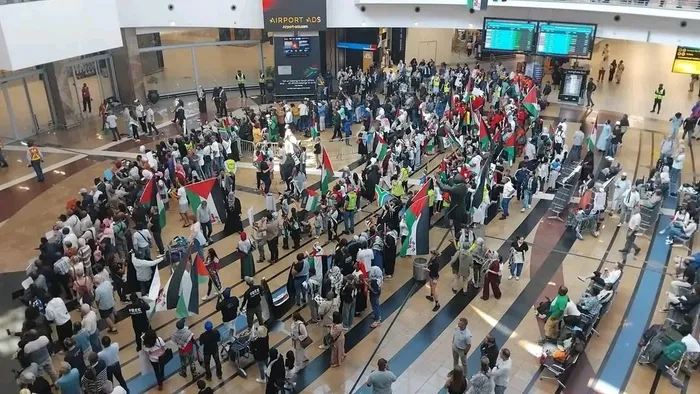
In the early hours of November 14, 2025, a chartered aircraft landed unexpectedly at O. R. Tambo International Airport in Johannesburg. There had been no public announcement, no diplomatic coordination, and no indication that South African authorities had authorised the arrival of such a flight. On board were men, women, children, infants, and elderly passengers, many of whom had endured prolonged exposure to the devastation in Gaza, where entire neighbourhoods had been reduced to rubble and basic necessities had become scarce or entirely unavailable.
What followed upon landing quickly escalated into a humanitarian crisis that unfolded not in a war zone but on the tarmac of one of Africa’s busiest international airports. Passengers were held on the aircraft for more than twelve hours by South Africa’s Border Management Authority, during which time food and water were denied despite urgent appeals. Witnesses described children crying from hunger and dehydration, adults collapsing from exhaustion, and a pregnant woman whose condition deteriorated as the hours passed in an increasingly suffocating cabin environment.
The South African humanitarian organisation Gift of the Givers responded rapidly and attempted to deliver aid to the stranded passengers, yet officials refused to allow the supplies to be brought onboard. Even the pilots reportedly intervened, urging authorities to permit basic humanitarian assistance, but these appeals were rejected, intensifying public outrage once footage of the घटना began circulating internationally.
At the centre of the unfolding controversy was a fundamental question that has yet to be satisfactorily answered. How had 153 Palestinians managed to leave Gaza, one of the most tightly controlled and militarised territories in the world, without any official record of exit from Israeli, Egyptian, or Palestinian authorities?
Passengers later described a remarkably consistent sequence of events that pointed to a coordinated and highly organised operation. Many said they had been contacted by a group calling itself Al-Majd Europe, which offered to facilitate their departure from Gaza in exchange for payments ranging from $1,400 to $5,000 per person. They were instructed to gather in southern Gaza, where buses arrived and transported them through the Kerem Shalom crossing into Israel. From there, they were taken to Ramon Airport near Eilat and placed on a chartered aircraft that travelled via Nairobi before ultimately landing in Johannesburg.
Despite the complexity of this journey, none of the passengers’ documents bore official exit stamps, and South African authorities later confirmed that they had not granted prior approval for the flight. President Cyril Ramaphosa publicly acknowledged the irregularity of the situation, stating that the passengers had somehow been placed on a plane and transported across international borders without clear authorisation, a remark that only deepened the sense that something far more complex was at play.
Subsequent investigations began to shed light on the shadowy network behind these movements. Reporting by the Israeli newspaper Haaretz found that Al-Majd Europe, the organisation facilitating these departures, appeared to have no legitimate institutional presence. It was not registered in Germany as claimed, its website had been created only months earlier, and its listed offices did not exist. Further inquiry linked the operation to a small Estonian company, Talent Globus OÜ, owned by Israeli-Estonian businessman Tomer Janar Lind, which had previously advertised services related to the “voluntary emigration” of Palestinians from Gaza.
More significantly, Haaretz reported that Israel’s Defence Ministry had established a “Voluntary Emigration Bureau” in 2025 and that this bureau had directed or facilitated coordination with entities such as Al-Majd. This revelation raised the possibility that what had been presented as a private humanitarian initiative might instead be connected to a broader and more formalised state-backed mechanism aimed at relocating Palestinians out of Gaza.
The November flight to South Africa was not an isolated occurrence but part of a wider pattern that had begun to emerge in the months leading up to it. Similar flights had transported Palestinians to countries including Indonesia, Malaysia, Kenya, and Hungary, often following comparable routes and involving the same intermediaries. In many cases, passengers were required to pay substantial sums, and the operations were conducted without coordination with the Palestinian Authority, which strongly condemned these activities and described the organisers as profiteers exploiting human suffering.
Within this broader context, NACI’s warning takes on a new and more urgent dimension. The organisation is not merely responding to reports of a future plan but is effectively drawing a line between those reports and what may already be unfolding in practice. In its statement, NACI explicitly rejected any attempt to relocate Palestinians to Africa, asserting that such a move would be resisted across the continent and by the African diaspora, and calling on South Sudan to refuse any involvement in what it described as an inhumane and dangerous policy.
The group also appealed to international bodies, including the United Nations, the African Union, and the European Union, urging immediate intervention to prevent what it characterised as a developing crisis that could have far-reaching legal and geopolitical consequences. These concerns are amplified by the fact that South Africa is already leading a case at the International Court of Justice accusing Israel of genocide in Gaza, where forced displacement is recognised as one of the acts that may constitute genocide under international law.
The arrival of Palestinians in South Africa via Israeli-controlled routes and unverified intermediaries therefore carries implications that extend well beyond immigration or humanitarian policy. It potentially intersects directly with the legal arguments being advanced in international courts and raises questions about whether a systematic effort to depopulate Gaza may be taking shape under the cover of war and humanitarian evacuation.
Israel has maintained that departures from Gaza are voluntary and conducted with the approval of third countries, yet this assertion is increasingly challenged by the realities described by those who have left. When individuals are fleeing a territory where homes have been destroyed, food is scarce, and survival is uncertain, the concept of voluntary migration becomes deeply problematic. The requirement to pay large sums of money to unverified organisations further complicates any claim of genuine consent, particularly when those organisations appear to be linked, directly or indirectly, to state structures.
For legal experts and human rights observers, the distinction between voluntary departure and coerced displacement is not merely academic but central to determining whether international law has been violated. Consent obtained under conditions of extreme duress, where individuals have no viable alternative, is widely regarded as invalid, and the involvement of state-affiliated mechanisms in facilitating such departures raises profound ethical and legal concerns.
What began as a mysterious flight landing in Johannesburg has therefore evolved into a case study with global implications, one that may offer insight into a much larger and still unfolding process. The questions raised by that घटना remain unresolved, and as new warnings such as those issued by NACI come to the fore, they serve to reinforce the urgency of obtaining clear answers.
Who authorised these movements across heavily controlled borders, and under what legal framework were they conducted? Why are African nations emerging as destinations or transit points in this process, and what role, if any, are they being asked to play? How many similar operations have already taken place beyond public view, and how many more may be in preparation?
For the 153 Palestinians who arrived in South Africa, the immediate concern was survival and safety, yet their journey may ultimately be remembered as part of a much larger and more consequential story. It is a story that touches on war, displacement, international law, and the shifting boundaries of what is being carried out under the justification of humanitarian necessity.
If the fears expressed by NACI and others prove to be well founded, then what occurred on that November morning in Johannesburg may not have been an isolated or accidental घटना, but rather an early and revealing indication of a broader process through which a population is being gradually and systematically removed from its homeland.