The Second Nakba? Targeting Civilians, Journalists and Infrastructure in Southern Lebanon
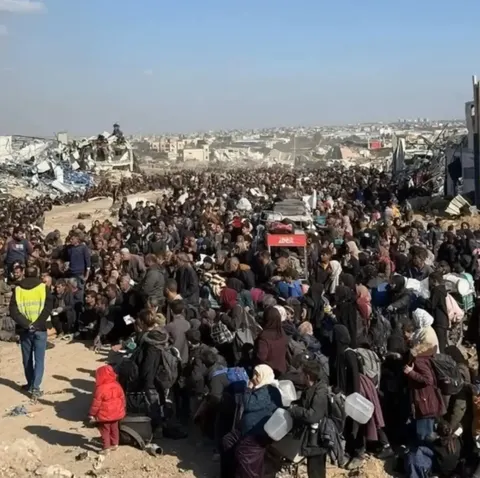
Southern Lebanon is witnessing one of the largest mass displacements in the region in decades, as Israeli military operations have forced an estimated one million people from their homes. Entire towns and villages near the border have been emptied under sustained bombardment, with critical infrastructure—particularly bridges and access routes—systematically destroyed, raising growing concerns that civilians are being prevented from returning.
A Region Emptied
Since the escalation of hostilities along the Lebanon-Israel border, Israeli airstrikes and artillery fire have intensified across southern Lebanon. Civilian areas, including homes, schools, and roads, have been heavily impacted. Local authorities and humanitarian agencies report that entire communities have fled northward, seeking refuge in already strained urban centers.
Particularly alarming to observers is the repeated targeting of bridges and transport infrastructure. Strikes on these routes have effectively severed southern Lebanon from the rest of the country, cutting off civilian return and complicating humanitarian access. What is unfolding, aid workers warn, is not simply displacement—but the creation of conditions that could make that displacement permanent.
Reports from the ground also indicate the use of white phosphorus munitions in civilian areas. Under international humanitarian law, the use of such weapons in populated zones is widely condemned due to their indiscriminate effects and the severe burns they inflict. Their deployment in this context is seen by critics as part of a broader effort to instill fear and accelerate civilian flight northward.
Journalist Targeted During Live Broadcast
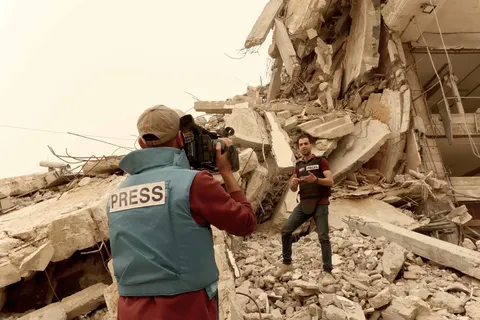
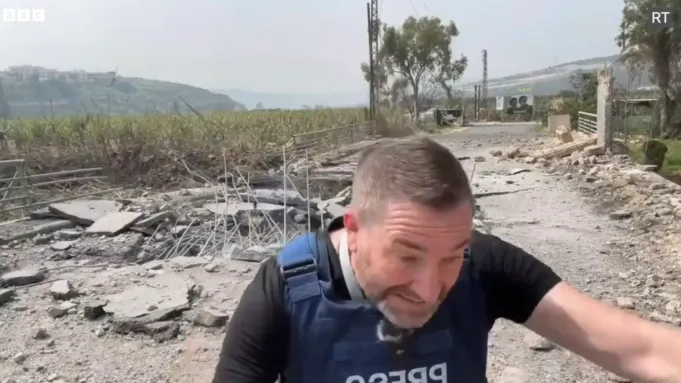
The dangers of reporting from the ground were underscored by an incident involving British journalist Steve Sweeney, who was wounded during an airstrike while reporting live from southern Lebanon.
Sweeney and his crew were covering the destruction of a bridge—part of what he described as a broader effort to isolate the south—when a precision strike landed just meters away. He was later treated in hospital for a shrapnel wound embedded deep in his arm.
Speaking after the incident, Sweeney said:
“You’ve probably all seen the footage of the air strike that took place… as we were reporting on the destruction of a bridge. I had a shrapnel wound in my arm… what I do want to say is that this was a deliberate targeted attack on journalists. There’s no mistake about it. This was an Israeli precision strike from a fighter jet.”
He added:
“What we were doing was reporting on the attacks on bridges which is effectively severing South Lebanon from the rest of the country. One million people now internally displaced. This is the real story.”
Sweeney framed the scale of events in stark terms:
“This is a plan… to ethnically cleanse the south of Lebanon. This is on the scale or bigger than the Nakba. This is the forced displacement of a million people… a war crime.”
The strike reportedly landed approximately seven metres from the reporting position. Given the precision of modern munitions, observers have raised serious questions about intent. Under international law, journalists are protected civilians, and the deliberate targeting of media workers constitutes a war crime.
Echoes of 1948
The scale and pattern of displacement in southern Lebanon have drawn comparisons to the events of 1948—the Nakba—when more than 700,000 Palestinians were expelled or fled their homes during the creation of the state of Israel.
Critics argue that what is unfolding today mirrors key elements of that period: widespread destruction of civilian areas, targeting of infrastructure necessary for return, and the creation of long-term displacement conditions.
Statements suggesting that displaced populations may not be permitted to return until undefined “security conditions” are met have intensified fears that the depopulation of southern Lebanon may not be temporary.
Internal Rift in Lebanon
The crisis is unfolding against a backdrop of deepening internal divisions within Lebanon itself. Tensions between the Lebanese government and Hezbollah have contributed to a fragile and fragmented political environment, limiting the state’s ability to respond cohesively to the escalating conflict.
Hezbollah operates as both a political force and a powerful armed group, maintaining significant influence in southern Lebanon. However, its military role and independent decision-making have long been a point of contention with elements of the Lebanese state and broader political factions.
This internal rift has created vulnerabilities that analysts say external actors can exploit. With Lebanon’s central authority weakened and political consensus fractured, coordinated national defense and humanitarian response efforts have been significantly constrained.
Observers warn that Israel may be leveraging this fragmentation—targeting areas associated with Hezbollah while simultaneously impacting civilian populations—to deepen divisions and destabilize the country further. The result is a complex environment in which military operations intersect with internal political fault lines, increasing the risk of long-term national fragmentation.
Gaza and the Sinai Question
The developments in Lebanon come against the backdrop of Israel’s ongoing war in Gaza following the October 7 attacks. In the early phase of that conflict, evacuation orders and sustained bombardment raised fears that Gaza’s population—over two million people—could be driven into Egypt’s Sinai Peninsula.
Egypt firmly rejected any such outcome, resisting what many saw as an attempt to forcibly transfer Palestinians beyond Gaza’s borders. International pressure also mounted against any scenario that could amount to ethnic cleansing.
Critics argue that similar tactics were employed: bombardment, displacement orders, and the targeting of routes, all contributing to conditions that might compel civilians to flee into Sinai. That effort ultimately failed, due in large part to Egypt’s refusal and heightened global scrutiny.
War Crimes and Legal Implications
Legal experts point to multiple potential violations of international humanitarian law arising from the current campaign.
The forced displacement of civilians, when not strictly required for their safety, is prohibited. The destruction of infrastructure essential for civilian survival and return—such as bridges and roads—may constitute collective punishment. The use of incendiary weapons like white phosphorus in civilian areas is widely condemned and may violate the laws of armed conflict.
Additionally, the targeting of journalists is explicitly prohibited under international law. As protected civilians, media workers must not be deliberately attacked.
Taken together, these actions—forced displacement, attacks on civilian infrastructure, the use of incendiary weapons in populated areas, and the targeting of journalists—have led human rights observers to warn of a pattern that could amount to war crimes.
A Precedent in the Making?
For many observers, the concern extends beyond the immediate humanitarian crisis. If large-scale displacement accompanied by systematic infrastructure destruction becomes normalized, it risks establishing a new precedent in modern warfare.
As displaced Lebanese families remain unable to return to their homes, and as journalists documenting the crisis come under fire, the situation in southern Lebanon is raising urgent questions—not only about the conduct of war, but about the future of civilian populations caught in its path.
Whether this displacement proves temporary or permanent may define the next chapter of the region’s history—and whether the term “Second Nakba” becomes a description of events, rather than a warning.