
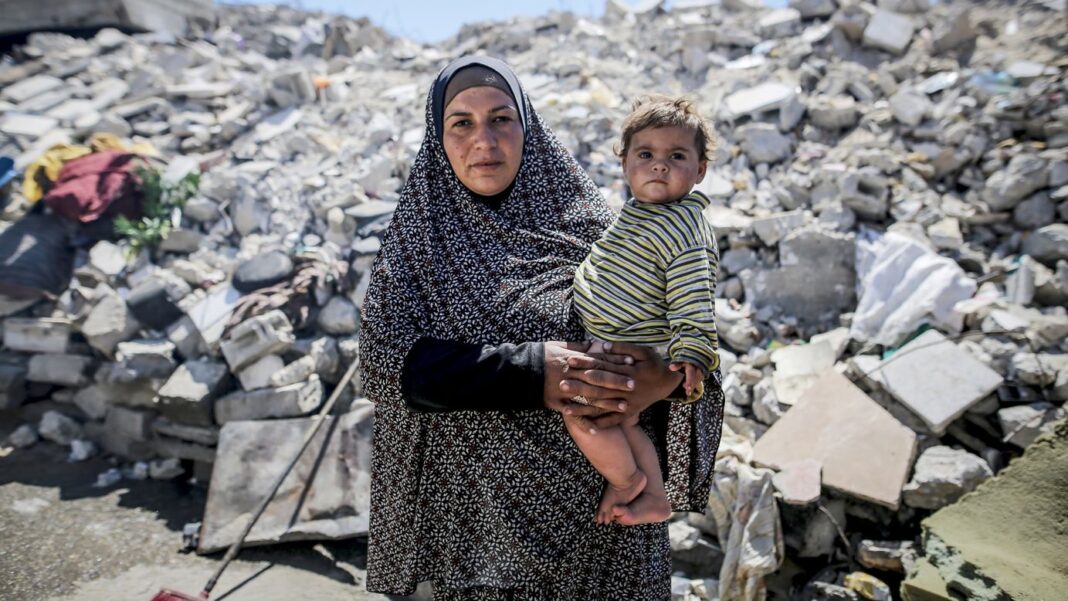

Donald Trump announced a historic agreement to disarm Hamas and withdraw Israeli forces from Gaza. Within days, Benjamin Netanyahu rejected the draft, Israeli strikes continued and the Board of Peace moved toward Israel’s demand that Hamas surrender its military power before the IDF gives up any ground. Its first prospective construction award in Gaza was meanwhile revealed to be a military outpost inside Israeli controlled territory rather than a civilian rebuilding project.
It took less than a week for Donald Trump’s newest Gaza breakthrough to become a dispute over whether a deal existed at all. On 30 July, the United States president said his Board of Peace had secured a historic agreement under which Hamas and other Palestinian armed factions would relinquish their weapons, a civilian Palestinian administration would take over Gaza, an international force would enter and Israeli troops would gradually withdraw. Trump called it a “great breakthrough.” By 4 August, Israeli Prime Minister Benjamin Netanyahu was insisting that Israel had accepted no such draft and would not move a single soldier from its current lines until Hamas was completely disarmed. “We did not agree. It is not our draft,” he said.
Between those declarations lay the central ambiguity that has followed every attempt to turn the October 2025 ceasefire into a political settlement: must Israeli withdrawal and Palestinian decommissioning proceed together, with each verified step unlocking the next, or must Hamas first surrender the principal source of its power while Israel continues to occupy most of the enclave and retains the freedom to strike? The published roadmap pointed toward reciprocity. Netanyahu’s answer was disarmament first. After the Board’s high representative, Nikolay Mladenov, met the Israeli leader in Jerusalem on 3 August, the Board’s own public language moved noticeably closer to Netanyahu’s position.
The dispute is not about whether Gaza should ultimately have one civilian authority and one lawful security system. It is about who takes the irreversible first step — and what protects Palestinians if Israel does not reciprocate after Hamas has disarmed.
No formally revised agreement has been published. That distinction matters. It would be too strong to say that Netanyahu literally rewrote the document in a legal sense. Yet the chronology supports a narrower and more consequential conclusion: Israeli pressure altered the terms on which the Board said the roadmap would be implemented. In a conflict where the stronger party controls the territory, the skies, the border regime and the pace of reconstruction, a change in sequence can change the substance of the entire bargain.
A breakthrough announced before both sides had agreed
Trump’s announcement followed negotiations in Cairo involving Egypt, Qatar and Turkey, the states that had spent months relaying proposals between the parties. Reuters reported on 30 July that Hamas described the text as a draft and that an Israeli official had already expressed objections. The following day, Trump told reporters that Israel was “very happy” with the arrangement even though Netanyahu had not publicly endorsed it. Hamas officials, meanwhile, said implementation depended on Israel halting attacks, fulfilling the humanitarian commitments made at Sharm el Sheikh and withdrawing to the positions set by the October 2025 ceasefire.
The three public accounts were incompatible from the outset. Trump described complete disarmament as settled. Palestinian factions described a conditional and phased process in which heavy weapons would be stored or decommissioned under Palestinian authority, not handed to Israel, and would be matched by Israeli movement. Israel said there would be no withdrawal from the lines it currently holds until “genuine” and complete disarmament had already occurred. The disagreement was therefore not an implementation detail that emerged later. It was embedded in the celebratory announcement itself.
That is a familiar feature of Trump’s diplomatic style: proclaim the outcome before every participant has signed on, then rely on political pressure and deliberate ambiguity to drag the parties toward the headline. The method can create momentum. It can also allow the party with the greatest military leverage to determine what an undefined phrase means on the ground. In Gaza, Israel holds that leverage. Hamas can withhold compliance, but it cannot compel an Israeli withdrawal, reopen a crossing or protect an area from an airstrike.
What the 15 point roadmap actually said
The full roadmap published by the Associated Press on 31 July was more detailed than Trump’s declaration. Its purpose was the complete withdrawal of Israeli forces, restoration of civilian life, Palestinian governance, reconstruction and a political path toward self determination and statehood. Before the next phase could begin, Israel and Palestinian factions were to meet existing ceasefire obligations. Israel was to cease military operations and complete its Sharm el Sheikh commitments, while Hamas and other armed groups were to cease theirs. An International Verification Committee would certify each stage before the next moved forward.
At the heart of the security transition was the principle “One Authority, One Law, One Weapon.” Hamas and other factions would leave government. A technocratic National Committee for the Administration of Gaza, known as the NCAG, would assume civilian authority. Palestinian police would be vetted and their arms placed under that committee. Heavy weapons, production sites, depots and tunnels would be dismantled, stored or rendered unusable through a gradual, time bound process under Palestinian and international supervision. Personal weapons would fall under Palestinian licensing law, supported by collection and reintegration programmes.
The obligations did not apply only to Hamas. Militias and clans operating outside the future administration, including anti Hamas factions armed with Israeli support, were also required to disarm. The roadmap prohibited factional displays, reprisals and internal violence. It envisioned an International Stabilization Force separating Israeli troops from areas controlled by the NCAG, monitoring the ceasefire, protecting aid operations and training the new Palestinian police. Weapons were to be transferred to Palestinian institutions rather than Israel or another foreign actor.
Most important, point eight linked decommissioning to Israeli withdrawal “in phases,” while point thirteen again described a phased withdrawal according to an agreed timetable. Mladenov summarised the approach in language that was difficult to misread: “Withdrawal must move in lockstep with decommissioning.” Draft schedules reported by Axios and Reuters envisaged an area by area process lasting roughly 200 to 320 days. Each side would take steps that could be checked. The International Stabilization Force would occupy the space between them. In theory, neither party would be asked to trust the other blindly.
The shift after Mladenov met Netanyahu
Israel did not accept that architecture. Netanyahu met Mladenov and American adviser Aryeh Lightstone on 3 August, after a weekend of intensified Israeli strikes. The Board described the talks as constructive and detailed. Mladenov urged Israel to stop the attacks so that the negotiating progress could be preserved, according to the Associated Press. Yet the statement issued after the meeting did something else as well: it said a full Israeli withdrawal beyond the Yellow Line would occur only once the decommissioning of light and heavy weapons and the destruction of tunnels were complete.
Palestinian negotiators immediately noticed what the statement did not repeat. It stressed weapons but omitted the reciprocal obligations to stop military operations, avoid targeted killings, implement humanitarian commitments and begin phased withdrawals as verified areas were demilitarised. On 4 August, Netanyahu made the hierarchy explicit. Israel would not move from its current lines before complete disarmament, he said, and it would continue to do whatever it considered necessary for its security.
There is an important legal nuance. United Nations Security Council Resolution 2803, adopted in November 2025 by 13 votes with China and Russia abstaining, already linked Israeli withdrawal to standards, milestones and timeframes associated with demilitarisation. It authorised the Board of Peace and the International Stabilization Force and allowed Israel to maintain a limited security perimeter until Gaza was considered secure. Netanyahu did not invent conditional withdrawal in August.
What changed was the balance inside that condition. In his May briefing to the Security Council, Mladenov said the roadmap rested on reciprocity: “Each step by one side triggers a step by the other.” The Board’s May implementation report likewise said phases of decommissioning would be matched with commensurate Israeli steps. Netanyahu’s position removes that symmetry at the decisive opening stage. Hamas is expected to relinquish the weapons, tunnels and coercive capacity that give it leverage before Israel begins retreating from the expanded lines it has established during the ceasefire.
A ceasefire under continuing fire
The argument over sequencing unfolded while the ceasefire remained violent in practice. Israeli strikes killed at least 18 people across Gaza City, Deir al Balah and Khan Younis on 2 August, according to Reuters, among them children and married couples. Israel said it was targeting commanders and militants and reserved the right to strike imminent threats. Egypt, Qatar and Turkey condemned the attacks as violations that could destroy the negotiations. Hamas accused Israel of trying to erase the political progress announced by Trump.
The numbers reveal the distance between diplomatic vocabulary and daily life. By 4 August, Gaza’s Health Ministry said at least 1,252 Palestinians had been killed since the ceasefire began on 10 October 2025. Four Israeli soldiers had also been killed during the period, Reuters reported. The ministry’s overall death toll since the start of the war had reached 73,377. The figures do not distinguish between civilians and combatants, but United Nations agencies have generally regarded the ministry’s totals as reliable. Thousands more are believed to remain beneath destroyed buildings.
On the day Netanyahu rejected the draft, families in Gaza held a mass funeral for 112 people whose bodies had been recovered from the rubble of a November 2023 strike in Gaza City’s Sabra neighbourhood. Forty were children. More than 150 people from the site were still missing, the Associated Press reported. The funeral placed the abstraction of “security milestones” beside the physical inheritance of the war: bodies identified years late, families still searching and reconstruction unable to begin while the political settlement remains suspended.
The war began after the Hamas led attacks on southern Israel on 7 October 2023, which killed about 1,200 people and took 251 hostages, according to Israeli figures. The October 2025 ceasefire and the release of the final hostage in January 2026 were supposed to create the foundation for a second phase. Instead, the ceasefire has become a holding structure in which major combat has eased without producing civilian safety, territorial withdrawal or a functioning postwar administration.
The moving lines of a shrinking Gaza
The territory from which Israel is refusing to withdraw is not static. When the October ceasefire began, the Yellow Line left Israeli forces in or around 53 per cent of Gaza. By late June, the United Nations Office for the Coordination of Humanitarian Affairs said an expanded Orange Line placed 64.9 per cent of the enclave under tighter and more direct Israeli control. Reuters cited estimates of 60 to 70 per cent in early August, an expansion Israel’s defence minister had acknowledged. More than two million Palestinians were increasingly confined to a narrow and overcrowded coastal zone.
The lines are not merely marks on a map. OCHA reported on 16 July that residents of 17 displacement sites near northern Rafah said yellow concrete blocks had been shifted northward. Israeli tanks moved nearby each day, sand embankments appeared and gunfire repeatedly forced families to remain inside tents. Eleven sites housing about 1,600 people had become inaccessible to humanitarian organisations, cutting water deliveries and other services. Many families said they had nowhere safer to go because other areas were already overcrowded and tents were scarce.
This makes Netanyahu’s demand more than a negotiating stance. If Israeli forces do not move until the entire decommissioning process is complete, an interim arrangement risks hardening into a territorial fact. Mladenov warned the Security Council in May that Gaza could become permanently divided, with its population trapped among rubble and dependent on aid. Reconstruction money will not flow into areas where armed factions remain, he said. Yet large scale rebuilding also cannot begin while Israel retains broad military control and contractors, administrators and international troops cannot safely enter. Each condition blocks the mechanism meant to resolve the other.
Hamas offers government, but not unconditional surrender
Hamas has made concessions that would have been difficult to imagine earlier in the war, but it has not accepted Israel’s definition of surrender. On 6 July, the group dissolved the emergency committee that supervised its government and said it was ready to transfer authority to the NCAG. Ministries and civil servants remained in place, and Hamas continued policing and security work in the areas it controlled while waiting for the technocratic committee to enter. Israel dismissed the move as a stunt because the organisation had not simultaneously given up its weapons.
The Palestinian position reported after Trump’s announcement accepted the storage and decommissioning of heavy arms, the elimination of tunnels and manufacturing sites and Palestinian control over policing. It insisted that those steps begin only after Israel stopped attacks, met humanitarian obligations and started withdrawing. Hamas rejected handing weapons to Israel and resisted language suggesting an immediate, total surrender of every firearm. The roadmap itself distinguished between heavy military capability and personal weapons that would later be regulated under Palestinian law.
That does not eliminate the obvious reasons for doubt. Hamas has ruled Gaza through a mixture of public administration and coercion for nearly two decades. Its armed wing has survived previous promises of demilitarisation, and Israel argues that any intact command structure could rearm, intimidate the new administration and eventually attack again. The proposed monitors would have to verify hidden stockpiles, sealed tunnels and local compliance in a territory of ruins, while a new police service and international force had yet to become operational. As of Trump’s announcement, the NCAG had not entered Gaza, the specialised Palestinian police were not fully trained and the stabilisation force had not deployed.
The roadmap tried to answer that problem with independent verification and parallel movement. Netanyahu’s formula answers it by demanding that the risk be absorbed almost entirely by Palestinians. Hamas would first abandon the means by which it can obstruct Israeli objectives. Palestinian civilians would then depend on the Board, Washington and international troops to ensure that Israel withdraws, stops striking and permits reconstruction. The history of unimplemented ceasefire provisions gives Palestinians little reason to regard that promise as a substitute for simultaneous action.
Netanyahu’s political calculation
Netanyahu’s resistance also has a domestic clock. Israel is due to hold an election in October, and the prime minister faces relentless pressure from the far right to maintain military control, rule out Palestinian statehood and prevent any arrangement that could be presented as a negotiated survival for Hamas. National Security Minister Itamar Ben Gvir rejected the roadmap almost immediately, calling for renewed assassinations, the destruction of Hamas and Palestinian emigration rather than a phased agreement.
Accepting reciprocal withdrawal would expose Netanyahu to attacks from coalition allies and rivals who argue that every concession rewards the 7 October attacks. Refusing the plan outright, however, risks a confrontation with Trump, whose administration supplies Israel’s essential diplomatic and military backing and whose prestige is now tied to the Board of Peace. Netanyahu’s solution has been to accept the destination in principle — a disarmed Gaza under a different administration — while redefining the road so that Israel makes no early, visible or difficult concession.
That tactic has worked before because Washington often treats Israeli security objections as technical requirements while Palestinian protections remain aspirations. The Board’s language after the 3 August meeting suggests the same gravitational pull. Even if no comma in the 15 point text has changed, the power to declare what counts as implementation lies largely with the Board and the United States. A roadmap built on reciprocity can therefore be administered as a sequence of Palestinian obligations followed by Israeli discretion.
A Board of Peace without a Palestinian seat
The institutional design reinforces that concern. Trump chairs the Board of Peace. Its prominent members include Secretary of State Marco Rubio, envoy Steve Witkoff, former British prime minister Tony Blair and Trump’s son in law Jared Kushner. Israel is among the participating states. No Palestinian representative sits at the top table. Several governments, including Brazil and Mexico, cited the absence of Palestinians when declining to join, Reuters reported.
The Board’s United Nations authority is limited to Gaza and currently runs through 2027, but its charter gives Trump sweeping powers over membership and decision making. States receive three year terms unless they contribute $1 billion for permanent status. Supporters say this structure can break through the paralysis that has repeatedly defeated conventional diplomacy and mobilise the tens of billions needed to rebuild Gaza. Critics see an unaccountable, imperial model in which outsiders govern a Palestinian territory while Palestinians themselves are assigned an administrative role beneath them.
Chatham House warned in an analysis of Resolution 2803 that the framework gives the Board vast authority with few safeguards, leaves Israel’s withdrawal timetable unclear and risks turning international administration into occupation by proxy. It also questioned whether the International Stabilization Force could realistically disarm Hamas without becoming a party to the conflict. Israel’s military failed to eliminate the organisation after years of war; a multinational force with uncertain rules of engagement would inherit the same task while trying to protect civilians and aid workers.
These are not arguments for leaving Hamas armed indefinitely. A durable civilian government cannot coexist with autonomous factions able to veto policy by force. Gaza needs accountable Palestinian policing, the end of militia rule and guarantees that neither rockets nor Israeli bombardment will return. The issue is whether the transition creates mutual security or merely rearranges control: Palestinian weapons removed, Israeli forces entrenched, reconstruction conditional and political rights deferred until an external board decides the territory is ready.
The first construction contract is a military base
The contrast between the Board’s reconstruction mandate and its first prospective construction award is stark. On 6 August, the Guardian’s Aram Roston reported that a contract had been provisionally awarded to Arkel International, a Louisiana company that has previously worked for the United States government in countries including Iraq, to build a rudimentary outpost for 150 Moroccan troops. The award had not been finalised. A Board official said the Board and the Palestinian technocrats of the NCAG were in the final stages of preparing several contracts, none of which was complete, and described the proposed facility as support for the International Stabilization Force and the roadmap’s security and governance arrangements. The facility may be necessary if an international force is ever to deploy, but the first visible building project associated with the Board is military infrastructure rather than homes, hospitals, sanitation systems or electricity.
The planned base would measure only 100 metres by 120 metres and stand about a mile from the Israeli border, inside the roughly 60 per cent of Gaza that the Israeli army directly controls. Israeli forces have established an additional buffer zone beyond that area. According to the Guardian’s source, the Moroccan contingent would rotate into Gaza from a base in Israel and would have a rapid extraction route if it came under attack. Morocco has promised a small contingent, but the legal framework for the International Stabilization Force has not been finalised and no deployment date has been set. The location would therefore anchor the force physically to Israeli controlled territory before it could separate Israeli troops from Palestinian administered areas or operate as an independent guarantor of reciprocal compliance.
Earlier contract plans reviewed by the Guardian described the 150 person outpost as the opening phase of a much larger base designed for 5,000 international troops. That expanded facility would include protected vehicle positions and a raised defensive perimeter. Its first phase would be deliberately austere, with tents and cots for sleeping, chemical toilets and handwashing stations suitable for a short deployment. The security logic is understandable: a force expected to monitor a ceasefire, protect aid operations, train Palestinian police and potentially supervise the removal of weapons needs accommodation and protection. Yet a force initially housed behind Israeli lines, supplied through Israel and designed around rapid extraction could be viewed by Palestinians less as a neutral buffer than as another component of an Israeli dominated security architecture.
The symbolism is sharper because the Board presented itself as the vehicle for Gaza’s physical revival. Trump said in February 2025 that the United States would take over and own Gaza, although the agreement establishing the Board stopped short of that claim. At the Board’s first meeting in January, Kushner unveiled a master plan for a “New Gaza” built around a waterfront city, gleaming mixed use towers and new industry. By July, the Guardian reported that the promise to rebuild the whole enclave had contracted to a small pilot project in southern Gaza. At least 80 per cent of Gaza’s buildings were damaged or destroyed during the war, and ten months into the ceasefire most of the territory’s two million people were still living in makeshift and unsanitary camps. A prospective military base does not prove that civilian rebuilding has been abandoned, and the Board says more contracts will follow. It does, however, reveal the present order of priorities: establish a protected international military footprint inside Israeli held Gaza before large scale shelter, public services, territorial withdrawal or Palestinian political control have taken material form. That sequence mirrors the broader deal now being imposed — security obligations are made concrete first, while reconstruction and Palestinian rights remain conditional promises.
The ceasefire is waiting to begin
Trump’s announcement produced a genuine opening. Hamas and other factions conditionally accepted a framework under which they would leave government and decommission heavy military capabilities. Israel approved, at least in cabinet, the possible entry of an international force. Regional mediators assembled a mechanism that linked weapons, withdrawal, policing and reconstruction rather than treating each as a separate demand. After nearly three years of destruction, those are not trivial developments.
But a peace process is measured less by the grandeur of its announcement than by which obligations are enforced. If Israel can continue striking, expand its lines and postpone movement until every Palestinian weapon has been certified away, while Hamas can delay decommissioning until Israel first withdraws and stops attacking, the roadmap contains a perfect recipe for paralysis. The reciprocal design was intended to break that deadlock. The Board’s post meeting statement weakened the very mechanism that made the proposal more than a list of incompatible demands.
Netanyahu has not yet destroyed Trump’s Gaza initiative. Nor has the Board published a legally amended plan. He has done something more subtle: persuaded the body responsible for enforcing reciprocity to speak in the language of Israeli preconditions. Unless Washington restores a clear, verified sequence in which the ceasefire is real, withdrawal begins as weapons are decommissioned and both sides pay a price for noncompliance, the “historic” agreement will become another instrument for managing Gaza’s permanent emergency.
The test is now concrete: whether Israeli forces make a verified first movement as Palestinian weapons are placed beyond factional control. Without that reciprocal act, Gaza has not entered a postwar transition. It remains under a ceasefire whose essential promises have yet to begin.