
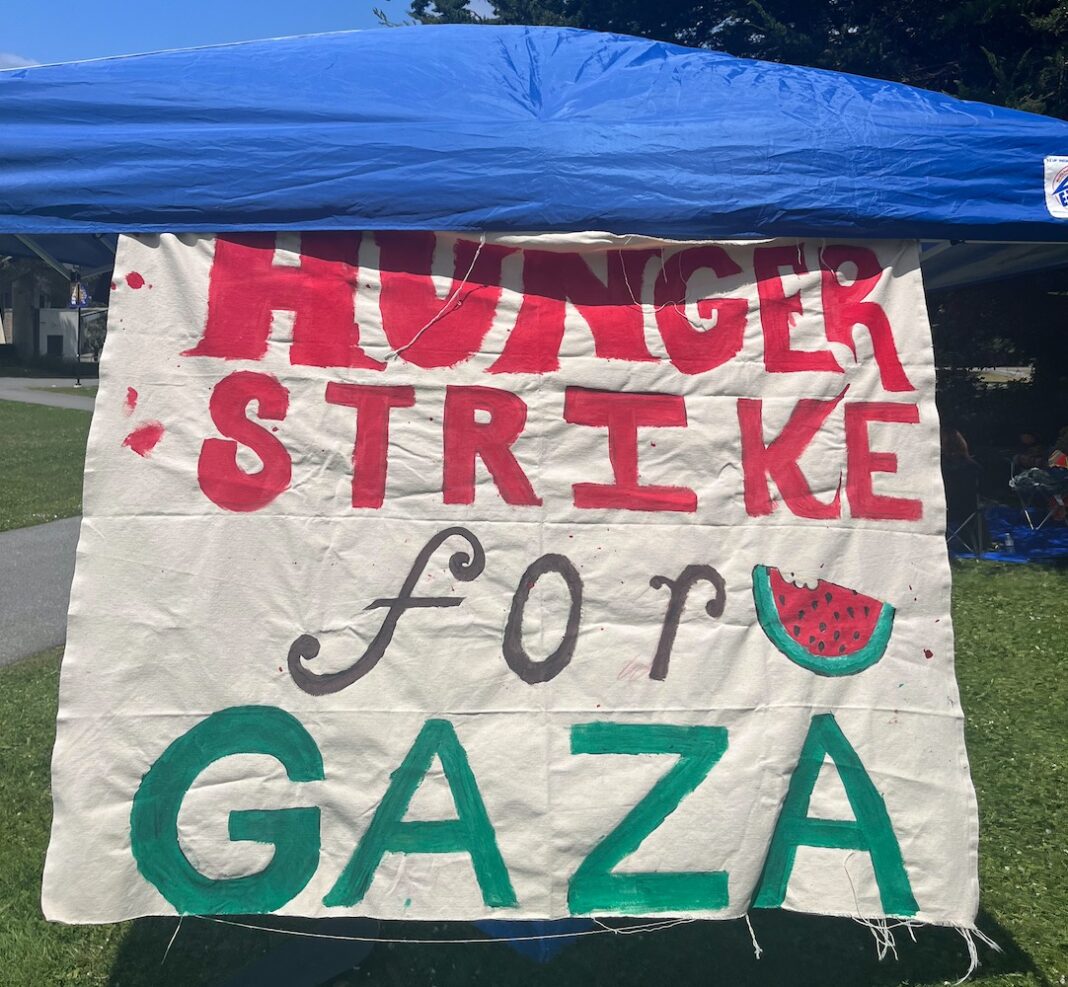

More than one hundred UK medical doctors have issued a stark warning to NHS England: intervene now, or hunger-striking prisoners could die in state custody. Their letter — addressed to the Health & Justice commissioning team responsible for medical oversight in prisons — comes amid rapidly deteriorating health among inmates affiliated with Palestine Action, several of whom have spent more than a year on remand awaiting trial.
The strike, described by campaigners as Britain’s most significant political hunger-strike since the Irish Republican protests of the 1980s, has received limited mainstream coverage. Yet its implications are explosive: it touches the core of Britain’s counter-terror policy, questions of due process, the boundaries of protest, and the state’s obligation to preserve life inside its prisons.
“If I die in custody, it will be on the state’s hands,” one prisoner is said to have told supporters.
As the first hunger striker was hospitalised, the urgency sharpened.
A timeline of escalation
September 2024–April 2025
Dozens of activists linked to Palestine Action are arrested in coordinated dawn raids. Many are denied bail. Supporters claim the detentions amount to indefinite remand for political protest.
May 2025
The Home Office formally proscribes Palestine Action as a terrorist organisation — the first time in modern UK history that a climate, human-rights or anti-arms protest movement has been banned under counter-terror legislation.
20 October 2025
Six prisoners — among them the “Filton 24” and “Brize Norton 5” — announce they will refuse food from November unless demands are met: bail, fair trial, access to mail/communication, and a reversal of the ban.
2 November 2025
Hunger-strike begins inside multiple prisons including HMP Pentonville, HMP Birmingham and HMP Peterborough.
25–26 November 2025
Kamran Ahmed, held without conviction for over a year, becomes the first striker to be hospitalised. Witnesses report rapid weight loss, breathing difficulties, chest pain, dangerously low blood sugar and ketone elevation.
Same week:
More than 100 medical doctors sign a letter to NHS England warning of a “medical emergency” and a possible preventable death.
Medical alarm: what doctors say is happening
Doctors familiar with hunger-strike physiology say the danger window opens rapidly after day 20–30:
- Muscle breakdown, including the heart
- Organ failure
- Cardiac arrhythmia
- Permanent neurological damage
- Possibility of sudden collapse without warning
Clinical risk rises even further when the individual is asthmatic — as in Ahmed’s case.
The signatory doctors argue that prison medical monitoring has been inadequate, describing the situation as “medical neglect under custodial authority.” They call for immediate external hospitalisation and independent medical oversight.
The letter has not yet been made public — a point critics highlight — but its existence has been confirmed by multiple advocacy groups, and by journalists reporting on the case.
Families: “We are watching them starve without help”
Relatives of several hunger strikers say communication has been inconsistent and medical information obscured. One family member told campaigners:
“We receive updates through other prisoners, not the authorities. We are terrified we will get the phone call too late.”
Another family describes prison staff as minimising symptoms and delaying treatment. In the case of women held at HMP Peterborough, supporters warn that strikers were reportedly denied electrolyte supplements until after collapse risk was imminent.
For families, the threat is not abstract — it is hourly.
State’s duty of care
Under NHS England’s equivalence-of-care principle, prisoners are legally entitled to the same medical treatment as any member of the public. In practice, critics say, hunger-striking prisoners fall into a grey zone where custodial control, political sensitivity and medical ethics collide.
Should a striker die, it would not be a natural death — it would be a case of state-permitted fatality.
Lawyers warn it could trigger inquests, civil litigation, international scrutiny and possibly European Court intervention.
The political dimension — and why authorities may fear retreat
The hunger-strike is not only a medical crisis, but a political one.
Conceding to even one demand — bail, restored communication, independent monitoring — could be interpreted as a crack in the proscription of Palestine Action, a government decision already under judicial review. The Home Secretary is politically invested in maintaining a hard line; Downing Street has tied the PA ban to national security and foreign policy alignment with Israel.
A death in custody, however, could prove politically catastrophic.
Not just morally — but legally.
Muted mainstream press, growing international concern
Coverage has so far been led by independent outlets, activist media and legal observers. Major newspapers have touched the story only when court hearings forced visibility. For supporters, this is a media blackout; for editors, it is a legal tightrope.
But international human-rights organisations are now watching — quietly, but closely.
If another prisoner collapses, silence will be harder to sustain.
What happens next
With at least one striker hospitalised and others reportedly nearing the same threshold, the next days are decisive. NHS England must either acknowledge the doctors’ letter and intervene — or choose not to.
The consequences of both decisions are historic.
| If NHS intervenes | If NHS does not intervene |
|---|---|
| Transfer to medical wards likely | Risk of death increases |
| Government pressure mounts | Legal scrutiny intensifies |
| Proscription debate escalates | State culpability probable |
Britain now faces a test of law, medicine and conscience.
The hunger-strikers have made their bodies the battleground.
Doctors have sounded the alarm.
The state must decide whether it listens — or watches.