
The documentary’s reception connects it to The Voice of Hind Rajab and No Other Land, whose international success has brought their backers and contributors into disputes over funding, freedom of expression and personal safety.
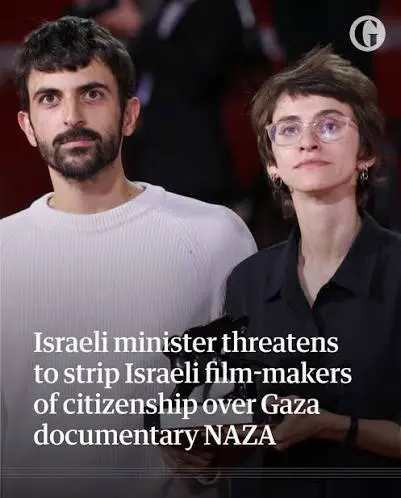
The audience at the Venice Film Festival applauded for approximately 25 minutes after NAZA, Yuval Abraham and Rachel Szor’s documentary about Israeli military operations in Gaza, premiered on 10 September. Four days later, the two Israeli filmmakers were facing a formal attempt by their country’s culture minister to initiate proceedings that could strip them of their citizenship. The sequence placed an extraordinary festival reception alongside a threat directed at the people who had brought the testimony to the screen.
The premiere took place at the 83rd Venice International Film Festival, where NAZA subsequently received the Special Jury Prize on 12 September. Accepting the award, Abraham said: “We believe that the denial of a crime is what helps it persist.” The prolonged applause brought attention to allegations that Israel’s political and military leaders would soon condemn, setting up a confrontation over both what the film shows and the right of its makers to show it.
That reception recalled the approximately 23 minutes of applause for The Voice of Hind Rajab at Venice the previous year. Kaouther Ben Hania’s film won the Silver Lion Grand Jury Prize in 2025. Abraham and Szor had already shared the 2025 documentary Oscar for No Other Land with Palestinian colleagues Basel Adra and Hamdan Ballal. Across these films, international recognition has created opportunities to reach audiences while leaving difficult questions about the protection of those whose work makes the screenings possible.
NAZA is built around accounts from 24 Israeli soldiers, most of them intelligence personnel, interviewed over three years with their identities concealed. “This is a film about a system,” Abraham and Szor wrote on 10 September, explaining that they sought to examine the orders and established practices through which civilians were killed. Their conclusion is that mass civilian deaths were deliberate and systematised, and they describe the campaign as genocide. They recount an officer listening to ordinary domestic life through surveillance, including conversations and a crying baby, before authorising bombardment. Asked why, he replied: “You understand that the objective is to destroy.” These are the filmmakers’ findings from their sources, and the Israeli military disputes them.
The title comes from a Hebrew military acronym for collateral damage, used in the documentary to describe the number of civilians expected to die in an airstrike. The film develops investigations published between 2023 and 2025 by +972 Magazine, the Hebrew publication Local Call and The Guardian. Its interviews, filmed at night on Tel Aviv rooftops, connect decisions taken inside Israel to their consequences in Gaza.
The testimony describes the use of artificial intelligence and data extracted from hacked phones to identify targets. Interviewees also discuss lethal restrictions on civilian movement, including near aid distribution points. The accusation running through these accounts concerns what military personnel knew about the civilians exposed to an attack and what they were permitted to do with that knowledge.
One allegation has become a particular focus of the military’s response. In a promotional excerpt, an interviewee says an attack was once approved with 500 civilian deaths anticipated, while acknowledging that he did not know the eventual toll. The IDF denies ever planning, approving or conducting a Gaza strike in which that many civilian deaths, or anything close to that number, were expected. It also challenges the ability to verify the anonymous interviewees’ identities, military service and access to the information they describe.
The military says human personnel select and authorise strikes, and has rejected the film’s broader allegations. The filmmakers say their sources were concealed because they feared retaliation. Their competing accounts leave a substantive dispute about targeting policy and civilian harm, even as political attention shifts towards punishing the people who made the documentary.
Culture Minister Miki Zohar publicly accused the directors of “treason against the state” on 13 September. The following day, he asked officials at the Interior Ministry and Population and Immigration Authority to examine whether citizenship proceedings could be pursued. His letter sought an investigation into the origins of the film’s material, whether it had come from military or intelligence personnel, and whether receiving or publishing it could amount to assisting an enemy during wartime. He also called for examination of whether information was false, distorted or presented without its context.
As of 14 September, the minister had requested an investigation into possible grounds for proceedings; no decision removing either director’s citizenship had been announced. Revocation would require a separate legal process and judicial approval. The distinction matters because the accusation of treason is a political allegation, not a court finding against the filmmakers.
The pressure also extended into the military. On 14 September, Chief of Staff Eyal Zamir instructed its senior legal official to examine possible action against NAZA and those involved in it, while separately ordering an investigation into alleged leaks of classified material used in the production. That development placed the directors and their sources under scrutiny by the institution whose conduct the film examines.
Prime Minister Benjamin Netanyahu joined the criticism on 14 September, presenting the film as part of a wider campaign against Israel. “We are fighting global antisemitic incitement and when it comes from within us it is intolerable,” he said in a video posted on Telegram. He criticised the applause given to filmmakers whose work portrayed Israeli soldiers as war criminals.
NAZA’s production credits identify The Guardian and James Wilson’s JW Films as its producers, Jonathan Glazer as executive producer, and Placeholder Films and Unseen Hand as associated companies. The involvement of The Guardian makes it a participant in the production as well as a publisher of reporting on the film. Producer Lindsay Poulton called the award “a testament to the power of cinematic storytelling grounded in fearless, independent journalism”. The documentary therefore carries the institutional backing of a news organisation alongside that of experienced filmmakers. The Guardian promised: “We will robustly defend NAZA — and the team behind it — from any attacks or attempts at censorship.”
MK2 Films is handling international sales, providing a route towards distribution in different territories. Its announcement establishes the companies’ credited roles, but does not disclose NAZA’s total budget, an investment schedule or the sums contributed by individual backers. A sales appointment is also distinct from an investment in production. The public record supports identifying the production partnership without assigning undisclosed financial stakes to its members.
Wilson and Glazer bring a particularly relevant history. They worked together on The Zone of Interest, which won the 2024 Oscar for Best International Feature. In his acceptance speech, Glazer challenged the use of Jewish identity and Holocaust memory to justify occupation, while referring to victims of both the 7 October attacks in Israel and the assault on Gaza. His remarks prompted a denunciation signed by hundreds of entertainment professionals, whose letter accused him of making a false moral equivalence between Nazi Germany and Israel.
Other Jewish artists publicly supported him. An April 2024 letter signed by figures including Joaquin Phoenix and Joel Coen defended Glazer’s speech and challenged the way it had been characterised. His subsequent involvement in NAZA places him within a continuing argument over whether the film industry will protect artists who use prominent platforms to criticise Israeli policy.
Wilson and Glazer also connect NAZA to The Voice of Hind Rajab. Wilson produced Ben Hania’s film with Nadim Cheikhrouha and Odessa Rae; Glazer is among its executive producers. The production, led by Mime Films and Tanit Films, reconstructs the efforts of Palestine Red Crescent staff to reach a Palestinian child trapped in a car under fire on 29 January 2024. Its cast includes Saja Kilani, Motaz Malhees, Clara Khoury and Amer Hlehel.
The film combines dramatic reconstruction with actual emergency recordings. Ben Hania says she consulted Hind’s mother and the Red Crescent personnel, and would not have proceeded without the family’s consent. That approach preserves the child’s recorded voice within a film shaped by the memories of people who tried to save her. Hind died, as did the two ambulance workers sent to reach her.
Its backing extends across commercial companies, foundations and public support. The official credits list Film4, MBC Studios Projects, Watermelon Pictures, Plan B and the Giustra International Foundation among the associated organisations. They also record a contribution from the Tunisian Ministry of Cultural Affairs and a development grant from the Doha Film Institute. Brad Pitt, Joaquin Phoenix, Rooney Mara, Alfonso Cuarón and Glazer carry executive producer credits; other names include Jemima Khan, Frank Giustra, Amed Khan, Sawsan Asfari, Ramez and Tiziana Sousou, and Guillaume and Sarah Rambourg. The credits identify participation without disclosing each person’s financial contribution.
The distinction between financing and public endorsement is supported by the producers’ own account. Speaking at the Doha Film Festival in November 2025, Cheikhrouha explained: “Some global names joined as executive producers not for funding, and they amplified the film’s reach.” Their participation could help draw attention to the film, but celebrity credits alone do not establish who paid its production costs.
International recognition did not allow everyone involved to accompany the film. In March 2026, Malhees said he could not attend the Academy Awards, where The Voice of Hind Rajab was nominated for Best International Feature. “I am not allowed to enter the United States because of my Palestinian citizenship,” he wrote on Instagram. He held only a Palestinian passport, while other cast members had citizenship allowing them to travel. The restriction concerned his travel documents and nationality; it was not a ban imposed specifically because he acted in the film.
Ben Hania had made her own protest the previous month. At the Cinema for Peace gala in Berlin on 16 February, she left behind the Most Valuable Film award, saying that recognition could not substitute for accountability over Gaza. “I refuse to let their deaths become a backdrop for a polite speech about peace,” she said, adding: “Peace requires justice and accountability, not glossy slogans.” The ceremony was separate from the Berlin International Film Festival. Her action challenged the comfort that an awards event could offer while the conditions described in her film remained unresolved.
No Other Land provides an earlier account of the same gap between international recognition and conditions at home. The film documents demolition and displacement in Masafer Yatta in the occupied West Bank through the work of Adra, Ballal, Abraham and Szor. Norwegian producers Fabien Greenberg and Bård Kjøge Rønning of Antipode Films helped bring the production to international audiences. Its success followed years of filming by a Palestinian and Israeli collective working amid the events they were recording.
There is unusually concrete public information about part of its financing. The IDFA Bertha Fund’s activity report records a €17,500 production and postproduction grant in 2021 and €40,000 for international coproduction in 2022. Together those awards amounted to €57,500, alongside travel and promotional assistance. These figures describe particular grants, rather than the film’s complete budget. They show how comparatively modest documentary support can help work originating in a threatened community reach an international audience.
Abraham and Adra said they had deliberately avoided Israeli government funding. “We didn’t want money from the government that is ethnically cleansing us and expelling us from our land,” Adra explained in 2024. They described working largely without payment during the early stages, before the Close Up programme helped connect them with Sundance, IDFA and Norwegian producers. The source of support was part of their understanding of the film’s independence, and of their ability to criticise the authorities responsible for the policies it documented.
The question of investment returned during distribution. In October 2025, the filmmakers announced that they had rejected a proposed American streaming agreement with Mubi over its ties to Sequoia Capital, which also backed the Israeli defence technology company Kela. They opted for a release they controlled themselves. The decision demonstrated how objections to an investor could affect a film’s route to viewers long after production had finished.
Mubi’s position was that the beliefs of individual investors did not represent the company’s own views and that it remained independent. The disagreement placed the filmmakers’ concerns about the financial relationships surrounding distribution against the platform’s claim to editorial autonomy.
For the people associated with No Other Land, exposure also brought direct risks. After its success at the Berlin festival in February 2024, Abraham reported death threats and said a mob had come to his family’s home in Israel, forcing relatives to leave. The episode followed denunciations of his acceptance speech, in which he had contrasted the rights he enjoyed as an Israeli with Adra’s life under occupation.
On 24 March 2025, weeks after the documentary won its Oscar, Ballal was attacked in his West Bank village of Susiya and detained by Israeli forces. Fellow filmmakers and witnesses said settlers had assaulted him. Ballal and two other Palestinians were accused of throwing stones, which they denied. The events brought international attention to the security of a filmmaker who had recently stood on an awards stage in Los Angeles.
After his release the following day, Ballal said soldiers had blindfolded and beaten him during detention. He believed his prominence had made him a target: “When they say ‘Oscar’, you understand. When they say your name, you understand.” That was his account of the motive, rather than an independently established finding. His face was bruised and his clothing bloodstained when he recounted what had happened. The military subsequently denied that detainees had been beaten in its custody.
The Academy’s response became a controversy of its own. Its leaders apologised after an initial statement condemning attacks on artists failed to name Ballal. More than 600 members, including Joaquin Phoenix, Olivia Colman and Emma Thompson, had criticised that response. The argument concerned whether an institution that had just honoured the film would clearly identify and support its contributor when he faced violence.
Another Palestinian associated with the documentary, teacher and community activist Awdah Hathaleen, was killed in Umm al-Khair in July 2025. He had helped the filmmakers, and footage recorded during the confrontation became central to reporting on his death. In August 2026, Israeli prosecutors charged settler Yinon Levi with reckless manslaughter, armed trespassing and malicious property damage. Levi denied wrongdoing and claimed self defence.
The indictment concerned an incident involving an excavator operated by settlers and a confrontation with residents, during which Hathaleen filmed the moment he was shot. The prosecution was a significant later development after a year of demands for accountability. An indictment establishes that criminal charges have been brought; it does not establish guilt.
These experiences give the response to NAZA a history that extends beyond the festival calendar. Ballal’s account of assault and detention, Hathaleen’s killing, Abraham’s reports of threats and Malhees’s inability to travel involved different circumstances and authorities. Their connection lies in the people’s participation in films about Palestinian lives, and in the limits of the protection that international recognition offered them.
Abraham has said that NAZA’s team intends to seek the widest possible distribution in Israel, explaining that the soldiers and officers interviewed wanted the Israeli public to hear what they had done in Gaza. An Israeli release schedule had yet to be confirmed as of 14 September.
The next confirmed opportunities to see it include New York Film Festival screenings on 26 and 27 September. As the film travels, its makers face a more immediate uncertainty over the investigations and proceedings being considered at home. The applause in Venice has secured attention for the testimony; the directors are now trying to bring that testimony to the public whose military it concerns.
Sources
1. AFP, 10 September 2026. NAZA’s premiere and approximately 25 minute ovation
2. Haaretz, 14 September 2026. Formal request concerning the directors’ citizenship
3. Reuters, 12 September 2026. Venice awards and Abraham’s acceptance speech
4. AFP, 10 September 2026. Reception of NAZA and comparison with The Voice of Hind Rajab
5. Venice festival archive, 2025. The Voice of Hind Rajab’s 2025 Grand Jury Prize
8. Reuters, 10 September 2026. The documentary’s testimony about targeting and civilian deaths
11. Siasat, 14 September 2026. The minister’s letter and the process required for citizenship revocation
13. MK2 Films production announcement, 10 September 2026. Production partners and international sales
14. Euronews, 19 March 2024. Response to Jonathan Glazer’s 2024 Oscar speech
15. Screen International, 5 April 2024. Jewish artists’ letter supporting Glazer
19. Reuters, 14 March 2026. Malhees’s statement about being unable to attend the Oscars
21. Norwegian Film Institute, 5 December 2024. No Other Land and its Norwegian producers
22. IDFA Bertha Fund activity report, 2024. Documented grants supporting No Other Land
23. Film Comment interview, 2024. Abraham and Adra’s funding decisions and Adra’s quoted explanation
24. Screen International, 17 October 2025. The filmmakers’ rejection of a proposed Mubi agreement
25. IndieWire, 17 October 2025. The proposed American streaming deal and independent distribution
26. Screen International, 30 July 2025. Mubi’s response to objections over Sequoia Capital
27. Financial Times, 13 March 2024. Threats against Abraham following the 2024 Berlin festival
28. Associated Press, 24 March 2025. Attack on Ballal and detention on 24 March 2025
29. Associated Press, 25 March 2025. Ballal’s release and accounts of the attack
31. Associated Press, 28 March 2025. The Academy’s apology and criticism from its members
32. Associated Press, 6 August 2026. Hathaleen’s killing and the charges against Yinon Levi
33. Reuters, 6 August 2026. Details of the indictment and Levi’s claim of self defence
34. Haaretz, 13 September 2026. Abraham’s intention to distribute NAZA in Israel
35. El País, 13 September 2026. Citizenship threats and the directors’ distribution plans
37. The Guardian, 14 September 2026. Zohar’s citizenship threat and accusation of treason
38. Reuters, 14 September 2026. Netanyahu’s criticism of NAZA and its Venice reception
39. The Guardian press office, 12 September 2026. Lindsay Poulton’s response to the Special Jury Prize
40. The Guardian press office, 14 September 2026. Statement pledging to defend NAZA and its filmmakers
41. The Guardian, 26 March 2025. Ballal’s account and the military’s denial of abuse in detention