
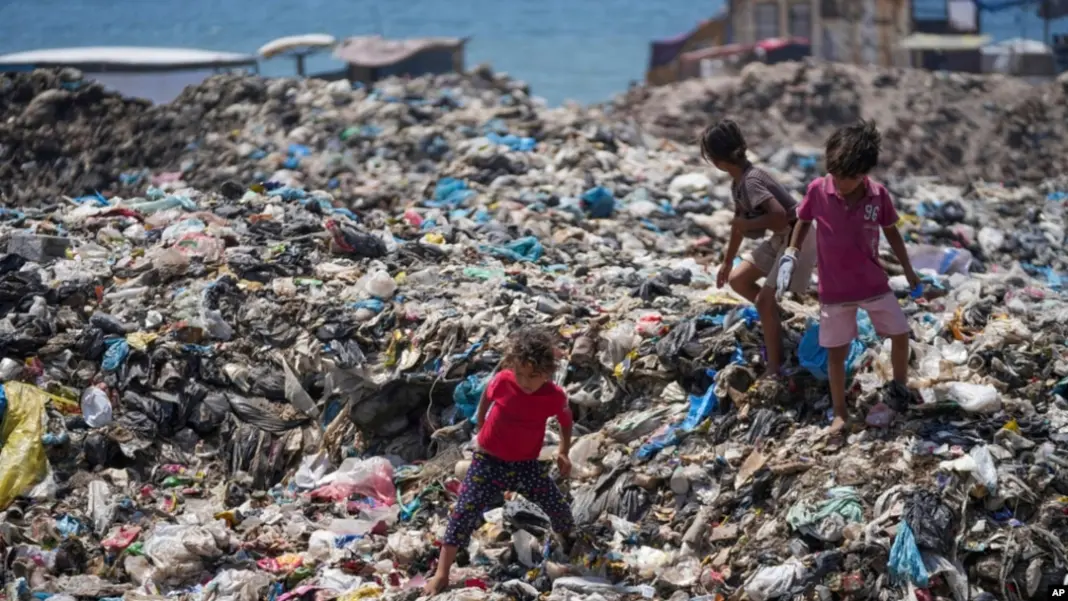

The destruction of sewage treatment has created a threat that Israel cannot confine to the other side of its border
Israel’s destruction of the infrastructure that sustains life in Gaza has helped turn a shared stretch of the Mediterranean into an outlet for untreated sewage. Along a coastline where Israel draws seawater to produce drinking water, the consequences expose a brutal contradiction: dismantling the systems that protect Palestinian health also weakens the environmental protection on which Israelis depend. The destruction of wastewater treatment has left contamination spreading through Gaza’s marine and coastal environment.1
There is a documented history behind that danger. Sewage discharged from Gaza has previously forced Israeli beaches to close and disrupted the desalination plant at Ashkelon. The water crossing this border does not remain within the political boundaries imposed on the people living beside it, making the destruction of sanitation a threat extending beyond Gaza itself.2
That vulnerability returned to public attention in late August and early September 2026, when an algae bloom forced five of Israel’s six major Mediterranean desalination plants offline. Large desalination facilities supply about 80 per cent of municipal drinking water. The shutdown exposed the fragility of concentrating so much production in coastal plants drawing from the same marine environment.3
“Desalination is supposed to complement, not replace, natural sources,” said Professor Dror Avisar of Tel Aviv University. The observation reaches beyond a question of engineering. A state whose drinking water depends so heavily on the sea has a direct interest in maintaining sewage treatment along the coast, including in Gaza.3
For a country whose population has passed 10 million, the stakes extend far beyond a temporary beach closure.4 If desalination became unworkable for months and replacement supplies proved inadequate, the resulting emergency could require severe rationing and disrupt farming, industry and public services. As a worst case scenario, prolonged failure to meet basic water needs could put pressure on people to leave affected communities. That conditional risk would depend on reserves, emergency supplies and the speed of restoring production; the recent shutdown does not establish a timetable for such an outcome.5
The precise contribution of Gaza’s sewage to the 2026 bloom remains unresolved. Oceanographic researchers believed the algae appeared to originate near Egypt’s Nile Delta and move north with Mediterranean currents. Sewage from Gaza may have supplied nutrients that intensified the bloom, but the available evidence did not establish it as the cause. Israeli energy minister Eli Cohen rejected the Gaza connection on 7 September, while the bloom’s origin remained under investigation.6
By 8 September, Ashkelon and Ashdod remained shut, with three other facilities operating at reduced output. Officials supplemented supplies through groundwater, reservoirs and the Sea of Galilee. Microscopic algae and suspended material were obstructing treatment and threatening desalination membranes. The disruption demonstrated how conditions at sea could compromise production, requiring alternative supplies even while the plants themselves remained standing.6
A shutdown does not establish that sewage has passed through treatment into household taps. On 4 September, Israel’s Energy and Water Ministry said drinking water remained safe. The demonstrated danger concerns polluted coastal waters and the reliability of producing clean water from them. Treatment restrictions can protect the quality of the water delivered while exposing the vulnerability of the system supplying it.7
Israel had received warnings about this connection long before the current devastation. Ashkelon’s desalination plant shut down twice in 2016 because of sewage discharged from Gaza. Untreated waste also travelled through the Nahal Hanun watercourse, threatening groundwater reservoirs near Ashkelon. These were concrete failures and identified risks, already available to policymakers years before the war that began in October 2023.2
The effects became visible to Israeli beachgoers in July 2017. On 6 July, faecal contamination from Gaza forced the closure of Zikim Beach, while swimming bans also affected Ashkelon National Park. Public health restrictions on the Israeli side acknowledged that Gaza’s sewage crisis could travel along the coast and affect people outside the territory.8,9
The 2017 electricity crisis involved disputes between Hamas and the Palestinian Authority as well as Israeli decisions. At the Palestinian Authority’s request, Israel reduced its electricity supply to Gaza, further restricting essential services. The system’s vulnerability was already understood: reducing power to sewage treatment could produce consequences on both sides of the border.2
Shortages of reliable energy, unfinished infrastructure and inadequate funding for operations and maintenance had already created a wider public health threat. Israel’s state comptroller warned about the environmental hazard from pollution crossing territorial boundaries. A treatment plant could achieve little without dependable power and the resources to keep it running, a lesson the subsequent destruction would make still more consequential.10
The assault after October 2023 went much further than leaving an inadequate system underfunded. On 9 October, then defence minister Yoav Gallant announced the siege in explicit terms: “There will be no electricity, no food, no water, no fuel, everything is closed.” Human Rights Watch later concluded that deliberate water deprivation amounted to extermination and acts of genocide, findings that Israel disputes.11
Satellite analysis identified the destruction by Israeli bulldozers of solar arrays serving at least four wastewater plants: North Gaza, Central Gaza, Khan Younis and Sheikh Ejleen. Tracks and patterns of destruction appeared in areas apparently under Israeli military control. Israel did not answer Human Rights Watch’s requests for an explanation concerning those facilities. The investigation distinguished deliberate destruction from incidents where responsibility or the target remained uncertain.12
Israel denied genocidal intent in court, describing its campaign as self defence and an effort to recover hostages. Those stated objectives leave unanswered the questions about disabling civilian sanitation equipment in areas already under military control. Removing the power supply from sewage treatment undermines a service whose protection extends to everyone sharing the surrounding environment.12
By mid 2024, the scale of the assault was measurable: water and sanitation sites had been damaged or destroyed by Israeli military attacks at an average rate of five every three days. Water availability, measured using supply data current to 26 May, had fallen by an estimated 94 per cent, to 4.74 litres per person per day. That allowance had to cover needs extending far beyond drinking, leaving families painfully little for washing and sanitation.13
“Now we are witnessing its weaponizing of water, which is already having deadly consequences,” said Lama Abdul Samad, an Oxfam water and sanitation specialist. The destruction extended to water quality laboratories, while restrictions obstructed the import of testing equipment. For a population already deprived of sufficient water, disabling the means of checking its quality deepened the danger.13
By the period covered in the environmental assessment published in September 2025, no wastewater treatment facility in Gaza was operational. Destruction of pipe networks and greater reliance on cesspits had increased contamination of the aquifer and coastal environment. Restoring sewage collection and treatment was urgently needed to protect health. These systems must function continuously if pollution is to be prevented, making every delay in restoration consequential.1
Médecins Sans Frontières described water deprivation in April 2026 as a systematic pattern of collective punishment and part of what it characterised as Israel’s genocide. It linked the denial of water to the killing of civilians, destruction of health facilities and displacement caused by the flattening of homes. These harms accumulated, progressively dismantling the conditions in which people could survive.14
That cumulative destruction is central to the story. Treating the sea pollution as an unfortunate failure of Gaza’s municipal services obscures the destruction and restrictions that made those services fail. Restoring sufficient water requires humanitarian access and the infrastructure to supply it. Palestinian survival provides an overwhelming reason to repair that damage, regardless of whether pollution subsequently reaches an Israeli beach.14
The human consequences remain most immediate in Gaza. In June 2026, displaced residents were entering the polluted sea to bathe and wash clothes because of stifling heat and inadequate fresh water. The same coastline receiving waste from collapsed sanitation had become a place where families sought relief from the conditions imposed on them. Their exposure turned a place of recreation into another route through which the failure of essential services could threaten health.15
Israel’s response to the September algae crisis produced another troubling episode. Authorities dispersed substances including copper sulphate offshore in an attempt to tackle the bloom. The Health Ministry recommended a temporary fishing ban as a precaution, while officials said the treatment did not endanger bathers and drinking water remained safe. The effort to protect desalination had itself prompted further questions about the marine environment.7
Environmental advocates have repeatedly urged attention to preventing sewage entering the sea. EcoPeace director Gidon Bromberg called for urgent cooperation to repair Gaza’s wastewater treatment facilities, including to protect Israel’s own water security. Shira Efron, a RAND adviser, described the obstruction confronting warnings about Gaza’s sanitation: “But the politics get in the way, and nothing has been done.”3
The bitter irony is that some of the structures Israeli forces disabled were helping protect the sea from which Israel makes drinking water. The appetite for destruction displayed in Gaza has undermined safeguards that Israel also needs. Repairing those systems requires allowing the equipment, power and expertise on which Palestinian civilian life depends. A government that has treated so much of Gaza as expendable must confront an environmental reality: protecting its own coast requires preserving the means of survival further along it.
Sources
1. UN Environment Programme. Assessment of environmental damage in Gaza, 23 September 2025.
8. The Jerusalem Post, 6 July 2017. Gaza sewage and the closure of Zikim Beach.
9. Haaretz, 6 July 2017. Gaza power shortages, coastal sewage contamination and Israeli swimming bans.
14. Médecins Sans Frontières, 28 April 2026. Findings on the use of water deprivation in Gaza.
15. Reuters, 22 June 2026. Displaced Gazans bathing and washing clothes in the polluted sea.