
Chances are that news out of Gaza has been showing up on your feed less and less. Maybe it has disappeared entirely.
The silence is not an accident. It is the result of a lethal confluence of factors: a three-year Israeli campaign that has made the territory the deadliest conflict for journalists ever recorded, a total ban on international press, and a global news cycle that has moved on to other priorities.
“Is it because Israel has been mass murdering journalists in Gaza for 3 years straight, making it the deadliest conflict for journalists ever recorded?” one observer asked. “Is it because Israel continues to ban international press from entering Gaza, turning the strip into what the Cost of War Project has described as a ‘news graveyard’? Or is it because there’s other more pressing issues to the American public like violence committed by these same countries but in ways that actually affect American citizens like our gas prices? Well, yes. Yes to all of those things.”
The ceasefire exists only on paper. The reality on the ground is a slow-burning catastrophe.
A Ceasefire in Name Only
Since the so-called truce began in October, Israel has violated the ceasefire over 2,500 times. The human toll is staggering: over 900 Palestinian people have been killed, including more than 250 children.
The month of May—the eighth month of the ceasefire—was the deadliest month for Palestinians in Gaza this year.
On the 78th anniversary of the Nakba, Israel bombed an apartment building and a civilian vehicle, killing and injuring a group of seven men, women, and children. Just days later, on June 3rd, Israel bombed two residential buildings and set them on fire, killing 10 Palestinian people. “An entire family was burned alive,” a witness said.
Even a seaside cafe was not spared. An Israeli airstrike there killed two people and injured 12 more.
“This is all happening right now during the ceasefire,” one Gaza-based observer noted.
A Humanitarian Abyss
While conditions have improved marginally since the IPC declared a famine late last year, that isn’t saying much. According to the latest data, 1.7 million people remain displaced from their homes, most of them permanently, their residences leveled by Israeli bombs and bulldozers. About 90% of the displaced are living in makeshift tent cities with little protection from the elements.
The struggle for basic survival is relentless. The vast majority of households rely on water deliveries, often forced to walk long distances to refill their containers. Water pumped in from Israel—called Mekorot, after Israel’s national water supplier—is often contaminated by the time it reaches distribution points through a network of shattered pipes and must be treated to be safe for drinking.
Electricity is only accessible through generators and solar panels, but due to Israeli import restrictions, these have become either inaccessible or extremely expensive.
According to the World Central Kitchen, “families continue to face severe challenges to food and nutrition security due to the Israeli restrictions on the entry of aid.”
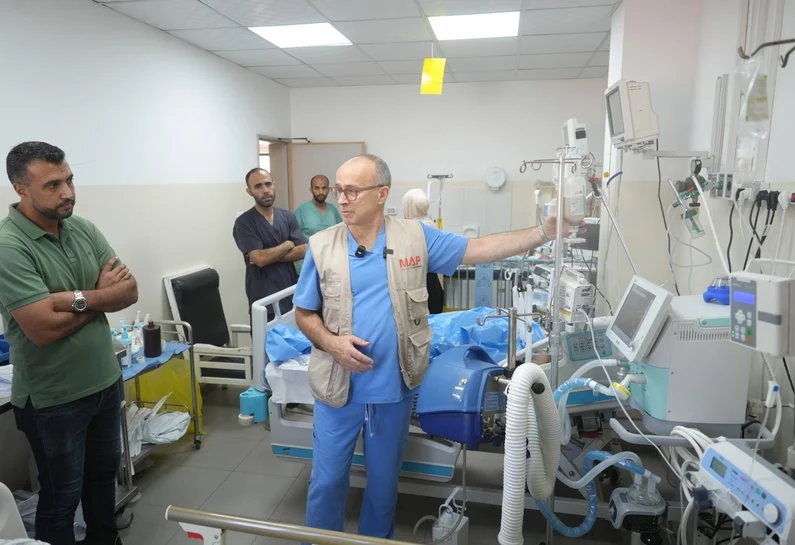
Doctors Without Borders reports that “the siege has had a devastating impact on pregnant and breastfeeding women, newborns, and infants under 6 months old.”
The latest UN situation reports show that nearly half of the aid trucks attempting to enter Gaza are being turned away. Of those that are allowed in, 80% are only carrying commercial goods bought in Israel—not the urgently needed humanitarian supplies.
Destroyed Livelihoods, Rising Disease
Israel has destroyed nearly all of Gaza’s internal food production capabilities, razing farmland, bombing fishing boats, and routinely killing fishermen with gunfire and shelling from Israeli naval ships. “This has destroyed livelihoods,” a local aid worker said. “Families that have been fishing for generations are no longer capable of doing so.”
The destruction of sewage and sanitary infrastructure means Palestinians are forced to share communal restrooms operating way over capacity. Severe shortages of engine oil cause the few remaining water and sanitation facilities to routinely shut down. The result is sewage and waste overflow, leading to widespread disease and unsafe, dehumanizing living conditions.
With the rising temperatures of spring, there has been a surge in disease-carrying rats. They have been cited in over 80% of the tent cities, terrorizing families and keeping them from sleeping due to the fear of being bitten.
Al Jazeera reported on Sama Alabla, a Palestinian woman whose daughter was bitten by one of these rats in the middle of the night, leaving her bleeding and traumatized. Sama believes the rats have grown more aggressive because “they’ve become used to eating human bodies buried under the rubble.”
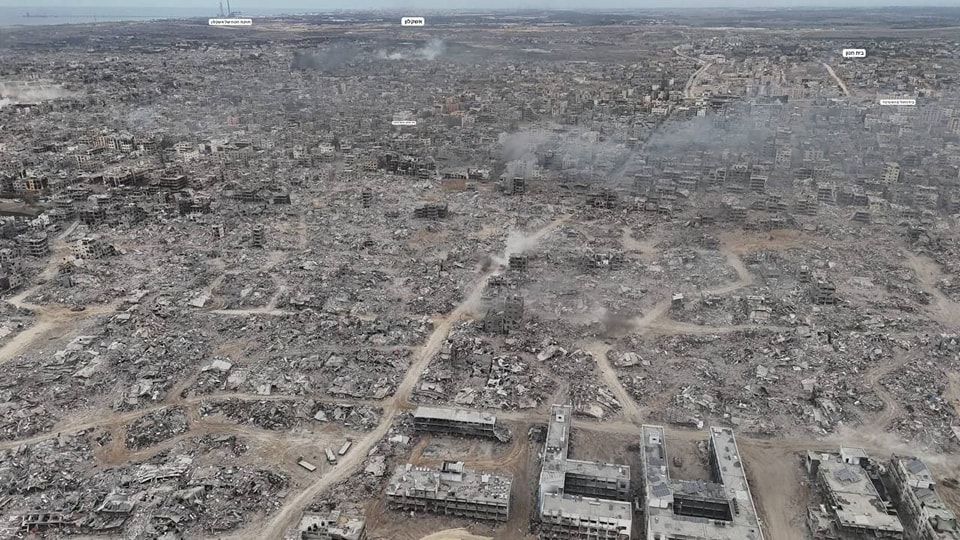
Aerial images from Gaza recently updated on Google Maps show a reality worse than anything seen before. “It looks like a different planet,” one analyst said.
The Moving Kill Zone
Israel is prolonging the destruction by denying Gazans the resources for rebuilding. Cement and steel face heavy import restrictions, making even small restorations virtually impossible. Among the restricted items are machinery for clearing rubble—of which there are over 70 million tons—and poles for tent housing.
The so-called “yellow line”—the border marking the transition between Israeli-occupied territory and the outright kill zone—is continuing to move inward.
In a press conference last week, Prime Minister Benjamin Netanyahu claimed that Israel now controls 60% of the territory of the Strip, while signaling his long-stated goals of total control.
“We were at 50%, we moved to 60,” Netanyahu said. “My directive is to move to…” He paused, and someone in the crowd yelled out “100.” Netanyahu then responded, “Let’s go step by step. First of all, 70. Let’s start with that. We’re pressing them from all sides. We’ll deal with the remnants.”
This strangulation has led to the creation of an “orange line”—a boundary supplied by Israel to humanitarian aid organizations that outlines the expanded kill zone. The United Nations Relief and Works Agency (UNRWA) has reported that 126 of its facilities now sit behind one line or the other.
“If you cross that line or you approach that line, you will be shot and killed,” one source said. Hundreds of Palestinians—including children playing, collecting firewood, and families attempting to return to their homes—have been killed at or near the line.
IDF soldiers themselves have repeatedly admitted to this. One soldier described the goal as being “to eliminate them no matter what.” Another said, “The situation is like a jungle.” Others have described these invisible boundaries as a “dog line”—where any Palestinian to get near them would be shot and their bodies unable to be retrieved, so dogs would gather along the line to eat the corpses.
The Media Blackout
So why is nobody hearing about this?
The largest media companies in the world treat this genocide as if it doesn’t exist. The New York Times, as the most prominent news outlet in the world, has great influence over what gets covered. Since the start of this year, they have published thousands of articles in their Middle East section. How many of these are standalone stories about the reality on the ground in Gaza? The count is less than 10.
When Gaza is mentioned, it is often amidst uncritical reinforcements of Israeli government positions. “Disarming Hamas is a big one,” one media critic noted. “There are more stories about Hamas’s disobedience for not disarming than about the genocide itself—where the debate is centered on Hamas being the obstacle to peace, because they won’t just lay down and die.”
Just as often, mainstream outlets revert to more openly dehumanizing propaganda. “Sure, Palestinians are being exterminated in front of our very eyes, but have you considered that they are rapists?” the critic continued, pointing to an Israeli propaganda report published in the Times. “Sure, Palestinians are being genocided, but have you considered that they have child brides? Or, last but not least, have you considered the mental health of the soldiers of the IDF—the emotional toll that doing a genocide takes on them? They’re still doing these stories. IDF mental health checks. It’s crazy.”
‘We Deserve Life’
Despite all this, Palestinians in Gaza continue to live.
The education system has been decimated, but where schools are open, children learn. Gaza’s strangled economy has been further crippled, but where jobs are available, people work. Restrictions on entry make resources few, but when celebrations are possible, people gather together.
“They want us to look like victims and to speak like victims and even to die like victims,” one Gazan said. “But even despite all these challenges until this moment, still we are full of hope, full of determination, and full of spirit.”
Another resident added: “We deserve for life. Despite all the destruction that you can see right here at this place, we are still until this moment full of determination, hope, and support despite all the challenges that we face.”
A content creator from Gaza reflected on the small, unshared moments of daily life: “For a long time, my camera roll has been full of moments I never shared. On some days, they felt too small, too ordinary. On others, they felt too precious to let go of—like little pieces of a home I was trying to hold together in my hands. The world sees Gaza through a lens of headlines and chaos. But in between the noise, there is a little life that refuses to be defined by it.”
“This isn’t a news record,” they concluded. “It’s just the Gaza I see when the cameras are still. Random moments of resilience, joy, and the life we choose to live every single day.”
Despite Israel’s best efforts, Palestinians refuse to be erased.
Witnessing Gaza: First-Person Accounts
The realities described in this report are documented not only by statistics and international organizations but by Palestinian journalists and creators on the ground. Their footage offers an unmediated window into the destruction and daily survival that mainstream outlets have largely ignored.
Among the most widely shared testimonies:
- Amir Ismail (@Amirismail100) documented the moment he visited his destroyed home in Gaza after 900 days, a journey that laid bare the scale of erasure facing ordinary families.
- Randa Lobra (@randa_lobra) produced a video titled The Gaza You Don’t See on the News, highlighting the small, resilient acts of life that continue amid the rubble.
- Bisan Owda, reporting for Mondoweiss, offered a sharp on-the-ground rebuttal to the notion of “peace” in Gaza, stating simply: There Is No ‘Peace’ in Gaza.
These creators, along with many others, continue to bear witness where international correspondents cannot enter. Their work forms a living archive of a people refusing invisibility.