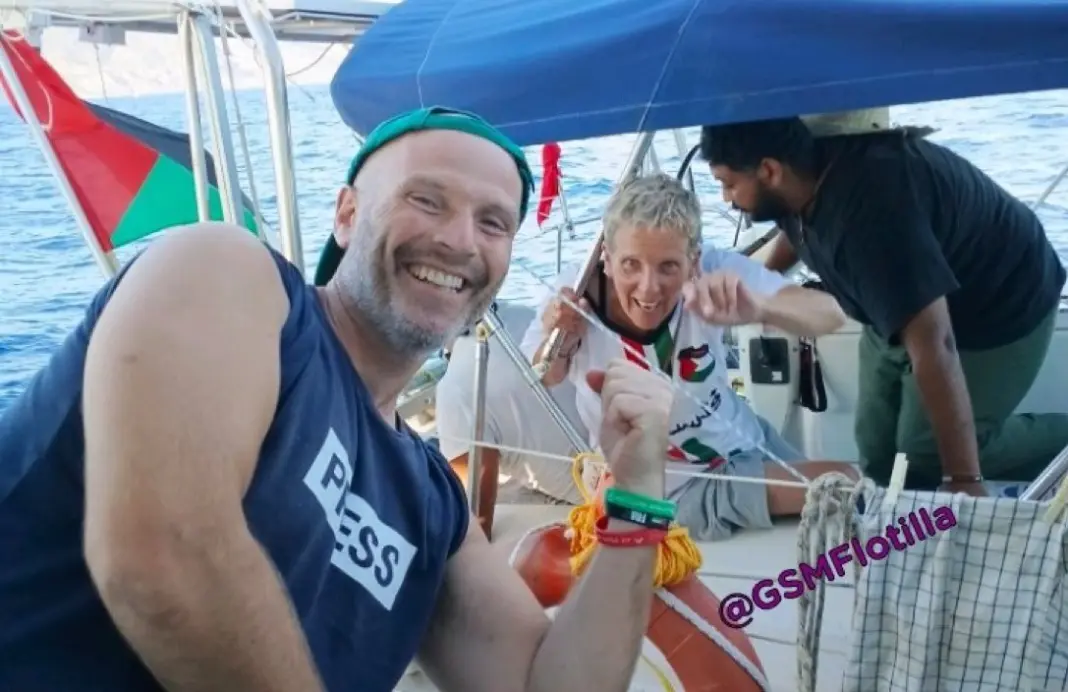
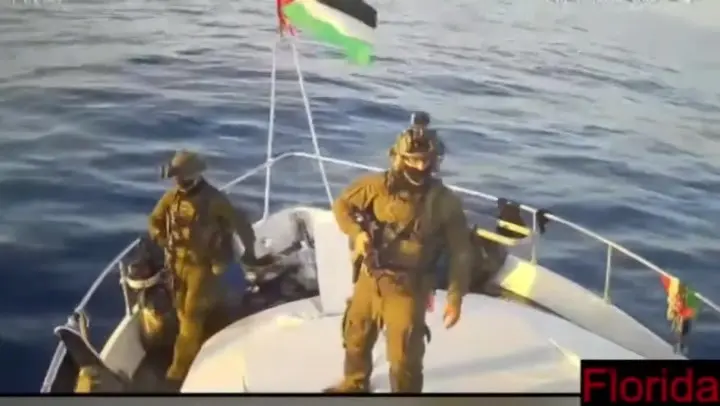

When Israeli naval forces stormed a convoy of around forty humanitarian vessels in international waters last Thursday, the world barely noticed. But according to former British diplomat and international law specialist Craig Murray, what happened was nothing short of an act of war — not just against Gaza-bound aid workers, but against every country whose flag those ships flew.
“There’s no right to intercept vessels on the high seas,” Murray said in an interview with The Crispin Flintoff Show from Dublin, where his flight to New York had been delayed by storms. “When you’re on the high seas, the law that applies is the law of the state whose flag the vessel flies. So an attack by a military ship on that vessel is legally an attack on that flag state.”
The Sumud Flotilla — Seized at Sea
The Sumud Flotilla (“sumud” meaning steadfastness in Arabic) was the latest in a series of civilian missions organized to deliver medical and humanitarian aid to Gaza, where Israel’s 18-year blockade has turned the enclave into what UN officials long ago called “an open-air prison.” The convoy — consisting of some forty vessels from multiple nations — was sailing in international waters when it was surrounded and seized by the Israeli Navy.
All communication from the ships abruptly ceased after Israel jammed and disabled their essential maritime systems — including emergency distress frequencies that are protected under international law. Commandos then boarded each vessel individually, pointing rifles at unarmed aid workers, dismantling radio equipment, and abducting the crews. Those taken from the flotilla were transported to Israeli prisons, where they remain detained.
Yet despite Israel’s sweeping assault, one vessel achieved the historic feat of breaking through the illegal blockade and reaching the coast of Gaza, marking the first successful civilian arrival in nearly two decades. The ship’s brief landing — before being overrun and seized — was celebrated across the besieged strip as an act of defiance and solidarity. Its crew, too, was detained shortly after, but their breakthrough has already entered the annals of Palestinian resistance and maritime history.
Some of the vessels flew British, Irish, Norwegian, Turkish, and Canadian flags. Their seizure has received almost no mainstream media coverage and no official condemnation from the governments concerned.
“This is an unprecedented scale of what is, effectively, piracy,” Murray said. “It’s hard to find other examples in modern history where a state has attacked and seized this many foreign-flagged civilian vessels on the high seas. When it happens, it’s not piracy — it’s an act of war.”
A Genocide in Progress
The flotilla’s mission takes on an even more urgent significance given that Israel has been officially accused of genocide in Gaza by both United Nations bodies and leading genocide scholars around the world.
In January 2024, the International Court of Justice (ICJ) — the UN’s highest judicial organ — ruled that there was a plausible case that Israel is committing genocide against the Palestinian people, ordering it to prevent genocidal acts and to allow humanitarian aid to reach civilians. Independent genocide scholars and multiple UN special rapporteurs have gone further, stating unequivocally that Israel is committing genocide through its systematic destruction of Gaza’s population and infrastructure.
By early October 2025, Israel’s assault on Gaza had killed more than 66,000 civilians, the vast majority of them women and children, according to the Gaza Health Ministry and UN relief agencies. Hospitals, refugee camps, and UN shelters have been targeted. Water and electricity have been cut off. Entire neighborhoods have been leveled.
Under the 1948 Genocide Convention, to which Israel, the United States, and the United Kingdom are all signatories, every member of the international community has a binding legal obligation to prevent and punish genocide. This obligation is not discretionary or symbolic — it requires action.
That, Murray noted, is precisely what the Sumud Flotilla sailors were doing.
“These were not criminals,” he said. “They were upholding the most fundamental law we have — the duty to prevent genocide. When governments fail in that duty, ordinary people have every right to act where their states have not.”
The Sea Siege That Kills
Israel’s maritime blockade is not merely a restriction on trade — it is a deadly enforcement mechanism of starvation and collective punishment. Gazans who attempt to fish in their own waters are routinely shot at, arrested, or killed by Israeli naval forces.
In May 2025, an unarmed fisherman was killed and another wounded when Israeli naval boats opened fire north of Gaza City. Earlier, in a widely condemned attack, Israeli forces shot and killed Mohammad Bakr, a 25-year-old father of two, while he was fishing with relatives. Human Rights Watch described the killing as “unlawful and deliberate.”
Other fishermen — Naser Ali Bakr, Muhammad Jaber Bakr, and Muhammad Fakhri Bakr — were seriously injured when Israeli gunboats opened fire with rubber-coated bullets. The Palestinian human rights organization Al-Haq has documented hundreds of similar incidents, including gunfire directed at stationary boats anchored well within Gaza’s territorial waters.
According to Gaza’s Fishermen’s Syndicate, more than 200 fishermen have been killed over the years under the blockade, and countless others have been maimed, detained, or had their boats confiscated.
The blockade enforces a constantly shifting, often arbitrary “fishing limit,” sometimes reduced to three nautical miles — a fraction of Gaza’s legal maritime zone. Violating that line, even inadvertently, can be a death sentence.
“The sea is one of Gaza’s last remaining sources of life,” said a Palestinian aid coordinator. “Israel has turned it into another front of death.”
Starvation as a Weapon of War
Beyond the deadly sea, famine and starvation have become central tools of Israel’s war policy. The UN Office of the High Commissioner for Human Rights (OHCHR) has confirmed that at least 101 people — including 80 children — have already died from starvation and malnutrition in Gaza. Hospitals report children dying daily from dehydration and hunger.
The World Health Organization (WHO) declared in August 2025 that famine is now a “man-made reality” in Gaza. More than half a million people are trapped in catastrophic hunger conditions. In May alone, over 5,000 children aged six months to five years were admitted for acute malnutrition, according to UNICEF, which warns that the numbers are “rising faster than aid can reach them.”
Al Jazeera reported that in just 24 hours, 15 Palestinians, including four children, starved to death, bringing the total recorded starvation toll to 101. UN officials note that the true number is far higher: many deaths go unrecorded because families cannot reach hospitals or retrieve bodies.
Israel’s complete obstruction of aid, combined with deliberate destruction of food warehouses and water facilities, amounts to what the UN has described as a policy of extermination through deprivation.
Under Article 54 of the Geneva Conventions (Additional Protocol I), “starvation of civilians as a method of warfare is prohibited.” Yet Israel’s siege has made food itself a forbidden weapon — and hunger a deliberate instrument of control.
The Law of the Sea — and How Israel Violated It
Under international law, the sea beyond 12 nautical miles from any coastline is international waters, or the high seas. Within that zone, no state has territorial jurisdiction. A country’s exclusive economic zone (EEZ) may extend up to 200 miles, but that only covers resource rights — such as fish or seabed minerals — not the right to control or intercept vessels.
“The law of the flag state governs what happens on board a ship in international waters,” Murray explained. “If you’re on a British-flagged vessel, British law applies, wherever in the world that ship may be.”
By intercepting, boarding, and seizing ships flying foreign flags on the high seas, Israel not only violated Article 87 of the United Nations Convention on the Law of the Sea (UNCLOS) — which enshrines the freedom of navigation — but committed what amounts to a military assault on the sovereign jurisdiction of those nations.
“When a state attacks a ship on the high seas, it is legally attacking the territory of that flag state,” Murray said. “That’s why this is so serious. It’s an act of aggression, not some minor maritime dispute.”
Blockades and Humanitarian Exceptions
Israel justifies its actions by claiming it maintains a “blockade” on Gaza — a claim Murray dismissed as both illegal and illegitimate under international law.
“Blockades are permitted only under very specific circumstances,” he explained. “They must be declared, they must be limited in duration, they must be proportionate, and they must not prevent humanitarian relief. Israel’s so-called blockade meets none of those requirements.”
The key text governing blockades at sea is the San Remo Manual on International Law Applicable to Armed Conflicts at Sea (1994) — a codification of customary international law written by over a hundred legal scholars and accepted worldwide as the definitive guide.
According to the San Remo Manual:
- A blockade must not block humanitarian assistance (Article 103).
- It must be proportionate to the military objective sought (Article 102).
- It must have a declared, finite duration (Article 94).
- It cannot be used as collective punishment of a civilian population (Articles 102 and 104).
Israel’s blockade of Gaza, in place since 2007, fails every test. It has lasted eighteen years — longer than most wars — and explicitly targets the civilian population.
“This isn’t a blockade in the legal sense,” Murray said. “It’s a siege. And a siege directed at civilians is, by definition, a war crime.”
Civilians Taken Hostage — Another Breach of Law
Beyond the seizure of ships themselves lies the issue of the human beings aboard them — civilians from neutral nations engaged in a humanitarian mission.
Under both the San Remo Manual and customary international law, civilians captured at sea under a declared blockade must be released immediately if they are not combatants or carrying weapons. Detaining or imprisoning them constitutes an additional violation — kidnapping under the law of the flag state, and unlawful detention under international law.
“The law is very clear,” Murray told Flintoff. “Even if there were a legitimate blockade — which there isn’t — civilians from neutral states captured at sea must be released immediately. They can’t be imprisoned, they can’t be prosecuted. Yet Israel is doing precisely that.”
He added that, in Britain’s case, the Metropolitan Police would be legally empowered to investigate and prosecute those responsible for the abduction of British nationals or the seizure of a British-flagged vessel.
“The police of individual flag states should be issuing charges against the Israelis involved for abduction and kidnapping,” Murray said. “But none of that is happening. There’s complete paralysis.”
Diplomatic Paralysis and Media Silence
Equally striking is the absence of media scrutiny. The mainstream press in Britain, Europe, and North America has devoted almost no coverage to what may be one of the most flagrant violations of maritime law in decades. There have been no major front-page stories, no primetime debates, and no editorial outrage over an incident that legally constitutes an attack on multiple NATO and Commonwealth states.
This silence, Murray argued, is part of a broader pattern of deference toward Israel’s violations of international law. “If any other state had seized forty foreign vessels in international waters and imprisoned their crews, it would be a global scandal,” he said. “But because it’s Israel, the media avert their eyes.”
The governments of the affected countries, meanwhile, appear to have made a political decision to downplay or ignore the episode. Neither the British Foreign Office nor the Irish Department of Foreign Affairs has demanded the sailors’ release or condemned the interception. No parliamentary inquiries have been launched; no ambassadors recalled.
To international lawyers, this inaction is extraordinary. The principle of flag-state sovereignty — that a vessel on the high seas is the legal extension of its home nation — is one of the oldest in existence. By failing to respond, these governments are effectively accepting an assault on their own citizens and territory.
“This is not a diplomatic misunderstanding,” said Murray. “It’s a direct attack on national sovereignty. That the media and governments alike are treating it as a non-event shows just how far the rot has gone in the rule-based order the West claims to defend.”
An Assault on Law Itself
The seizure of the Sumud Flotilla is not just an attack on humanitarian activists. It is an attack on the principle of freedom of navigation, on the sovereignty of nations, and on the rule of law itself.
By jamming communications, boarding and capturing ships in international waters, imprisoning their crews, and even blocking humanitarian frequencies, Israel has committed what international lawyers would classify as an act of aggression under the UN Charter — and done so in the context of a genocide already recognised by the United Nations and the International Court of Justice.
The sailors aboard the flotilla were not violating the law — they were upholding it. In the face of a genocide that has claimed over 66,000 civilian lives, and amid a maritime siege that kills fishermen and starves children, they were exercising the legal and moral duty, under the Genocide Convention, to prevent and stop the crime.
Yet the response from governments and the mainstream press has been one of near-total silence. The states whose citizens and vessels were seized have done almost nothing, and the media that claim to defend international law have looked the other way.
Murray’s final words to Crispin Flintoff were both legal and moral:
“This isn’t complicated. These people have been abducted. Their ships have been stolen. And the states whose flags they fly are doing nothing. The longer that silence continues, the more the rule of law itself dies with it.”
The Sumud Flotilla raid, in its brazenness and its impunity, reveals the heart of the crisis: that Israel’s crimes are no longer exceptional, but habitual — and that the so-called international community, paralyzed by fear of U.S. power, has become complicit through inaction.
As the aid ships sit impounded in Israeli ports, Gaza’s fishermen are shot in their own waters, and children die of hunger in hospitals without food or light, the world faces a defining question: if the high seas are no longer safe for civilians under the protection of law — and if even sovereign nations will not defend their citizens against a state officially accused of genocide — then what remains of the law at all?