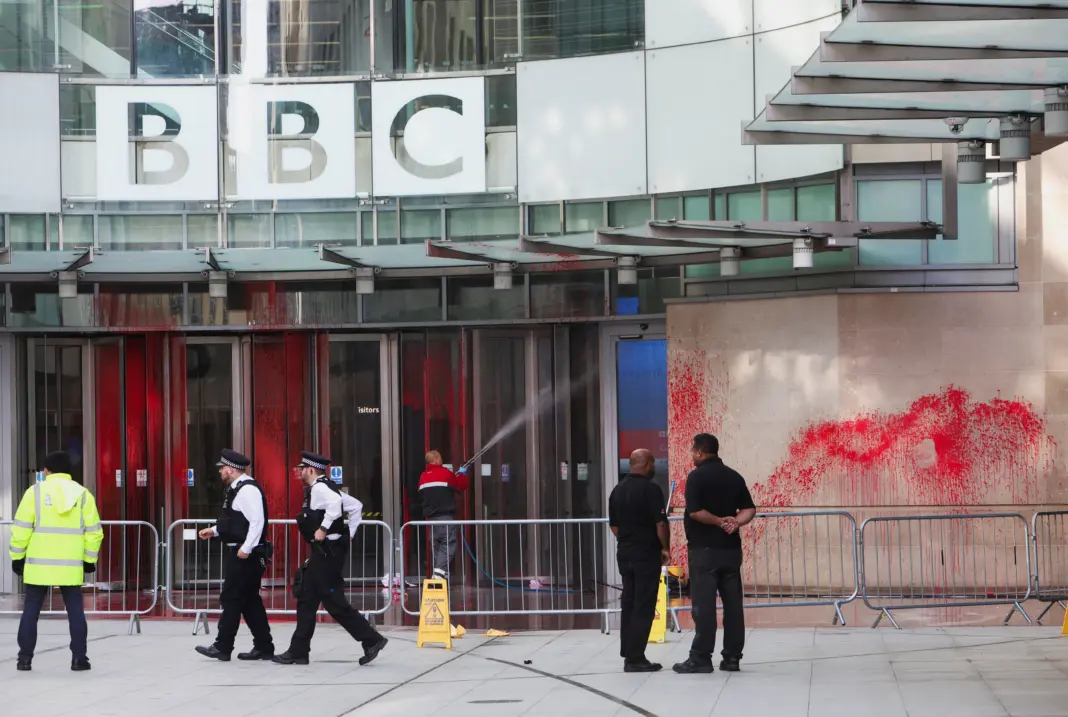

The BBC is in crisis — and for all the wrong reasons. The resignations of Director General Tim Davie and CEO of BBC News Deborah Turness followed a leaked dossier by Michael Prescott, an “independent adviser” to the corporation’s editorial guidelines and standards committee. The document, conveniently leaked to a right-wing newspaper, accused the BBC of systemic bias — from the way Panorama edited Donald Trump’s January 6 speech to supposed “anti-Israel” bias in BBC Arabic’s coverage of Gaza.
But the BBC’s crisis of impartiality didn’t begin with Donald Trump, or even the dossier. It began with Gaza — and before that, Jeremy Corbyn. The quiet edits, the careful omissions, the euphemisms, and the “balance” that always tilted one way had been noticed long before.
For decades, the BBC lived on its reputation long after it stopped earning it. People assumed neutrality because it declared neutrality — and for a time, that claim went unquestioned. It didn’t have to be trusted; it only had to be taken for granted.
Now that assumption is gone. Gaza broke it.
The Myth of Impartiality
The BBC’s authority rested on a simple myth: that balance equals truth. During the Corbyn years, the myth began to crumble. Coverage of his leadership performed impartiality while framing him as unelectable, dangerous, or illegitimate. The BBC didn’t need to smear him; it only had to select guests, questions, and tones that made one conclusion inevitable. It did not silence dissent — it rendered it unserious.
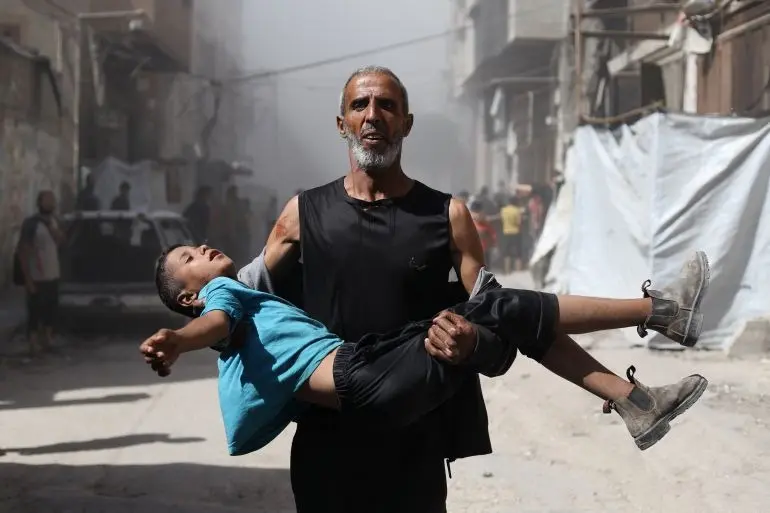
That pattern carried over to Gaza. The BBC’s “both-sides” framing of Israel’s assault on the besieged strip became a textbook example of what happens when “balance” becomes bias. Euphemism replaced clarity. Balance replaced fact. Concern replaced identification.
BBC Arabic vs. “Main BBC”
The leaked dossier’s attack on BBC Arabic revealed how deep the rot has gone. It accused the Arabic service of “minimizing Israeli suffering” to paint Israel as the aggressor — comparing it to the main BBC News website, as if the English-language baseline were objective.
But those statistics don’t lie. BBC Arabic has done far more to humanize Palestinians than the BBC’s domestic services. Working alongside BBC Monitoring and the World Service, its reporters investigated how Facebook censored Palestinian news outlets — exactly the kind of journalism the English newsroom should have led.
Instead, the main BBC’s coverage has systematically undercounted deaths, erased genocidal intent, and framed Israeli claims as fact while presenting Palestinian ones as speculation.
The Death Toll Debate
One of the dossier’s central claims was that the BBC had “pushed false Hamas claims” about Gaza’s death toll. But the basic fact is that the official Gaza death toll is a drastic underestimate.
Even the right-wing Economist — which backed Israel’s war — estimated that by May 5, 2025, the upper-end figure of violent deaths in Gaza was twice the official total, while the lower-end estimate still added 25,000 deaths.
The BBC’s problem isn’t inflating numbers. It’s minimizing them.
And the numbers speak for themselves.
The Centre for Media Monitoring analyzed 35,000 pieces of BBC content from the first year of the war. It found:
- Israeli deaths received 33 times more coverage per fatality, despite 34 times more Palestinians being killed.
- Emotive terms like “massacre” were applied 18 times more for Israelis.
- Israeli victims were described with humanizing words like “daughter” or “grandfather” four times more often.
- 2,350 Israelis were interviewed versus 1,085 Palestinians.
- When presenters offered “the Israeli perspective,” it happened 2,340 times; “the Palestinian perspective” appeared 217 times — an 11-to-1 ratio.
The BBC, in short, has given Israeli lives 33 times more narrative space than Palestinian ones.
Whistleblowers and Revolt Inside the BBC
In December 2024, journalist Owen Jones published an investigation for Drop Site News titled “I Investigated How the BBC Reports on Gaza. Here’s What I Found.” Thirteen BBC journalists and whistleblowers spoke to him, exposing how the corporation’s “commitment to impartiality” had become an institutional fiction.
“The BBC’s coverage of Israel’s genocide in Gaza is frankly despicable,” said one current BBC journalist. More than 100 staff members signed an internal statement accusing the broadcaster of pro-Israel bias.
Their accusations were stark:
- The BBC shows excessive credulity toward Israeli military claims.
- It devalues Palestinian life.
- It whitewashes atrocities or reports them as disputed.
- It creates false equivalences between occupier and occupied.
The whistleblowers cited a defining moment. In an editorial meeting in late 2023, Deborah Turness, then CEO of BBC News, said:
“We’ve got to all remember that this all started on October 7.”
Her colleague Liliane Landor, head of the World Service, calmly replied:
“No, that’s not the case — and I’m sure that’s not how you meant to phrase it.”
That exchange became symbolic of the BBC’s default position: start the clock on October 7, erase decades of occupation, and strip Palestinians of historical context.
When Palestinian Life Doesn’t Count
Some examples of BBC coverage were so egregious that public outrage forced retractions.
In July 2024, the BBC published a report titled “The lonely death of Gaza man with Down’s syndrome.” The story described Muhammed Bhar, a 24-year-old Palestinian with Down’s syndrome who was attacked by an Israeli army dog, locked in a room, and left to die. His family was expelled from their home, only to return to his decomposing body.
Readers had to scroll 500 words before discovering what had actually happened. The backlash was immediate. Under pressure, the BBC changed the headline to:
“Gaza man with Down’s syndrome attacked by IDF dog and left to die, mother tells BBC.”
As one journalist told Owen Jones:
“There has to be a moral line drawn in the sand. And if this story isn’t it, then what?”
Another data analysis by journalists Dana Najjar and Jan Lietava found that spikes in the BBC’s mention of Palestinian deaths corresponded not to massacres in Gaza, but to incidents where Westerners were also killed.
When Israel bombed a World Central Kitchen convoy in April 2024, killing several Western aid workers and their Palestinian driver, Saifeddin Abutaha, coverage surged. Palestinian deaths were suddenly newsworthy — because Western blood was spilt.
“It took Western deaths,” the report concluded, “for Palestinian life to really matter.”
The Middle East Desk and the “Death by a Thousand Cuts”
Whistleblowers also pointed to Raffi Berg, the BBC’s online Middle East editor, accusing him of systematically reshaping stories to favor Israel. One described his approach as “death by a thousand cuts.”
According to multiple staffers:
- Berg softens headlines and images that cast Israel negatively.
- He foregrounds Israeli perspectives and minimizes Palestinian ones.
- His writing and editorial tone “waters down everything that’s too critical of Israel.”
Berg has previously attended a pro-Israel rally and authored a book lauding Mossad’s operations to evacuate Ethiopian Jews, describing a senior Mossad commander as a “legend” and “very close friend.” The book’s launch, he boasted, was attended by Mark Regev and other Israeli officials — “a big honour,” he wrote — and a copy reportedly sits on Benjamin Netanyahu’s bookshelf.
When approached for comment, Berg instructed defamation lawyer Mark Lewis, former director of UK Lawyers for Israel. The BBC defended him, claiming all staff “must adhere to editorial guidelines.” But whistleblowers said their complaints were dismissed as “emotional issues” or attributed to “Muslim staff being too close to the story.”
Systemic Bias, Not Individual Error
The BBC’s Gaza failures are not random lapses; they are structural design features. The broadcaster’s charter binds it to neutrality as a condition of state legitimacy. A state-funded institution cannot name state violence plainly without risking its own survival.
This is why, when genocide was unfolding, the BBC called it “a conflict.” When starvation became deliberate policy, it called it “a humanitarian crisis.” When occupation defined reality, it called it “disputed territory.”
This pattern — the performance of neutrality to maintain access — is what destroyed the BBC’s authority.
Political Capture and the Pro-Israel Lobby
The BBC’s leadership crisis is not separate from politics. It’s entwined with them.
Figures like Sir Robbie Gibb — brother of a Conservative minister and a former BBC editor turned government spokesperson — have blurred the boundary between journalism and politics. Emily Maitlis once called him “an active agent of the Conservative Party.”
In 2020, Gibb helped lead a consortium bid to buy The Jewish Chronicle, a newspaper that “has acted as a zealous cheerleader for the Israeli state.” Inside the BBC, Gibb and his allies are said to have shaped coverage standards, discouraging criticism of Israel while enforcing harsh “impartiality” rules on those who raised human-rights concerns.
Whistleblowers say this influence directly affected Gaza coverage, embedding political caution deep in the editorial process.
Meanwhile, the pro-Israel lobby outside the BBC has celebrated Davie’s and Turness’s resignations, claiming victory against “anti-Israel bias” — in defiance of all available data.
The Collapse of Broadcast Authority
The BBC’s claim to neutrality has finally collapsed under the weight of its own contradictions. The public no longer needs a single broadcaster to define reality. They can watch events live, access original documents, and compare narratives across independent outlets.
The BBC didn’t lose trust because the public became cynical; it lost trust because the public became observant.
And those viewers are no longer fooled by the performance of balance. They see what the BBC cannot say — that genocide is genocide, that neutrality without truth is complicity, and that silence in the face of atrocity is not journalism.
What Accountability Would Look Like
If the BBC hopes to survive as a credible public broadcaster, it must stop performing impartiality and start demonstrating it. That means:
- Naming state violence clearly when the evidence warrants it.
- Giving proportional voice to those under occupation.
- Publishing transparent editorial justifications for language choices.
- Fire-walling governance from political appointees and lobbyist influence.
- Elevating BBC Arabic’s humanizing coverage instead of treating it as a liability.
Until then, the building will stand, but the authority is gone. The BBC no longer defines the truth — the public does.
And as the genocide in Gaza continues, that public no longer mistakes neutrality for morality.