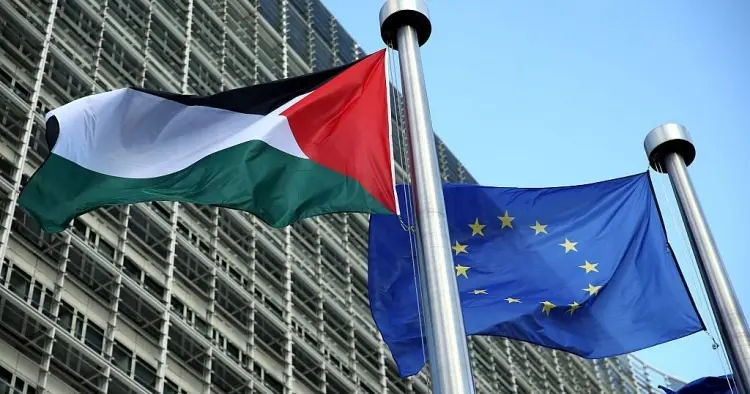

In a move drawing sharp reactions from both ends of the spectrum, the European Union has chosen not to pursue any of its 10 proposed actions against Israel over its conduct in Gaza, opting instead to “keep them on the table” without enforcement.
Following the EU-Israel Association Council in Brussels this week, EU foreign policy chief Kaja Kallas shook hands with Israeli Foreign Minister Gideon Sa’ar, highlighting the bloc’s decision to stall sanctions. Sa’ar lauded the outcome on X, calling it “a diplomatic feat” that prevented what he termed an “attack on Israel…and the EU itself.”
Palestinian Foreign Minister Varsen Aghabekian‑Shahin fired back, describing the move as “shocking and disappointing.” He reiterated that the EU’s own report highlighted 38 violations of human rights in Gaza and emphasized that violence—“killings, atrocities, war crimes”—continues even after agreements were reached to boost humanitarian aid.
Agnes Callamard, Secretary General of Amnesty International, went further, condemning the EU’s decision as a “cruel and unlawful betrayal” of international law and of its own principles. “European leaders had the opportunity to take a principled stand against Israel’s crimes,” she said, “but instead gave it a green light to continue its genocide in Gaza.”
EU Dissension: Who’s Speaking Out?
Several EU countries have been especially vocal in pressing for tougher measures against Israel:
Ireland, represented by Foreign Minister Thomas Byrne, emphasized that the aid deal remains “insufficient,” citing continued “slaughter” and restricted food and water supplies. He pledged that Kallas would provide biweekly updates on humanitarian access to Gaza. Meanwhile, under intense grassroots pressure, the Irish government is now bringing forward legislation to ban goods from Israeli settlements in the West Bank and the Golan Heights—albeit in a diluted form. Despite this, the Irish Central Bank continues to host the sale of Israeli bonds, which Israel admits are helping finance its war in Gaza.
Spain has taken a leading stance. Foreign Minister José Manuel Albares urged that the agreement “is not the end—we must stop the war.” Spanish PM Pedro Sánchez labeled Israel “genocidal,” secured a national arms embargo and pledged to pursue recognition of a Palestinian state.
A coalition of nine EU countries—Belgium, Finland, Ireland, Luxembourg, Poland, Portugal, Slovenia, Spain, and Sweden—signed a letter urging a reassessment of trade with Israeli settlements, citing the ICJ’s advisory opinion on their illegality.
Belgium’s Foreign Minister Maxime Prévot pressed the EU Commission to align trade policy with moral and legal responsibilities. Belgium is also contemplating formal recognition of Palestine.
The Netherlands’ Foreign Minister Caspar Veldkamp emphasized that public pressure had driven the humanitarian aid agreement and stressed the need to “maintain” that collective EU force.
Sweden’s Foreign Minister Maria Malmer Stenergard argued that now was the time to exert pressure to allow humanitarian aid access.
Despite these calls, a lack of unity has stalled movement. Key EU members—Germany, Italy, Hungary, Czechia, and others—have blocked both agreement suspensions and sanctions, citing legal or political objections. But critics say Germany, more than any other country, is actively enabling the genocide. “Germany is the biggest obstacle to any action by the EU,” said journalist David Cronin, citing the country’s ongoing arms sales to Israel and its declared policy of Staatsräson—a fundamental duty to protect Israel.
What’s Next?
The EU had previously launched a formal review of its Association Agreement with Israel—intended to strengthen ties—to investigate breaches related to Gaza’s humanitarian situation. This review confirmed “indications” that Israel violated its human rights obligations, particularly through access restrictions to humanitarian aid.
Yet for now, the bloc’s 10 diplomatic and economic “options” remain idle. Kallas insists all are still “on the table” and that she will report on progress regularly—but she provided no concrete timeline for action.
According to Cronin, what changed the political dynamic was a vague and unenforceable voluntary agreement between the EU and Israel in which Israel purportedly agreed to increase aid access to Gaza. “This allowed Israel to buy very valuable time,” Cronin said, “and to continue its genocide without any fear of being held accountable by the European Union.”
The next opportunity for action won’t come until the Foreign Affairs Council reconvenes in October—by which time, rights advocates warn, thousands more Palestinians may be dead.
Humanitarian Aid: A Fragile Deal
In Brussels, EU ministers backed a deal to increase humanitarian aid into Gaza—including food, fuel, and medical provisions. Some improvement has been reported: trucks are entering and power lines partially operating. However, access remains seriously constrained, and UN and EU officials continue to call for a ceasefire to ensure delivery teams can reach civilians safely.
Critics from Amnesty International and Oxfam have labeled the EU’s stance “cowardice” and a “betrayal” of fundamental values. Amnesty head Agnès Callamard warned that continued inaction may make the bloc complicit in atrocities. “There is a legal obligation under the Genocide Convention,” Cronin added. “Kallas is now abetting genocide by declaring that punishing Israel is not the EU’s aim.”
🔍 Inside the EU’s Gaza Violations Report: 38 Breaches of International Law
While the EU has refrained from taking punitive action, its own internal review presents a damning picture of Israeli conduct in Gaza.
Compiled by the European External Action Service (EEAS), the report—circulated among all 27 EU foreign ministers in early July—identified 38 specific violations of international humanitarian and human rights law. These findings stemmed from field data, satellite imagery, NGO reports, and diplomatic assessments, painting a picture of systematic abuse and disregard for civilian protections.
Key violations outlined in the report include:
- Deliberate obstruction of humanitarian aid, including fuel, medical supplies, and food—in contravention of Israel’s legal obligations under the EU-Israel Association Agreement.
- Indiscriminate bombing of civilian areas, with no discernible military targets, leading to mass casualties among women and children.
- Targeting of civilian infrastructure, including water facilities, hospitals, refugee shelters, and schools—many of which had been deconflicted through international coordination channels.
- Documented instances of collective punishment, as Israeli authorities imposed full siege conditions on Gaza, depriving 2.2 million residents of electricity, water, and medical care.
- Killings of journalists and aid workers, which the report called “consistent with a wider pattern of obstruction and impunity.”
Notably, the report concluded that Israel’s actions had “likely breached Article 2” of the EU-Israel Association Agreement, which defines respect for human rights as an essential condition of partnership.
Yet despite this language—and the political weight behind the findings—the EU has taken no formal steps to enforce the agreement.
A senior EU official, speaking anonymously, described the report as “an airtight case” that was “deliberately ignored for political reasons.”
“The diplomatic implications are severe. The EU acknowledged breaches of its own treaty and has chosen silence. That’s not neutrality—that’s complicity,” said the official.
The report has since been cited by human rights groups, legal scholars, and several EU parliamentarians demanding immediate suspension of the agreement with Israel. But for now, the document remains politically explosive—and diplomatically inert.
The Germany-Israel Axis and the Role of EU Officials
David Cronin also pointed to individuals within the EU bureaucracy who have played key roles in shielding Israel from accountability. One is Katharina von Schnurbein, the EU’s Coordinator for Combating Antisemitism, who has been accused of using her office to defend Israeli policies and smear the Palestine solidarity movement. An EU Observer report recently revealed that she labeled a bake sale for Gaza organized by EU colleagues as “ambient antisemitism.” Cronin says von Schnurbein has no mandate to weigh in on Middle East policy—yet is heavily involved in internal efforts to stifle criticism of Israel.
Ursula von der Leyen, President of the European Commission and a supporter of von Schnurbein, has similarly offered full-throated support to Israel throughout the war. Critics allege both women have weaponized antisemitism to suppress dissent and shield war crimes.
“Rather than protecting Jews in Europe from racism, von Schnurbein has worked to silence Palestinians and their allies,” Cronin said. “This is a betrayal of her office—and of EU taxpayers who fund it.”
Grassroots Pressure Grows
Across the EU, civil society is intensifying demands for accountability. Activists in countries like Ireland and Spain have pushed their governments to take stronger positions. Ireland is moving forward with a long-delayed ban on settlement goods. In Spain, PM Sánchez has pledged to recognize Palestinian statehood. But popular frustration remains high.
“Citizens of Europe have no control over these officials. Von Schnurbein has been in office nearly a decade without any democratic oversight,” said journalist Ali Abunimah. “She spreads atrocity propaganda while aiding and abetting genocide—and no one can remove her.”
As Cronin put it, “The EU continues to project itself as a neutral broker committed to peace. But its inaction, hypocrisy, and internal alignment with Israel’s war machine reveal the opposite.”—and a desire to maintain ties with Israel—are preventing meaningful action.