
The United Nations Special Rapporteur on the occupied Palestinian territories has accused Israel of using the post ceasefire period to consolidate its control over Gaza while the surviving population remains confined amid hunger, displacement and continuing attacks. In an uncompromising interview with Double Down News, she also accused Western media organisations of failing Palestinian journalists and helping to obscure the legal and historical context of Gaza’s destruction.
A ceasefire was supposed to mark the beginning of Gaza’s recovery. Instead, more than ten months after the agreement was announced on 10 October 2025, much of the territory remains under Israeli military control, hundreds of thousands of Palestinians are living in tents or dangerously damaged buildings, and Israeli airstrikes, shelling and gunfire continue to kill civilians.
More than 1,280 Palestinians had been reported killed in Gaza since the ceasefire took effect by 24 August 2026, while four Israeli soldiers had been killed during the same period. Subsequent reporting placed the Palestinian death toll above 1,300.
Israel says its operations are intended to prevent imminent attacks by Hamas and other armed groups. Hamas accuses Israel of repeatedly violating the ceasefire and obstructing the wider peace plan negotiated under the administration of US President Donald Trump.
Against this background, Francesca Albanese, the United Nations Special Rapporteur on the situation of human rights in the Palestinian territories occupied since 1967, has issued one of her starkest warnings about Gaza’s future.
Speaking in an interview broadcast by Double Down News on 28 August, Albanese argued that the reduction in international attention since the ceasefire had allowed Israel to continue reshaping Gaza while its population remained trapped in conditions that she described as a continuation of genocide.
“Conditions in the Gaza Strip remain appalling because there are no measures that have been taken that might alleviate the suffering of the Palestinians caught up in the theatre of a genocide,” Albanese said.
Albanese is an independent expert appointed by the UN Human Rights Council, rather than a UN employee speaking on behalf of the institution. Her mandate nevertheless gives her a prominent role in investigating alleged violations in the occupied Palestinian territory and presenting her findings to the Human Rights Council and General Assembly.
Her central warning is that Gaza is not moving towards reconstruction, Palestinian self government or a meaningful Israeli withdrawal. Instead, she believes it is being transformed into what she called “a sacrificial zone”, where Palestinians can be contained and deprived of the means to rebuild without the return of the continuous large scale bombardment that once dominated international headlines.
A ceasefire without safety
United Nations humanitarian reporting supports many elements of Albanese’s description of a population living in increasingly confined and unstable conditions.
In its 31 July 2026 humanitarian situation report, the UN Office for the Coordination of Humanitarian Affairs said Israeli military operations near the so called Yellow Line, together with attacks elsewhere in Gaza, were causing civilian casualties, damaging shelters, driving renewed displacement and restricting access to essential services.
The Yellow Line was established under the October ceasefire as a military redeployment boundary. Israeli forces nevertheless remain deployed across more than half of Gaza, while the line itself has been described as unclear and subject to movement.
“Israel has continued to advance the taking of the land beyond what Israel calls the Yellow Line,” Albanese said. “So far, between 54 and 60 per cent of the Gaza Strip is totally under Israeli control. Most of it is destroyed. What was rubble was turned into dust. Israel is literally pulverising the Gaza Strip.”
Humanitarian agencies have reported that military advances around the boundary have temporarily displaced families, damaged tent encampments and placed hospitals, farmland, infrastructure and humanitarian facilities beyond the reach of much of the population.
The result is that most of Gaza’s surviving population is crowded into a shrinking area, largely close to the Mediterranean coast, while access to other parts of the territory remains prohibited or dangerously uncertain.
Aid has not entered at anything approaching the scale required, Albanese said, while medical evacuations remain grossly inadequate and foreign medical personnel cannot enter Gaza freely.
“The situation is like a paralysis,” she said. “Israel has also continued to conduct targeted attacks, whatever that means, and there is not much coverage or analysis of it.”
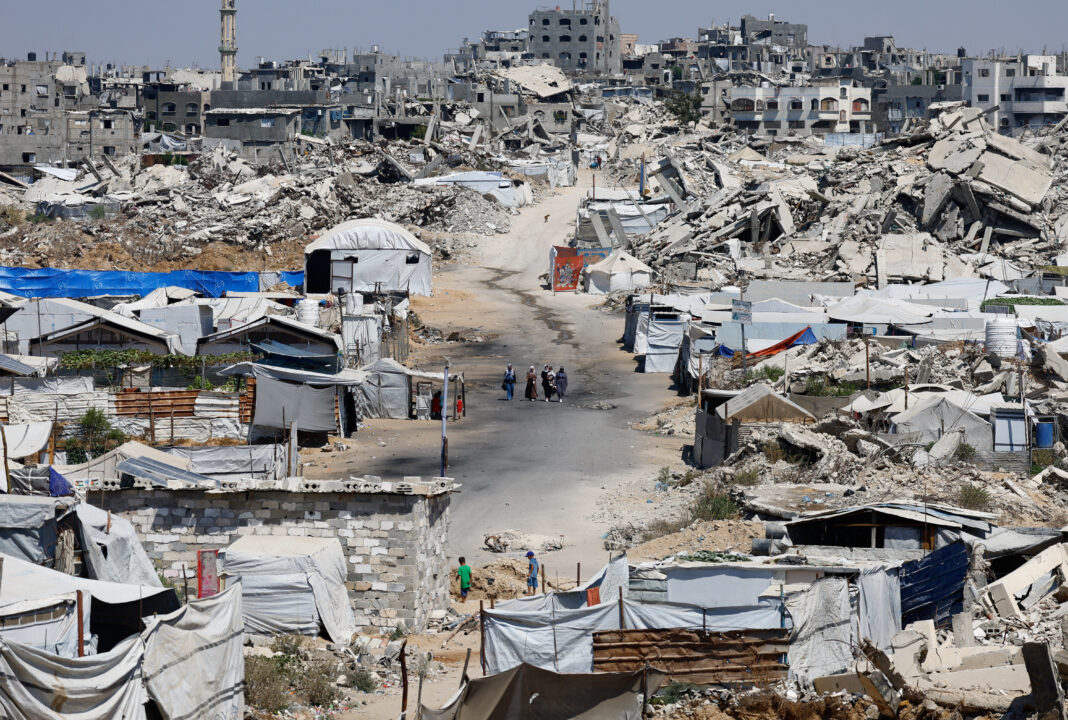
Conditions within the displacement areas remain severe. Families who endured cold temperatures and violent storms in makeshift tents during the winter are now exposed to intense summer heat under plastic and fabric coverings.
“The population lives mostly in tents, cramped in an area close to the sea,” Albanese said. “They were exposed to the cold and storms in winter, and now they are trapped in this plastic cage because they live in plastic tents under the summer heat.”
Sewage, overcrowding, insects, rats, contaminated water and uncollected waste have created conditions in which infectious and skin diseases can spread rapidly.
“Gaza is a wasteland of human remains and waste,” Albanese said. “There has been an infestation of rats and insects. The situation is catastrophic.”
OCHA reported that 67 per cent of Gaza’s population was still facing high levels of acute food insecurity in July. It warned that falling aid coverage, funding shortages, military restrictions and the expansion of militarised areas could rapidly reverse the limited improvements that followed the ceasefire.
Medical services remain similarly precarious. Shortages of insulin, dialysis supplies, cardiac equipment and diagnostic materials have restricted treatment for chronic illnesses, while medical evacuations and the entry of specialist personnel remain inadequate.
Albanese rejected any suggestion that these conditions could be dismissed as the unavoidable aftermath of a completed war. In her assessment, Israel continues to exercise decisive control over Gaza’s territory, borders, movement and access to humanitarian assistance, giving it direct responsibility for the conditions under which Palestinians are being forced to survive.
Gaza as a “sacrificial zone”
Asked what Israel was ultimately attempting to achieve, Albanese said the immediate strategy might be less complicated than the search for a formal master plan suggests.
All remaining Israeli hostages were returned under the ceasefire arrangements, while Hamas indicated that it was prepared to relinquish direct governmental control of Gaza. Hamas has not agreed to the complete disarmament demanded by Israel, and the later stages of the peace agreement remain stalled.
“Even if all the hostages have been returned, even if Hamas has said it is ready to step down, Israel doesn’t care,” Albanese said. “Gaza is a sacrificial zone.”
Albanese argued that Israel was in no hurry to resolve Gaza’s future because the existing arrangement already served its interests. Israeli forces retain control over most of the territory, Palestinians remain concentrated in devastated areas, and Gaza is no longer disrupting daily life inside Israel to the extent it did during the height of the war.
“The aim, as stated by Israeli politicians and ministers, but also by US officials and other prominent figures, is for Gaza to be land that is taken and never returned to the Palestinians,” she said.
“So far, the genocide survivors are trapped in this awful ghetto, waiting for something to happen.”
Albanese said Israel’s actions had to be considered within the wider history of Palestinian displacement and an Israeli political movement increasingly committed to permanent territorial control.
“Israel has no intention of returning Gaza to the Palestinians,” she said. “In the long run, Israel is to be for Jews and Jews only. I would say for Zionists and Zionists only, because even Jewish Israelis are having trouble when they challenge the Israeli genocidal and apartheid agenda.”
Her comments reflected her assessment of the Israeli state and its governing ideology. Israel rejects accusations that it is an apartheid state or that it is pursuing the permanent removal of Gaza’s Palestinian population.
Albanese did not claim that the immediate objective was necessarily to expel every Palestinian from Gaza. Instead, she described a policy of attrition in which Israel could allow deprivation and preventable deaths to continue while facing little pressure to determine the territory’s final political status.
“In the short run, Palestinians can keep dying and can keep starving, and it doesn’t really matter,” she said.
“Look at people in Tel Aviv and in other places in Israel. They continue their lives normally. They are enjoying summer. From an Israeli perspective, the situation is calm.”
This does not mean displacement has disappeared from Israel’s longer term calculations. Albanese pointed to statements from Israeli ministers and other political figures advocating Palestinian emigration, permanent Israeli control and the establishment of settlements in Gaza.
She also cited restrictions affecting students, academics, medical patients and families seeking to leave temporarily. According to Albanese, Israel has not consistently facilitated the departure even of Palestinians who have received scholarships, teaching positions or offers of medical treatment abroad.
“There are dozens, if not hundreds, of students and surviving academics who have been accepted for scholarships or teaching positions elsewhere,” she said. “Israel is not facilitating this. Why? Because they don’t want intellectuals from the Gaza Strip outside.”
Albanese also alleged that Israel rarely permits an entire family to leave when one person obtains permission to travel.
“The message is: be careful what you say when you are outside, because your family is still here,” she said.
Her conclusion was that Palestinians are being denied both a viable life inside Gaza and a safe, voluntary means of temporary movement outside it.
“The short term plan is no plan,” Albanese said. “Let them die. Let them starve. This is the essence of a genocide: the intentional destruction of a people as such.”
The Israeli government strongly rejects allegations of genocide. It maintains that its military operations are directed against Hamas and other armed organisations, which it accuses of operating from civilian areas and concealing weapons within homes, hospitals, mosques and other protected locations.
Israel has also accused Hamas and criminal organisations of interfering with humanitarian supplies. Humanitarian agencies, however, continue to identify Israeli access restrictions, military operations and insufficient funding as major impediments to their work.
Western governments “know exactly what is happening”
Albanese said her greatest anger was directed not only towards Israel but towards the governments that possess the diplomatic, economic and military power to intervene.
“I’m not even shocked by what Israel is doing, because Israel is an apartheid state which has totally lost whatever remained of its moral compass in the past two and a half years,” she said.
“What I’m really revolted by is the posture of the international community and the posture of the West, because they know exactly what is happening. They don’t even condemn it any more.”
Albanese argued that governments could not escape their responsibilities simply by refusing to use the word genocide.
“This is how dozens of experts worldwide, hundreds of human rights observers, monitors, qualified people and scholars have described it,” she said. “This imposes an obligation to at least take preventive measures.”
Under the Genocide Convention, states are required to employ the means reasonably available to them to prevent genocide when they are aware of a serious risk that it is occurring.
The International Court of Justice has not yet issued a final ruling on South Africa’s genocide case against Israel. It has, however, imposed and repeatedly reaffirmed provisional measures intended to protect Palestinians from acts covered by the Genocide Convention while the proceedings continue.
A separate UN Independent International Commission of Inquiry concluded in September 2025 that Israel had committed genocide in Gaza. Israel rejected the commission’s findings as false, biased and politically motivated.
Albanese argued that preventive action should include sanctions, the suspension of military cooperation and direct international efforts to deliver food, medical equipment, specialist personnel and adequate shelter.
“They should send their own navies to the Gaza Strip carrying humanitarian equipment, medical equipment, medical personnel and survival kits,” she said.
“Not just tents, but material that can provide dignified shelter for displaced people. Nothing moves. It doesn’t concern them.”
Such an operation would carry substantial political and military risks, particularly if Israel attempted to prevent foreign vessels from approaching Gaza. Albanese nevertheless argued that the severity of the humanitarian emergency demanded action extending beyond statements of concern.
A peace structure accused of bypassing international law
Albanese was also sharply critical of the Board of Peace established under Trump’s Gaza plan.
The board was welcomed by UN Security Council Resolution 2803, adopted in November 2025, and was presented by the White House as a mechanism for supervising reconstruction, mobilising international resources and overseeing Gaza’s transition from conflict.
“The so called Board of Peace that the Trump administration has chaperoned is not working,” Albanese said. “It has been a distraction and a destruction.”
She argued that the structure had transferred decisions concerning Gaza away from established international law and into a political body shaped by the Trump administration, selected governments and other appointed institutions.
“In all this, international law has been completely trashed and sidelined,” she said. “We forget that Gaza is illegally occupied territory, that Israel has no right whatsoever to be there, and that it should allow international humanitarian aid to flow in as needed.”
Her concern is not simply that the board has failed to deliver rapid reconstruction. It is that debates over demilitarisation, investment, security management and administrative control can obscure Gaza’s underlying legal status and the right of the Palestinian people to self determination.
In its July 2024 advisory opinion, the International Court of Justice concluded that Israel’s continued presence in the occupied Palestinian territory is unlawful and must be brought to an end as rapidly as possible. The court also said Israel must cease new settlement activity and evacuate settlers from the occupied territory.
Albanese argues that this determination should be the starting point for any discussion of Gaza’s future. Israel should not be permitted to decide unilaterally how much territory it retains, which Palestinians may return or what political institutions will govern them.
“The most important international tribunal, the International Court of Justice, has qualified the occupation as unlawful and therefore something that must be dismantled totally and unconditionally,” she said.
“That means Israel had no right to have boots on the ground in Gaza, let alone the West Bank. There was no possibility to claim and invoke self defence, and there has been no attention whatsoever to this legal framework.”
That interpretation remains contested. Israel maintains that it retains a right to defend its population from Hamas and other armed groups, including threats originating from occupied territory.
The killing of Palestinian journalists
The interview also provided a preview of Albanese’s forthcoming report on media conduct during the destruction of Gaza.
She said the investigation would examine the killing of Palestinian journalists, the targeting of their families, the destruction of media infrastructure, the conduct of the Israeli press and the reporting practices of influential Western news organisations.
“Many reputable media outlets have not scrutinised Israel’s conduct,” she said. “They have actually had guidance policies avoiding criticism of Israel.”
Albanese referred to estimates approaching 300 Palestinian journalists and media workers killed during the war. Different organisations use different definitions and verification standards, producing significantly different totals.
As of June 2026, the Committee to Protect Journalists had documented 207 Palestinian journalists and media workers killed in Gaza. Across Gaza, Lebanon, Yemen, Iran and Israeli detention facilities, CPJ had recorded 259 journalists and media workers killed by Israel.
CPJ had determined that at least 75 journalists and media workers across the affected region were deliberately targeted in retaliation for their work, while continuing to investigate other suspected cases.
“It’s not just that nearly 300 journalists and other media workers have been killed in the Gaza Strip,” Albanese said. “Their family members have also often been targeted. There are dozens of family members who were killed while the journalist or media worker was targeted.”
Albanese also criticised Western journalists for failing to show sufficient solidarity with their Palestinian colleagues.
“The way their colleagues in the West have covered their targeting has been far from professional,” she said.
Because international reporters have largely been prevented from entering Gaza independently, Palestinian journalists became the principal witnesses documenting bombardments, displacement, hunger, hospital attacks and the destruction of civilian infrastructure.
As those journalists were killed, injured, displaced or deprived of communications equipment, Gaza’s ability to describe its own destruction was progressively weakened.
Albanese accused some Western news organisations of treating journalists in Gaza as political participants simply because they reported statements issued by Hamas officials.
She offered the routine description of Gaza’s hospitals as “Hamas run” as an example of wording that can subtly transform a civilian institution into something presumed to be connected with an armed organisation.
“The moment you call a hospital ‘Hamas run’, it is like validating the argument that there is something wrong with that hospital,” Albanese said.
She made the same point about journalists quoting representatives of Gaza’s governing authority or Hamas’s political leadership.
“I cannot hold you responsible if you share what Netanyahu, Trump or Hamas have said,” she told the interviewer. “Reporting their declarations does not make journalists the house organs of the Hamas leadership in Gaza.”
A hospital does not lose its protected civilian status merely because a particular authority administers its health ministry. Nor does a reporter become an agent of that authority by quoting one of its representatives.
Albanese said Palestinian reporters had frequently been treated with disrespect and condescension by Western news organisations.
“The level of condescension towards them by Western media has been remarkable and unprofessional,” she said. “I want to hope that there will be investigations that also examine whether there is liability in this respect.”
She was careful not to call for increased state regulation of journalism, which could itself become an instrument of censorship.
“Protecting freedom of expression and protecting freedom of the media is fundamental,” she said. “I decided to steer away from recommendations for greater control by states. But my report will be a call for responsible media to look at what has been done to their profession.”
Albanese said her investigation had concentrated on news organisations generally regarded as authoritative and objective, rather than openly partisan outlets.
“The picture is really interesting,” she said. “Revolting, but still interesting. It is food for thought for the time in which we live.”
Reporting Gaza without its history
Albanese argued that one of the most serious failures of Western reporting had been the removal of Gaza from its historical and legal context.
Reports of individual airstrikes, deaths or humanitarian shortages often appeared without sustained discussion of occupation, blockade, forced displacement or the findings of international courts.
“What has been extremely striking for me, as a legal scholar and as a Special Rapporteur, is the omission of the context and the legal qualification,” she said.
This omission allowed each episode of Palestinian suffering to be presented as an isolated tragedy rather than part of a continuing system.
It also allowed Israeli military statements to establish the initial framework through which an event was understood. Palestinian evidence was frequently treated as something requiring extensive verification, while official Israeli claims were rapidly included in reports despite Israel’s documented history of issuing explanations that were subsequently challenged by video, witness testimony or independent investigation.
Albanese said her report on the media was expected to be released by the end of September or early October, ahead of its presentation to the UN General Assembly in New York.
Whether she will be able to present it in person remains uncertain. Albanese said she had applied for a new US diplomatic visa and contrasted the restrictions imposed upon her with the treatment of Israeli Prime Minister Benjamin Netanyahu, who has travelled to the United States despite being subject to an International Criminal Court arrest warrant.
“It is unacceptable that someone who is wanted by the ICC for war crimes and crimes against humanity, including using starvation as a weapon, is allowed to travel to the United States and go to New York, while a UN person cannot,” she said.
The ICC warrant alleges that Netanyahu bears responsibility for war crimes and crimes against humanity, including starvation as a method of warfare. Netanyahu rejects the allegations, while Israel and the United States dispute the court’s jurisdiction.
“Genocide knows no break”
Asked whether she saw any reason for optimism, Albanese offered little reassurance.
“No, honestly, optimism was displaced a long time ago,” she said. “But this doesn’t matter. We need to intervene.”
Her answer was that the absence of immediate hope did not remove the obligation to act, particularly for European societies that built their postwar identities around the promise that the mass abandonment and extermination of civilians would never be repeated.
“I’m from the continent that committed its worst crime ever on its own soil less than one century ago,” she said. “We have forgotten that Jewish people were left to die, left to be killed and slaughtered in concentration camps until the Soviet Army broke into them.”
“We cannot let it happen again. The moral conscience of society in 2026 should be different.”
Albanese’s historical parallel was not that the experiences were identical, but that a civilian population confined beyond ordinary public view can be allowed to die when political leaders decide intervention is too costly or inconvenient.
The difference today is that Gaza’s destruction has not been hidden. Images, testimony and casualty reports have circulated continuously, even as social media algorithms and editorial priorities have made it possible for audiences to look away.
“There is a civilian population, the entire Palestinian population, trapped under the yoke of a genocidal attack conducted by an apartheid state that has deprived them of their rights for longer than we can all remember,” Albanese said.
She directed particular criticism towards the contrast between ordinary summer life in Western capitals and Israel and the conditions endured by Palestinians beneath plastic tents, amid ruins, disease and continuing attacks.
“I know everyone is enjoying summer, but genocide knows no break,” she said.
Albanese called for renewed strikes, demonstrations and political pressure, pointing to previous mobilisation by Italian workers and civil society organisations as evidence that governments can be challenged from below.
“Italians were phenomenal, but they were not the only ones,” she said. “They declared strikes and protested. This seems to be gone now, and it is really sad for us as well.”
“What kind of human beings are we if we can live with it?”
That question goes to the heart of the struggle over Gaza’s future. The immediate issue is whether food, medical supplies and adequate shelter will reach the population. Behind it lies a larger question: whether Gaza will again become a place in which Palestinians can live and govern themselves, or remain an enclosed territory managed by Israel and outside powers while its surviving inhabitants wait for decisions in which they have little voice.
For Albanese, the danger is that the world will become accustomed to the second outcome. Gaza may disappear from the headlines without its people escaping the conditions that produced the catastrophe.
The war would then appear to have ended, even as its territorial, political and human consequences were made permanent.