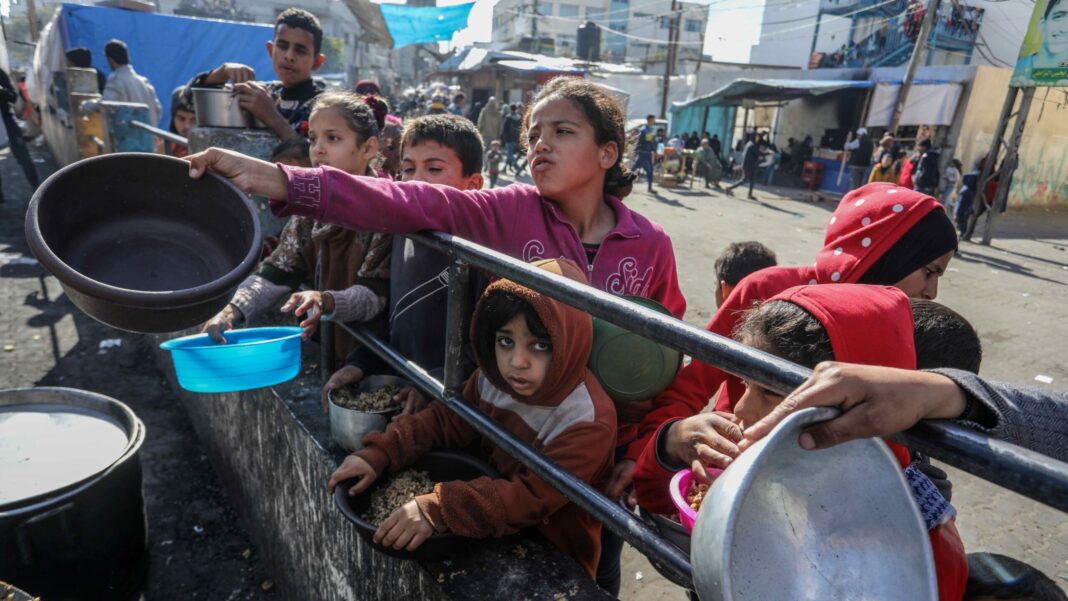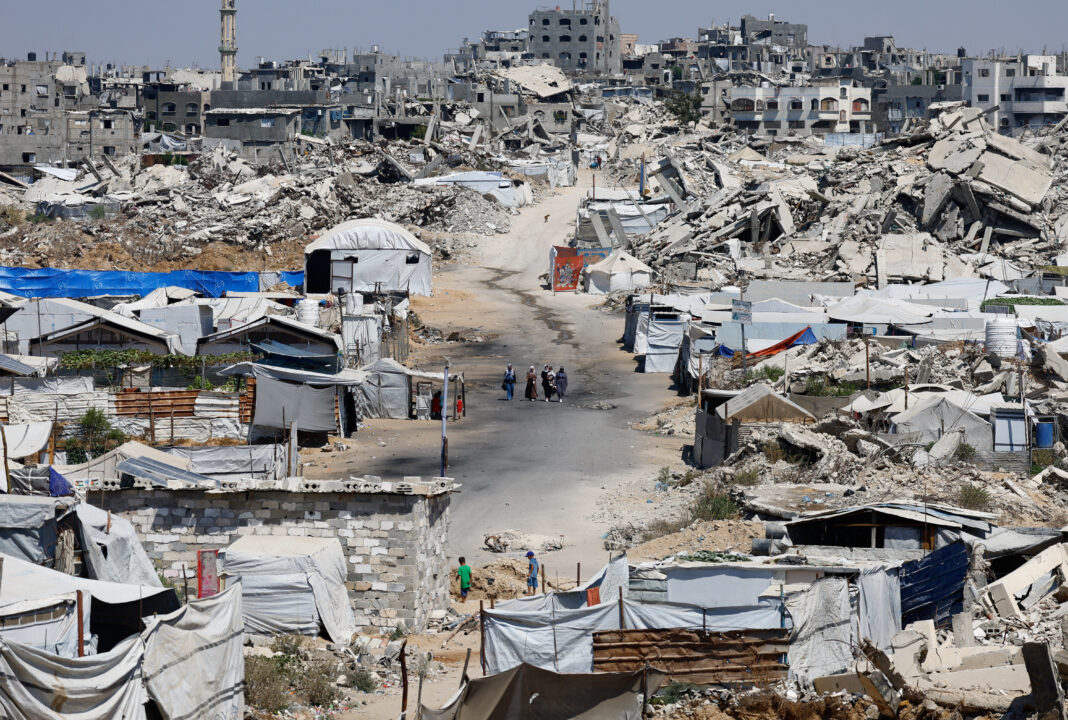

The BBC’s obituary of Ratko Mladić describes siege, mass killing and ethnic expulsion with uncompromising moral clarity. Apply the same narrative structure to Yoav Gallant, wanted by the International Criminal Court over Gaza, and the gulf in the broadcaster’s treatment of Bosnian Serb and Israeli leaders becomes impossible to ignore.
MEDIA ANALYSIS
When convicted Bosnian Serb commander Ratko Mladić died in The Hague on 27 August 2026, the BBC did not hide behind the bloodless vocabulary so often used to report a war while it is still being fought.
Its headline was blunt: “The monstrous crimes of Ratko Mladic, the ‘Butcher of Bosnia’”.
The accompanying obituary described a brutal nationalist consumed by the pursuit of territorial and ethnic supremacy. It placed responsibility directly upon him for the siege of Sarajevo, the terrorising of civilians, the forced removal of Bosnian Muslims and Croats, and the genocide at Srebrenica. It did not describe shells as falling mysteriously or people as simply having “died”. Mladić and his forces shelled, terrorised, expelled and murdered.
The BBC was entitled to write with that certainty. Mladić had been convicted after a lengthy trial and his convictions had been upheld on appeal. The International Criminal Tribunal for the former Yugoslavia found him guilty of genocide, crimes against humanity and war crimes, including murder, extermination, forcible transfer, terror and unlawful attacks on civilians. He was serving a life sentence when he died. The United Nations tribunal confirmed his death and legal status, while the ICTY’s judgment records the crimes for which he was convicted.
Yet the BBC article raises an unavoidable question. What would the same story sound like if Mladić’s name were replaced with that of former Israeli defence minister Yoav Gallant, if Sarajevo became Gaza City, if the Bosnian Serb army became the Israel Defense Forces, and if Bosniak civilians were replaced by Palestinians?
The comparison is not exact, because history never repeats itself with perfect symmetry. Mladić was the operational commander of the Bosnian Serb army, while Gallant was Israel’s civilian defence minister. Srebrenica involved the organised capture and execution of thousands of men and boys, while Gaza’s destruction has been inflicted principally through bombardment, siege, starvation, mass displacement and the dismantling of civilian life.
Nevertheless, the two narratives share so much of their structure that the contrast in language is startling.
A story that almost rewrites itself
As commander of the Bosnian Serb army, Mladić oversaw a campaign intended to remove non Serbs from territory claimed by Serbian nationalists. The BBC described that project as ethnic cleansing and presented the ideology of a “Greater Serbia” as the political objective behind the violence.
As Israel’s defence minister, Gallant helped direct the military campaign launched in Gaza after the Hamas led attacks of 7 October 2023, in which approximately 1,200 people were killed in Israel and 251 were taken hostage. The crimes committed by Hamas against Israeli civilians were grave and were themselves investigated by the International Criminal Court. They did not, however, suspend the laws of war or convert every Palestinian man, woman and child into a military target.
The prisoners missing from the opening frame
That familiar summary of 7 October also leaves out a crucial part of the history. Palestinian prisoners were not a secondary issue invented after the attack. Their release was a central and publicly declared objective of Hamas and a cause with enormous political importance across Palestinian society.
It would be too categorical to claim that freeing prisoners was the sole cause of Operation Al Aqsa Flood, or to treat it as a legal defence for the killing of civilians and taking of civilian hostages. Hamas leaders also described broader military, political and religious objectives. Yet the prisoner exchange strategy was unmistakable. On 7 October, senior Hamas official Saleh al Arouri said the captives taken into Gaza would be used to secure the release of Palestinians in Israeli prisons. Nine days later, Khaled Meshaal said Hamas had what it needed to empty the prisons. Yahya Sinwar, himself released with more than 1,000 other Palestinians in the 2011 exchange for Israeli soldier Gilad Shalit, had long vowed to free the remaining prisoners.
Immediately before 7 October, Israeli and Palestinian sources counted the population somewhat differently. Israel Prison Service figures compiled by the Israeli human rights organisation B’Tselem showed 4,764 Palestinians held at the end of September 2023. Palestinian prisoner organisations placed the total at approximately 5,200, including 33 women and 170 children.
Not all of those people were imprisoned without charge or trial. Some had been convicted of serious offences, including attacks that killed civilians. Any responsible account must say so. However, approximately 1,310 were administrative detainees. Under that system, Palestinians can be imprisoned on secret evidence, without being charged or tried, under orders that can be repeatedly renewed. Amnesty International reported that the number held administratively increased from 1,319 on 1 October 2023 to 2,070 one month later, describing Israel’s systematic use of the measure as arbitrary detention rather than the exceptional security procedure permitted by international law.
The distinction matters because the entire population cannot accurately be described either as convicted criminals or as people lawfully serving sentences. Palestinians in the occupied West Bank are prosecuted through a military court system from which Israeli settlers living in the same territory are exempt. Children have been imprisoned. Administrative detainees have been held for extended periods without seeing the evidence against them. Gazans have been designated “unlawful combatants”, a classification used to permit prolonged detention without the ordinary protections of a criminal trial.
Israel then carried out mass arrests in Gaza and the West Bank. The number of Palestinians in custody rose to approximately 10,000 during the war, although the total changed continually as people were arrested, released or exchanged. The scale cannot be dismissed as a slogan from a Palestinian advocacy group. In a March 2026 communication to Israel, United Nations special procedures experts recorded Israel’s own statement that more than 6,500 security detainees from Gaza and the West Bank had been added to an already overcrowded prison population by December 2024.
That UN communication cited an estimated 11,000 Palestinians in Israeli detention in May 2025. It recorded 9,183 in December 2025, including about 350 children and 48 women, and reported that 9,245 remained imprisoned in February 2026. Around 3,200 people from the West Bank were administrative detainees, while another 1,300 Gazans were classified as “unlawful combatants”. Only about 2,200 were identified as convicted prisoners.
The word “only” does not imply that everybody else was necessarily innocent of an offence. It means that the state had not proved guilt through a completed criminal process. Nor can every detention be declared unlawful without examining the individual case. What can be said is that UN investigators have documented arbitrary, secret and prolonged detention, enforced disappearance and denial of due process on a vast scale.
Those detained have included civilians seized during military operations, labourers who had permits to work in Israel, journalists, women, children and medical personnel removed from hospitals. In July 2026, UN experts called for the immediate release of Dr Hussam Abu Safiya, director of Kamal Adwan Hospital, and other Palestinian health workers held without due process. Physicians for Human Rights Israel has documented doctors and other medical workers taken from their workplaces, held for months without charges and subjected to torture and sexual abuse.
The evidence concerning prison abuse is extensive and comes from Palestinian, Israeli and international organisations. The March 2026 UN communication documented allegations of beatings, suspension by bound hands, electric shocks, sleep deprivation, starvation, denial of medical care and attacks by dogs. It also recorded allegations of rape, attempted rape, threats of rape, sexual assault and violence directed at detainees’ genitals involving male and female prisoners.
This was not confined to unverified testimony circulating outside the international system. In its annual report published in May 2026, the United Nations listed Israeli armed and security forces among parties credibly suspected of committing or being responsible for patterns of conflict related sexual violence. UN investigators verified sexual violence against 31 Palestinian men, women and children between 2023 and 2025, including rape and sexual torture in detention, while warning that obstruction of access meant the documented cases represented only part of the likely total. The report also continued to list Hamas and other Palestinian armed groups over sexual violence associated with 7 October.
The same communication reported 94 Palestinian deaths in Israeli custody between October 2023 and 31 August 2025, while warning that figures differed and that Israel’s lack of transparency made the precise causes difficult to establish. A review of ten post mortem examinations found signs of physical assault in five cases, with evidence consistent with beatings and restraints in two. Other deaths were associated with extreme malnutrition, untreated illness or denial of life saving care. The report described the death of a 17 year old detainee whose post mortem findings indicated starvation, dehydration, untreated infections and prolonged medical neglect.
The experts did not declare every allegation proved. They demanded independent investigation and warned that the scale and severity of the evidence suggested either grave official neglect or a de facto policy that encouraged, condoned and institutionalised torture. Israel denies systematic abuse, maintains that its security detentions are lawful and says allegations are subject to investigation. The UN communication recorded 52 military investigations into the treatment of Gazan detainees, but also said that no Israel Prison Service employee had been indicted for torture, sexual violence or the death of a Palestinian detainee since 7 October.
This history does not make the taking of Israeli civilians as hostages lawful. Hostage taking is prohibited by international law, regardless of the objective. It does expose the selective context through which the conflict is commonly introduced. Israeli captives are given names, families and biographies. Thousands of Palestinians held without trial are compressed into the anonymous term “security prisoners”, if they are mentioned at all.
The missing context changes neither the identity of the civilians killed on 7 October nor the criminal character of attacks upon them. It changes the reader’s understanding of the political landscape in which the operation occurred and of the exchange Hamas intended to force. A news report can condemn crimes against Israelis without erasing the thousands of Palestinians already behind bars, the children and administrative detainees among them, or the prison system that became one of the operation’s central declared targets.
Two days after the Hamas attack, Gallant announced that he had ordered a “complete siege” of Gaza. There would be no electricity, food, water or fuel. He said Israel was fighting “human animals” and would act accordingly.
That statement was not an allegation reported by an enemy government, an anonymous witness or a political campaign group. It was a public declaration by the Israeli minister exercising authority over the war.
The International Criminal Court subsequently found reasonable grounds to believe that Gallant and Prime Minister Benjamin Netanyahu bore criminal responsibility as co perpetrators for starvation as a method of warfare, as well as the crimes against humanity of murder, persecution and other inhumane acts. The judges also found reasonable grounds concerning their responsibility as civilian superiors for intentionally directing attacks against the civilian population. The ICC issued the warrants on 21 November 2024, and its defendant page continues to list Gallant and the outstanding warrant.
Gallant has not been tried or convicted, and that distinction must be stated clearly. An arrest warrant is not a judgment of guilt. It means ICC judges concluded that the evidential threshold of reasonable grounds had been met and that a criminal case should proceed if the accused is brought before the Court.
That legal caution does not require journalism to conceal the nature of the allegations, erase the official who issued the siege order or describe the resulting catastrophe as though it were an unexplained natural disaster.
Sarajevo and Gaza City
The BBC’s Mladić obituary devotes considerable attention to Sarajevo. Bosnian Serb forces occupied the surrounding heights and subjected the capital to years of shelling and sniper fire. Civilians lived under permanent threat while homes, streets and public buildings were destroyed.
The tribunal later concluded that Mladić had contributed to a campaign intended to spread terror among Sarajevo’s civilian population. That judicial finding permits the BBC to connect military method, political purpose and human consequence in a single, coherent account.
The story of Gaza contains recognisable elements. Gaza City and northern Gaza were placed under siege and repeatedly bombarded. Civilians were ordered to leave, often with little time, although many had nowhere genuinely safe to go. Hospitals, schools, universities, homes, religious buildings, water systems and other foundations of civilian life were destroyed or severely damaged.
People who obeyed evacuation instructions were frequently displaced again. Areas presented as humanitarian zones, together with schools and other buildings sheltering uprooted families, were themselves attacked. The formal status of those locations was not identical to Srebrenica, which the United Nations had declared a safe area, but the human promise was similar: move here and you may survive. For many Palestinians, that promise proved false.
Mass graves, named in Bosnia and qualified in Gaza
The BBC’s Mladić obituary places the graves of Srebrenica near the centre of its moral account. It describes thousands of men and boys being bound, blindfolded, shot and forced into unmarked mass graves. It later reminds readers that many of those bodies were exhumed so that families could bury them properly.
That language rests upon an immense body of forensic and judicial evidence. The ICTY’s Krstić judgment recorded at least 448 blindfolds and 423 ligatures recovered during exhumations and concluded that most of the bodies examined had not been killed in combat but in mass executions. Investigators established that Bosnian Serb forces later opened primary graves and transferred dismembered remains to remote secondary sites in an effort to conceal the crime.
The word “mass grave” therefore carries several meanings at once in the Bosnia story: mass killing, concealment, forensic proof and the destruction of each victim’s identity. The BBC presents those meanings as a coherent chain because trials, exhumations and decades of investigation have established it.
Gaza also became a landscape of mass graves, although not every grave has the same forensic history. This distinction is essential. Many were emergency communal burial grounds dug by Palestinian families, hospital workers and civil defence teams because ordinary cemeteries were full, unreachable or too dangerous to approach. Their existence does not by itself prove that everyone inside was executed at the burial site. It proves something different but no less horrifying: death on such a scale, amid such danger and infrastructural collapse, that families could no longer identify and bury their relatives through ordinary rites.
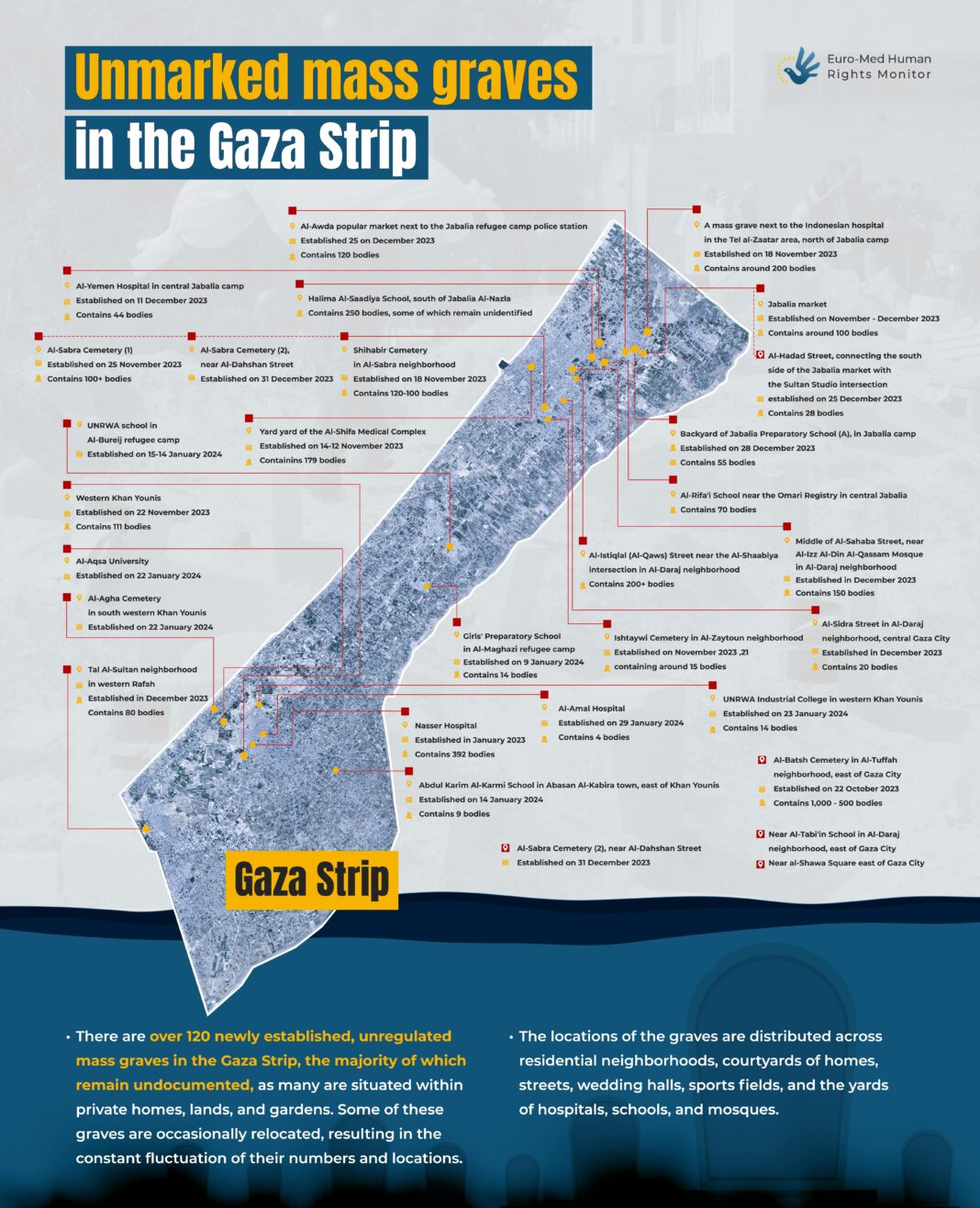
A September 2024 investigation by Euro Med Human Rights Monitor reported at least 120 improvised graves containing three or more bodies and mapped 29 of the most prominent sites, which it estimated held about 3,000 dead. Because investigators have not enjoyed unrestricted access and some graves have been moved or destroyed, these totals should be understood as field estimates rather than a completed forensic census.
The geography is nevertheless extraordinary. Gaza’s dead were placed in hospital courtyards, school grounds, markets, residential plots, road intersections, sports grounds and land beside mosques. Euro Med estimated that between 500 and 1,000 people were buried at Al Batsh in eastern Gaza City. It listed more than 250 bodies at Halima Al Sadia School, about 200 beside the Indonesian Hospital, approximately 179 in the Al Shifa Medical Complex courtyard, more than 200 near the Al Sha’biya intersection, about 111 in western Khan Yunis and around 80 in Tel al Sultan in Rafah.
These were not remote sites selected to hide an old crime. They were improvised cemeteries in the middle of surviving civilian life. Families used pieces of wood, cardboard, plastic containers and other household objects as grave markers because stone and cement were unavailable. Some buried the unidentified. Others later had to search again after fighting, bulldozing or repeated displacement disturbed the ground.
The graves at Nasser Medical Complex raise additional and more specific questions. After Israeli forces withdrew from Khan Yunis in April 2024, Palestinian Civil Defence teams recovered 392 bodies. The UN humanitarian office reported that only 165 had been identified by 25 April. The remaining 227 were difficult to identify because of decomposition, changed body markings, mutilation or the conditions in which they were buried. Civil defence officials reported three grave sites and sought forensic examination of bodies they believed might have been buried alive.
There were also reports that some of the dead at Nasser and Al Shifa were found stripped or with their hands tied. The UN human rights office said those claims required corroboration and called for an independent, effective and transparent investigation involving international experts. The presence of restraints, if established and linked to the manner of death, could be evidence of execution or the killing of detainees or other protected people. It cannot responsibly be converted into a final finding without forensic work.
Israel denied creating graves or executing the people buried there. It said Palestinians had buried the bodies before its operation and that Israeli forces had examined some remains while searching for hostages, then returned non Israeli bodies to the ground. Imagery and earlier reports confirm that hospital staff had established burial areas before the raids. That means the discovery of a body at Nasser does not by itself establish who killed that person, when the death occurred or whether the person died in combat, bombardment, detention or because medical care collapsed.
It does not settle the allegations either. Israeli troops admittedly opened and examined Palestinian graves. Hundreds of bodies remained unidentified. Some were reportedly bound. Hospitals had been placed under siege and raided, while patients and medical personnel were detained. The appropriate response was therefore preservation of the sites, unrestricted access for forensic investigators, identification of every body and an accounting for every death. The sites did not receive the immediate, comprehensive international forensic examination demanded by the UN and human rights organisations.
The BBC did report the discovery. Its April 2024 headline was “UN rights chief ‘horrified’ by mass grave reports at Gaza hospitals”. The report correctly explained that Palestinian officials had recovered hundreds of bodies, that the manner and time of death were unclear, that the UN was still seeking corroboration and that Israel denied the allegations.
That caution was journalistically defensible at the time. The contrast lies in what the caution does to the structure of the story. In Bosnia, the sentence begins with the perpetrators and ends at the graves. In Gaza, the headline begins with an international official’s reaction, places “mass graves” at one remove as reports and then proceeds through a contest of claims. The first grave becomes evidence of a criminal project. The second becomes a controversy about whether the available evidence is sufficient to describe what happened.
The legal stages are different, but equal journalism requires more than repeating uncertainty at the moment a grave is opened. It requires returning to the site, pursuing the investigation, preserving testimony, identifying the units that controlled it and asking why international forensic experts were not admitted. Caution must be a method for reaching the truth, not the point at which the story ends.
There is also the separate destruction of established cemeteries. A CNN investigation based upon satellite imagery, video and first hand observation documented damage or destruction at 16 burial grounds as Israeli forces advanced, while Euro Med recorded allegations of bulldozed graves, scattered remains and bodies removed from burial sites. Israel said some grave disturbances were connected to searches for hostage remains or military infrastructure. International humanitarian law requires parties to treat the dead respectfully and to respect, maintain and mark graves. Military necessity is not a general licence to erase burial grounds.
Gaza’s mass graves cannot yet be described with the same final forensic certainty as the execution and concealment sites of Srebrenica. They must be described with the same seriousness. They are repositories of evidence, records of families obliterated together and proof that the machinery of civilian burial collapsed under siege and bombardment. To treat them mainly as a disputed allegation while presenting Bosnia’s graves as history is to allow the passage of time, and the political identity of the accused, to determine whose dead receive moral clarity.
Even following the October 2025 ceasefire framework, Gaza remains devastated. In its humanitarian report published on 29 August 2026, the United Nations Office for the Coordination of Humanitarian Affairs said continuing Israeli military activity was still causing civilian casualties, displacement and damage to civilian and humanitarian infrastructure. It reported that 94 per cent of Gaza’s population required shelter assistance and that 58 per cent faced critical or catastrophic shelter needs.
The vocabulary available to describe this is not mysterious. Gaza was besieged. Its people were deprived of essentials. Its civilian infrastructure was destroyed on a vast scale. Its population was repeatedly displaced. The principal political and military decision makers are known.
Yet British reporting has repeatedly softened this chain of agency. Civilians are “caught in fighting”. Food “fails to enter”. Hospitals “cease functioning”. Families “find themselves displaced”. Buildings are “hit”. The identity of the power imposing the siege or dropping the bombs often arrives later in the report, sometimes accompanied immediately by an Israeli justification.
In the Mladić obituary, by contrast, verbs have owners.
From “monstrous crimes” to institutional process
The disparity can be seen in the BBC’s own headlines.
On the day Gallant announced his siege, the broadcaster reported: “Gaza ‘soon without fuel, medicine and food’ – Israel authorities”. The headline presented deprivation as an approaching condition and attributed the forecast to “Israel authorities”. It did not say that Israel’s defence minister had ordered a complete siege of a civilian population.
When the ICC issued its warrant, the BBC headline read: “ICC issues arrest warrants for Netanyahu, Gallant and Hamas commander”. The report conveyed the Court’s allegations, and the BBC also published analysis describing the warrants as a “major blow to Israel’s standing”.
None of those formulations is individually false. The BBC reported the warrant and later reported that Downing Street indicated Netanyahu could face arrest if he entered Britain. The problem is one of accumulated framing.
The Israeli story is commonly presented through institutions, diplomatic consequences and competing claims. The subject becomes the ICC’s controversial action, Israel’s damaged international reputation, Washington’s reaction or Britain’s legal dilemma. Gallant remains a former minister responding to allegations.
The Bosnian Serb story is presented through perpetrator, intention and victim. Mladić is not merely a former general affected by a tribunal decision. He is the man who oversaw the siege, issued the orders and pursued a violent nationalist objective.
The gulf is therefore larger than a difference between one adjective and another. It concerns who receives narrative agency.
The obituary that could have been about Gallant
If the BBC applied the architecture of its Mladić obituary to established facts and current judicial findings concerning Gallant, a legally careful opening might read like this:
Yoav Gallant became one of the principal political faces of Israel’s destruction of Gaza.
As defence minister, he helped oversee a campaign of siege, bombardment and mass displacement within a territory whose civilian population had no reliable route of escape.
On 9 October 2023, Gallant announced a complete siege. Gaza would receive no electricity, food, water or fuel. Declaring that Israel was fighting human animals, he said it would act accordingly.
The consequences were catastrophic. Families were driven from one district to another, hospitals were deprived of supplies, residential neighbourhoods were reduced to rubble and civilians were attacked in places to which they had been ordered to evacuate.
Mass graves appeared in hospital courtyards, schools, markets, residential land and beside roads. At Nasser Medical Complex alone, Palestinian teams recovered 392 bodies after Israeli forces withdrew, many of them unidentified, while the United Nations demanded an international investigation into the deaths and reports that some bodies had been found bound or stripped.
Israel said its objective was to destroy Hamas and recover the hostages taken on 7 October. International investigators concluded, however, that there were reasonable grounds to believe the methods employed included starvation as a weapon of war, murder, persecution and intentionally directed attacks on civilians.
The International Criminal Court issued a warrant for Gallant’s arrest in November 2024. Israel rejected the Court’s jurisdiction and denounced its decision, while powerful allies continued to provide diplomatic and military protection.
Every essential element in that passage is drawn from a public statement, an international judicial decision or extensively documented conditions in Gaza. It does not call Gallant a convicted criminal, because he is not one. It does not require the BBC to accept every allegation made against Israel. It simply places the official, his words, his authority and the human consequences within the same frame.
From allegation to historical certainty
The strongest defence of the BBC’s differing tone is the difference in legal stage. Mladić was convicted beyond reasonable doubt after a trial lasting more than four years. The Chamber sat for 530 trial days, heard 592 witnesses and considered nearly 10,000 exhibits. Gallant has an arrest warrant but has not entered a plea, heard the prosecution case or presented a defence before the ICC.
This matters. Responsible reporting must distinguish allegation from conviction.
It does not fully explain the contrast, however. Mladić was first indicted in 1995 and remained a fugitive for almost sixteen years. During that period, journalists did not need to pretend there was no evidence, no identifiable chain of command and no devastated civilian population merely because the final verdict had not yet arrived. A court had not pronounced guilt, but reporters could still describe what had happened and identify the official accused of ordering it.
Gallant’s position is also no longer based solely upon accusations from Palestinians or Israel’s political opponents. ICC judges have assessed evidence and issued an arrest warrant. In September 2025, the United Nations Independent International Commission of Inquiry concluded that Israel had committed genocide in Gaza. Its legal analysis also concluded that statements by Gallant, Netanyahu and Israeli President Isaac Herzog constituted incitement to genocide.
That Commission is not a criminal court, and the separate genocide case brought by South Africa against Israel at the International Court of Justice has not reached a final judgment. The ICC warrant against Gallant concerns alleged war crimes and crimes against humanity, not a genocide charge. These institutional differences are important, but none of them justifies treating the subject as an ordinary retired politician whose wartime record is merely controversial.
Israel rejects the ICC’s jurisdiction and denies that Gallant or Netanyahu committed the alleged crimes. It argues that its forces targeted Hamas, that the militant organisation operated within civilian areas and that the Court ignored Israel’s right to defend itself following 7 October. Hamas’s murder of civilians and taking of hostages must remain part of any honest account.
The same principle must apply in the opposite direction. The existence of Serb casualties and crimes committed by other forces did not make Mladić’s campaign lawful. The existence of Hamas crimes cannot render the siege and destruction of Gaza immune from description, investigation or prosecution.
National heroes and international fugitives
The BBC observed that Mladić remained a hero to Serbian nationalists who regarded him as a protector of their people. It described the fury with which supporters denounced the tribunal as an institution created to demonise Serbs.
Again, the Israeli parallel is difficult to miss.
Israel’s government dismissed the ICC warrants as illegitimate and antisemitic. Political figures presented the prosecution of Gallant and Netanyahu as an attack upon Israel itself rather than a proceeding against two named individuals. The United States rejected the warrants and imposed sanctions upon Court personnel, turning its enormous power against an institution it had supported when the accused were Russian, African or Balkan.
Gallant has not spent years moving between safe houses as Mladić did, and Israel is not Serbia after the Balkan wars. He remains inside a sovereign state that refuses the ICC’s jurisdiction and is protected by alliances far more powerful than anything available to the Bosnian Serb leadership.
That distinction may make accountability less likely, not less necessary.
The BBC’s Mladić article describes the pressure placed upon Serbia through its ambition to join the European Union. International politics eventually made continued protection of the fugitive too costly. In Israel’s case, the flow of arms, diplomatic support and political protection has frequently reduced the cost of defying international institutions.
One state was told that acceptance into the Western order required surrendering an accused war criminal. The other has often been told that it represents the Western order, even while its former defence minister remains wanted by the ICC.
Not Serbs and Israelis, but protected and unprotected power
The comparison must not become an indictment of entire peoples. Mladić commanded Bosnian Serb forces and was protected for years by Serbian institutions, but Serbs are not collectively responsible for his crimes. Gallant exercised authority within the Israeli government, but Israelis are not collectively responsible for the crimes alleged against him. In both societies, people resisted nationalist violence, challenged their governments and demanded accountability.
The double standard operates at the level of states, alliances and media assumptions.
Bosnian Serb leaders came to be portrayed as perpetrators belonging to a defeated and internationally isolated project. Israeli leaders are generally introduced as representatives of a democratic ally responding to terrorism. The first frame encourages reporters to examine ideology, intention and command responsibility. The second encourages them to foreground security claims, military complexity and the official response to every accusation.
Language follows power.
The moral clarity that arrives too late
There is value in the BBC’s unsparing account of Mladić. Future generations should understand what was done in Bosnia, who ordered it and how nationalist myths were used to make brutality appear necessary. The problem is that such moral clarity often arrives only when it can no longer protect the victims.
Atrocities are rarely introduced to the public under their final historical name. While they are taking place, they are described as complicated security operations, disputed casualty figures, unfortunate consequences, intelligence failures or excesses committed amid a legitimate war. Perpetrators speak of self defence, existential danger and the need to eliminate an enemy embedded among civilians. Friendly governments repeat those explanations. News organisations present the resulting contest of claims as neutrality.
Years later, after mass graves have been opened, archives examined and political alliances rearranged, the same institutions discover active verbs and moral judgment.
That is the unsettling significance of the BBC’s Mladić obituary. Its account of siege, displacement, dehumanisation, international failure, domestic hero worship and eventual proceedings in The Hague could already be adapted to Gallant with remarkably few structural changes.
The names, places and methods differ. The legal proceedings remain at different stages. The central journalistic question is the same.
If the BBC can recognise the language of atrocity in Bosnia after the killing is over, why does it struggle to use equally direct language about Gaza while survivors are still living among the ruins?
The danger is not simply that history will judge Gallant differently from the way British broadcasters describe him today. It is that, one day, the BBC may publish another morally certain obituary and quietly omit the part played by years of cautious, passive and deferential reporting when moral clarity might still have mattered.
Principal sources
The BBC, “The monstrous crimes of Ratko Mladic, the ‘Butcher of Bosnia’”, 27 August 2026.
International Residual Mechanism for Criminal Tribunals, “Statement on the passing of Ratko Mladić”, 27 August 2026.
International Criminal Tribunal for the former Yugoslavia, “ICTY convicts Ratko Mladić for genocide, war crimes and crimes against humanity”, 22 November 2017.
International Criminal Court, warrants for Benjamin Netanyahu and Yoav Gallant, 21 November 2024.
United Nations Independent International Commission of Inquiry, legal findings concerning genocide in Gaza, 16 September 2025.
United Nations Office for the Coordination of Humanitarian Affairs, Humanitarian Situation Report, 29 August 2026.
B’Tselem, statistics on Palestinians in Israeli custody, updated 29 March 2026.
Amnesty International, “Horrifying cases of torture and degrading treatment of Palestinian detainees amid spike in arbitrary arrests”, 8 November 2023.
United Nations special procedures experts, communication to the Government of Israel concerning Palestinian detainees, 18 March 2026.
United Nations Secretary General, report on conflict related sexual violence, published 29 May 2026.
Physicians for Human Rights Israel, “Torture of Medical Staff from Gaza in Israel”, 26 February 2025.
International Criminal Tribunal for the former Yugoslavia, Prosecutor v Radislav Krstić judgment and forensic findings concerning the Srebrenica mass graves, 2 August 2001.
The BBC, “UN rights chief ‘horrified’ by mass grave reports at Gaza hospitals”, 24 April 2024.
United Nations Office for the Coordination of Humanitarian Affairs, Flash Update 158 concerning the Nasser Medical Complex graves, 26 April 2024.
Euro Med Human Rights Monitor, mapping of prominent mass graves in Gaza, 18 September 2024.
CNN, satellite and video investigation into damage to 16 Gaza cemeteries, 20 January 2024.
International Committee of the Red Cross, legal fact sheet on respecting, maintaining and marking graves, 7 November 2025.