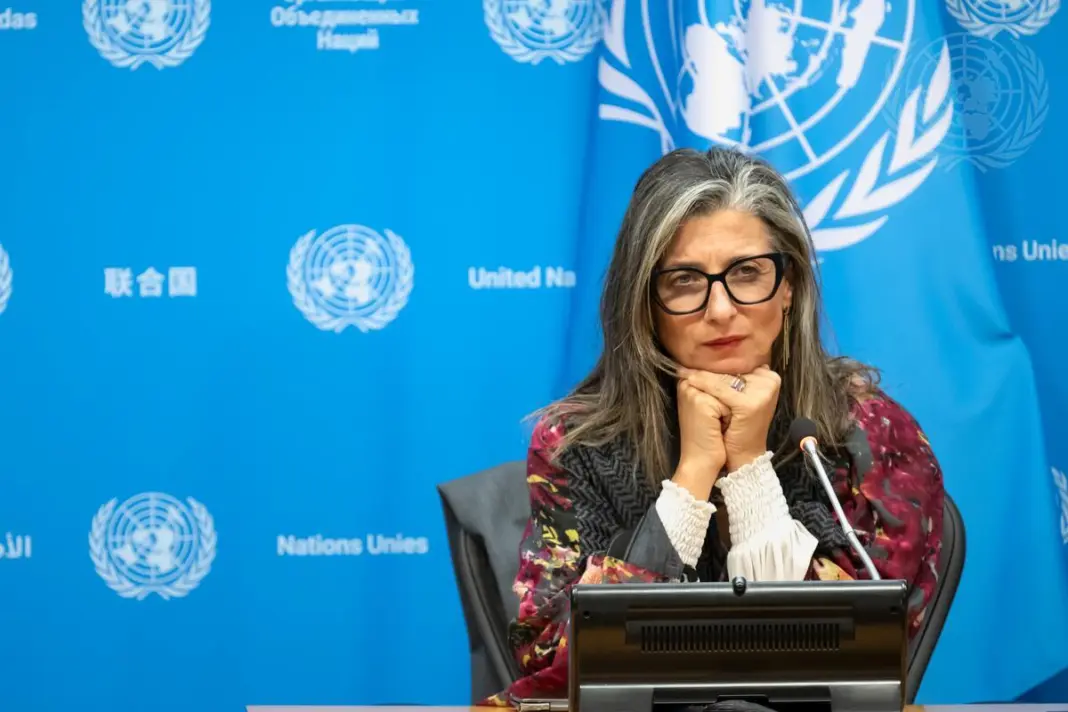

Francesca Albanese, the United Nations special rapporteur on human rights in the occupied Palestinian territories, says her life has become “a rollercoaster” of death threats, financial restrictions, and political backlash following her public assertion that Israel’s war in Gaza constitutes genocide.
In an interview with The Guardian this week, Albanese described the personal and professional consequences of her March 2024 report, Anatomy of a Genocide, which marked the first time a UN official formally used the term in relation to Israel’s military campaign in Gaza.
Since then, she has faced sanctions from the administration of Donald Trump, including designation as a “specially designated national” — a label typically reserved for terrorists and criminal organizations. The designation effectively cut her off from global financial systems, froze assets, and led to the seizure of her apartment in Washington, she said.
“It puts you together with mass murderers and drug dealers,” Albanese told the newspaper, adding that she was sanctioned “without trial” and denied any opportunity to defend herself.
Escalating Risks and Threats
Albanese also revealed that she and her family have received serious threats, including explicit warnings involving her children. One anonymous caller reportedly referenced her daughter’s school, prompting her to seek police protection.
Her husband, Massimiliano Calì, was also targeted in what she described as a coordinated campaign by pro-Israel activists, which she claims contributed to his removal from a senior role at the World Bank.
Despite the pressure, Albanese has continued her work, stating that she feels compelled to act. “There is a lot that I’m putting on the line… but I don’t have any alternative,” she said.
Global Backlash and Political Isolation
Albanese’s stance has drawn sharp criticism from Western governments. She said authorities in Germany attempted to block her from speaking engagements and even threatened arrest over remarks comparing historical genocides.
She also criticized political leaders including Keir Starmer, Emmanuel Macron, and Giorgia Meloni, accusing them of complicity or hostility toward her work.
Her June 2025 report, From Economy of Occupation to Economy of Genocide, expanded her critique to include multinational corporations allegedly linked to Israel’s occupation infrastructure.
Rising Profile Amid Gaza War
The controversy has also elevated Albanese’s global profile. She has drawn large crowds at public events and gained support from pro-Palestinian activists and segments of the political left, amid growing international scrutiny of the Gaza war.
She argues that the scale of public reaction reflects a shift in global awareness, particularly due to Western involvement in the conflict. “This is a test for universality of rights and for humanity,” she said.
According to the interview, the Gaza conflict — triggered by the October 7, 2023 Hamas attack that killed approximately 1,200 people — has resulted in more than 75,000 Palestinian deaths and widespread destruction across the territory.
Defiance Despite Pressure
While some critics argue Albanese’s outspoken rhetoric undermines her role as a neutral legal expert, she rejects the notion that human rights advocacy can be apolitical.
“Everything that is being done is political,” she said. “Why can’t I express a political view?”
Despite the personal toll, Albanese signaled she will continue her work through the remainder of her UN mandate. Addressing students in Geneva, she framed the current moment as one of global transformation.
“My freedom is stronger than my fear,” she said. “You are defeated the moment you stop fighting.”