
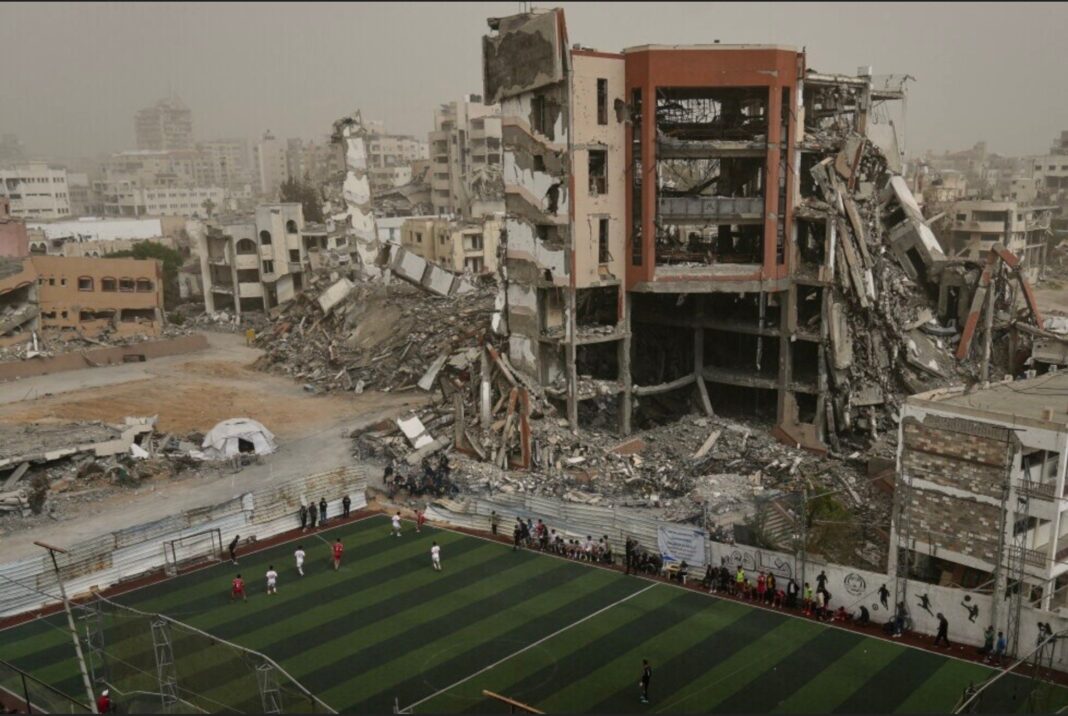

An Associated Press image showed Palestinian footballers reclaiming a fragment of ordinary life amid Gaza’s ruins. After a pro-Israel campaigner branded it Hamas propaganda, organisers of the Deauville Sport Images Festival replaced it with a photograph of cyclists.
A photograph of Palestinian footballers playing on a makeshift pitch surrounded by the ruins of Gaza has been removed from a major sports photography exhibition in France following complaints from pro-Israel campaigners.
The image, taken by Palestinian Associated Press photojournalist Jehad Alshrafi, had been displayed on the port esplanade as part of the second Deauville Sport Images Festival in Normandy.
It showed players from Gaza Sports Club and Al-Ahly Club competing on a newly constructed football field surrounded by buildings destroyed during Israeli ground and air operations.
There were no weapons, political banners or armed combatants in the photograph. It did not depict Hamas or the events of 7 October 2023. Its subjects were Palestinian footballers attempting to revive their sport in a landscape devastated by war.
Nevertheless, after the picture was denounced online as pro-Hamas propaganda, it disappeared from the exhibition. In its place appeared an image of cyclists.
The municipality of Deauville has admitted that the photograph was replaced after it received requests for its removal, but has refused to identify who made those requests.
The episode has raised questions about political censorship, the erasure of Palestinian experiences from European cultural spaces and the readiness of publicly supported institutions to abandon their editorial decisions when confronted by organised pressure.
Football amid the ruins
Alshrafi took the photograph on 14 February 2026, during a match between two local Palestinian teams on a newly constructed field in northern Gaza.
The football ground had been created after the Palestinian Football Federation cleared rubble, laid worn artificial turf and erected fencing beside the remains of destroyed buildings.
Only three days before the photographed match, Palestinian amputee footballers had trained on the same improvised field as children watched from beside the pitch.
Gaza’s principal football stadium had been levelled during the war and converted into a tent camp for displaced families. With much of the territory’s sporting infrastructure destroyed, the improvised ground represented far more than a replacement playing surface.
It was a place where Palestinians could gather, compete and briefly recover some sense of communal life.
The Associated Press photo essay described football’s return as part of a broader effort by Palestinians to reclaim fragments of ordinary existence amid widespread destruction and a fragile ceasefire.
Alshrafi’s wide composition captured that contrast. The footballers appear comparatively small within the frame, surrounded by shattered apartment blocks and the physical evidence of Israel’s military campaign.
The ruins are not incidental background. They are central to the meaning of the photograph.
Yet the image is not simply a record of destruction. It documents survival, determination and the refusal of a population to surrender every element of ordinary life.
That combination made it an obvious choice for a festival that claimed to examine sport through social, cultural, historical and artistic perspectives.
A festival devoted to the human meaning of sport
The Deauville Sport Images Festival opened on 6 June and is scheduled to run until 6 September 2026.
Organised by the municipality, the festival transformed the Normandy resort into an open-air photography exhibition featuring nearly 300 pictures from more than 100 international photographers.
Its programme was divided into four broad themes: current events, society, artistic photography and the history of sport.
According to festival information published by Agence France-Presse, the exhibition was intended to present sport not only as competition, but as a source of human stories and a reflection of wider social developments.
Agnès Vergez, the festival’s artistic director, described its selection as a subjective but shared choice offering different perspectives on sport.
Alshrafi’s photograph appeared to embody precisely those stated ambitions. It connected football with war, displacement, disability and the Palestinian struggle to preserve community life.
Its subsequent removal therefore exposed a contradiction at the centre of the festival. Organisers had invited visitors to consider the social meaning of sport, but withdrew a powerful social image after its political implications became uncomfortable.
The campaign against the photograph
The public campaign can be traced at least partly to Mike Krief, who operates an Instagram account devoted to security news from Israel and current events in France.
On 11 August, Krief published a photograph of the Gaza image as it appeared in Deauville and tagged the city’s official account. He characterised the exhibit as propaganda and suggested that displaying a photograph from Gaza amounted to supporting Hamas.
The accusation was unsupported by anything visible in Alshrafi’s photograph.
No person depicted in the image was identified as a Hamas member. The Associated Press caption described a football match between two local clubs on a field surrounded by buildings destroyed in Israeli operations.
By equating the depiction of Palestinian civilian life with support for Hamas, the complaint effectively treated the visibility of Palestinians themselves as a political provocation.
By the evening of Thursday, 20 August, the photograph had vanished.
Its disappearance was noticed by Sylvain Larcher, secretary of the local Socialist Party section and a member of the Gauche Côte Fleurie association.
Larcher challenged the festival to explain its decision, arguing that the photograph communicated something much deeper than a football match. It showed people continuing to play, gather and preserve hope while everything around them had been destroyed.
“The photograph does not simply show a football match,” he told the local newspaper Le Pays d’Auge.
After the picture was replaced, Krief publicly celebrated the result.
“As promised, friends, the Deauville photo has indeed been changed,” he wrote, explaining that it had been replaced by a picture of cyclists. He concluded: “Never give up.”
The sequence provides strong evidence that pro-Israel campaigning contributed to the decision. A campaigner publicly demanded action, the municipality subsequently removed the photograph and the same campaigner then claimed victory.
However, there is currently no public evidence that the Israeli government or Israeli Embassy directly intervened. The most accurate description is therefore that the festival acted following pro-Israel pressure, rather than confirmed pressure from the Israeli state.
Municipality refuses to identify complainants
Contacted by Le Pays d’Auge, the festival’s organisers confirmed through the municipality that the photograph had been replaced following requests.
The city did not reveal the identity of those responsible.
“We do not want to enter into controversy or offend anyone,” the municipality said.
According to subsequent reporting by Le Média, the municipality acknowledged that the photograph was “in no way pro-Hamas,” but argued that it was creating “new pain” and that removing it would bring the controversy to an end.
That explanation has intensified criticism of the decision.
If the photograph was not pro-Hamas, the question remains why an accusation that the city itself did not accept was allowed to determine the festival’s editorial policy.
The desire not to “offend anyone” also appears to have been applied selectively. Removing the image inevitably offended the photographer, the Palestinian community and visitors who believed that documentary photography should not be subordinated to political pressure.
The municipality has not explained why the discomfort of people objecting to an image from Gaza was given greater weight than the professional integrity of the Palestinian journalist who created it.
It has also not explained whether Alshrafi or the Associated Press was consulted before the replacement.
Political condemnation
The removal has prompted condemnation from local campaigners and French political representatives.
Emma Fourreau, a French member of the European Parliament representing La France Insoumise, described the decision as disgraceful and demanded an explanation from both the festival and the municipality.
She argued that the incident represented the continued invisibility of Palestinians, extending even into cultural and artistic spaces.
Larcher similarly warned that cultural institutions should not allow their programmes to be determined by pressure campaigns.
“La culture ne doit pas être soumise aux pressions,” or “Culture must not be subject to pressure,” became one of the central responses to the controversy.
The principle reaches beyond the politics of Gaza. Photography festivals are expected to defend the independence of photographers and curators, particularly when their work documents war, displacement or abuses of power.
If images can be removed merely because an organised group labels them propaganda, documentary festivals risk becoming exhibitions of only those realities that powerful audiences find comfortable.
When Palestinian existence is treated as propaganda
The Deauville controversy illustrates a recurring feature of public debate surrounding Gaza: images showing Palestinian suffering or survival are frequently treated as political statements in a way that images of other civilian populations are not.
Alshrafi’s photograph does not instruct the viewer what to think. It records what was present before his camera: footballers, artificial turf, spectators and destroyed buildings.
The political significance comes from the reality depicted, not from any slogan imposed by the photographer.
The photograph becomes uncomfortable because it places two facts within the same frame. Palestinians are attempting to continue living, while the urban environment around them has been destroyed.
Removing the picture does not alter either fact. It merely prevents festival visitors from seeing them together.
The replacement image of cyclists may be an entirely valid piece of sports photography, but its use in this context carries an unavoidable symbolic meaning. A photograph that connected sport with the consequences of war was exchanged for one less likely to generate political complaints.
The result was not neutrality. It was an editorial decision made in response to pressure.
The photograph they tried to remove
Alshrafi’s image has now travelled far beyond the port esplanade in Deauville.
The attempt to suppress it has brought renewed attention to his wider photographic record of football’s return to Gaza, including images of amputee players training and children watching from beside the improvised pitch.
What festival visitors were prevented from seeing can still be viewed through the Associated Press and across international media.
The controversy has also left the Deauville Sport Images Festival facing questions more consequential than the complaint it apparently hoped to silence.
Who demanded the removal? How many complaints were received? Was the photographer consulted? Who made the final decision? Why was an image the city accepted was not pro-Hamas nevertheless removed following an accusation that it was Hamas propaganda?
Until the municipality answers those questions, the replacement of Alshrafi’s photograph will remain difficult to describe as anything other than an act of political censorship.
The image recorded Palestinians playing football amid the wreckage of their city. Its removal recorded something else: the extent to which even the peaceful visibility of Palestinian life can be treated as intolerable.