
A Westminster Hall debate was meant to examine whether Britain’s democracy is being lobbied by a foreign state. Dominated instead by MPs with their own ties to that state’s lobby, conducted under the charge of antisemitism, and convened over the strenuous objections of a community body the debate’s own opener had privately met, it became a study in how the question gets silenced – even as a United Nations inquiry ruled the targeting of Gaza’s children deliberate, even as the British public it claimed to speak for reached the opposite verdict, and even as Washington, of all places, began to say the unsayable.
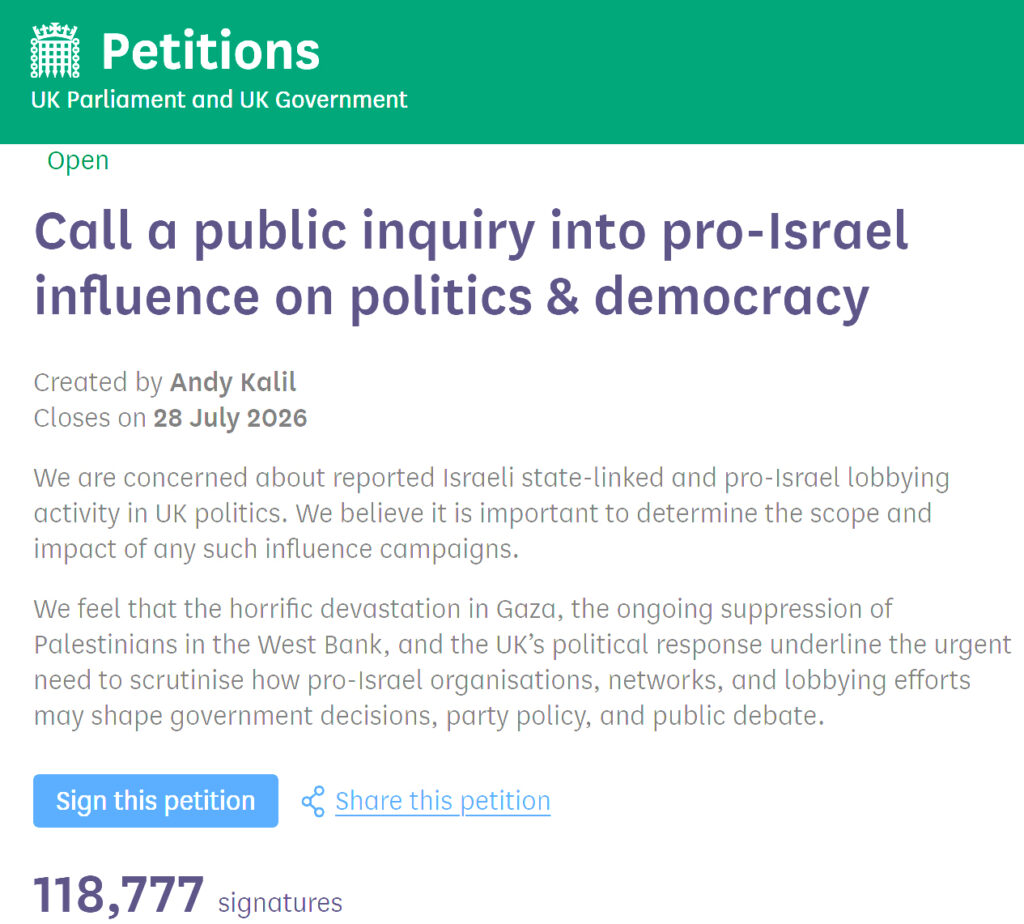
On the evening of Monday 22 June – the same day their Prime Minister had stood outside Downing Street and announced that he would step down – a relatively small number of MPs gathered in the cramped horseshoe of Westminster Hall, rather than the main Chamber, to debate whether Britain should hold a public inquiry into pro-Israel influence on its politics and democracy. They were there because they had no choice. E-petition 752646, started in late January by a member of the public named Andy Kalil, had gathered more than 118,000 signatures, comfortably past the 100,000 threshold that obliges Parliament to schedule a debate. The session was, in the Chair’s own description, heavily oversubscribed; many more members had asked to speak than the ninety minutes could hold. Petition debates do not end in a vote and cannot compel a government to act; their function is to put a question on the record and force a minister to answer it. The question here was narrow and, on its face, procedural: how do pro-Israel organisations, networks and lobbying efforts shape government decisions, party policy and public debate, and should the scope of that influence be formally examined?
What followed was not really an argument about lobbying. It was an argument about whether the question could be asked at all. And the people who rose, one after another, to insist that it could not – that to ask it was to traffic in an ancient and murderous conspiracy theory – were, to a striking degree, the very MPs whose own funded trips, declared memberships and lobby affiliations the petition was implicitly asking about. The debate did not refute the petitioners’ premise. It performed it.
A petition that met the standard
The debate did not arrive in Westminster Hall by accident, and the fight over whether it should happen at all began months before any member rose to speak. Kalil’s petition, as the House of Commons Library’s own briefing for members set out four days before the debate, had cleared the formal bar in the ordinary way. Petitions to Parliament are checked against a published set of standards, and one of the grounds on which a petition can be rejected is that it is, in the Committee’s words, ‘defamatory or libellous, or contains false or unproven statements’. That is the precise ground on which the petition’s most prominent opponents argued it should have been struck out. The body responsible for applying the standard judged that it was not met.
That judgement was tested, repeatedly, by the Jewish Leadership Council, the charity that represents a wide range of British Jewish organisations. On 11 February the Council wrote to the Petitions Committee asking that the petition be rejected as defamatory, false or unproven, and drawn from conspiratorial tropes widely recognised as antisemitic. On 3 March the Chair of the Committee replied, declining. The Committee, the Chair explained, makes no assessment of the merits of what a petition asks for; it rejects petitions only where there is an unequivocal breach of the standards, and once a petition has been published it does not accept requests to remove it. Then came the detail that ought to settle, on the documentary record, the charge that would dominate the debate. Before e-petition 752646 was opened, the Chair noted, petitions calling for public inquiries had already been opened relating to Russia and to China. The Israel petition had been judged against the identical test and the same recent precedent, and had passed it on the same terms.
This is worth pausing on, because it answers in advance the objection that several MPs would treat as self-evidently damning: that out of all the world’s states, it was uniquely Israel that someone had thought to interrogate. It was not. Petitions seeking inquiries into Russian and Chinese influence had passed the same scrutiny and been scheduled for debate without anyone suggesting they were vehicles for prejudice, without a campaign to have them withdrawn, and without the question of whether they should exist becoming the substance of the debate itself. The singling out, such as it was, ran in the opposite direction to the one alleged. Only in this instance was the act of petitioning treated as inherently suspect.
The Council wrote again on 1 June, and its letter registered, fairly, that the context had darkened. Following an antisemitic terror attack in Golders Green that had left two Jewish men in hospital, and amid a spate of arson attacks against the Jewish community, the Prime Minister had hosted a summit in Downing Street, and in the King’s Speech the Crown had reiterated the government’s commitment to ‘take urgent action to tackle antisemitism’. Against that backdrop, the Council argued, the petition supplied no credible evidence for the influence campaigns it alleged, invited suspicion of covert or improper activity by unnamed organisations, and the Committee’s decision to schedule a debate on it was, in the Council’s word, irresponsible. The fear behind that letter was not invented, and the violence it described was real.
The Committee Chair’s reply, on 16 June, acknowledged as much, calling the escalating violence towards Jewish communities alarming and defending the e-petitioning system as a mechanism through which the public can hold the government to account and through which, the Chair added, Jewish people can have their voices heard. The merits of a petition, the letter repeated, are not assessed either when it is checked against the standards or when it is chosen for debate. And then the closing detail, offered by the Chair as reassurance, which reads rather differently once the debate it anticipated had taken place: John Lamont, who would open the debate on behalf of the Petitions Committee, had already met the Jewish Leadership Council to discuss its concerns, and the Chair trusted that he would give voice to those concerns in the Hall.
He did. The MP charged with opening a procedurally neutral debate on behalf of the Committee – the member who would set its tone before any other had spoken – had met privately with the organisation that had spent four months campaigning to have the petition suppressed, and was expected, with the Chair’s blessing, to carry its objections into the room. His opening speech duly recast the petition as the latest descendant of the oldest antisemitic libel, and the debate never recovered the question it had been convened to ask.
‘The world’s only Jewish state’
The framing was therefore set before the substance could be reached. Even before Lamont began, Sir Andrew Mitchell, the Sutton Coldfield MP and a Foreign Office minister in the last Conservative government, rose on a point of order to ask whether he was alone in feeling ‘distinctly uneasy’ about the debate. Why, he asked, is Israel singled out in this way, and not the Gulf states, Iran, eastern Europe or the United States? He did not trust the motivation of the petition’s organisers, he said, and feared the whole thing smacked of an antisemitic conspiracy theory. Mitchell had visited Israel in May 2025 on a trip funded by Conservative Friends of Israel. The Chair noted that the scheduling of petitions was a matter for the Committee, and reminded members of the parliamentary requirement of good temper and moderation. Lamont then rose, referred members to his own entry in the Register of Members’ Financial Interests, and said he had ‘a great degree of sympathy’ with Mitchell’s remarks.
What followed was a sustained argument that the petition was not a request for transparency but a coded revival of the libel of secret Jewish power. The petition, Lamont said, did not call for a general review of lobbying; it singled out one country and invoked the centuries-old allegation that those who support that country exercise hidden or improper control over democratic institutions. He traced the lineage from the forged Protocols of the Elders of Zion through to the present, where, he argued, the same charge is now made not against Jews explicitly but against ‘Zionists, the lobby, hidden influence networks or pro-Israel control’. He described being handed, outside Parliament, mock banknotes marked ‘Bank of Zionism’ – an insinuation, he said, of Jewish control of British politics and economy that was ‘unmistakably racist’, and the kind of rhetoric from which he believed the petition stemmed. Holding Israel to standards applied to no other country, he added, was itself a breach of the International Holocaust Remembrance Alliance’s working definition of antisemitism, as the former post-Holocaust envoy Lord Pickles had warned, and this Parliament, he said in a striking phrase, had ‘played a dangerous role in the explosion of antisemitism in this country’.
He brought a statistic to support the central contention that there is no lobby silencing criticism of Israel, but rather the opposite. In the year after the 7 October 2023 attacks, he told the Hall, MPs made 4,369 contributions in the Chamber relating to Israel – more than double the 1,895 mentions of the National Health Service, against 1,449 for Russia’s invasion of Ukraine and a ‘paltry’ 225 for the war in Sudan. Anyone who claimed the existence of a lobby seeking to silence dissent, he concluded, was ‘nothing less than delusional’; if anything, Israel was the country uniquely singled out. It is a genuine figure and a genuine point, and it deserves to be met honestly rather than waved away. But it cuts two ways. That Israel saturates the business of the British Parliament more completely than the health of the British people is not, by itself, evidence that the saturation runs towards scrutiny. The debate itself was the proof: hour upon hour of parliamentary attention to Israel, the overwhelming majority of it spent not examining the state’s conduct or the lobbying around it but defending both, and converting the attempt to examine them into a charge of racism. Volume is not the same as scrutiny. A subject can dominate a parliament and still have one question about it rendered unspeakable.
The chorus that followed Lamont was, with a handful of exceptions, of one voice. Sammy Wilson, of the Democratic Unionist Party, called the motion ‘yet another angle of the antisemitism that we are experiencing in this country, especially driven by the left’, and reasoned that if a secret Jewish lobby existed it was ‘not being very successful’, since Israel was the most scrutinised country in Parliament. Richard Tice, for Reform, declared the motion ‘antisemitic in its very motivation and at its core’ and proposed that the House instead celebrate Israeli scientists, entrepreneurs and artificial-intelligence researchers. Jim Shannon, also of the DUP, declared his interest ‘as a friend of Israel’ and described it as ‘a lone beacon of democracy’, the real threat to British democracy coming, in his view, not from those advocating for an ally but from antisemitism on campuses and streets. Lisa Smart, for the Liberal Democrats, robustly rejected the ‘dangerous antisemitic trope that British Jewish people are somehow puppets for a foreign state’, while arguing that the genuine disease was structural – money, opacity and foreign influence allowed to creep into British politics over years, with the last Conservative government ‘relaxed about Russian money’. ‘Seven Prime Ministers in a decade’, she observed drily, ‘might suggest that it is more than just the wrong people getting the keys to No. 10.’
The most affecting contributions came from those for whom the subject was not abstract. Gareth Snell, the Stoke-on-Trent Central MP, told the Hall that his wife is Jewish – ‘a British Jew, a British citizen’ who had herself been an MP. To fund her election campaign she had taken a donation from a fellow British citizen who happened to be Jewish, and for that her name had appeared on a list, propagated by the Green Party’s deputy leader and circulating still, of politicians said to be ‘bought and sold for Israel’. The list, Snell said, swept up Cabinet members, shadow Cabinet members and peers, ‘British citizens being funded by British citizens’, the only common thread being that the donors were Jewish. The effect, he argued, was to make every Jewish person in public life answerable for a country far away, and to make others wary of them: ‘That stops Jewish people wanting to participate in any form of public life.’ He had been in a Manchester synagogue, he said, on the day the Heaton Park synagogue was attacked, and had seen British citizens who were simply frightened. Peter Prinsley, the member for Bury St Edmunds and Stowmarket and, he noted, perhaps the only Jewish MP in the Chamber that afternoon, declared his membership of Labour Friends of Israel and the Board of Deputies and spoke of a history that long predates the present: the slaughter of fifty-seven Jews in his own constituency town in 1190, the expulsion of all England’s Jews in 1290, the Weimar antisemites’ jibe that the republic had become ‘Jewified’, the Nazi propaganda of 1941 depicting Jews manipulating London, Washington and Moscow. The petition’s title, he said, belonged to that lineage. ‘Hon. Members should try being a law-abiding Jew in a British town centre on a Saturday afternoon.’
These are not arguments to be dismissed, and a serious account of the day cannot pretend otherwise. The violence is real; the fear is real; and the danger Snell and Prinsley described – that the legitimate scrutiny of donations can curdle into a suspicion attached to Jewish people as such – is a real danger, not a rhetorical one. A crude list that brands every recipient of a Jewish donor’s money as ‘bought and sold for Israel’ is exactly the essentialising the IHRA definition was written to name, and it is both wrong and corrosive. The difficulty is that this genuine concern was made to do work it cannot bear: to stand in for the entirely different question the petition had actually asked. For there is a distinction, and the whole debate turned on the refusal to hold it, between suspecting Jewish people of disloyalty because they are Jewish, which is racism, and asking what a documented apparatus of lobbying, donation and embassy activity actually does inside British politics, which is the ordinary business of a democracy. The first is the Protocols. The second is journalism, and a public inquiry would be its parliamentary equivalent. By collapsing the two, the debate’s dominant voices were able to answer a question nobody had asked and leave the real one untouched.
A state, not a people
That distinction was not lost on everyone in the room. ‘This is not about the Jewish community,’ said Ayoub Khan, the independent member for Birmingham Perry Barr, opening his remarks; ‘it is about the state of Israel. We must be careful in our words and ensure that we do not conflate the two.’ Shockat Adam, the independent member for Leicester South, put it more pointedly still: conflating a people’s religion with a government’s actions was unacceptable, and criticising the state of Israel was no more antisemitic than criticising the bombing of Iraq or Afghanistan was Islamophobic. The petition, on its face, did exactly what these members insisted it did – it named a state and an apparatus, not a faith – and the persistent recasting of it as an attack on Jews was, as the Blackburn independent Adnan Hussain told the minister directly, a conflation the petitioners had never made.
The minister could decline Hussain’s question. The country has not. Whatever James Frith felt able to say at the despatch box, the proposition he would not engage – that Israel stands accused of genocide in Gaza – is no longer a fringe contention in Britain. It is close to the settled view of the British public, and the distance between that public and the politicians who claim to speak for it has widened into a chasm.
The numbers are not ambiguous. By the autumn of 2025, YouGov found that just 12 per cent of Britons sympathised more with Israel than with the Palestinians, the lowest figure it had recorded since October 2023, while 57 per cent had come to regard Israel’s assault on Gaza as unjustified, the highest. An Ipsos survey the same month found a majority – 53 per cent – saying Israel’s actions had gone too far, and fewer than one in five that Britain should take its side. Among those who oppose the war, polling for the Council for Arab-British Understanding found that 81 per cent believe what is being done in Gaza amounts to genocide. Majority after majority, across two years and across the political divide, has supported halting British arms sales to Israel; majorities have wanted an immediate ceasefire; and barely a sixth of the public has ever approved of the way its own government has handled any of it. This is not the opinion of a faction. It is the settled view of the country, held with a steadiness that has survived every attempt to wish it away.
And it has hardened for a reason that has nothing whatever to do with Jewish people and everything to do with what a state has done to children. Four days before the Westminster Hall debate, on 18 June, the United Nations commission of inquiry published an eighty-nine-page report concluding that Israel had committed genocide, crimes against humanity and war crimes by deliberately targeting the children of Gaza. It took its title from a doctor’s words in the ruins of a hospital – the essence of childhood has been destroyed. It recorded at least twenty thousand Palestinian children killed and more than forty thousand injured in two years, over five thousand of the dead under the age of five, with thousands more believed to lie uncounted beneath the rubble. It set down accounts of children arriving at hospitals shot with a single round to the head or the chest; of drones with thermal cameras, able to distinguish a child’s outline from an adult’s, turned upon the young; of soldiers who described the killing as a video game. The commission found that the harm done to children was not incidental but intended, a means of destroying a people’s capacity to continue. So careful was it of the dead that it declined to name them, lest their surviving families be punished for appearing in its pages.
The gulf between that report and the temper of the debate was captured in a single exchange. When Tice rose to celebrate Israeli technology and called for more partnerships with its artificial-intelligence specialists, Iqbal Mohamed intervened to ask whether the House needed more of the kind of AI weaponry that had been used, he said, to target Gaza’s children in their bodies. Tice did not engage the substance. The best way to guarantee peace, he replied, was to prepare for war so that one’s opponents would offer respect. One member had named an atrocity against children; the other had answered with a maxim about military strength. That, in miniature, was the moral distance the debate could not cross.
That distance is the thing the British public has been watching, on its screens, for two years, and that is the thing it has rendered its verdict upon. Its revulsion is not a prejudice. It is the most ordinary moral reflex a society can have: that the mass killing of children is wrong, that a government which arms and shields those doing the killing is complicit, and that the proper response of a citizen is to demand that it stop. To call that sentiment antisemitism is not merely inaccurate. It is an inversion so complete that it recasts a people’s conscience as a symptom of bigotry, and it insults the very Jewish people in whose name it is so often invoked – the overwhelming majority of whom are no more the authors of Israeli policy than anyone else watching the same footage in the same horror.
Which is what makes the campaign to suppress this debate so much graver than a procedural skirmish. The petition the Jewish Leadership Council wrote three times to have struck down said nothing about Jews; it asked a question about lobbying, and the Petitions Committee, whose job is precisely to make that judgement, found that it crossed no line and rested on the same footing as the petitions already opened on Russia and China. To press, against that finding, that the debate was defamatory and irresponsible and should not be held at all was to ask Parliament to treat scrutiny of a foreign state’s conduct as a form of racism – and to do so at the very moment a United Nations commission was concluding that the conduct in question amounted to the deliberate killing of children. The charge of antisemitism is among the gravest a society can level, and it is grave because antisemitism is real and is hurting people in Britain now. That is exactly why it must not be spent as a shield for a government accused of genocide. Each time it is used to close down a legitimate argument, it is worth a little less the next time it is needed against the genuine article. Those who reach for it to end debates like this one are not protecting Jewish people. They are devaluing the most important word Jewish people have.
The questions that went unanswered
Back in Westminster Hall, the case the petition’s critics refused to engage was being made, in detail, by a handful of independents – and it was, throughout, a case about a documented apparatus rather than a hidden hand. Iqbal Mohamed, the member for Dewsbury and Batley, opened by condemning antisemitism in all its forms and making clear that his remarks concerned the Israeli government and its organisations’ dealings with parliamentarians, not Jewish people. He then set out the figures. In June 2024, he reminded the Hall, Declassified UK had revealed that thirteen of the then twenty-five members of the Labour Cabinet had received hundreds of thousands of pounds in donations from pro-Israel donors, and that some 180 of Britain’s 650 MPs – one in four – had accepted such funding over their careers. The 255 of his own constituents who had signed the petition, and the 118,000 across the country, he said, were entitled to ask what that money was for.
He was challenged at once. Gareth Snell pressed him to define a ‘pro-Israel donor’. Mohamed’s answer was precise, and it is the answer the rest of the debate spent its energy ignoring: donors, he said, ‘who turn a blind eye to blatant violations of Israeli law, British law or international law’ – not, as a later intervention would accuse him of meaning, Jewish people as such. When the shadow minister Mike Wood later charged him with breaching the IHRA definition by holding British Jews responsible for Israel’s conduct, Mohamed rose on a point of order to repeat the distinction: his remarks referred to pro-Israeli donors, whoever they happened to be, and specifically to those who supported Israel’s illegal actions. The clarification was on the record twice over. It changed nothing about how his argument was characterised.
The evidence the independents brought was specific, sourced and, for the most part, already in the public domain. Tahir Ali, the Labour member for Birmingham Hall Green and Moseley, anchored the case in history that Westminster has chosen to forget. In 2017, he reminded the Hall, an Israeli embassy official named Shai Masot had been recorded by an undercover journalist expressing his wish to ‘take down’ British politicians who criticised Israel – among them the Conservative minister Alan Duncan, targeted for his criticism of illegal settlement expansion. The ambassador had apologised; the official had gone home; the matter had been allowed to lapse. Ali added a fresher example of the entanglement: in January 2025, Lord Austin had been reappointed as the UK trade envoy to Israel, and officials had urged ministers to allow him a visit in May – even as the Foreign Secretary was announcing that Britain would suspend free-trade talks with Israel over its blockade of Gaza and its attacks on hospitals. Pro-Israel lobby groups, Ali said, had paid hundreds of thousands of pounds in political donations, and the evidence he could have cited, had time allowed, was ‘countless’.
Ayoub Khan widened the indictment. For two years, he said, the government had supported Israel ‘through the unimaginable: genocide in Gaza, illegal settlement building in the occupied west bank, and even war in Iran’ – through continued arms sales ‘amid mass extermination’, the use of terrorism law to silence dissent, and ‘the welcoming of wanted war criminals on the steps of 10 Downing Street’. Lobbying was a legitimate part of democracy, he allowed, but lobbying conducted in secrecy while moving large sums was a different matter, and he asked whether the government was truly committed to cleansing British politics of foreign influence or merely to blocking the foreign money it did not itself receive. He returned to a structural point the debate never answered: Labour Friends of Israel, which had funded many Cabinet members, had this year been reported to the Electoral Commission over the opacity of its funding, yet ministers who publicly identified as members sat inside a body not registered as a members’ association, and so escaped the disclosure that status would require. More troubling still, he said, electoral records showed that the Israeli Ministry of Foreign Affairs had itself provided financial support to UK parliamentarians. That, at the very least, ought to be transparent.
None of this was, in the proper sense, secret. The figure of Joan Ryan runs through it as a single thread: the former Labour MP filmed in that 2017 documentary discussing embassy money, who then chaired Labour Friends of Israel, and who now leads the British arm of ELNET, the lobby whose funders include American donors to AIPAC and which has flown a steady stream of British parliamentarians and their staff to Israel. The donations sit in the Electoral Commission’s own filings. The Masot recordings were broadcast on national television. The Elbit meeting was prised out by a Freedom of Information request. What the independents were asking for was not the exposure of a conspiracy but the examination, in one place and under oath, of a body of facts already lying in the open – and it was that, precisely that, which the debate’s dominant voices were determined to prevent.
Against this, the opposition’s case was that the petitioners had identified the wrong threat. Mike Wood, responding for the Conservatives, said the petition asked MPs to ‘chase shadows and investigate legitimate domestic advocacy’, distracting from the real and daily dangers of foreign interference that the security services warned of – above all from China and Russia. He cited MI5 guidance issued to Parliament in October 2025 about Russian hacking, and the sentencing in November 2025 of Nathan Gill, the former leader of Reform UK in Wales, to more than ten years’ imprisonment for taking bribes from a pro-Russian Ukrainian politician to spread Kremlin narratives; he pointed to Chinese attempts to recruit inside Westminster. It is a serious argument, and the threats are serious. But it was answered, devastatingly, by Mohamed in a single intervention. The Rycroft review – the government’s own flagship inquiry into foreign financial influence – had, he noted, focused specifically on Russia and China and had ‘not mentioned Israel once’. It had been carried out without objection. What, then, was the difference? Wood’s reply, that Russia and China attack British democracy every day, did not address the point, which was not whether those states pose a threat but why evidence concerning Israel alone is met not with a review but with a denial that there is anything to review.
A review of everything except this
When the minister rose, it fell to him to answer the questions the independents had laid out, and his reply was a study in deflection by category. James Frith, the Parliamentary Secretary in the Cabinet Office – who, like Lamont and Mitchell, referred members to his own entry in the register, the LFI-organised trips to Israel among them – began by saying that the government did not support a public inquiry solely on pro-Israeli influence. He then turned not to the evidence but to the premise. It was unfortunate, he said, that the petition ‘plays into the same old antisemitic tropes of hidden forces and malign control’; the IHRA definition listed the application of double standards to Israel among the hallmarks of contemporary antisemitism, and the petition, by speaking of pro-Israel organisations shaping government decisions, invoked the stereotype of collective Jewish power. He reaffirmed the ‘deep and enduring relationship’ between Britain and Israel, reaching back across his own party’s history – the 1917 declaration of support for a Jewish homeland, Harold Wilson’s advocacy – to the recognition of the state seventy-six years ago.
Two exchanges during that speech laid the whole matter bare. The first came when Ayoub Khan rose to confront the minister with the contradiction at the centre of his argument. Frith had said the petition fell foul of the IHRA definition; but the petition and its wording, Khan pointed out, had already been through the Petitions Committee, whose function is to apply exactly that kind of judgement. Did the minister not agree that it did not fall foul – ‘otherwise we would not be debating it’? Frith’s answer was that he agreed there was ’cause for concern that the premise of the petition is antisemitic’. It is hard to overstate what had just happened. A government minister, at the despatch box, had set his own judgement against the formal ruling of the parliamentary body whose job it is to make that ruling, and had branded as antisemitic a petition that the Committee – having considered precisely this objection, raised three times by the Jewish Leadership Council – had cleared, on the same terms as petitions about Russia and China. The Committee’s process had said the question was legitimate. The minister, from the government benches, overruled it with an assertion of prejudice, and in doing so demonstrated, more cleanly than any of the petition’s supporters could have, exactly the dynamic the petition had asked Parliament to examine.
The second exchange came from Mohamed, who tried, twice, to make the minister address the specific organisations at issue. He agreed, he said, that lobbying and donations from any source must be scrutinised and the rules reinforced – but on the specific point of Labour Friends of Israel, Conservative Friends of Israel and the other friends-of-Israel groups, what would the government do? Frith did not answer. He referred instead to ‘misassociation’, observed that one could belong to Labour Friends of Israel without endorsing every action of the Israeli government, and urged the member to ‘pull back from wilfully or unintentionally using tropes’. ‘Will the Minister answer the question?’ Mohamed asked again. The minister thanked the Chair and moved on – to the Ethics and Integrity Commission’s review of lobbying, to the Rycroft review of political finance, to the £100,000 cap on donations from British citizens abroad and the moratorium on cryptocurrency donations. Asked the one specific question the entire debate existed to put, the government’s representative answered with a procedural inventory and a warning to the questioner.
It would be unfair to say the government has done nothing about foreign influence, and that inventory was real. The existing transparency framework – the quarterly publication of ministers’ external meetings, the statutory register of consultant lobbyists, the Codes of Conduct – sits alongside genuine new work: the Ethics and Integrity Commission’s review of lobbying, disclosure and access; the Lords Conduct Committee’s consideration of the rules on peers; and the Rycroft review, reported on 25 March 2026, answered at once with the donations cap and the crypto moratorium. Read together, it is a serious programme, and it is precisely calibrated to miss. Every instrument is either general or aimed at a different target: overseas individual donors and cryptocurrency, the channels the Rycroft review associated with Russia and China. None of it touches the machinery the petition named – domestic lobby organisations operating inside the parties, the activity of a foreign embassy, the funded delegations that have carried scores of MPs and their staff to a single foreign capital. The £100,000 cap restrains a wealthy expatriate; it does nothing about a registered British lobby group flying a serving minister to Israel and declaring the trip, lawfully, in the register. The government could therefore tell the petitioners, with a paper trail, that it was acting decisively on foreign influence, while the influence they had asked about passed through none of the doors being closed.
Elbit in the room
If any single fact aired on Monday illustrated the distance between the rhetoric of ‘chasing shadows’ and the documentary record, it was Elbit Systems – and it was raised, with precision, by two members in turn. Mohamed set out the shape of it: Israel’s largest arms manufacturer operates sixteen sites across the United Kingdom, supplies around 85 per cent of the Israeli military’s drones and ground equipment – the systems used throughout the destruction of Gaza – and, in December 2024, sent three representatives to meet three officials from Yvette Cooper’s Home Office in a private meeting whose details were withheld under Freedom of Information exemptions. A defence contractor, he said, cannot become a shield for privileged and secret political access without accountability.
Shockat Adam took the case further, and into territory the government has worked to keep dark. Elbit, he reminded the Hall, continues to profit from a war that is before the International Court of Justice on allegations of genocide, and whose Prime Minister and former defence minister are the subject of International Criminal Court arrest warrants; United Nations investigators have documented the repeated use of armed quadcopter drones against Palestinian civilians, among them the Lanius, an Elbit system. Freedom of Information disclosures, Adam said, revealed repeated meetings between Elbit executives and the Home Office, with briefing papers showing that ministers had prepared to reassure the company in response to Palestine Action’s protests, that officials had been in contact with the police about those protests, and that another meeting had been arranged to include a representative of the Attorney General’s Office. Then the detail that ought to have stopped the debate in its tracks: the section of the ministerial briefing headed ‘Past lobbying’ had been redacted in its entirety. ‘If there is nothing to conceal,’ Adam asked, ‘why are the details of previous lobbying being withheld from Parliament and the public?’
The juxtaposition he drew is the heart of the matter. While ministers met privately with the executives of a company whose weapons are alleged to have been used in acts now before the international courts, the citizens who sought to challenge those activities through protest were being treated as a terrorist threat. The December 2024 meeting had taken place only months after an Elbit-made drone was used in the strike on a World Central Kitchen aid convoy that killed seven humanitarian workers, three of them British military veterans. Declassified UK’s wider reporting has shown that Elbit runs what a police file calls its own intelligence cell in Britain, sharing information with forces every fortnight. And in July last year Palestine Action was proscribed under counter-terrorism legislation, placed in the same legal category as al-Qaeda. The suppliers of the weapons were granted meetings; those who objected to the weapons were granted handcuffs. Set that beside the official posture that scrutiny of Israeli influence is a paranoid distraction, and the word that comes to mind is not paranoia.
Nor is Elbit a marginal contractor whose proximity to government might be waved away. By late 2025 the same company was reported by Private Eye to be close to securing a fifteen-year Ministry of Defence contract worth around £2 billion to run the British Army’s training, instructing some 60,000 soldiers a year, a bid it was pursuing in competition with the American group Raytheon. The firm whose drone killed three British veterans, and which met the Home Office behind a sealed recording and a redacted lobbying record, was at the same moment in line to train the British Army itself.
The Scottish test case
The asymmetry has rarely been as cleanly demonstrated as it was a fortnight before the debate, and not by Press TV or any of the outlets Westminster finds it convenient to dismiss, but by the government of France. On 11 June, at a press conference alongside the French prime minister Sébastien Lecornu, the head of France’s official disinformation watchdog Viginum, Marc-Antoine Brillant, named an Israeli firm called BlackCore as the suspected operator of a covert digital-interference campaign. Viginum had first detected the operation – codenamed Rokh Solis – targeting candidates from the pro-Palestinian France Unbowed party in the March French municipal elections, smearing three of them in Marseille, Toulouse and Roubaix with fabricated criminal and sexual-assault allegations through a network of fake websites and coordinated social accounts. But the same methodology, Brillant said, appeared to have been deployed well beyond France: in Angola, in Togo, in the 2025 municipal election in New York City won by Zohran Mamdani, and in the elections in Scotland.
In Scotland, Viginum reported, BlackCore-linked accounts had targeted the First Minister, John Swinney, who has described the situation in Gaza as a man-made catastrophe and said a genocide may be unfolding. The SNP’s head of digital, Ross Colquhoun, told Reuters that during the May Holyrood elections the party’s platforms had been hit by an unprecedented volume of negative activity from accounts that appeared to be AI-generated bots. Swinney called the reports deeply concerning and pressed the British government, which holds responsibility for national security, to treat hostile state interference as a far higher priority. BlackCore, which had described itself online as an elite influence, cyber and technology firm built for the modern era of information warfare, scrubbed its presence from the internet once journalists at Reuters, Libération and Haaretz began asking questions. The French investigation has not been able to name whoever commissioned the work. But the attribution of the operation itself – a direct campaign against a sitting First Minister, traced by a Western government’s own intelligence service to an Israeli company – is about as concrete as evidence of foreign electoral interference ever gets.
Now weigh how differently the two stories have travelled. For more than a year, a confident narrative has circulated in the Scottish and Westminster press that Iran has been covertly inflating support for Scottish independence online. It rests on real research – the Clemson University Media Forensics Hub traced networks of accounts, some with comically tone-deaf attempts at Scots dialect, that fell silent for sixteen days in June 2025 precisely when Israeli strikes knocked out Iranian infrastructure, and the firm Cyabra estimated that a quarter of pro-independence accounts on one platform were fake. That narrative was repeated by former foreign secretaries and woven into the security conversation without much friction. Yet when a French state agency attributes a far more direct operation, against the actual head of the Scottish government, to an Israeli firm, the same political class that entertained the Iranian story with ease finds its appetite for scrutiny suddenly exhausted. One can hold both that Iran runs influence operations and that this asymmetry is real. The point is not that Tehran is innocent. The point is that the standard of proof, and of concern, slides depending on the flag.
The week the Prime Minister fell
It is worth dwelling on when this debate took place, because the week supplied its own commentary. On the morning of Monday 22 June, hours before MPs filed into Westminster Hall to decide that pro-Israel lobbying could not safely be examined, the Prime Minister had stood outside Downing Street and announced that he would step down. Keir Starmer’s premiership had unravelled with startling speed: dismal local elections in May, the resignation of his Health Secretary and then, over defence spending, his Defence Secretary, and finally the arrival in Parliament of Andy Burnham, who had engineered a by-election in Makerfield for the express purpose of challenging him and won it decisively. Having lost the confidence of his parliamentary party, Starmer set out a timetable for his own departure and became, at a stroke, an outgoing Prime Minister governing on borrowed time while his likely successor waited in Manchester. It was, against that backdrop – a fallen premiership, a leaderless governing party, a country waiting on its seventh prime minister in a decade – that one might have expected the smaller preoccupations of Westminster to be crowded out.
They were not. On Wednesday 24 June, at his first Prime Minister’s Questions since announcing he would go, Starmer took a question from David Pinto-Duschinsky, the Labour MP for Hendon. Hendon sits at the heart of the largest Jewish community in Britain, in the London borough of Barnet, and Pinto-Duschinsky rose to describe constituents living in fear: across north-west London in recent months, he said, Jewish charities had been firebombed, synagogues attacked and Jewish people stabbed in the street, against a daily drumbeat of abuse and intimidation. He welcomed the government’s actions against antisemitism and asked what more would be done, not only to protect the Jewish community of Hendon and Barnet but to ensure they could live full and proud Jewish lives, free from fear.
Nothing in that question was illegitimate, and nothing in it should be waved away. The attacks Pinto-Duschinsky described are the same wave of violence that had shadowed the petition through the spring, the firebombings and synagogue assaults and stabbings that had prompted a Downing Street summit and a commitment in the King’s Speech to act – the same Heaton Park attack that Gareth Snell had lived through and that the minister, whose own constituency lies nearby, had named in the Hall. A member of Parliament whose constituents are being attacked in the street has every reason to raise it with the Prime Minister, and an outgoing Prime Minister has every reason to answer. Starmer did, reaching for the formulation that has defined his relationship with the subject: antisemitism is a poison, he said, and ‘that is why I drove it out of the Labour party’. He set out new powers to ban repeated protests, plans to root antisemitism out of schools, universities and the health service, and new proscription-like powers against malign state activity that incites hatred and violence, and he pledged to fight for the security and freedom of British Jews.
The point is not that the exchange was wrong. The point is what it reveals about the grooves the conversation is permitted to run in. Here, in the register of antisemitism and Jewish safety, the Commons could find consensus, Prime Ministerial airtime and an unqualified answer even in the throes of a leadership collapse. Two days earlier, in the register of lobbying and Gaza, the same Commons could not bring itself to weigh a body of public evidence, could not give a straight answer to whether the state in question stands accused of genocide, and treated the very asking as a slur. The two registers are not symmetrical, and the asymmetry is the entire subject. The words that organised Monday’s debate – influence, lobbying, transparency – belong to the channel that is closed. The words that organised Wednesday’s exchange – antisemitism, protection, safety – belong to the channel that is open. Israel as a community under threat is sayable in that chamber, and rightly so. Israel as a state that acts, lobbies and arms is not.
And here the figure of Pinto-Duschinsky himself disposes of the conspiracy theory that shadows this whole subject more completely than any rebuttal could. He is not a hidden hand. He is the son of the Hungarian-born Holocaust survivor and Policy Exchange constitutional scholar Michael Pinto-Duschinsky, who as an infant was smuggled out of a ghetto in what is now western Ukraine while most of the Jews around him were murdered, and who descends, on that side, from seven generations of rabbis. The son is himself a figure of impeccable establishment conventionality – president of the Oxford Union, a McKinsey consultant, a partner at one of the large accountancy firms, an adviser to a Labour Chancellor – who used his maiden speech to tell the story of his father’s survival, and who is a committed parliamentary ally of Labour Friends of Israel. His attachment to Israel and to Jewish safety is plainly sincere, rooted in a family history of real and unspeakable persecution, and held entirely in the open. That is exactly the point. The durability of the pro-Israel position in British politics is not the residue of a plot; it is the product of conviction – sincere, personal, often born of genuine historical trauma – threaded through the establishment and through both main parties by people who believe every word they say. That is precisely why the subject never falls out of the conversation, and precisely why subjecting it to the ordinary scrutiny applied to any other foreign alignment is treated, uniquely, as a moral transgression rather than a democratic routine. The charge of the Protocols is not merely false. It is the most effective shield the position possesses, because it allows sincere conviction to stand guard over a relationship that would otherwise have to answer for itself.
The fracture in Washington
What makes this a story about more than British parliamentary procedure is that the silence in Westminster is now conspicuous precisely because it is no longer matched in Washington. In the weeks before the debate, the Vice President of the United States, JD Vance, said something on a conservative podcast that would have been close to unsayable in American politics two years ago. Pro-Israel advocates, he argued, make two errors: they fail to distinguish American interests from Israeli ones, which are not always the same, and they reflexively brand criticism of a particular government as hatred of Jews. ‘If everything is Jew hatred’, he said, ‘then nothing is Jew hatred’ – comparing it to the way the word racist had been drained of meaning by overuse, and warning against smearing people as antisemitic to serve a foreign-policy goal when they simply are not. The remarks came as visible distance opened between Washington and Jerusalem over the American memorandum of understanding with Iran, a deal Israeli hawks denounced as too soft and which left Iran, by many assessments, in a stronger position than before.
This is the inversion that ought to focus minds in Westminster. The argument the independents were shouted down for making on Monday – that conflating criticism of the Israeli government with antisemitism corrodes both the fight against real antisemitism and the capacity to scrutinise a foreign state – is now being made, in cruder form, by the second most powerful official in Israel’s indispensable patron. The mood music from the American administration has shifted from unconditional embrace towards something colder and more transactional, a willingness to treat Israel, at least rhetorically, as a liability rather than an asset. Whatever one thinks of the motives behind that shift, its existence is a fact, and it changes the meaning of British deference. For decades the case for Britain’s closeness to Israel could be carried by the assumption that this was simply where the Western consensus sat. That assumption is fraying at its source.
It is worth being precise about what is and is not changing, because the temptation to overstate is strong. The deeper Western attachment to Israel was never primarily a triumph of persuasive lobbying; it rested on shared strategic interest in a pivotal region, and lobbying functioned less to invent that interest than to sell Israel as the most reliable instrument for securing it. What is wavering now is the confidence in that bargain – the question of whether Israel remains the asset it was sold as – rather than the underlying geometry. But pariah status, once attached, is difficult to shed, and the historical rhyme is not lost on anyone who lived through the long delegitimisation of apartheid South Africa. The label was the beginning of the end there. Whether it proves the same here is unknowable. That a serving American vice president can gesture towards it in public is, by itself, remarkable.
The ordinariness of the question
Petition debates resolve nothing by design, and this one resolved less than most. There will be no inquiry. The government has its formula and will repeat it, backed by a genuine apparatus of reviews and amendments that addresses every foreign-influence question except the one that was asked. The MPs who dominated the proceedings will continue to take their funded trips and declare them, lawfully, in the register of interests, and the independents who asked for the evidence to be examined will return to a chamber where the asking itself is treated as the offence.
If there were any doubt about that, Lamont removed it in his closing remarks. The debate had shown, he said with evident satisfaction, a ‘unity of voice’ across the House – with, he allowed, ‘a few notable exceptions’ – and a minority of members had said things that ‘amounted to the expression of antisemitic views’. Then Richard Tice asked whether there was a minimum period before the question could be forced back onto the floor, and Lamont gave the answer that completes the circle. Any fresh petition would again have to gather more than a hundred thousand signatures; but even if it did, he said, he would argue that it should not be debated again. Consider what that means. The member who opened a debate on behalf of a committee whose entire purpose is to let the public compel Parliament to listen used his closing breath to recommend that, should a hundred thousand citizens raise this question a second time, Parliament should decline to hear them. The suppression that began with the Jewish Leadership Council’s three letters, and that ran through the minister’s overruling of the Committee’s own judgement, ended with a proposal to foreclose the question in advance, no matter how many people asked it.
But the significance of Monday was never going to be found in an outcome. It was found in what the debate revealed about the shape of the conversation Britain permits itself. A petition that named no community and asked a question that had already been asked, without controversy, of Russia and of China was met with the heaviest charge in the political lexicon, deployed largely by people with a documented interest in the answer, and set in motion by an opener who had met the petition’s most determined opponents before he rose to speak. The substantive material – the donations, the embassy recordings, the redacted lobbying briefing, the secret meeting with an arms firm whose drones had killed British citizens and which is now bidding to train British soldiers, the French intelligence service’s attribution of an operation against a British First Minister to an Israeli company – was left lying on the floor of the room, unanswered, because answering it was less convenient than questioning the motives of anyone who raised it.
The man who started all this, Andy Kalil, has described how it began. He saw a parliamentary petition about Russian influence in British politics, scrolled the comments beneath it, and noticed how many people were asking the same thing about a different country. So he wrote the petition, and was mildly surprised that no one had got there first. There was nothing sinister in the impulse. It was the most ordinary democratic reflex imaginable, and the Petitions Committee, when it defended its decision to publish, reached for that same Russia petition as the precedent that made his admissible. If we are willing to ask the question of one foreign state, why not of another? The whole of Monday’s debate was an elaborate demonstration of why, in Westminster, that question is not yet allowed to be ordinary – and a reminder, arriving from an unexpected direction across the Atlantic, that it may not stay forbidden for very much longer.
Israel was singled out in that chamber. Not, as its defenders claimed, for a unique and prejudicial scrutiny, but for a unique and stubborn exemption from it.