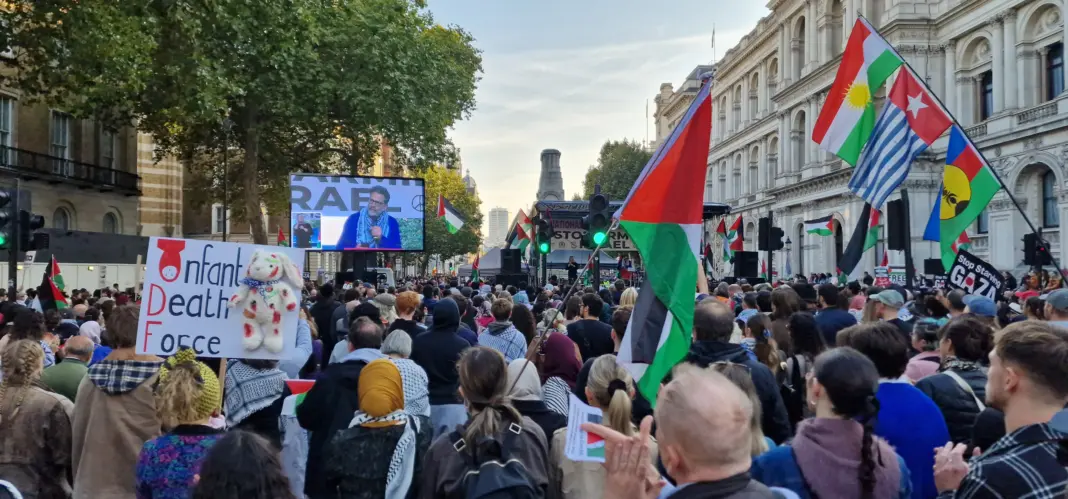

Organisers of Saturday’s Gaza solidarity march in London claimed a turnout of around 600,000 people, making it the largest protest in the UK since the 2003 Iraq War demonstration, when more than a million marched against the invasion of Iraq.
The Palestine Solidarity Campaign (PSC), which coordinated the event, told crowds gathered outside Downing Street they had taken part in “a historic show of solidarity with the people of Gaza.”
The march came one day after a ceasefire between Israel and Hamas took effect, ending nearly two years of devastation that has left as many as 100,000 Palestinians dead or missing — mainly civilian women and children — according to Gaza’s health authorities and UN agencies.
But for protesters, the ceasefire did not mark peace — it marked what many called a pause in an ongoing system of occupation and apartheid.
A fragile ceasefire and a controversial peace plan
The ceasefire forms part of a 20-point “peace plan” designed by U.S. President Donald Trump and endorsed by the UK, Egypt, Qatar, and Turkey.
Under the proposal, Israel retains a permanent military presence inside Gaza, along its border and across wide sections of the Strip, while a multinational force of Arab and Muslim troops handles internal security.
The Israeli army has said it will continue to operate “defensively” from roughly 50% of Gaza after pulling back to agreed lines — a claim widely dismissed by observers as a euphemism for continuing military occupation. In practice, it means Israel will still control around half of Gaza’s territory, including most of its arable farmland, making any meaningful recovery or food production impossible.
Israel has also announced its intention to demolish what it calls Gaza’s “terror tunnels” — the vast underground network constructed beneath the Strip.
In reality, the tunnels formed a strategic civil and military infrastructure that enabled Gaza’s government and resistance forces to survive and continue operating when Israel dropped the equivalent of 12 Hiroshima atomic bombs on its population.
The stated campaign to “eliminate” the tunnels signals that the IDF plans to continue operating offensively across Gaza, destroying remaining infrastructure for years to come. Far from a peaceful withdrawal, the arrangement grants Israel open-ended licence to wage war under the banner of security.
Prime Minister Keir Starmer is due to attend a summit in Sharm El Sheikh for a signing ceremony, where Downing Street says he will pay “particular tribute” to Trump and to Egypt, Qatar and Turkey for brokering the deal. The plan’s first phase is expected to include the return of remaining hostages and the release of Palestinian prisoners.

Blair’s return: from Iraq to Gaza
Adding a layer of historical irony to the moment, former British prime minister Tony Blair — whose decision to invade Iraq in 2003 sparked the last protest of comparable scale — has reportedly been tapped to play an advisory role in the new Gaza governance framework being discussed between Washington, Tel Aviv, and Cairo.
According to diplomatic sources cited in Israeli and U.S. media, Blair will work alongside American envoys to help design “institutional pathways” for Gaza’s post-war administration — a plan already criticised as an attempt to reimpose Western control through proxy authorities.
For many of those marching through London, Blair’s re-emergence represents a bitter symbol of hypocrisy. The 2003 Iraq War, launched without UN authorisation and based on false intelligence, left over a million Arab civilians dead and destabilised the entire region.
“It’s grotesque,” said one protester near Parliament Square. “The last time this many people filled London’s streets, it was to stop Tony Blair from attacking Iraq. Now, twenty years later, he’s helping design a new colonial regime in Gaza — after another illegal war.”
That resonance was not lost on organisers. The 2025 Gaza march was the largest UK protest since the Iraq War march that defied Blair’s government, making the former prime minister’s quiet re-entry into Middle East policy all the more controversial.
“This isn’t peace — it’s unfinished justice”
Despite the truce, PSC director Ben Jamal said the movement would not demobilise.
“Millions of people all over the world have been marching against Israel’s genocide. But this movement has never been only about the genocide — it’s about ending the occupation, apartheid, and dispossession of the Palestinian people which goes back generations.”
He said demonstrators shared the “relief and joy” of Palestinians in Gaza but added that many feared the truce would only mask continuing oppression.
“We saw people dancing on the streets of Khan Younis,” he said. “Maybe now Palestinian parents won’t have to write their children’s names on their arms in case they’re blown to pieces. But Israel has violated every ceasefire it has ever signed — and this one is no different.”
Jamal described the U.S.-backed framework as “a plan for containment, not liberation.”
“It says nothing about the root causes — nothing about occupation, apartheid, or the right to self-determination. Until those are addressed, there can be no peace.”
Arson spree as ceasefire took hold
In the hours immediately after Trump announced the ceasefire, Israeli units withdrawing from Gaza torched homes, food stores and vital infrastructure, according to an investigation by Drop Site News. Soldiers’ own social-media posts show dozens of buildings engulfed in flames as troops from multiple brigades — Golani, Givati, Nahal, Hashmonaim and Kfir — pulled back toward the newly agreed “yellow line.”

One Kfir soldier posted a photo showing himself in front of burning pallets of food, captioned: “On Friday, just before departure. Burning food so that it won’t reach the Gazans, may their names be erased.” Others described the arson as “final touches,” “a small souvenir,” and “one last memory.”
Among the targets was the Sheikh Ajlin Sewage Treatment Station, a central part of Gaza City’s sanitation network. Monther Shoblaq, Director General of the Coastal Municipalities Water Utility (CMWU), said the attack could push the city’s wastewater system “to point zero.”
“If the plant was burned down, remediation could take years,” he told Drop Site. “Without Sheikh Ajlin, raw sewage will have to be dumped directly into the sea. You’re talking about Gaza without sewage treatment — shorelines covered with waste, groundwater at risk, and untreated sewage flooding the streets.”
The plant, financed with German development funds, had been slated for emergency repairs once the ceasefire took hold. Its destruction, Shoblaq said, “dispels any pretext that these attacks were security-related” and fits a broader pattern of systematic strikes on Gaza’s water network.
Photos geolocated by Drop Site also show mass arson in the Sheikh Radwan district of Gaza City, where soldiers set fire to residential buildings used as temporary bases. Some were left vandalised with graffiti such as “Enjoy[,] sluts” and “We shall return here.”
The IDF did not comment. The soldiers’ posts — boasting about torching civilian infrastructure — stood in sharp contrast to Trump’s claim on Truth Social that the ceasefire was the first step toward “a Strong, Durable, and Everlasting Peace.”
Legal observers say the destruction of civilian property and essential facilities like water and sanitation systems may constitute war crimes under international law.

Demonisation and the battle over narrative
Jamal condemned what he called a deliberate campaign of demonisation against Palestine protesters by politicians and the press.
“Those who oppose genocide are labelled extremists,” he said. “Yet on our marches you see Christians, Muslims, Jews — banners reading ‘Jews Against Genocide.’ The smear is collapsing because the reality is visible.”
He criticised what he called the “weaponisation” of a recent racist attack on a Manchester synagogue to justify new protest restrictions.
“Those who rightly condemn racist violence have no moral foundation if they support Israel’s genocide and apartheid system,” he said. “You cannot denounce one form of racism while endorsing another.”
Police restrictions and new protest laws
Scotland Yard imposed conditions on both the PSC march and a small counter-protest by the Jewish-led Stop the Hate group under the Public Order Act, citing the need to prevent “serious disruption.”
The government’s Crime and Policing Bill, now in the House of Lords, would allow police to ban protests based on their “cumulative impact.” Civil liberties groups warn it could make repeat demonstrations illegal.
“Imagine if the suffragettes had been told: you’ve already marched once, you’ve made your point,” Jamal said. “A few weeks ago, they even tried to ban megaphones near Chatham House because the Israeli president was speaking. That’s not policing — that’s political censorship.”
A movement that outlasts the ceasefire
Analysts say the Gaza solidarity movement has shifted British public opinion, forcing mainstream debate over arms sales, sanctions, and international accountability.
Polling consistently shows a majority of Britons believe Israel has committed war crimes and back an arms embargo.
But Jamal warned that with the guns now silent, there would be an effort to declare the issue over.
“There will be an attempt to say: everything’s back to normal,” he said. “That is precisely why we must not stop.”
He cited the International Court of Justice’s July 2024 opinion, which reaffirmed the illegality of Israel’s occupation and said states must not aid it — a finding he said obliges the UK to impose sanctions and a full arms embargo.
Grassroots pressure and global isolation
Under pressure from local communities, more than 20 UK councils have voted to divest from Israeli-linked companies, while the Co-operative Group has removed Israeli goods from its shelves. Imports from Israel have fallen by about 17% since 2024, and activists are calling for Israel’s exclusion from Eurovision and UEFA events.
“These levers of pressure are essential, just as they were against South African apartheid,” Jamal said. “If Israel isn’t held accountable, it will repeat the same crimes.”
He added that the far right’s alignment with Israel’s government — including the invitation of Tommy Robinson to Israel — exposed a shared ethno-nationalist ideology.
“We’re not just fighting for Palestinians,” he said. “We’re fighting for the kind of world we want to inhabit — one built on equality and justice, or one built on racist supremacy.”
Global recognition of genocide
Saturday’s march came as an overwhelming body of international legal and scholarly opinion now classifies Israel’s campaign in Gaza as genocide.
The United Nations Commission of Inquiry, multiple UN special rapporteurs, and the International Association of Genocide Scholars have each concluded that Israel’s actions meet the definition of genocide under the 1948 Genocide Convention.
Israel’s two-year military campaign in Gaza — which the United Nations Commission of Inquiry, multiple UN special rapporteurs, and the International Association of Genocide Scholars have each concluded constitutes genocide — has killed or left missing up to 100,000 civilians.
If verified, the turnout of 600,000 would make Saturday’s demonstration not only a milestone in British protest history, but also a symbol of global reckoning — a movement refusing to be silenced even as governments claim peace has been achieved.
In a Britain where dissent is increasingly constrained, the crowds in London offered a reminder that solidarity itself remains an act of democracy, and that justice for Gaza and Palestine is far from over.