
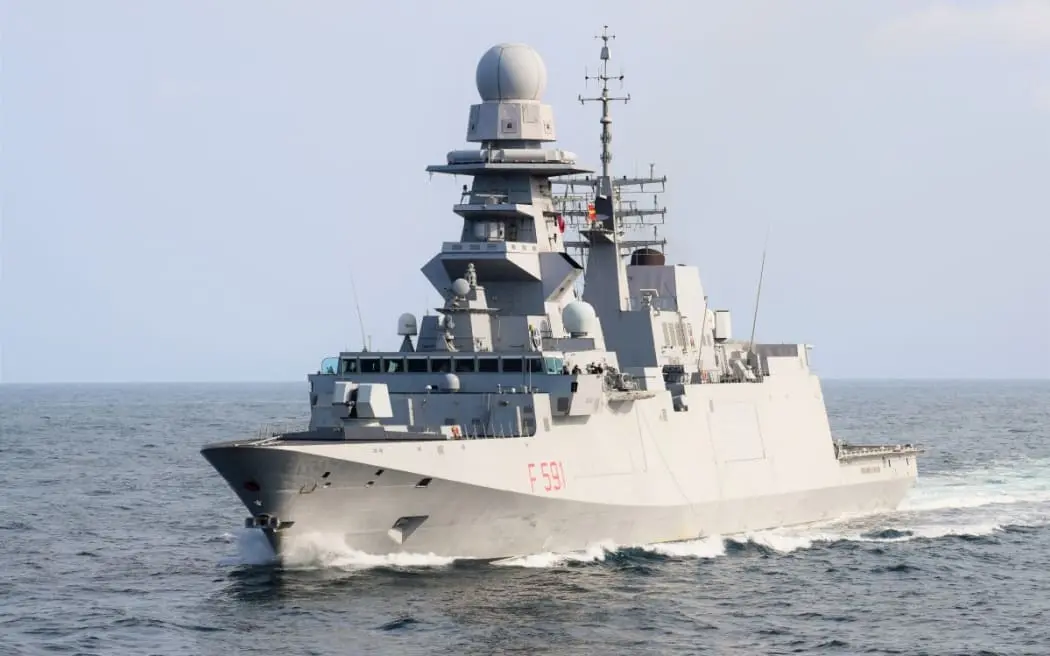

The Mediterranean is on the brink of a dramatic escalation. What began as a civilian-led humanitarian mission to break Israel’s blockade of Gaza has now drawn in European governments, regional militaries, and the looming shadow of war crimes accountability. The Sumud flotilla—around 50 vessels carrying aid and activists from more than 44 countries—is pressing toward Gaza under direct naval protection from Italy and Spain, with Ireland poised to join. At the same time, Turkey and Egypt are conducting joint naval exercises in the eastern Mediterranean, a show of force that many interpret as an implicit shield for the convoy.
Even in the skies, the pressure is visible. On his way to the UN General Assembly, Benjamin Netanyahu’s Wing of Zion jet made a historic detour, avoiding much of European airspace for fear that states might be obliged to enforce the International Criminal Court’s arrest warrant and detain him as a suspected war criminal. Europe and the wider region, once reliable protectors of Israel’s freedom of action, are beginning to shift.
Public Pressure and Italy’s Dramatic Reversal
Italy’s decision to send a warship came as a surprise. Prime Minister Giorgia Meloni had only months earlier refused to recognize a Palestinian state, and her government was widely seen as firmly aligned with Israel. Yet Defence Minister Guido Crosetto pushed through the deployment, a move that analysts believe was influenced not only by strategic concerns but by mounting domestic unrest.
On 22 September, Italy was shaken by a general strike and protests across more than 75 municipalities. From Rome to Milan and Bologna, tens of thousands took to the streets under the banner Blocchiamo tutto—“Let’s block everything”—demanding recognition of Palestine and an end to military cooperation with Israel. Demonstrations turned violent in places: protesters clashed with police at Milan’s central station, threw smoke bombs in Bologna, and blocked major roads. Dockworkers in Genoa, La Spezia, Livorno and Trieste slowed or halted arms shipments to Israel. Earlier in June, hundreds of thousands had marched through Rome with similar demands.
Faced with Italian citizens aboard the flotilla and public fury at home, Rome’s deployment of naval protection seems as much a concession to domestic pressure as a humanitarian stance. Meloni herself sought to deflect, suggesting the flotilla dock in Cyprus and hand over its cargo under Israeli supervision, but the organizers were adamant. “We are continuing to Gaza despite all threats and risks,” one participant declared.
Spain quickly followed. Speaking in New York, Prime Minister Pedro Sánchez confirmed that a Spanish warship would depart within 24 hours to join the escort. Madrid has been increasingly critical of Israel’s actions in Gaza, recognizing Palestinian statehood earlier this year, and its decision signals a willingness to match rhetoric with action. Ireland, too, is weighing participation, pressed by citizens and lawmakers whose compatriots are among the passengers. If Dublin joins, the flotilla would carry the backing of three European states—two of them NATO members—directly into waters Israel claims to control.
Attacks at Sea and the Risk of Wider War
The convoy’s journey is being documented in real time, despite Israeli attempts to jam communications. Activists have broadcast video messages describing multiple explosions, drones circling overhead, and chemical dispersals. “This is the sixth explosion we hear … we are humanitarian, nonviolent, protected by international law … pressure your governments … we are being attacked right now,” one message pleaded. The appeals spread rapidly online, echoing across continents faster than Israel’s censors could suppress them.
As of late September, the flotilla was navigating south of Crete, slowly advancing through Greek waters under drone surveillance. Its progress is determined by the slowest vessels, and organizers estimate it may take several more days—possibly up to a week—before it can attempt to reach Gaza’s coast. Carrying roughly 250 tons of aid, its goal is to unload directly in Gaza, breaking Israel’s 17-year blockade that has been condemned internationally as a form of collective punishment.
The mission’s success would establish a precedent: a sea corridor into Gaza beyond Israel’s control. For Tel Aviv, allowing this would be unthinkable, but attacking the flotilla now means risking a clash not only with civilians but with European warships. That possibility raises the specter of NATO itself. An attack on an Italian or Spanish frigate could trigger Article 5, NATO’s collective-defense clause, forcing an emergency summit and testing the alliance’s unity as never before.
The anxiety is well-founded, because Israel has a long history of attacking such missions. In 2010, its commandos boarded the Mavi Marmara in international waters, killing nine activists and injuring dozens; a tenth later died of his wounds. UN investigations ruled the raid unlawful and disproportionate. Other flotillas in 2011, 2015 and 2018 were also intercepted, passengers beaten and deported, aid seized. In recent months, vessels like the Madleen and Handala were targeted with chemical spray, boarded in international waters, and their passengers—journalists, parliamentarians, even Nobel laureates—arrested and expelled. Activists aboard the Sumud now report similar harassment: drones, explosions, jamming, and chemical attacks. The risk of further escalation is not hypothetical but rooted in precedent.
Shifting Alignments in the Mediterranean
The wider region is shifting too. Turkey and Egypt have resumed joint naval exercises for the first time in over a decade. Dubbed Friendship Sea 2025, the drills involve Turkish frigates, submarines, and F-16s alongside Egyptian warships and helicopters in the same eastern Mediterranean waters the flotilla must cross. Officials describe the exercises as a renewal of military ties, but the timing is seen as a pointed signal. With Israel facing growing isolation, the image of Turkish and Egyptian ships maneuvering as the flotilla sails nearby under European protection underscores the risks of escalation.
Meanwhile, Netanyahu’s flight detour symbolized Israel’s increasingly fragile position in Europe. On 25 September, the Wing of Zion routed only through Greece and Italy before swinging south past Gibraltar, avoiding France, Spain, Portugal, Ireland, and the UK. The concern was clear: if forced to land, European states might be legally bound to arrest the Israeli leader under the Rome Statute. It was a striking moment—an Israeli prime minister altering his route through fear of arrest in capitals that once provided near-automatic diplomatic cover.

Genocide Findings and Europe’s Break with Israel
All this unfolds as international legal bodies sharpen their judgments. On 16 September, the UN’s Independent Commission of Inquiry declared that Israel has committed genocide in Gaza, citing evidence of four of the five genocidal acts defined in the 1948 Convention. The International Association of Genocide Scholars likewise voted overwhelmingly to declare Israel’s policies genocidal. The casualty figures underline the conclusion: over 60,000 Palestinians killed since October 2023, with roughly 83 percent civilians. Since March 2025, fifteen of every sixteen people killed by Israeli fire have been noncombatants. Families, neighborhoods, entire communities are being erased daily.
Yet while European allies mobilize to protect their citizens and the flotilla, Britain remains conspicuously absent. Despite maintaining a major base at RAF Akrotiri in Cyprus—just miles from the convoy’s route—the UK has offered no protection to British-flagged vessels, just as in previous flotilla missions. Instead, the base is integrated into U.S. and Israeli surveillance networks, providing intelligence that critics say enables targeting operations in Gaza. For British activists aboard the flotilla, the silence is a bitter reminder of their government’s alignment.
That Italy, Spain and possibly Ireland are now acting, that Turkey and Egypt are flexing naval power, and that Netanyahu himself is avoiding European airspace marks a profound shift in alignments. Some of Israel’s allies are no longer willing to stand aside while genocide unfolds live before the world. The Sumud flotilla may succeed in delivering its cargo or it may be stopped. Either way, it has become far more than a humanitarian convoy. It is now a flashpoint for international law, the future of Western alliances, and the struggle for Palestine itself.