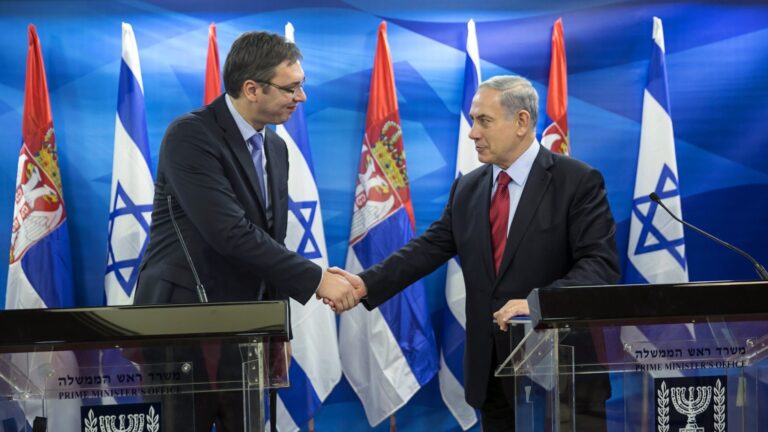
The European Union, which has spent two decades trying to stitch together peace in the Balkans, now faces humiliation. Serbia’s $1.64 billion arms deal with Israel—its largest in modern history—not only bankrolls a state accused of genocide in Gaza, but also threatens to unravel the fragile stability Europe claims to safeguard. By indulging Belgrade while it defies international law, Brussels risks exposing itself as powerless, its credibility as a guardian of human rights and regional order in tatters.
Last week, Israeli weapons manufacturer Elbit Systems announced it had signed a contract worth $1.64 billion with an unnamed European country. The buyer’s identity was initially kept secret, a clear indication that the optics of purchasing weapons from Israel—a state currently facing accusations of genocide at the International Court of Justice—were politically toxic. But within days, the veil slipped. The buyer is Serbia.
For Belgrade, the agreement represents the largest single arms purchase in its modern history. For Tel Aviv, it is a lifeline to Israel’s war economy, battered by boycotts, divestments, and mounting scrutiny over the devastation in Gaza. For Europe, however, it is something altogether darker: a deal that risks reigniting the fragile peace settlement that has held the Balkans together since the wars of the 1990s.
This is not simply another defense sale. It is a gamble—one taken at the worst possible moment. Serbia has chosen to bankroll Israel’s “genocide economy” with billions of dollars, while Israel has chosen to export Gaza-tested weapons into one of Europe’s most fragile regions. Together, they risk unleashing an arms race in the Balkans and destabilizing a continent still haunted by the memory of ethnic conflict.
A Question of Timing
On the surface, Serbia’s deal with Elbit may appear to be a straightforward case of military procurement. Small states buy arms all the time, and Israel has long sold its “battle-proven” weapons abroad—battle-proven being shorthand for “tested on Palestinians.” Yet the scale, the timing, and the political context transform this from an ordinary purchase into something far more consequential.
Serbia is not Switzerland, secure in neutrality and stability. It is a state that never fully reconciled with the wars of Yugoslav succession, refuses to recognize Kosovo’s independence, and stokes nationalist sentiment at home by invoking grievance and defiance. Israel is not a neutral exporter either. Under its 2007 Defense Export Control Law, every major sale requires government approval, making this contract not just a commercial deal but a political act sanctioned at the highest levels in Tel Aviv.
The transaction thus symbolizes more than military modernization. It embodies a shared logic: Serbia’s opportunistic nationalism aligned with Israel’s war economy, both treating international law and regional peace as expendable.
Prestige, Not Defense
The weapons package includes Hermes 900 drones, long-range precision rockets capable of striking targets 300 kilometers away, and advanced electronic warfare systems. Yet there is no immediate war threatening Serbia. The acquisition is not about defending against invasion. It is about prestige.
President Aleksandar Vučić has built his legitimacy on restoring Serbian pride after the humiliation of the 1999 NATO bombing campaign. Equipping Serbia with cutting-edge Israeli systems sends a domestic message: Serbia is no longer weak. It is to be feared and respected. That symbolism extends beyond Serbia’s borders. Kosovo will see the purchase as threatening. Bosnia, particularly the Republika Srpska entity under Milorad Dodik, will read it as emboldenment. Croatia and Romania—both NATO members—will feel compelled to modernize further.
Even if Serbia never fires a single Elbit rocket, the purchase alone shifts the regional psychology. If Serbia buys weapons, others will too. The Balkans risks stumbling into a new arms race.
Israel’s War Economy
For Israel, the deal is more than a financial win. It is a propaganda victory at a time of growing international isolation. Human rights groups have documented the use of Hermes drones and precision rockets in Gaza, where they have been deployed to enforce blockades and flatten entire neighborhoods. By exporting these systems to Serbia, Israel converts its military campaigns into marketing pitches. Gaza becomes both a laboratory of suffering and a showroom for arms sales.
The timing is deliberate. This year, global boycotts have intensified: Norway’s sovereign wealth fund divested from Israeli firms, the World Council of Churches endorsed boycotts, and the British Medical Association severed ties. Against this backdrop, Serbia’s contract allows Israel to claim Europe still values its weapons—an image of resilience carefully cultivated by Prime Minister Benjamin Netanyahu.
A Dangerous Balancing Act
Belgrade’s choice of Israel also reflects its precarious geopolitical balancing act. Historically, Serbia has leaned on Russia for arms and diplomatic cover, particularly Moscow’s veto at the UN Security Council on Kosovo. But sanctions and the demands of the Ukraine war have weakened Russia’s ability to supply. At the same time, Serbia is not a NATO member and cannot access Western supply chains directly.
Buying from Israel provides a middle path: access to Western technology without formally joining NATO. It signals engagement with a U.S. ally while maintaining claims of neutrality. Yet this strategy is fraught with risks. Moscow will not welcome Belgrade spending billions on arms from Israel, a close adversary of Russia’s allies Iran and Hezbollah. Brussels, meanwhile, looks toothless if it tolerates a candidate state bankrolling a country accused of genocide.
The Balkan Domino Effect
The consequences extend beyond symbolism. In Kosovo, the idea that Serbia could project Hermes drones and long-range rockets across its territory undermines fragile confidence. In Bosnia, Dodik may see Serbian rearmament as a green light for secessionist ambitions, rattling a country still scarred by Srebrenica. Croatia and Romania may feel compelled to escalate their arsenals, fueling a regional arms race that could spiral far beyond Serbia’s intent.
The European Union, which has invested two decades in Balkan peace, faces humiliation. By indulging Serbia while it buys from Israel and defies international law, Brussels risks undermining its credibility as a guardian of human rights and regional stability.
Exporting Doctrine
Perhaps the most disturbing aspect is the export not only of weapons but of doctrine. Israel’s military model in Gaza—overwhelming firepower, surveillance, and collective punishment—is embedded in these systems. By adopting them, Serbia risks importing a worldview that sees political compromise as unnecessary, because technological dominance can enforce control instead.
Just as Gaza is treated as a captive zone, northern Kosovo or Bosnia’s Serb enclaves could one day be managed through intimidation rather than diplomacy. What Israel tests in Gaza does not stay there—it metastasizes through arms deals.
A Meeting of Kindred Logics
The symmetry is unsettling. In the 1990s, Serbia was accused of ethnic cleansing in Bosnia and Kosovo. In 2025, Israel is accused of genocide in Gaza. Both justified their actions through narratives of existential threat. Both sought to launder reputations through military strength rather than justice.
By funding Israel’s war economy today, Serbia is aligning itself with a state that mirrors its own darkest history. The deal illustrates how conflicts are exported: the same drones that terrorize Palestinians may one day be deployed in the Balkans.
The Elbit-Serbia deal is more than an arms contract. It is a state-sanctioned gamble with far-reaching consequences. For Israel, it sustains a war economy under genocide scrutiny. For Serbia, it is a statement of prestige with destabilizing regional implications. For Europe, it is a reminder of how fragile peace can unravel when nationalism, militarism, and political expediency collide.
The question now is whether Europe recognizes the danger in time—or whether it will once again sleepwalk into conflict until the Balkans are burning once more.