
Nearly 100 Palestinians have died in Israeli custody since the Gaza war began — and hundreds more have simply disappeared. Inside the system where torture, starvation and impunity have become routine.
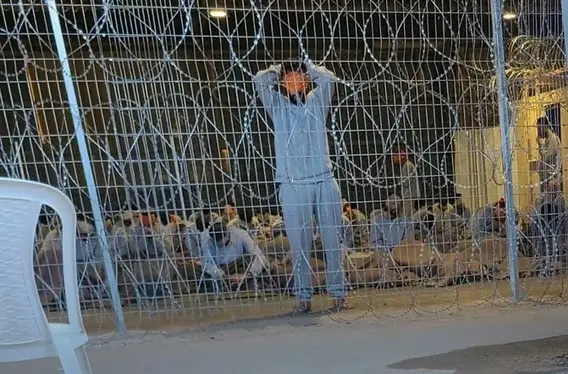
When the gates of Sde Teiman military base close, the world outside has no idea what happens next. There are no visitor logs, no public rosters of detainees and almost no photographs—except for the ones Israeli soldiers themselves leaked, showing rows of Palestinians blindfolded, hogtied and left on the ground under armed guard. Those images were dismissed as anomalies.
They weren’t.
Over the last two years of war, Sde Teiman and Israel’s network of “security” prisons have become the epicentre of a detention regime that rights groups now describe bluntly as lethal. According to a major new investigation by Physicians for Human Rights–Israel (PHRI), at least 98 Palestinians have died in Israeli custody since 7 October 2023.
Many were civilians. Many were never charged. Many were never even registered.
PHRI researcher Naji Abbas says even this astonishing figure undercounts the real toll:
“Even though we are providing evidence for a higher number of deaths than previously reported, this is not a full picture. We are sure that there are still people who died in detention that we don’t know about.”
Before the war, Israeli detention facilities reported two or three Palestinian deaths a year. During the war, the number has climbed to one every four days.
The transformation is so dramatic that even Israeli prison staff now use a macabre term for what the system has become. One military guard told reporters:
“The facility had been dubbed a ‘graveyard’ because so many prisoners were dying there.”
This is the story of how a hidden network of desert camps and concrete prisons became, in the words of one detainee, “Guantánamo”—and how hundreds of families are still waiting to learn whether their sons, husbands and fathers are alive.
Sde Teiman: A Military Base Turned Death Camp
Sde Teiman was never intended to house prisoners. It was an army base about 30 minutes from the Gaza border. But after the first week of Israel’s ground assault, trucks arrived stacked with bound and blindfolded detainees—many pulled from bombed-out neighbourhoods, others seized in mass roundups, still others abducted during the high-profile raids on Gaza’s hospitals.
Soldiers who served there describe scenes of organised cruelty.
Detainees were forced to lie on gravel for hours, hands zip-tied behind them, legs shackled. Loud music blasted through the night. Former detainee “Nabela,” held in Gaza before transfer, recalled:
“We were freezing and forced to remain on our knees on the ground… Loud music, shouting and intimidation — they wanted to humiliate us. We were handcuffed, blindfolded, and our feet were tied in chains.”
Inside the camp’s makeshift medical tent, Israeli doctors reported seeing detainees brought in with broken ribs, head wounds, spinal injuries, and deep bruising. PHRI staff who attended ten autopsies later confirmed patterns of violence:
“In two of the cases, the autopsies found severe signs of violence and assault… In at least one autopsy, our doctor found that the specific cause of death was medical neglect.”
By August 2025, PHRI had verified 29 deaths at Sde Teiman alone—more than any other detention site in Israel.
One Israeli doctor who treated detainees before resigning described the base in starker terms:
“It’s a place where people disappear.”
The IPS Prisons: Ktzi’ot, Megiddo and the Spread of Systemic Abuse
Beyond Sde Teiman, Israel’s civilian prison service—known as the IPS—recorded 42 Palestinian deaths across its high-security facilities: Ktzi’ot, Megiddo, Ofer, Nafha, Ramon, Nitzan (the medical centre), Kishon and Shikma.
The numbers dwarf previous decades.
Ktzi’ot, Israel’s largest desert prison, became a hub of mass death, with 14 fatalities since the war began. Former detainees describe systematic beatings, prolonged restraints, and starvation rations.
One recently released prisoner said bluntly to international media:
“It is Guantánamo.”
In Megiddo, seven detainees died. In Shikma, where interrogations took place, six died—some after prolonged stress positions and sleep deprivation.
Before 2023, Israel recorded only a handful of Palestinian deaths annually. In 2024 alone, IPS prisons recorded 21.
Many were ordinary civilians who had never stood before a judge.
Civilians, Doctors, and the Disappeared
The most disturbing revelation is who the dead were.
A classified Israeli military intelligence database seen by journalists shows that out of more than 47,000 Hamas and Islamic Jihad fighters listed, only 21 militants had died in custody by May 2024.
But by that same point, 65 detainees from Gaza had died in Israeli jails.
In other words: most of the dead were not combatants.
Among them was Dr. Adnan al-Bursh, the head of orthopaedics at al-Shifa hospital. Arrested in December 2023, al-Bursh was transferred between facilities and eventually died in Ofer prison. A fellow detainee reported seeing him shortly before his death:
He was “visibly injured and naked from the waist down.”
His body has never been returned.
Other cases are even more chilling. PHRI documented 21 deaths where Israeli authorities refused to provide even a name—just a location and date.
Families have no idea whether their loved ones are alive or dead.
Enforced Disappearance Becomes State Policy
For the first seven months of the war, Israel refused to provide any list of Gaza detainees. The Red Cross was barred. Lawyers were told their clients “did not exist.” Hundreds were simply swallowed by the system.
HaMoked, an Israeli human rights organisation, filed hundreds of tracing requests. In 400 cases, authorities replied: “No record of arrest.”
This included people whose arrests were filmed and shared online.
One high-profile example was Dr. Hussam Abu Safiya, the director of Kamal Adwan hospital. Video showed soldiers taking him away. For a week, Israel denied holding him. Only intense media scrutiny forced confirmation.
PHRI describes the situation plainly:
“These grave violations of international law have rendered any effort to determine the full scope of Israel’s policy of killing detained Palestinians, or to trace the fate of the many Palestinians taken into custody, extremely difficult, if not impossible.”
For many families, disappearance has extended for months. Some have waited more than a year.
Hadeel, the wife of detainee Mohammed Hussein Ali, said her young daughter gradually stopped asking for him:
“She’d say ‘baba, where’s baba’, but after time she stopped asking.”
Another former detainee told PHRI investigators:
“We slept beside the dead.”
Torture, Starvation and Medical Neglect: How the Deaths Happened
Autopsies and testimonies reveal consistent causes of death:
- Blunt-force trauma
- Multiple fractures
- Internal bleeding
- Prolonged restraints
- Untreated chronic diseases
- Starvation
- Hypothermia
In one case, a detainee with diabetes died after being denied insulin. Another died of untreated cancer. Several showed signs of long-term shackling.
One female detainee described the atmosphere:
“They wanted to humiliate us.”
A military guard described a facility that had become synonymous with death.
“It was called a ‘graveyard’ because so many prisoners were dying there.”
These accounts are not isolated. They reflect a pattern of state-sanctioned cruelty.
Impunity at Every Level
The most shocking fact is not just the deaths—but the silence that followed them.
Despite nearly 100 fatalities, not a single Israeli officer has been charged with murder or manslaughter.
Only one case—an assault captured on video—led to a conviction. The soldier received a seven-month sentence.
Attempts to prosecute others triggered furious political backlash, with right-wing protesters defending the accused soldiers. Israel’s top military lawyer was even arrested by police after attempting to pursue charges in a particularly gruesome sexual torture case.
PHRI’s Abbas summarised the crisis:
“While these policies are being applied, every Palestinian in detention is in danger, even the healthy ones, even the young ones who have no underlying medical issues.”
International Law Collapses in Real Time
Israel is a signatory to the Geneva Conventions. Yet the treatment of detainees since October 2023 has violated nearly every provision governing the treatment of prisoners of war and civilians under occupation:
- Failure to register detainees
- Denial of Red Cross access
- Torture and cruel treatment
- Lack of food, water, shelter
- Failure to provide medical care
- Failure to return bodies
- Failure to investigate deaths
PHRI states that deaths were avoidable:
“These deaths were preventable. The lack of medical attention and poor detention conditions directly contributed to fatal outcomes.”
What has emerged is not a broken system, but a deliberate one—constructed in the fog of war, empowered by political extremism and protected by total impunity.
Families Still Wait for News of the Missing
Under the ceasefire agreement in October 2025, Israel released 1,700 Gaza detainees held without charge. But even after the mass release, more than 1,000 Palestinians remain in indefinite detention.
Hundreds more are simply unaccounted for.
Police and soldiers who served in the camps say they saw detainees collapse and die after beatings. Some watched bodies removed at night. Others say detainees were taken away by patrol units and never seen again.
Israeli authorities will not publish the full list of the dead.
For the families, the war has not ended.
And for many of the disappeared, it may never be clear where—or how—they died.
A System Built to Disappear People
Nearly 100 confirmed deaths. Hundreds missing. No accountability.
What has unfolded in Israel’s military camps and prisons since October 2023 is not an aberration triggered by chaos. It is a system—a lethal network of detention centres where Palestinians, many of them civilians, have been held without oversight and left to die in secrecy.
As PHRI researchers put it:
“This isn’t just an individual case here and there. It is systemic and it will continue.”
Sde Teiman and Ktzi’ot will be remembered not just as prisons, but as sites where the machinery of the state quietly ended human lives.
And until Israel is forced to reveal the full list of the detained and the dead, families across Gaza and the West Bank will continue waiting—for answers, for bodies, and for justice.