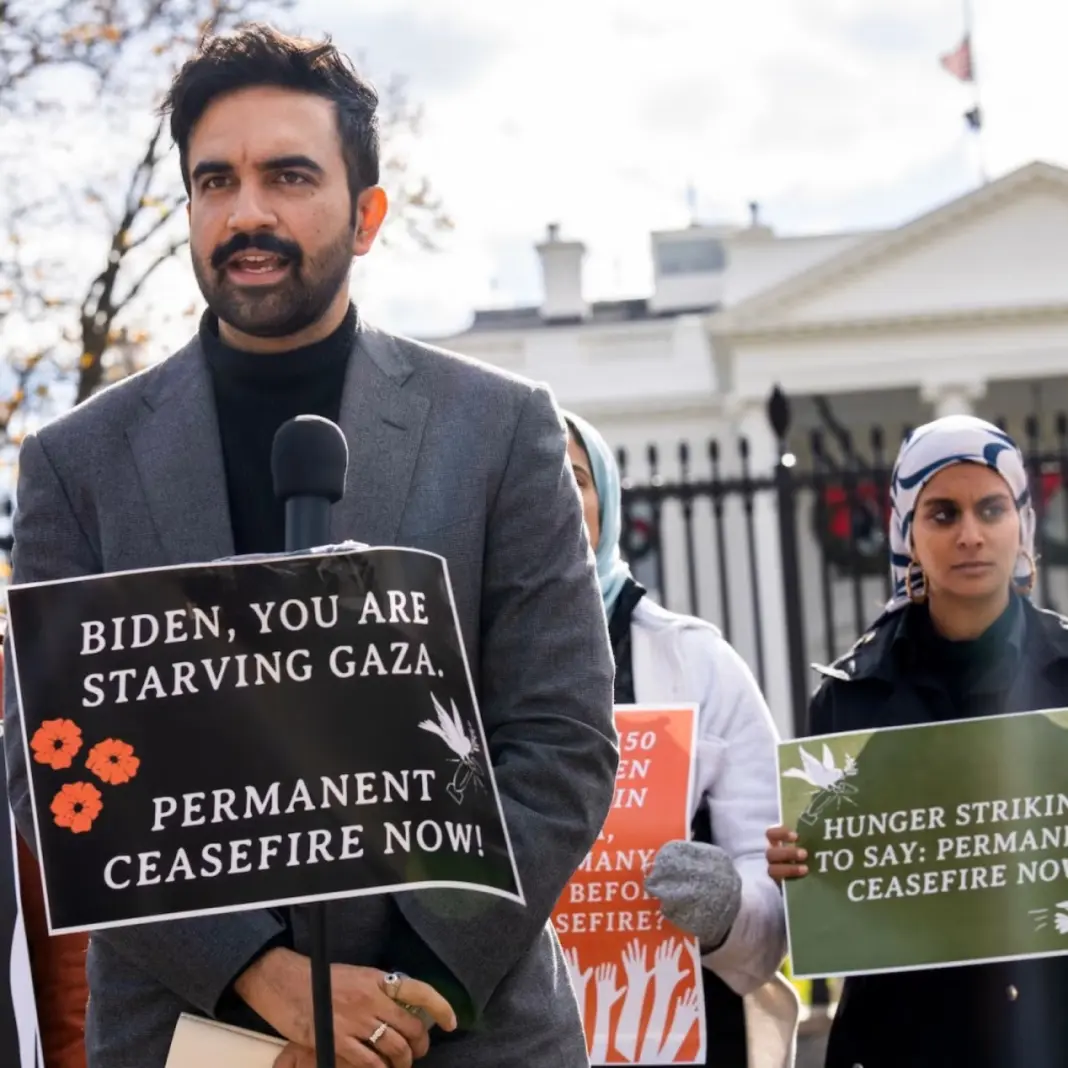

The ramifications of Israel’s war in Gaza are ricocheting across the world’s democratic capitals, unsettling establishment politics in places once considered safe territory for supporters of Israeli policy. Nowhere has that shock been louder than in New York City, where voters have elected Zohran Mamdani — a Muslim candidate who demanded a Gaza ceasefire, condemned U.S. police training exchange programs with Israeli forces, and repeatedly referenced international law without apology.
The victory shattered a decades-old assumption: that candidates in New York, home to the largest Jewish population outside Israel, must tiptoe around Israeli state interests. Mamdani did not. He ran as he is. And voters rewarded him.
In Tel Aviv, the reaction was not diplomatic. It was panic. Prime Minister Benjamin Netanyahu immediately accused Mamdani of antisemitism for supporting enforcement of International Criminal Court arrest warrants — including one that names Netanyahu himself. National Security Minister Itamar Ben-Gvir, convicted in Israel for incitement, called the election a “disgrace.” Their tone was unmistakable: rage at the sudden loss of narrative control.
A Narrative That Was Never Supposed to Break
For decades, consultants treated New York as an outstation of Israeli messaging. The red line was clear. Criticism of Israeli policy meant political exile.
Mamdani stepped over that line as if it didn’t exist.
What makes this unprecedented is who delivered him to victory. His coalition was not built on elite donors or boutique academic activism. It came from tenants’ unions, nurses, bus riders, cooks, retail workers — the people treated as security problems instead of a public. When the smears began, that coalition did not scatter.
Accusations attempted to paint Mamdani as pro-Hamas, dangerous to Jews, linked to 9/11, illegal in the country — none supported by any record. The smear existed entirely on expectation: that suspicion alone would be enough.
It always had been.
Not anymore.
The Jewish Left Refused to Be Weaponized
The machine malfunctioned because Jewish New Yorkers refused to participate. Jewish Voice for Peace, IfNotNow, Jews for Racial and Economic Justice, and the DSA Jewish Caucus campaigned publicly for Mamdani. Their message: Jewish safety does not require Palestinian death.
When the targeted community rejects the accusation, the accusation has nowhere to land.
That is why Israeli officials reacted so emotionally. They lost the ability to define Jewish identity from Tel Aviv.
Enter Norman Finkelstein: A Shifting Battlefield
Political theorist Norman Finkelstein — himself a child of Holocaust survivors — argues that Mamdani’s rise reveals something deeper than foreign-policy dissent:
“He represents, almost in pure form, the class struggle.”
Citing Marx’s famous line from The Communist Manifesto, Finkelstein argues that class conflict is the motor of political history — and that Mamdani’s campaign has cleared the ideological fog surrounding it. The Gaza genocide has fused foreign-policy outrage with economic immiseration.
It is, he argues, a return to fundamentals.
During Bernie Sanders’s insurgent campaigns, Finkelstein notes, both Republican and Democratic elites deployed identity politics to obscure class demands. Sanders attacked “billionaire class” power nightly; critics answered with culture-war framing: racism, reparations, Bernie Bros. Republicans exploited white resentment; Democrats exploited minority representation. Anything to avoid confronting Goldman Sachs.
But Mamdani’s presence scrambles the script.
“You can’t say a fellow named Mamdani is weak on race questions, ethnic questions, religious questions. It’s not going to work. So it’s a straight-out class struggle.”
Identity politics — elite liberalism’s shield — cannot be used against him. Nor can Islamophobia’s usual tropes when Jewish organizers refuse to amplify them.
Panicked Billionaires, Flooded Mailboxes
The business class responded in the only way it knows: money.
Michael Bloomberg alone poured millions into anti-Mamdani messaging. Mailboxes across the city were flooded with warnings of antisemitism. And yet, turnout surged in Mamdani’s favor.
Why? Because voters now feel the system collapsing on them.
Finkelstein estimates that roughly 80% of the city lives insecurely: multiple gig jobs, no healthcare, no pensions, no future.
That 80% is no longer afraid.
As Finkelstein puts it:
“Remember the Occupy slogan: we are the 99%. It’s closer to 80%. But 80% is a lot.”
A Global Pattern: Corbyn, Sanders, and the Antisemitism Gambit
Finkelstein draws a direct line to the UK’s Jeremy Corbyn, where accusations of antisemitism — originating with pro-Israel organizations — metastasized into a national elite offensive. Media outrage buried Corbyn’s economic insurgency. The weapon worked then.
Now, Finkelstein warns, the same playbook is underway in New York.
Step one: consolidate challengers. Buy them off, threaten them, promise future careers. Step two: define the insurgent as antisemitic. It worked against Corbyn because he appeased.
“Appeasement never works. It disillusions your base. The juggernaut never stops.”
Mamdani, Finkelstein argues, must do the opposite: surround himself with Jewish allies and appeal to international law, human-rights rulings, and genocide scholarship.
“You are the extremists. I am not.”
Who Is the Fringe Now?
From the UN Human Rights Council to Amnesty International and the International Court of Justice, the consensus is stark: Israel’s assault on Gaza may constitute genocide. That finding has rallied a younger generation — including young Jews — against impunity.
Israel’s defenders are increasingly isolated, their rhetoric out of step with global law.
Mainstream Media’s Collapse
The establishment press is losing its grip. When The New York Times editorialized that Mamdani shouldn’t even be allowed a line on the primary ballot, the response was indifference. A generation raised on livestreams, not print endorsements, ignored the scolding tone.
The Times lost the power to anoint legitimacy. Credibility, not branding, now shapes political reality.
Why Israel Is Afraid
Officials in Israel are not panicking because a mayor in New York might change transit policy. They are panicking because something broke:
- The fear stopped functioning.
- The smear stopped biting.
- Jewish identity stopped being proprietary.
- Diaspora obedience stopped being assumed.
The Gaza war has revealed the unthinkable: democratic publics do not want complicity in mass killing.
The Class War at the Core
At bottom, Mamdani’s platform is simple: free buses, expanded childcare, rent control, a $30 minimum wage, taxes on billionaires. Policies aimed at the working-class majority.
The same billionaire class funding Israel’s impunity funds urban austerity. Gaza’s struggle mirrors New York’s: dispossession, policing, real-estate speculation.
The moment solidarity becomes material — in neighborhoods, rent hikes, and police encounters — the propaganda breaks.
The Generational Break
Finkelstein predicts the older Jewish establishment will remain loyal to Israel, but estimates the younger cohort:
“About 30% of young Jews — enough to matter.”
Those numbers terrify Israeli officials. They are losing the future.
Israel’s Self-Inflicted Wound
The tragedy — and the irony — is that Israel’s Gaza war is eroding support where it matters most: in diaspora democracies that have protected Israel diplomatically for 50 years.
Genocide is not just a crime. It is a reputational suicide.
Israel’s leadership has transformed global Jewish identity from a moral force into a liability. Critics worry that conflating Zionism with Judaism not only harms Palestinians but endangers Jews.
The System Cracks, and Other Cities Will Follow
Mamdani’s election demonstrates something simple and seismic:
- The accusation stopped working.
- The fear stopped working.
- The smear stopped working.
Other candidates will notice. Other donors will panic. Other coalitions will refuse to split. And once fear evaporates, power collapses gravitationally.
Where Israel Cannot Follow
In Israel itself, such a shift appears distant. Whistleblowers are arrested. Soldiers filmed abusing Palestinian prisoners plead victimhood. Extremists occupy cabinet posts.
A society built on permanent emergency cannot reform without unraveling.
Which is why change is emerging abroad.
A New Political Era Begins
Israel’s Gaza campaign is killing tens of thousands — but it is also killing the mythic authority Israel has wielded over diaspora politics. New York’s election signals the first major break in a global machinery of intimidation.
If the precedent spreads — London, Paris, Berlin, Sydney, Toronto — Israel will face something more dangerous than war-crimes courtrooms:
democratic accountability.
Mamdani’s victory is not about one city. It is about the sudden and public collapse of a 50-year political weapon.
If it can happen in New York — the capital of capital, the citadel of pro-Israel consensus — it can happen anywhere.
And after Gaza, many believe it must.