
When Benjamin Netanyahu launched Israel’s full-scale assault on Gaza in October 2023, he vowed to eradicate Hamas, rescue every hostage, and restore deterrence. In his first televised address he invoked Amalek—a biblical signal of total destruction. Defence Minister Yoav Gallant followed with a chilling order: “No electricity, no food, no fuel; everything is closed. We are fighting human animals and we act accordingly.”
Within hours, power and water to 2.3 million civilians were cut and aid convoys blocked. Human-rights lawyers called it collective punishment; UN experts labelled it starvation warfare. By mid-2024—and reaffirmed in 2025—UN investigators and genocide scholars concluded that Israel’s conduct met the legal threshold for genocide, prompting the International Court of Justice to order provisional measures under the Genocide Convention. These findings now define the legal and moral frame of the entire war.
Strategic Outcome: Hamas Survived, Israel Compromised
Two years later, every core Israeli war aim has collapsed. Hamas’s leadership endured; most hostages returned through negotiation, not rescue; Israeli forces withdrew under a mediated cease-fire. In asymmetric war, endurance itself is victory. Hamas endured—militarily battered yet politically strengthened—while Israel conceded terms it once swore it never would.
Israel’s toll:
- ≈ 1,100 soldiers killed, ≈ 3,000 wounded, and roughly 20,000 veterans in rehabilitation, half suffering psychological trauma.
- Independent estimates suggest fatalities 1,300–1,800 and trauma cases 12,000–15,000—figures likely suppressed by wartime censorship.
The aura of invincibility is gone. Israel’s army returned home exhausted, its objectives unmet, its society bitterly divided.
Gaza’s Catastrophic Toll
- 67,000 Palestinians killed, 169,000 injured—including 20,000 children and 10,000 women.
- 1,100 medical workers, 540 aid staff, and 200 journalists killed—the highest professional death toll ever recorded.
- Entire districts levelled; hospitals, schools, and shelters repeatedly struck.
Investigators cite these patterns—together with official rhetoric and siege tactics—as evidence of genocide and multiple war crimes. Gaza became both a humanitarian graveyard and a legal crime scene.
The Legal Reckoning
The political shield that once protected Israel in Western capitals is cracking. During the war’s first days, leading politicians across the UK, US, and Europe repeated the mantra: “Israel has the right to defend itself.” In Britain, opposition leader Keir Starmer went further, publicly affirming that Israel “has that right” even to cut water and electricity to Gaza—a statement that human-rights lawyers condemned as endorsement of collective punishment. His shadow attorney general Emily Thornberry echoed the same defence.
Now, as UN bodies and genocide experts document the scale of civilian destruction, those early declarations are being re-examined under the lens of complicity. International-law specialists note that under the Rome Statute and customary humanitarian law, political leaders who encourage or enable policies known to cause widespread civilian suffering may be liable for aiding and abetting war crimes.
The International Centre of Justice for Palestinians (ICJP) has already lodged evidence with the UK Metropolitan Police War Crimes Unit, urging investigation of officials who publicly justified siege tactics or authorised arms exports used in Gaza. Similar filings are being prepared in Spain, South Africa, and Ireland. Across the Atlantic, U.S. lawyers have petitioned federal courts to halt weapons transfers that “materially assist genocide.”
Critics argue that Western leaders bet on Israel winning—believing overwhelming force would restore deterrence and silence dissent. Israel lost, and its defeat exposes the moral and legal bankruptcy of that bet. Human-rights groups now speak of a coming legal reckoning, in which those who financed, armed, or defended the campaign will face investigation in national or international forums. The jurisprudence of Nuremberg and Rwanda leaves no safe harbour for officials who knowingly endorse starvation, displacement, or indiscriminate bombardment.
Whether prosecutions succeed or not, the legitimacy of those governments is already eroding. The war that was supposed to crush Hamas instead criminalised its backers in the court of global opinion.
Detention, Torture and New Allegations
Since October 2023, at least 75 Palestinians have died in Israeli custody, amid credible reports of torture, sexual assault, beatings, and medical neglect at sites such as Sde Teiman. A February 2024 report by Euro-Med Human Rights Monitor alleged that Israeli soldiers brought civilians into detention centres—notably Zikim and Naqab (Negev)—to watch and film the abuse of Palestinian detainees. Witnesses describe prisoners beaten with batons and electric rods, scalded with hot water, and mocked by spectators. Such acts, investigators warn, constitute crimes against humanity under the Rome Statute.
Israel claims to be investigating “aberrant incidents” but has blocked independent access. To many observers, denial has become policy.
October 7 and the “Hannibal” Controversy
Israeli media later confirmed that commanders invoked the Hannibal directive on 7 October 2023—authorising overwhelming fire to prevent hostage-taking even at risk to hostages. Verified footage shows tanks and helicopters firing on vehicles seized by militants. Families demand to know how many Israelis were killed by their own army.
Three hostages—Yotam Haim, Alon Shamriz, Samer Talalka—were confirmed shot dead by Israeli troops in Shujaʿiyya after escaping captivity. The incident became a symbol of moral collapse: a government that vowed to “bring everyone home” killed its own citizens in the fog of vengeance.
Economic Shock and Societal Strain
The financial toll rivals Israel’s costliest wars combined.
- Total losses: ≈ ₪ 250 billion (≈ US $67 billion).
- Direct combat spending: ≈ ₪ 112 billion (≈ US $31 billion).
- Northern evacuations: ≈ 144,000 displaced residents; losses ≈ ₪ 590 million per week.
- Tourism: arrivals down ≈ 70 %; revenue loss ≈ US $3.4 billion; Masada visitors –95 %.
- Currency: shekel –20 % at lows.
- Investment: Intel’s US $25 billion plant suspended; thousands of tech workers emigrated.
- Port of Eilat: virtually idle; Red Sea freight premiums spike worldwide.
Even with a cease-fire, recovery remains hostage to politics. The war’s price is now measured in lost confidence.
Global Reversal: Recognition for Palestine, Isolation for Israel
By September 2025, the UK, France, Canada, and Australia joined Ireland, Spain, Norway, Slovenia, Chile, and more in recognising the State of Palestine—bringing total recognition to roughly 157 UN members. The UN General Assembly voted overwhelmingly for full Palestinian membership, blocked only by a U.S. veto. Meanwhile, the International Criminal Court sought arrest warrants for Netanyahu and Gallant, and the ICJ genocide case continues.
For decades Israel relied on Western immunity; now even its allies talk of sanctions and travel bans. What began as a war for “deterrence” ends in diplomatic isolation.
The Cease-Fire Mechanics — Scott Ritter’s Analysis
Former UN weapons inspector Scott Ritter describes the cease-fire as effectively a Hamas peace plan repackaged for Israeli consumption:
- Hostage Exchange: Hamas and Islamic Jihad return all living captives and remains; Israel frees ≈ 1,200 Palestinian prisoners.
- Territorial Pullback: IDF withdraws from ≈ 70 % of Gaza in Phase 1.
- Humanitarian Surge: aid corridors and reconstruction open under international monitors.
- Conditional Disarmament: Hamas to disarm only after Palestinian statehood is secured and guaranteed.
- External Guarantors: a U.S.-led consortium enforces phased compliance.
Ritter notes that every demand Hamas made in late 2023 has been met—cease-fire, prisoner swaps, Israeli withdrawal, reconstruction, and a political horizon. He argues that Hamas would trade its remaining leverage precisely because the deal creates the opportunity for a Palestinian state.
The danger, he warns, is sabotage by escalation: Netanyahu could ignite a broader confrontation—perhaps with Iran—to bury the peace process and rally domestic hardliners. Whether Washington restrains that impulse will decide whether this cease-fire “reaches maturity.”
Power and Legitimacy
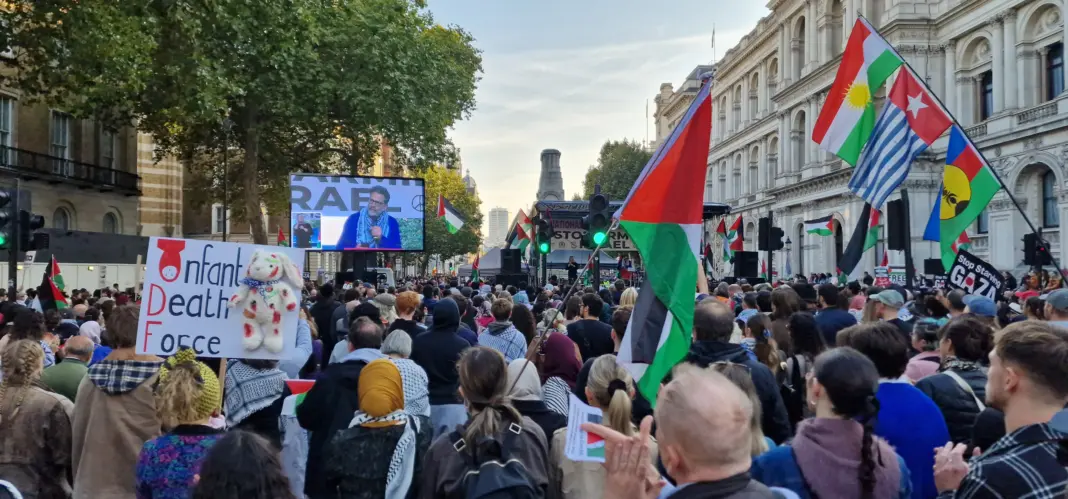
Israel retains advanced weaponry and U.S. support, yet its legitimacy has collapsed. Images of Gaza’s devastation—tents on rubble, starving children, the endless funerals—shifted global consciousness. Civil-society movements in Europe, Africa, Latin America, and North America have redefined the moral map. For millions, Hamas now embodies Palestinian endurance, while Israel—once marketed as a fortress democracy—stands accused before the world’s highest courts.
Defeat and Endurance — The Balance Sheet
Israel’s Aims vs. Outcomes
| Objective | Result |
|---|---|
| Eradicate Hamas | Leadership intact; movement survived |
| Rescue hostages | Most freed through negotiation |
| Restore deterrence | Crumbled region-wide |
| Protect economy | ₪ 250 billion losses; recession looming |
| Sustain legitimacy | ICC warrants; ICJ case; global isolation |
Gaza’s Ledger
| Metric | Figure |
|---|---|
| Killed | ≥ 67 000 (20 000 children, 10 000 women) |
| Injured | 169 000 |
| Medical workers killed | 1 100 + |
| Aid staff killed | ≈ 540 |
| Journalists killed | ≈ 200 |
| Died in custody | ≥ 75 |
| Displaced | > 2 million |
These numbers are not merely statistics; they are the architecture of moral collapse.
How Israel Lost the War It Chose
- Maximalist Aims Guaranteed Failure – annihilation of Hamas was impossible against a dispersed, embedded resistance.
- Collective Punishment Shattered Legitimacy – siege and starvation turned global sympathy to outrage.
- Hostage Doctrine Backfired – military rescues killed hostages; diplomacy freed them.
- Regional Pressure Raised Costs – Hezbollah’s fire, Yemen’s drones, and Red Sea disruptions drained Israel’s economy.
- Global Politics Shifted – recognition of Palestine surged; international law re-asserted primacy.
What Comes Next — The Statehood Sequence
If the cease-fire endures, the pathway likely unfolds as:
- Hostages Home / Prisoners Freed (verified exchange).
- IDF Pullback to the 70 % line, then full redeployment.
- Humanitarian Reconstruction under monitors.
- Administrative Handover to a technocratic Palestinian cabinet.
- Security Regime with international supervision.
- Conditional Disarmament linked to sovereignty milestones.
- Elections and Constitutional Lock-In.
- Normalization and Guarantees—economic packages and regional integration.
It is the first credible trade in generations: guns for a state.
From Catastrophe to Consequences
The 2023–2025 war was a human and moral catastrophe—but it exposed truths long buried under propaganda. Israel wielded overwhelming force yet failed to achieve its aims. Hamas endured and emerged politically strengthened. Global opinion turned, Western immunity cracked, and a legal movement for accountability began to gather momentum.
Measured by any rational metric, Israel lost: Hamas un-eliminated, hostages freed through negotiation, deterrence shattered, economy wounded, leadership under investigation. Hamas won by surviving, forcing a cease-fire on its terms, and putting Palestinian statehood back at the centre of world politics.
What follows is a struggle over law and memory. International tribunals will grind forward; documents, testimonies, and satellite archives will outlast propaganda. Politicians who cheered a “right to cut water and power” may one day answer to judges, or at least to history.
Hamas survived. Hamas thrives. Israel retreats in stunning defeat. Whether this ushers in a lasting Middle East settlement or the opening act of a wider regional war will depend on one outcome: whether the world finally transforms recognition into a real, sovereign, accountable Palestinian state.
—
Reaction – Lowkey: ‘Israel Has Woken the World to the Horrors of the Zionist Project’
A ceasefire deal has been announced by U.S. President Donald Trump, aimed at halting Israel’s devastating military campaign in Gaza. But British-Iraqi rapper and human rights campaigner Lowkey warns that the agreement offers little real hope for peace.
“Israel has broken every single ceasefire agreement it has ever had with any state ever,” he said. “This will be no different.”
After nearly two years of what legal experts and humanitarian organizations have called a genocidal assault, the artist argues that Israel has “brought itself directly into an antagonistic conflict with the vast majority of humanity” through its actions.
“When people are seeing on a daily basis children killed on their phones, they go away and try to understand — what could cause this? What is the ideological underpinning of all this killing and murder?” he said. “And that has led them to the ideology of Zionism.”
A Global Shift Against Israel
According to the campaigner, the war on Gaza has triggered a historic turning point in global consciousness. “In the United States, you see stalwart supporters of Israel on the right-wing side of the equation turning against Israel and turning against Zionism in large numbers,” he said.
Before his assassination, Charlie Kirk had begun questioning the media’s portrayal of Israel’s conduct, urging Americans to think critically. “Is the media totally presenting the truth when it comes to Israel?” he asked. “Maybe we shouldn’t believe everything the media says. I’ve been conditioned to ask a lot more critical questions over the last couple of years.”
On-air, Joe Rogan described Israel’s actions as indefensible. “What they’ve done to Gaza is insane,” he said. “If you can’t see that — if your only response is ‘Israel has the right to defend itself’ — what are you talking about? Against what? Children?”
Conservative commentator Candace Owens spoke of the disillusionment felt by many in the West. “I would literally rather saw off my own foot than support Israel ever again,” she said. “I feel like America’s just… owned by Israel. I thought we owned them.”
Referring to Israeli Prime Minister Benjamin Netanyahu, Theo Von added: “He’s running around the Middle East and telling people point blank, ‘I control the United States. I control Donald Trump.’ It’s humiliating.”
The Ideology of Zionism Exposed
Lowkey believes Israel’s campaign in Gaza has stripped away the facade surrounding its founding ideology. “Israel has woken the world to the horrors of the Zionist project practiced upon Palestinians,” he said. “People will never go to sleep again.”
Yet, he emphasized, Palestine’s story is not one of defeat but of survival. “The story of Palestine is not simply a story of unchecked Zionist power — it’s the story of a refusal to die. The Palestinians have not been defeated. In fact, they are victorious. Palestine was supposed to die in 1948. It didn’t. Palestine was supposed to die across the last two years in Gaza. It didn’t.”
He placed the Palestinian struggle alongside history’s most revered movements for liberation: “The Palestinian resistance has taken its place alongside the Vietcong in Vietnam, the French Resistance in World War II, the Warsaw Ghetto uprising, and the heroes of Ireland who refused to bow to 800 years of British colonialism. All free people of the world — the majority of humanity — support the Palestinians’ right to armed resistance as an occupied people.”
From Isolation to Global Solidarity
Across the world, solidarity with Palestinians has reached unprecedented levels. “We see Spain, which has a history of warm relations with Israel, now engaging in a full arms embargo with the Zionist entity,” Lowkey said. “Greece and Italy have been brought to a standstill by unions refusing to cooperate with government diktats on Israel.”
At the United Nations, the majority of countries now oppose Tel Aviv’s position. “The victory that this represents,” he explained, “is that Israel’s genocide is having to disguise itself and hide in bureaucratic violence. It is no longer able to pursue this war in the naked way it was before, or with the same propagandists it could rely on for many decades.”
Trump’s “Ceasefire Deal”
The new ceasefire agreement, in Lowkey’s view, is largely symbolic. “What has been agreed upon is not the full withdrawal of Israeli forces,” he said. “Instead, what you have is a vague promise by Donald Trump, acting as guarantor, that Israel will withdraw to particular points within Gaza — with specifics to be agreed upon later.”
Under the terms, 20 Israeli captives are to be released in exchange for around 2,000 Palestinian prisoners, including several hundred serving life sentences. Israel must also permit 600 aid trucks into Gaza daily — a tacit admission that it had been using food as a weapon of war, a hallmark of genocidal policy.
“The people of Gaza are celebrating a ceasefire which could finally offer them respite from the daily bombings of every single hospital in the Strip,” he said.
He cited the case of journalist Muhammad Balushi, who uncovered the rotted corpses of babies left on incubators in a bombed hospital, only to be killed himself later. “That’s the reality Israel has created,” he said.
Reverberations Across the West
The Gaza genocide, Lowkey warned, has reshaped politics and civil liberties worldwide. “Its reverberations have entailed the changing of laws in other countries — the imprisoning of 33 political prisoners here for refusing to allow genocide to take place on their watch,” he said. “We’ve seen blind protesters arrested for holding placards, and a young man arrested for simply holding a magazine with these now criminal words printed on the cover.”
“This is the authoritarianism that Israel’s genocide has unleashed on the rest of the world,” he continued. “We’ve seen heroic support from billions across the globe — but also an unprecedented servility among political classes who have been materially involved in this genocide.”
British Complicity and Historical Amnesia
The activist accused the UK government of complicity. “Already you have Israel lobby–backed politicians like John Ashworth coming on TV trying to claim, ‘I’ve wanted a ceasefire for two years,’” he said. “Simply not true. The UK has been a party to this genocide.”
He pointed to Britain’s daily reconnaissance flights over Gaza, carried out by Royal Air Force R1 Shadow spy planes — “even in the hours around the killing of three former UK military personnel.”
“Genocide in New Clothes”
Over the coming months, he warned, governments and media institutions will attempt to reframe the narrative. “They’ll tell you the war is over — genocide in new clothes,” he said. “They’ll assure you there are legal processes underway to determine what happened in Gaza. Don’t let them treadmillize you or numb your conscience. Now is not the time to retreat — it’s the time to escalate.”
The Role of Independent Media
He also credited independent journalism for exposing what mainstream outlets ignored. “Over the last two years, there have been very, very few news organizations that have actively investigated and covered the genocide in Gaza in a serious way that will stand the test of time,” he said. “Doubledown News has delivered a pioneering service to humanity during that period. Please support them on Patreon in any way you can.”
A Turning Point in History
Whether or not the Trump-brokered ceasefire holds, Lowkey believes the moral landscape has shifted permanently. “Israel has woken the world to the horrors of the Zionist project practiced upon Palestinians,” he said. “People will never go to sleep again.”
The Gaza genocide, he concluded, has forced humanity to choose sides — between complicity and conscience. “The Palestinians have not been defeated,” he said. “They are victorious.”