


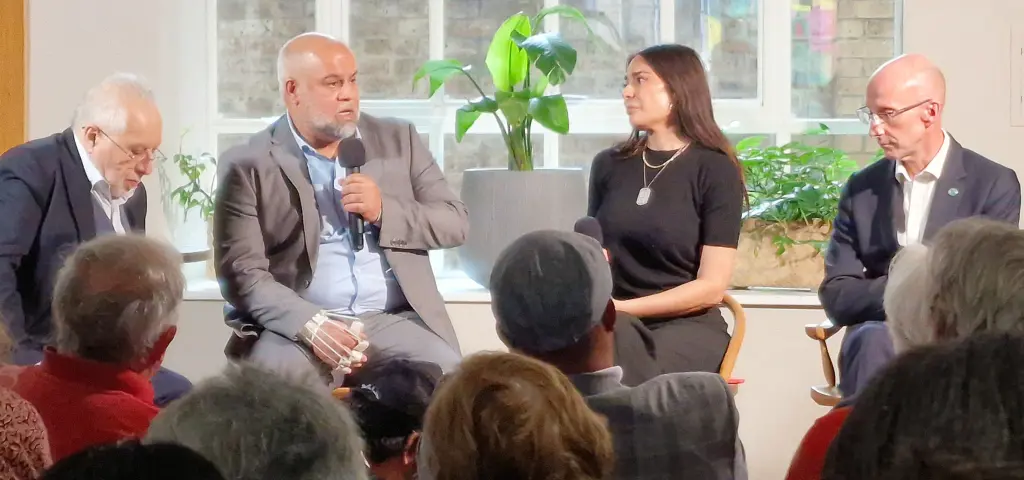
When Wael Al-Dahdouh stepped onto the stage at The Conduit Club in London on September 2, 2025, the sold-out crowd greeted him with a standing ovation. The veteran Al Jazeera Gaza bureau chief, who has endured unconscionable personal loss while steadfastly reporting from the front lines, was at the panel on Israeli war crimes against journalists.
Despite recounting how Israel’s genocidal campaign had killed his wife, children, grandson, and colleagues, Al-Dahdouh shed not a single tear. His voice remained calm, his expression composed — as though grief had been transmuted into unwavering resolve. But beside him, his elderly translator faltered. Mid-sentence, he broke down, his voice cracking as he conveyed Al-Dahdouh’s words to the audience of journalists, aid workers, lawyers, and solidarity activists.
It encapsulated Al-Dahdouh’s essence: a man who has paid so heavy a cost that he has no room left for public breakdown — instead channeling his grief into the relentless work of bearing witness.
A Voice of Gaza
Born in Gaza City’s Al-Zaytoun in 1970, Al-Dahdouh grew up under occupation. He studied communications and turned to journalism in the 1990s, driven by a conviction that bearing witness was both duty and defiance. By the early 2000s, he had become Al Jazeera’s Gaza bureau chief — a voice of calm amid Gaza’s chaos.
Tragedy at Home
That steady voice wavered only once before the cameras — on October 25, 2023, when Israeli strikes in Nuseirat refugee camp killed his wife, son, daughter, and infant grandson. Footage showed him weeping over their bodies in the hospital. Yet the very next day, he was back on air, saying, “This is my duty. If I stop, their voices will stop too.”
Weeks later, during a drone strike on a school in Khan Younis, Al-Dahdouh was injured; his longtime cameraman, Samer Abu Daqqa, was killed — blocked from aid efforts and left to die.
On Shireen: A Journalist Murdered in the West Bank
At the London panel, Al-Dahdouh also spoke of the killing of his colleague, veteran Al Jazeera journalist Shireen Abu Akleh, who was fatally shot by an Israeli sniper while wearing a press vest in the Jenin refugee camp in May 2022. Her death, long before the October 7 escalation, remains one of the most emblematic cases of the lethal risks Palestinian journalists face, even outside Gaza.
Targeted Killings of Journalists
Al-Dahdouh reminded the London audience that the killing of journalists has become not incidental but systematic. He pointed to two recent incidents:
- A strike on a press tent outside Al-Shifa Hospital in August 2025, where five journalists were killed, including prominent Al Jazeera videographer Anas Al-Sharif.
- A double-tap airstrike on Nasser Hospital in Khan Younis just a week before his London appearance. A suicide drone first hit the hospital building during a live news broadcast; followed minutes later by multiple tank shells, killing at least five journalists — among them a Reuters cameraman — as they filmed the aftermath.
These attacks, Al-Dahdouh stressed, were not accidents but deliberate assaults on the very act of documenting war.
Journalists Under Fire: A Broader Pattern
These were not isolated tragedies. Gaza’s press corps has been devastated: entire media offices reduced to rubble, reporters struck in their homes along with their families, clearly marked vehicles bombed. The West Bank has seen a parallel campaign of repression: journalists covering protests or raids have been shot, beaten, or detained. The killing of Shireen Abu Akleh remains a stark reminder that not even internationally recognized reporters are spared.
Bearing Witness
Through it all, Wael Al-Dahdouh has continued. His broadcasts now carry the weight of both testimony and mourning — grief so deep it can no longer spill publicly.
In London, his composed recounting of these stories underscored that silence can be greater than tears — that the act of speaking out is itself defiance. “What happened to me is what is happening to thousands of Palestinian families,” he told the audience. His translator’s tears momentarily cracked the room — but Wael stood firm, reminding everyone that as long as someone speaks, someone bears witness.
For those who stood in that hall, he was more than a journalist. He was a testament — that even under the unrelenting strain of loss, some voices are not silenced.