


On September 1, 2025, the news went dark.
From Latin America to Asia, from Africa to Europe, and across parts of the Middle East, more than 250 media outlets spanning over 70 countries staged a coordinated blackout in protest at what they called the “systematic killing of journalists” in Gaza.
Front pages turned black. Television broadcasts cut away to silent screens. Digital platforms dimmed their homepages. The collective action—rare in both scale and symbolism—was meant as a global alarm bell.
“This is not just a tribute,” declared Thibaut Bruttin, general director of Reporters Without Borders (RSF). “At the rate journalists are being killed in Gaza by the Israeli army, there will soon be no one left to keep you informed.”
The blackout was not simply a show of solidarity. It was a warning that the future of journalism itself is in jeopardy.
The Death Toll That Defies History
Since October 7, 2023, when Israel launched its most extensive military assault on Gaza, Palestinian journalists have been paying the ultimate price.
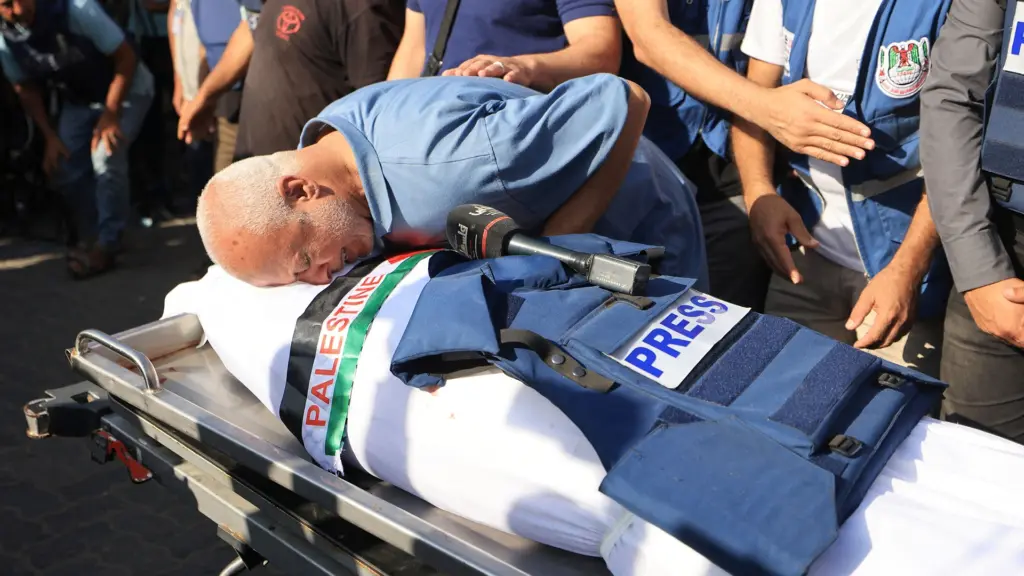
By late August 2025, at least 247 journalists had been confirmed killed. Almost all were Palestinians. Others were injured, detained, or forced into exile. RSF has described Gaza as “the deadliest conflict for journalists in modern history.”
The numbers themselves conceal the human cost.
In August, a double-tap strike on Nasser Hospital in Khan Younis killed more than 20 people, including five journalists. The victims included local reporters, wire service photographers, and field producers. Survivors said the area was clearly marked as a press gathering point.
Earlier in the war, Al Jazeera’s veteran correspondent Wael Dahdouh lost his wife, son, daughter, and grandson in a single strike. The message to Gaza’s press corps was unmistakable: no journalist, no matter how prominent, was safe.
And then there was Anas al-Sharif, a videographer whose raw frontline footage had become a lifeline for international newsrooms barred from Gaza. Just days before he was killed in a deliberate strike, the Israeli military reportedly offered him safe passage out—on the condition he stop reporting. He refused. His death turned him into a symbol of defiance.
Memorial Wall — Journalists Killed in Gaza
This wall of remembrance is a partial list of those who gave their lives documenting the war. Each name represents not only a personal tragedy but also a loss for truth itself.
- Anas al-Sharif (Al Jazeera, Gaza) — Videographer whose footage defined much of the world’s view of Gaza. Refused to stop reporting despite threats. Killed in 2024.
- Issam Abdallah (Reuters, Lebanon) — Veteran video journalist killed by Israeli shelling in southern Lebanon while covering the regional spillover.
- Roshdi Sarraj (Ain Media, Gaza) — Filmmaker and fixer for international outlets, including the BBC. Killed in an airstrike on his home in October 2023.
- Sami Shehada (freelance, Gaza) — Young photographer known for capturing daily life amid ruins. Died alongside his brother during a bombing raid in Rafah.
- Wael Dahdouh’s family — The Al Jazeera bureau chief in Gaza lost his wife, son, daughter, and grandson in a targeted strike, showing how the families of journalists are also under threat.
- Ahmed Abu Hussein (Voice of the People Radio, Gaza) — Shot in 2018 while covering protests at the border fence, his earlier killing is still cited by Palestinian journalists as proof of systemic targeting.
- Yaser Murtaja (Ain Media, Gaza) — Killed in 2018 during border protests while wearing a PRESS vest. His death became a rallying cry for protections for Palestinian journalists.
- The Nasser Hospital Five (various outlets) — A group of reporters and photographers killed in August 2025 during a double-tap strike. They included local freelancers, stringers for wire agencies, and a producer assisting an international crew.
- Noor Harazeen (freelance TV reporter, Gaza) — One of the few female voices in Gaza’s field reporting. Killed with her children during a strike on Gaza City in late 2023.
- Rami al-Rayes (photojournalist, Gaza) — Known for documenting refugee camps. His last images captured children queuing for bread before he was killed.
- Mohammed Abu Hatab (Palestinian TV) — Died in 2023 after his home was bombed. His colleagues aired a broadcast from his destroyed house in his honor.
- Shireen Abu Akleh (Al Jazeera, West Bank, 2022) — Although killed prior to the current war, her assassination while reporting in Jenin remains a powerful symbol of Israel’s pattern of targeting journalists.
- Bisan Owda’s colleagues (various) — The young influencer and journalist, who has become globally recognized for her dispatches, has repeatedly memorialized colleagues killed alongside her, including camera operators and sound technicians.
- Dozens of unnamed freelancers — Many Gaza reporters were community-based photographers, stringers, and citizen journalists. They died without international recognition, but their images and posts still circulate online, bearing witness to their sacrifice.
This memorial wall is incomplete. The list of names continues to grow with each week of bombing. But every addition is a reminder that journalism in Gaza is not an abstract ideal—it is a profession lived, loved, and too often cut short.
What Drove the Blackout
The September blackout was orchestrated by RSF, the International Federation of Journalists (IFJ), and advocacy group Avaaz. Planning had been underway for months as the death toll mounted.
For Dominique Pradalié, IFJ’s president, the action was a “historic moment of unity in defense of truth.”
Major dailies in Europe published entirely black front pages. Broadcasters in Latin America interrupted programming with moments of silence. Independent digital outlets across Asia replaced their homepages with stark banners reading simply: “Journalists are being killed in Gaza.”
The symbolism was deliberate. Just as news provides light in moments of darkness, its sudden absence is meant to show what the world would look like without it.
Who Stayed Dark—And Who Stayed Silent
Yet the blackout also revealed a deep fracture in global journalism. While hundreds of outlets participated, many of the most influential newsrooms in the West remained conspicuously absent.
The New York Times, The Washington Post, and Los Angeles Times—pillars of American journalism—did not take part. Neither did CNN or other major U.S. broadcasters. Their pages and screens remained business as usual.
For some observers, this silence was as telling as the blackout itself.
The Los Angeles Times has faced particular scrutiny. In early 2024, the paper barred dozens of staff—including Palestinian and Muslim journalists—from covering the Gaza war after they signed a statement condemning the killing of journalists. That internal crisis laid bare the pressures inside Western media houses, where accusations of bias and fears of backlash often shape editorial decisions.
By contrast, independent and regional outlets—many with fewer resources and less protection—took bold steps to join the action. For them, solidarity was not optional but existential.
“Western newsrooms want to believe they stand for press freedom everywhere,” said a European journalist involved in the blackout. “But when it comes to Palestine, their silence speaks volumes.”
Testimonies from Gaza: Reporting Under Siege
For journalists still alive inside Gaza, the blackout was both a gesture of solidarity and a reminder of their vulnerability.
“I saw our homepage go black for the first time,” said one Gaza-based reporter, speaking anonymously for fear of reprisals. “It felt like the world was finally acknowledging our struggle. But the next morning, we were back in the rubble, filming, knowing any moment could be our last.”
Another, a photographer in Rafah, described the fear of double-tap strikes: “We rush to cover one bombing, then another missile follows. They target the rescuers, the medics, and the press. They want to erase witnesses.”
These testimonies underscore why Gaza’s journalists are indispensable. With foreign reporters barred by Israel from entering, Palestinian journalists are the only eyes and ears on the ground. Without them, the war’s civilian toll would remain hidden.
Global Outrage, Political Evasion
The blackout generated headlines across continents. Civil society groups hailed it as one of the most coordinated acts of media solidarity in recent memory.
But governments responded cautiously. European leaders expressed “concern” about the safety of journalists but stopped short of calling for sanctions or investigations. In Washington, the White House reiterated its “support for press freedom” but avoided any direct criticism of Israel.
Rights advocates argue this gap between rhetoric and action emboldens impunity. “Words are not enough,” said an Avaaz spokesperson. “Every journalist killed without accountability makes the next killing more likely.”
Historical Echoes: When Reporters Became Targets
The killing of journalists is not new. During the Vietnam War, dozens were killed in crossfire. In Iraq and Afghanistan, media workers became targets of roadside bombs and assassinations. In Ukraine, reporters face daily shelling.
Yet Gaza is different in scale and intensity. Never before have so many journalists been killed in such a concentrated period of time.
There is also a deeper historical resonance. In 1982, during Israel’s invasion of Lebanon, several journalists were killed covering the conflict. But then, as now, calls for accountability were muted. Critics argue that four decades later, the pattern of impunity remains.
Why Some Media Stayed Out
Analysts suggest several reasons why major Western outlets abstained from the blackout.
- Editorial Neutrality: Some editors argued that participating would compromise their “neutral” stance. Critics call this a false equivalence, noting that neutrality in the face of mass killings amounts to complicity.
- Political Pressure: U.S. media organizations face intense lobbying and political scrutiny over coverage of Israel. Fear of accusations of bias, or of losing access to officials, often shapes editorial choices.
- Corporate Interests: Large media conglomerates are tied to advertisers and shareholders wary of controversy. Solidarity actions that might alienate political allies or business partners are often avoided.
- Cultural Bias: Western media has historically framed Palestinian suffering as secondary to Israeli security concerns. This bias, ingrained over decades, influences decisions about which causes are deemed worthy of collective action.
The Stakes for Journalism
The blackout raised a fundamental question: what is journalism’s role in times of atrocity?
For Gaza’s reporters, the answer is simple—document reality, no matter the cost. For Western institutions, the calculus appears murkier, balanced between ideals of press freedom and political expediency.
As one Palestinian journalist put it: “We don’t have the luxury of neutrality. Every bomb that falls, every life that ends, is in front of us. If we don’t tell the story, no one will.”
Turning Darkness into Accountability
The September blackout may be remembered as a watershed moment—when media across the world united, if briefly, to defend the principle that killing journalists is an attack on truth itself.
Yet symbolism alone cannot shield reporters from missiles, nor bring justice to the families of the dead. For that, governments must act: demanding investigations, supporting accountability under international law, and insisting on press access to Gaza.
Until then, the blackout stands as both a collective act of mourning and a moral challenge. If journalism dies in Gaza, it does not only silence Palestinians—it diminishes the ability of the entire world to know, to remember, and to seek justice.
As Bruttin warned: “Killing the messenger doesn’t kill the truth—but it delays justice. And without justice, more journalists will die.”