


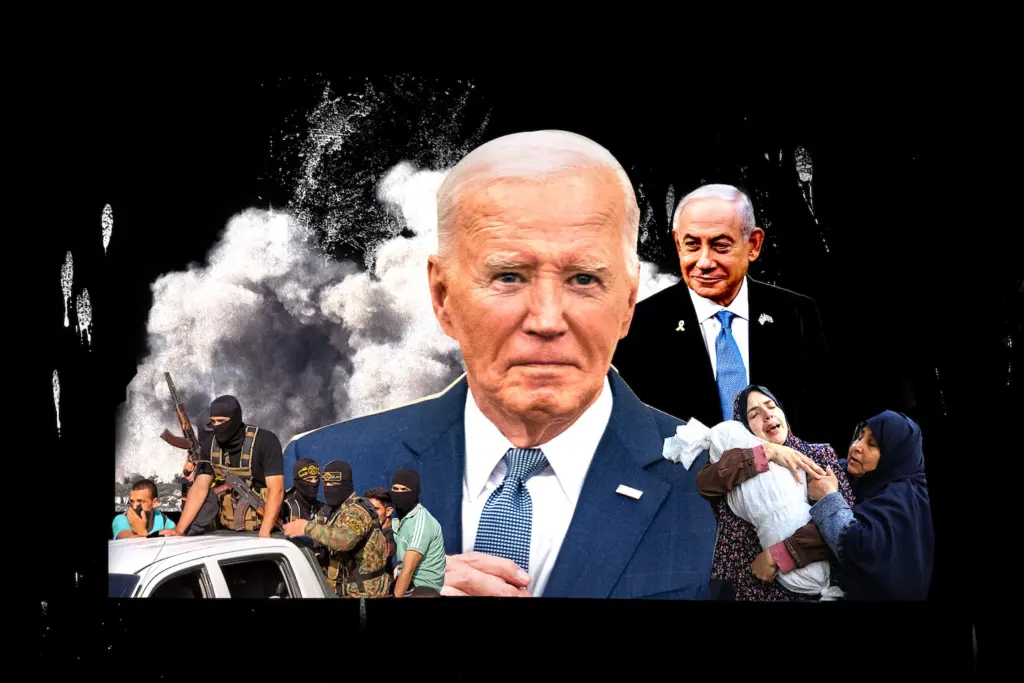
A proposed transfer of 40,000 heavy bombs to Israel gives new urgency to an investigation into the warnings Washington received, the pressure it withheld and the military support that survived a change of president.
Two years after the Biden administration paused a shipment of 2,000lb bombs over fears of mass civilian casualties in Gaza, Donald Trump’s administration is preparing a $2.8bn package that would send Israel 40,000 bombs of that weight.
Congress has been informally notified of the proposed deal, which is not yet final. Most of the package is expected to be financed through American military assistance, using US taxpayer funds to purchase weapons for Israel.
The proposal gives immediate relevance to the reckoning over Washington’s earlier decisions. The weapons that once prompted an exceptional restriction are now at the centre of another vast arms package.
The warnings were already circulating inside Joe Biden’s administration while American weapons continued flowing to Israel. Government lawyers were raising the prospect of complicity in war crimes. Humanitarian officials were describing the consequences for Palestinian civilians. Diplomats were questioning a policy that appeared increasingly incapable of delivering even its own stated objectives.
That is the central allegation in Crossing the Red Line: Biden, His Advisors, and Israel’s War in Gaza, investigative journalist Akbar Shahid Ahmed’s examination of the decisions behind Washington’s support for Israel’s military campaign.
The reporting draws on almost 175 interviews, including people across the White House, intelligence agencies, humanitarian departments and State Department. Many were career professionals who had worked under successive administrations.
“What I kept hearing was this level of absolute shock and horror at how the Biden administration was failing to get even a grip for their own stated goals of what was happening in Gaza.”
Even some Israeli sources were surprised by the freedom Washington allowed them. Their assessment, recalled in the investigation, was blunt: “We thought the US would rein us in much earlier than they did.”
The account describes repeated opportunities to impose limits, followed by decisions that preserved Israel’s room for manoeuvre.
“They instead used American influence to either cover for Israel or they left Benjamin Netanyahu in the driver’s seat.”
The decision to allow “no daylight”
The foundations were laid in the first days after the Hamas-led attacks of 7 October 2023.
Shock, solidarity with Israel and the urgency of recovering people taken captive shaped the American response. But the officials making those decisions were already familiar with Netanyahu’s methods and the extremism of his coalition.
“They knew that Netanyahu had a record of playing the US and essentially using the US political system to defy any pressure from the US side.”
The significance of American influence was equally clear: “And they knew that the only player that Israel would listen to in this instance was America.”
The immediate response was to accelerate weapons deliveries. The investigation describes officials “jumping through hoops to rush weapons to Israel”, while bypassing checks that would ordinarily accompany such exports.
By approximately 11 October, the administration had settled on an approach described internally as “no daylight”: public solidarity intended to purchase influence behind closed doors. Its premise was “no public rebuke of Israel ever”.
Washington supplied the solidarity and the weapons. The restraint it expected in return repeatedly failed to materialise.
Ideological commitment, assumptions inherited from the war on terror, bureaucratic self-protection and an unwillingness to admit error reinforced one another. A policy could continue even as the evidence against its effectiveness accumulated.
Warnings that failed to change policy
The danger to civilians was being described from the outset. Israeli leaders announced restrictions on essentials, while humanitarian organisations warned about the consequences of cutting off food, fuel and other supplies.
Inside the American government, lawyers were considering the implications for the country supplying the weapons.
“They were so alarmed by this prospect that memos were being written as early as that November.”
The reported concerns included possible American complicity in war crimes, humanitarian deprivation and collective punishment. The prospect of legal exposure had entered official discussion while the administration still had opportunities to change course.
Yet the investigation describes a recurring presumption that Israeli explanations deserved additional time and consideration. Allegations could be referred back for investigation, assurances accepted and conclusions deferred.
“And so a firm conclusion was never reached.”
One official’s description of the resulting paralysis was “process constipation”. The effect was a system in which scrutiny could continue indefinitely while the military relationship remained intact.
The public record exposed a similar gap. In May 2024, the administration assessed that American weapons had likely been used in ways inconsistent with Israel’s obligations under international humanitarian law. It nevertheless stopped short of a conclusive determination that Israel had violated that law.
On 13 May, the State Department’s response was that there was “no policy change to announce”. Its explanation cited the difficulty of investigating an urban battlefield, Hamas’s use of civilian infrastructure and Israel’s own investigations.
The defence offered later by some former officials is captured in the investigation’s account: “Oh, in retrospect, it seems clear, but at the time we couldn’t have known.”
The response is unequivocal: “I find that really unconvincing.”
Palestinian suffering and the treatment of dissent
The treatment of Palestinian testimony is another central concern. Humanitarian officials struggled to get senior figures to confront the implications of their briefings, including the prospect of further deaths among children.
The signal sent down through the system is characterised in a bleak sentence: “Don’t put this up the chain, they don’t want to know.”
Such a message can shape what reaches a president long before any formal decision is taken. Officials learn which assessments receive a hearing and which encounter resistance. The gaps that follow can later be invoked as explanations for inaction.
Dissent nevertheless emerged early, including the resignation of State Department arms-transfer official Josh Paul and objections raised through internal channels.
The account describes those objections frequently being treated as matters of identity or personal distress. Separate meetings were arranged for Muslim, Arab and Jewish appointees, while the central policy remained protected from challenge.
Human rights officials were reportedly directed towards other parts of the world if they wanted to influence policy. They could register objections about Gaza and then turn their attention elsewhere.
The pressure extended to political allies. The investigation recounts Biden personally urging Senator Bernie Sanders to drop a vote challenging weapons sales to Israel, offering assurances that his approach was changing.
One source’s description of the White House’s attitude towards people questioning its policy was “fundamentally disloyal”.
The administration could acknowledge distress, receive objections and hold meetings without allowing any of those processes to alter its central commitment.
The pier and the limits Washington imposed on itself
The floating aid pier off Gaza became a particularly visible expression of the administration’s approach to humanitarian relief.
Some officials were determined to get more assistance to Palestinians. Yet extraordinary effort went into finding alternative delivery routes while adequate access through land crossings remained unsecured.
“It reflects to me how the US in this period shrunk its own leverage relative to Israel.”
The United States could mobilise ships, military engineers and a temporary maritime supply system. It remained reluctant to apply sustained pressure on the ally restricting access to Gaza.
The approach is described as “moonshot outlandish approaches like the floating pier or like airdrops”. The alternative demand was straightforward: “Israel, you need to open more land crossings and let more trucks in.”
Concerns inside USAID reflected that same tension. Staff feared the pier would distract from efforts to open land crossings, a more effective and established means of delivering aid.
The project cost an estimated $230 million and operated for only 20 days. It delivered enough assistance to feed approximately 450,000 people for one month, against a goal of assisting 500,000 people each month for three months. Weather, security and access problems all obstructed its operation.
The practical difficulties of delivering relief became the focus while the political decisions constraining access remained insufficiently challenged.
When pressure worked
The killing of seven World Central Kitchen workers by Israeli forces in April 2024 provides a crucial comparison.
After the attack, Biden spoke to Netanyahu and made clear that American policy towards Gaza would depend on concrete steps to address civilian harm and humanitarian suffering.
The account of that intervention describes an unusually forceful president and officials who noticed an immediate difference afterwards: “They immediately saw results from the Israeli side in terms of the increase of aid, reduction in strikes.”
One senior aid official described being able to look beyond the immediate task of keeping people fed and towards other urgent needs, including care for pregnant women.
The implication was that firmer pressure could produce results even within Biden’s strongly pro-Israel approach.
“They could still choose to make Israel behave in different ways.”
“They just didn’t choose to do it consistently.”
Rafah became the next test. Biden had warned against a major assault on a city sheltering large numbers of displaced Palestinians. His administration paused a shipment of bombs in May 2024, and he threatened further restrictions on offensive weapons. The pause applied to a particular shipment; wider American arms supplies continued.
Biden publicly acknowledged the consequences of the weapons already supplied: “Civilians have been killed in Gaza as a consequence of those bombs and other ways in which they go after population centers.”
As Israel’s operation proceeded, however, the White House maintained that it had not crossed the threshold of the major offensive Biden had warned against.
The contrast between the World Central Kitchen intervention and the subsequent assault on Rafah is among the investigation’s most consequential findings. Officials had seen that pressure could change conditions. They then watched the administration decline to sustain it.
For those inside the system, the two episodes were particularly disheartening “because it showed what they were complicit in, and that they could have changed the course of it”.
From a suspended shipment to 40,000 more bombs
Trump lifted the hold on the heavy bombs when he returned to office in 2025. The package now being prepared would include 20,000 MK-84 bombs and 20,000 BLU-117s, each weighing approximately 2,000lb.
The proposed sale is part of a wider expansion of American military support. In 2025, the administration bypassed the normal congressional review process to approve a nearly $3bn sale that included more than 35,500 heavy bombs. A further series of arms sales totalling $6.67bn received approval in January 2026.
The financing makes the American role particularly direct. Under foreign military financing, Washington gives Israel funds that it can use to buy weapons from American suppliers. Most of the proposed $2.8bn package would be paid for through that arrangement.
The concern that prompted Biden’s limited intervention remains relevant: the destructive effects of heavy bombs in densely populated areas. Analysis of strike footage and recovered fragments has linked American-made bombs to attacks in Gaza, including civilian deaths in densely populated areas.
The new package remains a proposal. Informal notification to Congress does not mean that the weapons have been delivered, and the reported plan does not establish where they would be used.
Nevertheless, the sequence reinforces the investigation’s argument about the durability of American support. A restriction imposed amid fears of mass civilian deaths was reversed by the next president, followed by further approvals and another proposed transfer on a vast scale.
The decisions documented inside the Biden administration therefore have consequences beyond its historical reputation. They concern the strength of the limits Washington was prepared to impose, and how easily those limits could subsequently be removed.
The struggle over the record
The consequences extended beyond Gaza. Exceptional treatment for Israel weakened the credibility of American demands elsewhere and exposed officials to questions about the standards they were asking other countries to uphold.
“I chart in the book how the US in this moment found it harder at the UN to rally support for Ukraine.”
That damage is connected to the “Palestine exception”: the practice of weakening or setting aside principles in this conflict that American officials invoke in others.
The investigation also enters a struggle over how the Biden years will be remembered. Some people who spoke anonymously during the reporting have subsequently sought to soften their accounts or recast their role.
“Multiple people who spoke with me exclusively anonymously are now trying to put their names on mea culpas or partial mea culpas or walk back some of what they told me and that I cross-checked.”
“It’s just surreal and bizarre.”
The concern is that official failure will be followed by retrospective regret and professional rehabilitation, with insufficient scrutiny of the decisions taken while people were still in power.
“There’s not a rejection of these figures or at least a demand to have them be frank about what they did.”
The central challenge concerns the choices available at the time. Warnings were reaching the administration. Officials were raising legal concerns. Palestinian suffering was being documented. On the occasions when Washington applied firmer pressure, the accounts describe results.
The proposed transfer of another 40,000 heavy bombs makes that reckoning a question of continuing policy. Biden’s limited pause demonstrated that Washington could withhold weapons. Trump’s reversal and the latest proposal demonstrate how readily that restraint could be discarded.
The question now reaches across both presidencies: what force do American warnings about civilian deaths carry when successive administrations keep approving or proposing further arms supplies?
Sources and attribution
The main source is Akbar Shahid Ahmed’s interview with Owen Jones, supplied as a transcript, discussing Crossing the Red Line: Biden, His Advisors, and Israel’s War in Gaza. Unless an official or other source is identified in the article, interview quotations are Ahmed’s own words. The Israeli source’s comment, descriptions of internal messages and former officials’ hindsight defence are reproduced as Ahmed recounts or characterises them; they are not independently authenticated recordings or documents. Accounts of private discussions and internal warnings are allegations from his reporting. Quotations have been checked against the supplied transcript, with punctuation, repeated words and clear transcription errors normalised; the original recording has not been checked.
- Associated Press, “US set to deliver 2,000lb bombs to Israel as part of vast arms deal”, published in the Guardian on 16 September 2026, supplied by the user. The AP report published by Action News Jax on 15 September also details the proposed $2.8bn package, its 40,000 bombs, financing, informal congressional notification and previous sales. The package was described as not yet final.
- W. W. Norton lists the book’s publication date as 22 September 2026.
- US State Department briefing, 13 May 2024 records the weapons-use assessment, the administration’s explanation and spokesperson Vedant Patel’s statement that there was “no policy change to announce”.
- USAID Office of Inspector General, 27 August 2024 documents the maritime aid project’s planning, estimated cost, operational period and outcomes.
- ABC News, 4 April 2024 reports Biden’s call with Netanyahu following the World Central Kitchen killings, including the White House’s account of the call.
- Reuters, 9 May 2024: Biden’s CNN interview and the paused bomb shipment.
- Associated Press, 1 June 2024 explains the administration’s position on whether its Rafah threshold had been crossed.