


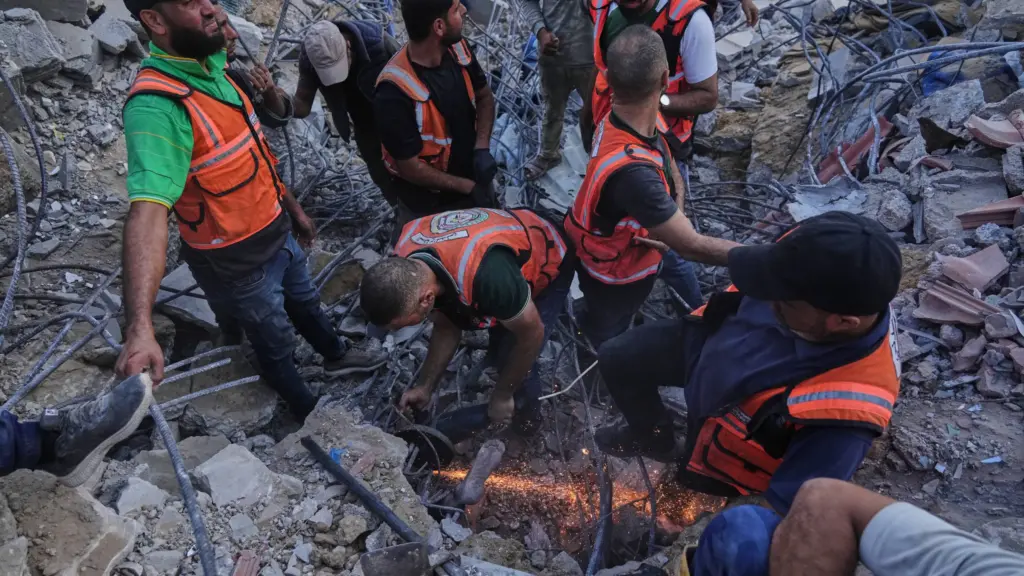
People are reported alive beneath a building damaged by Israeli strikes. Rescuers are struggling for equipment while the chance to save lives remains.
At least 50 children are feared trapped beneath a collapsed residential building in Gaza City, according to an early civil defence estimate, as rescuers struggle to reach people reported still alive under the rubble.
The emergency is unfolding amid Israeli restrictions on the entry of heavy machinery into Gaza, leaving rescue crews short of equipment and some people digging through wreckage by hand. Survivors have already been brought out. Others may still be saved if rescuers can reach them.
“There are people that are still alive,” reporter Hind Khoudary said from Gaza City as the operation continued.
Civil defence teams initially reported around 100 people trapped, including at least 50 children, after the building collapsed at about 1am while displaced families slept inside. Both the number missing and the number surviving beneath the debris remain uncertain.
Twelve people were reported pulled out alive during the early rescue effort. The reported death toll subsequently rose to 16, including at least 12 women and children, according to Gaza’s Health Ministry.
International rescue deployments have followed comparable emergencies elsewhere. When a residential tower collapsed in Surfside, Florida, in 2021, teams from Israel and Mexico joined the search. After the February 2023 earthquake in Turkey, Britain flew in 77 rescue specialists, four search dogs and equipment, arriving the following day.
That British deployment included listening devices to locate survivors, tools for cutting through concrete and equipment to support unstable structures. It demonstrates the specialist capacity governments can mobilise when access and political decisions allow it.
In Gaza City, the available reports describe rescuers trying to assemble whatever equipment they can obtain. No comparable overseas rescue deployment for this collapse has been confirmed in the reporting reviewed for this article.
Khoudary described efforts involving the United Nations Development Programme, Gaza’s municipalities and the International Committee of the Red Cross to mobilise equipment. Their work underlines both the determination to save those trapped and the limits of the resources available.
The restrictions are documented. A UN human rights statement issued on 15 September, before this collapse, said: “Israel refuses entry of heavy machinery for removing the rubble.”
International warnings have therefore been made. They have not secured the access and equipment needed to overcome the shortages confronting Gaza’s rescue services. For people buried alive, the practical test of an international response is whether help reaches them while they can still be rescued.
The building had already been damaged in an Israeli strike. Families sheltered there because Gaza’s destruction and shortage of emergency accommodation left them without a safe alternative.
“This building was partially damaged but families did not have any other choice than to shelter inside this building,” Khoudary said.
“The lack of options and alternatives left them with no other choice,” said civil defence rescuer Aboud Majdalawi.
Residents described preferring the protection of surviving walls to plastic shelters and tents, despite the danger. The structure collapsed while most of those inside were asleep.
The shelter shortage is also being prolonged by restrictions on supplies. A recent UN humanitarian report recorded that Israeli authorities rejected 36,960 pieces of timber and 660 emergency shelter kits on 26 August, then rejected the shipment again when it was presented on 2 September.
At least 400 truckloads were needed to bring in urgent shelter supplies awaiting clearance through the Jordan corridor. Funding shortages were also constraining assistance. Aid deliveries have continued, but remain insufficient for the scale of need.
Civil defence officials warn that more than 2,000 damaged buildings remain dangerous. Gaza City civil defence director Raed al-Dahshan has estimated that at least 400 face an imminent risk of collapse.
At the site of Wednesday’s disaster, the immediate priority remains reaching those who may still be alive. The 12 people already brought out demonstrate why that effort matters.
Governments capable of flying rescue specialists and equipment to disasters elsewhere have the means to help. Securing their deployment and entry into Gaza should be treated with the urgency of a rescue operation in which children’s lives may still be saved. Expressions of concern cannot lift the concrete above them.
Sources: Hind Khoudary’s live report from Gaza City, using the supplied transcript; Associated Press, 16 September 2026; Reuters on the Gaza collapse, 16 September 2026; UN Human Rights Office statement, 15 September 2026; UN OCHA shelter and access update; Reuters on international teams at Surfside, 27 June 2021; UK government account of the Turkey rescue deployment, 7 February 2023.
The figure of 50 children is an early estimate of those trapped, not a confirmed count of survivors. Rescue and casualty figures reflect the reports available during preparation on 16 September 2026.