



Ben Gvir turned the suffering of a woman Israel released in a prisoner exchange and later rearrested into election propaganda, exposing a detention system accused of torture, secret imprisonment and concealing the fate of Palestinians taken from Gaza.

Israel has publicly mocked Palestinian women as they described torture and deprivation inside one of its prisons, including a mother of four whom Israeli authorities released in a negotiated prisoner exchange and then rearrested without putting her on trial for a new offence.
In footage published by National Security Minister Itamar Ben Gvir, Palestinian women at Damon Prison described being denied regular showers, water inside their rooms, adequate medical care and basic personal necessities. In the English captions embedded in the supplied recording, one woman says they face “repression day and night,” that their privacy and personal needs are not respected, and that they have gone three days without showering or changing their underwear. She warns that infections and other diseases will follow while the women receive no treatment.
Ben Gvir, the cabinet minister responsible for the Israel Prison Service, did not dispute the conditions they described or order an investigation, choosing instead to celebrate them. “The good conditions that previously existed in the prisons are over,” he says in the captioned recording. “This is the situation you will face, and I’m responsible for everything.” He then adds that he is happy their conditions have been reduced to the “absolute minimum.” Later, when challenged again, he replies: “Correct. I don’t want to help you, and I don’t need to help you.”
The minister subsequently published the footage through his own social media accounts and dismissed the women’s complaints as “whining.” The video appeared during Israel’s election campaign, less than two months before the country’s scheduled 27 October vote, transforming the women’s inability to wash, obtain treatment or protect themselves from disease into campaign material.
The principal speaker was identified by her husband as Yasmine Shaaban, a Palestinian mother from the Jenin area. Israel released Shaaban in November 2023 as part of the exchange in which Palestinian women and children were freed in return for Israeli hostages held in Gaza. Israeli forces raided her home and arrested her again on 18 May 2025. Her renewed imprisonment was converted into administrative detention, allowing Israel to hold her on secret evidence without presenting a new criminal charge or proving a case in open court.
The other women shown in the footage have not been publicly identified. Ben Gvir’s office described all three as members of Palestinian Islamic Jihad, while the recording shows one woman identifying herself with the organisation. Whatever allegations are made against an individual prisoner, the prohibition against torture and degrading treatment remains absolute, while food, water, sanitation, medical care and women’s hygiene needs are legal obligations rather than privileges to be withdrawn for political revenge.
The spectacle at Damon provides a visible entry point into a much larger detention system. In this instance, the minister wanted the women and their suffering to be seen. Across the same system, however, Palestinians taken from Gaza have frequently been made invisible, leaving relatives unable to establish where they are held, whether they have been injured or whether they are still alive.
For thousands of Palestinian families, Israel’s war in Gaza has produced a form of suffering that cannot be resolved by a funeral, a prison visit or even the confirmation of death. Their relatives have simply vanished, leaving them to search among lists of detainees, hospital records, photographs of unidentified bodies and the ruins of destroyed homes.
On the International Day of the Victims of Enforced Disappearances, Palestinian prisoner organisations warned that this uncertainty is not merely an unavoidable consequence of war. They accused Israel of using enforced disappearance as a systematic policy against Palestinians taken from Gaza, concealing detainees’ identities, locations, health and, in some cases, their deaths.
The joint statement published on 30 August 2026 by Palestinian prisoner organisations described a third consecutive year in which Gaza detainees have been cut off from their families, lawyers and international monitors. Although the organisations have eventually traced some of those taken by Israeli forces, they said the fate and location of hundreds remain unknown.
“The continued concealment of the fate of hundreds is not merely an information gap,” the organisations said, characterising it as a continuing crime enabled by Israeli military practices, emergency legislation and the absence of independent oversight.
The organisations demanded that Israel disclose the names, locations, legal status and health of everyone taken from Gaza; allow the International Committee of the Red Cross, lawyers and human rights organisations into all detention facilities; permit independent investigations into torture and deaths in custody; and return the bodies of Palestinians who died after being detained.
Their warning is supported by evidence gathered well beyond the Palestinian prisoner movement. United Nations experts, Amnesty International, the International Committee of the Red Cross and several Israeli human rights organisations have separately documented prolonged incommunicado detention, restrictions on legal access, allegations of torture and deaths inside Israel’s prison and military detention system.
Yet the precise number of forcibly disappeared Palestinians remains unknown. Gaza’s broader missing-person crisis includes people believed to be beneath rubble, people who vanished while searching for food and people last seen being taken away by Israeli soldiers. Those groups overlap in the anguish experienced by their families, but they are not legally or statistically identical.
Missing, detained or dead beneath the rubble
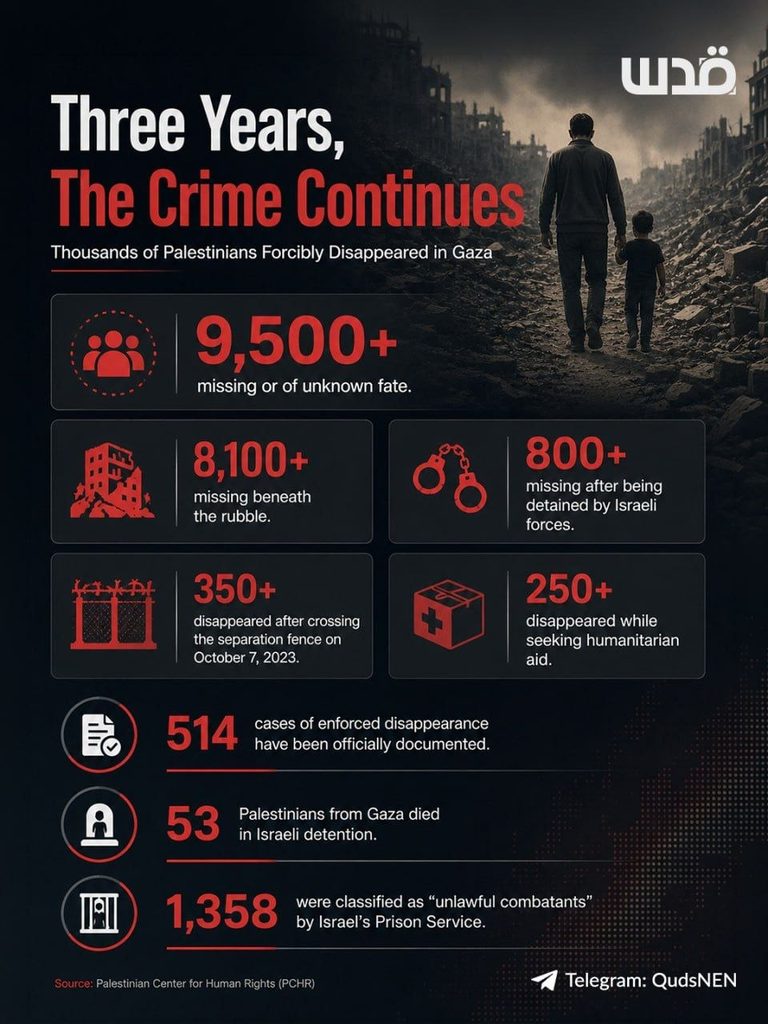
The scale of the uncertainty was illustrated by a June 2026 report from Gaza’s Al-Dameer Foundation for Human Rights, which estimated that more than 9,500 Palestinians were missing or no longer in contact with their families. Approximately 4,700 were reported to be women and children.
Al-Dameer divided the total into several circumstances. More than 8,100 people were believed to remain beneath rubble or in areas that rescue workers could not reach. More than 800 were said to have disappeared after being detained during Israeli ground incursions, while passing through military checkpoints or while travelling between northern and southern Gaza. More than 350 were reported missing after crossing the boundary fence on 7 October 2023, and more than 250 vanished near aid-distribution sites or routes used by humanitarian convoys.
Those figures, subsequently reproduced in a Quds News Network graphic, require careful interpretation. The estimate of more than 9,500 covers all reported missing people; it is not a count of 9,500 confirmed victims of enforced disappearance. People believed to be buried beneath destroyed buildings are missing and presumed dead, but they do not automatically fall within the legal definition of enforced disappearance.
The cases most clearly raising that possibility are those in which witnesses saw Israeli forces take a person into custody, followed by a refusal to acknowledge the detention or disclose the person’s location. Cases involving people who disappeared near aid points, military boundaries or areas of active combat require further investigation to determine whether they were killed, detained or buried without identification.
On 29 August, Al-Dameer director Alaa al-Skafi said the organisation had formally documented 514 suspected cases of enforced disappearance. He said Israeli authorities had not provided information revealing the location or fate of most of the people in that case file.
The figure of 514 comes from Al-Dameer, rather than the Palestinian Centre for Human Rights, as stated at the bottom of the Quds graphic. PCHR reported in August 2025 that it had documented 383 cases, illustrating how different organisations, reporting periods and evidential thresholds have produced different totals.
A new estimate of up to 3,000 suspected disappearances
A separate study released on 30 August by the Palestinian Centre for Missing and Forcibly Disappeared Persons examined a sample of 317 people suspected of having been forcibly disappeared during the war. Based on family reports, field documentation and recurring patterns, the centre estimated that the wider number could be between 2,500 and 3,000.
The centre stressed that this estimate was separate from between 4,000 and 5,000 people it believed remained beneath destroyed buildings. Its lower rubble estimate, compared with Al-Dameer’s June figure of 8,100, demonstrates the absence of a unified registry and the continuing difficulty of identifying bodies, reconciling family reports and removing recovered victims from missing-person lists.
Of the 317 cases examined in the new study, 302 were male and 15 female. The sample included 41 children and 17 people aged 60 or older. Gaza City accounted for 89 cases, northern Gaza for 74, Khan Younis for 59, central Gaza for 37 and Rafah for 32. Other cases involved the boundary area, crossing points, the Netzarim corridor and the Israeli-designated “yellow line.”
The circumstances recorded were equally revealing. Seventy-six people vanished during raids on homes or sieges of neighbourhoods. Sixty disappeared while returning to their homes or retrieving necessities, 42 during displacement or at military checkpoints, and 39 while searching for food or waiting for aid. Twenty-two cases were connected to the siege or storming of medical facilities or the transfer of patients, while ten involved journalists or other field workers.
The centre cautioned that its sample could not be mechanically projected across the entire population and that each case required individual investigation. Nevertheless, it argued that the repetition of similar disappearances across different locations, age groups and military operations warranted an investigation into whether the cases formed part of a broader pattern.
The legal machinery of disappearance
Under international law, enforced disappearance occurs when a state or people acting with its authority deprive someone of liberty and then refuse to acknowledge the detention or conceal the victim’s fate or whereabouts, placing the person outside the protection of the law.
The offence does not depend on proving that the disappeared person was innocent of every suspected act. States may detain individuals under narrowly defined wartime or security provisions, but they must register the detention, treat the person humanely, provide the necessary legal safeguards and allow the person’s fate to be established. Security allegations do not permit a state to make a detainee vanish.
When enforced disappearance is committed as part of a widespread or systematic attack against a civilian population, Article 7 of the Rome Statute provides that it can constitute a crime against humanity.
Palestinian and international organisations say Israel’s Detention of Unlawful Combatants Law has provided the domestic framework for much of Gaza’s incommunicado detention. The law allows people described as security threats to be imprisoned without an ordinary criminal charge or trial on indefinitely renewable orders. Evidence supporting their detention may be withheld from both the detainee and the defence lawyer.
Emergency amendments adopted after 7 October 2023 initially allowed Israeli forces to hold a person for as long as 45 days before issuing a detention order, as long as 75 days before judicial review and up to three months without access to a lawyer. The provisions created a period during which families and legal representatives could be unable to determine whether a missing person was alive or in Israeli custody.
At the beginning of August 2026, Israeli Prison Service data supplied to the Israeli organisation HaMoked recorded 1,358 people held as “unlawful combatants.” The same data listed 3,198 administrative detainees, another category permitting detention without a conventional trial, among more than 9,000 Palestinians in Israeli custody.
The 1,358 figure does not establish how many detainees are currently disappeared. It does, however, confirm the large scale on which Israel continues to employ an exceptional legal classification against people from Gaza.
In a July 2024 investigation, Amnesty International interviewed 27 released Gaza detainees, including women and a 14-year-old boy. They had been held without contact with their families or ordinary access to lawyers for periods lasting as long as four and a half months. Every person interviewed reported torture or other cruel, inhuman or degrading treatment.
Amnesty documented people detained at homes, hospitals, displacement shelters and military checkpoints. Its researchers observed injuries consistent with torture, examined medical evidence and verified videos showing detainees stripped and publicly humiliated. The organisation concluded that the Unlawful Combatants Law enabled arbitrary, incommunicado detention and, in some cases, institutionalised enforced disappearance.

A swap detainee released, rearrested and placed before the cameras
Shaaban’s history illustrates how the machinery of Palestinian detention can move between conviction, negotiated release and imprisonment without a new trial.
Israel first imprisoned her in 2014 and released her in 2019 after she had served five years. She was arrested again in March 2022. In 2023, an Israeli military court approved a plea agreement under which she received a six year sentence and a fine. Israel’s Kan public broadcaster reported that authorities accused her of working with Palestinian Islamic Jihad and recruiting armed cells that planned attacks on Israeli targets.
Shaaban was freed in the November 2023 exchange after serving approximately 21 months of that sentence. Israeli forces raided her home in Al Jalama, north of Jenin, on 18 May 2025 and arrested her again. Ten days later, according to Palestinian prisoner organisations that followed her case, Israel converted her incarceration into an administrative detention order lasting three and a half months. Such orders are based on secret evidence, can be repeatedly renewed and do not require prosecutors to prove a new offence in open court. The International Solidarity Institution for Human Rights reported her detention history and the administrative order.
The video published by Ben Gvir confirms that Shaaban remained imprisoned at Damon in August 2026, although it does not explain the current legal order authorising her detention or provide evidence supporting its continuation.
Her previous conviction does not diminish Israel’s duties toward her in custody. International rules do not divide prisoners into people who possess rights and people whom a minister may deliberately subject to disease, hunger or humiliation. Nor does a prisoner exchange provide moral cover for releasing someone as part of a negotiated bargain and later placing that person back into indefinite detention without a new open trial.
The women’s accounts in the Damon footage were specific. Speaking through an interpreter, Shaaban described repeated incursions into the women’s section, the absence of water inside the rooms, inadequate showers, illness and the failure to provide treatment. The relevant exchange, transcribed from the English captions embedded in the supplied one minute and 52 second recording, begins with an official asking: “How do you find the treatment here, under these circumstances?”
“It’s very bad,” the woman replies. “We face repression day and night. Our situation is extremely bad. We are not even receiving any of our rights. Especially, as women, we have needs and privacy that are not being respected.” Asked for examples, she says: “Everything: our personal needs, including using the bathroom. Today is the third day that we haven’t showered, and haven’t changed our underwear. There will certainly be infections, many diseases, and we are not being treated either.”
Ben Gvir answers: “Let me tell you one thing. The good conditions that previously existed in the prisons are over. This is the situation you will face, and I’m responsible for everything.” He continues: “I’m happy that they have reduced your good conditions to the absolute minimum.” Later in the clip, after further argument, the captions record him saying: “Correct. I don’t want to help you, and I don’t need to help you. You kidnapped our children. Why should I help you? Those days are over.”
That accusation is collective rather than individual. Ben Gvir addresses the women as though they personally carried out the abductions of 7 October, but the recording presents no evidence that Shaaban abducted anyone or had any direct role in the attack. She is from the Jenin area of the occupied West Bank, not Gaza, and the previous case reported against her concerned alleged work with Palestinian Islamic Jihad and the recruitment of armed cells said to have planned attacks on Israeli targets, not the taking of hostages from southern Israel.
Gaza and the West Bank are treated under international law as parts of the occupied Palestinian territory, but Israel has spent decades restricting movement between them and physically separating their Palestinian populations. Even before 7 October 2023, Palestinians could travel between the two areas only with Israeli permission and within narrow categories defined by Israel. Since the attack, Israel has imposed what the Israeli human rights organisation Gisha describes as a “near total ban” on movement between Gaza, Israel and the West Bank, including in urgent humanitarian cases. The restrictions make any suggestion that a West Bank prisoner simply participated on the ground in events inside Gaza particularly untenable without specific evidence.
Affiliation with the same political or armed organisation would not establish personal responsibility for a hostage taking committed elsewhere. By saying “you kidnapped our children” without identifying an individual act, Ben Gvir converts crimes attributed to armed groups in Gaza into a justification for punishing Palestinian women in his custody. It is the rhetoric of collective punishment: individual conduct and evidence disappear, while an entire category of prisoners is made to answer for events in which they are not shown to have participated.
The wording matters. The recording does not show Ben Gvir literally saying that he personally ordered prison officials to deny the women food and water, nor does he call their treatment illegal. What it does show is the minister responsible for the prison service accepting responsibility for the regime immediately after a prisoner describes deprivations that put women at risk of disease, then publicly expressing satisfaction with those conditions. Separate reporting on the same footage records Shaaban saying there was no water inside the rooms, while the wider prison system has been accused of systematically restricting both water and food.
Ben Gvir sought to justify the prison regime by invoking the treatment of Israeli hostages held in Gaza. Those hostages endured hunger, violence, humiliation and prolonged deprivation, but their abuse cannot justify reciprocal mistreatment of people under Israeli control. The prohibition against torture is not conditional on the conduct of an opposing party, while collective punishment is forbidden under international humanitarian law.
Ben Gvir nevertheless used the hostages’ suffering to defend his own policy. His office told the Jerusalem Post that Palestinian prisoners would receive the minimum required by law and nothing beyond it. He presented reductions in conditions as a deliberate programme rather than an accidental consequence of overcrowding or wartime pressure.
The conditions behind the boast
Damon Prison, near Haifa, holds most of the Palestinian women incarcerated by Israel. A June 2026 report from the Palestinian Commission of Detainees and Former Detainees Affairs said 87 women were then held there, including three from Gaza, with administrative detainees comprising approximately one third of the total.
Lawyers who visited the prison described overcrowded cells, extreme heat, poor ventilation, inadequate medical treatment and shortages of clothes, personal belongings and essential hygiene supplies. The women were reportedly allowed one hour outside their cells each day, during which they were expected to take both recreation and showers. The Commission’s report expressed particular concern about pregnant detainees and women requiring specialist treatment.
Teacher and mother of four Lina Mohammad Wazwaz told a lawyer that some women were forced to sleep on the floor and that even obtaining painkillers was severely restricted. She alleged that armed prison units conducted violent raids and that she suffered a facial injury during one such operation in June. The allegations cannot independently establish every detail of Shaaban’s treatment, but they closely match the conditions described directly to Ben Gvir.
Evidence of serious mistreatment extends beyond Damon. In a formal communication to the Israeli government in March 2026, the United Nations special rapporteurs on torture and on extrajudicial executions described allegations of physical and psychological torture, degrading treatment, medical neglect, starvation and deaths in custody. They warned that the accumulated evidence suggested either grave neglect or, more seriously, a policy that encouraged or institutionalised torture and cruel treatment with support from ministerial and operational authorities.
The UN communication cited findings from Israel’s own Public Defender’s Office, including severe overcrowding, deteriorating sanitation, bed bugs, scabies, insufficient ventilation, restricted drinking water, inadequate healthcare and serious limitations on cleaning and hygiene supplies. The UN Committee Against Torture separately raised concerns about Palestinian women’s access to feminine hygiene products and gynaecological care.
Israel’s Supreme Court ruled in September 2025 that the government had failed to provide thousands of Palestinian prisoners with sufficient food and that the deprivation had caused malnutrition and starvation. Five months later, lawyers and released detainees told Reuters that severe hunger continued despite the order.
The Israel Prison Service rejected allegations of starvation or systematic neglect and said it provided food, healthcare and adequate living conditions in accordance with the law. Ben Gvir’s own words complicate that denial because he has repeatedly described reductions in food, shower time and other conditions as a political achievement. When Shaaban explained the consequences inside Damon, he did not contradict her but claimed responsibility for the policy.
Independent domestic oversight has also been weakened. In May 2026, the Association for Civil Rights in Israel said Ben Gvir had failed to appoint official prison visitors from the Ministry of Justice since the beginning of the year and had not appointed visitors from the Israel Bar Association since early 2023. The organisation argued that these appointments were a legal duty and that the absence of inspectors removed another safeguard against abuse.

The political purpose of the Damon recording is difficult to separate from its timing. Israel’s parliamentary election is scheduled for 27 October 2026. The video was published on 30 August, although Ben Gvir’s office said the visit occurred several weeks earlier. Released through the minister’s own political platform, it offered voters a visual demonstration of his authority over captive Palestinian women and promoted vengeance as a measure of effective government.
The Palestinian Prisoners’ Club described the filming and publication as an assault on the women’s dignity. In the broader context of secret detention, the episode exposes two sides of the same system. Some Palestinians are hidden so completely that their families cannot determine whether they are alive, while others are deliberately displayed when their humiliation can serve the political interests of the minister controlling their confinement.
The Red Cross shut out
The International Committee of the Red Cross has traditionally served as an independent channel between detainees and their families, registering prisoners, monitoring detention conditions and facilitating contact. After 7 October 2023, Israel stopped ICRC visits to Palestinian detainees in Israeli prisons and military detention centres.
In a public explanation issued in November 2025, the ICRC said it had not been able to visit any Palestinian detainee in Israeli places of detention since the beginning of the war. It repeatedly asked Israeli authorities to notify it about detainees, permit visits and allow detainees to communicate with relatives.
The blackout remained in place even as evidence of abuse accumulated. Families were frequently forced to rely on released prisoners, informal messages and expensive legal searches to discover whether their relatives were alive.
On 3 June 2026, Israel’s Supreme Court unanimously ruled that the blanket ban contravened Israeli and international law and must be repealed. The Association for Civil Rights in Israel, which participated in the legal challenge, said the judgment should allow more than 9,000 Palestinian detainees to receive Red Cross visits for the first time in nearly three years.
The Israeli government had defended the ban on security grounds and linked it to the refusal of Hamas and other Palestinian armed groups to grant the ICRC access to Israeli hostages held in Gaza. The court determined that these considerations did not provide a lawful basis for a comprehensive prohibition on visits to Palestinian prisoners.
Palestinian prisoner organisations reported on 16 August that the visits still had not resumed. Their 30 August statement again demanded immediate ICRC access, indicating that the Supreme Court victory had not yet produced the independent scrutiny sought by detainees and their families.
A death hidden for nearly two years
The case of Gaza journalist and photographer Ehab Mohammed Diab demonstrates how the concealment of detention can continue after death.
Israeli forces detained Diab in front of his family on 12 December 2023. When legal organisations later sought information about him, Israeli authorities reportedly responded that there was no indication he had been arrested or detained, despite witnesses having seen soldiers take him away.
His family searched for him for almost two years. In August 2026, Israeli authorities finally acknowledged that Diab had died in custody and that his body was being held. Palestinian prisoner organisations believe he may have died on 18 September 2024, meaning his family spent nearly two years seeking a man who had already been dead for most of that time.
Israeli authorities reportedly attributed his death to a health condition. His family rejected that explanation, saying he had been healthy when detained, and called for an independent investigation and the return of his body.
The Committee to Protect Journalists has also demanded an explanation of Diab’s death, the release of his remains and an investigation into the deaths of Palestinian media workers in Israeli custody.
Diab’s case is not isolated. The Palestinian prisoner organisations’ 30 August statement counted 53 identified Gaza residents among 99 Palestinians known to have died in Israeli custody since October 2023. These are identified cases and do not include every person whose death may remain concealed.
Physicians for Human Rights Israel reached a similarly grave conclusion through a different evidential process. In a report covering the period to August 2025, the Israeli medical rights organisation documented 94 deaths, followed by four additional cases. It said 46 occurred in Israel Prison Service facilities and 52 in military custody, with all 52 military detainees originating from Gaza.
Post-mortem findings, medical records and testimony collected by the organisation pointed to severe physical violence, internal injuries, broken bones, extreme malnutrition and denial of essential care in multiple cases. PHRI said the true total could be higher because people taken from Gaza continued to be concealed from their families and monitoring organisations.
The Israeli Prison Service has rejected allegations of a systematic torture policy. In responses to Israeli and international reporting, it has said that prisoners are held according to law, that detention facilities are subject to oversight and that specific complaints submitted through official channels are examined. The Israeli military has similarly maintained that detainees are held for security reasons and that allegations of abuse are investigated.
Those denials have not resolved the central transparency problem. Families cannot submit detailed complaints about a detention they have not been told exists, challenge secret evidence they cannot see or request an autopsy when a body remains withheld.
UN experts warn of a wider pattern
On 18 July 2025, United Nations experts reported that approximately 4,000 Palestinians, including children and older people, and 51 Israelis remained missing following 7 October 2023. They called on authorities in both Israel and the occupied Palestinian territory to disclose the fate and whereabouts of every person subjected to disappearance.
The experts described widespread patterns of enforced disappearance affecting Palestinians in Gaza and elsewhere in the occupied territory, including healthcare workers, journalists, women and children. They warned that legislation permitting indefinite detention without trial, the obstruction of legal access and the failure to provide reliable detention records had created conditions in which people could be removed from the protection of the law.
The UN statement also addressed Israeli hostages taken by Hamas and other armed groups, whose concealment and denial of access likewise violated international law. The prohibition on enforced disappearance applies to state authorities, while hostage-taking and comparable concealment by armed groups are prohibited under international humanitarian and criminal law.
For Palestinian families searching for relatives held by Israel, however, the state’s comprehensive administrative, military and technological capacity makes its failure to provide answers particularly consequential. Israeli agencies maintain prison databases, military records, surveillance systems and legal mechanisms capable of tracking detainees, yet families and lawyers continue to receive responses stating that no information exists.
US students turn decisively against the Israeli government
The footage from Damon and the continuing concealment of Gaza detainees are emerging at a moment when Israel faces a profound generational shift in opinion abroad, particularly among young Americans.
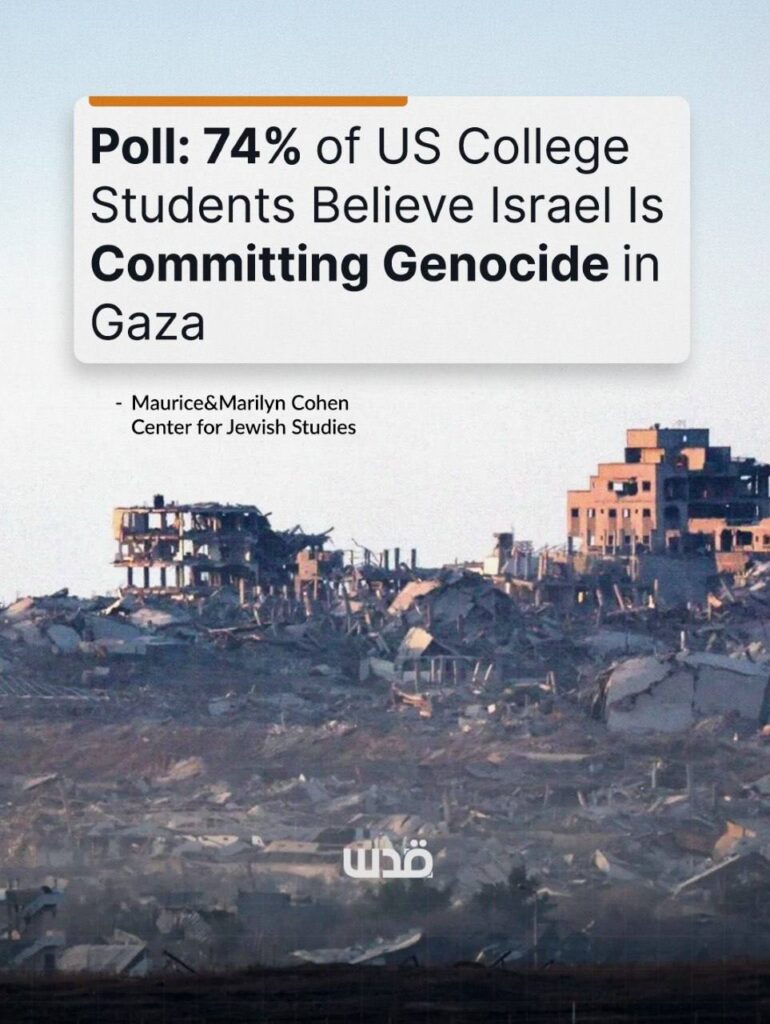
A major study released in August 2026 by Brandeis University’s Maurice and Marilyn Cohen Center for Modern Jewish Studies found that 74 percent of American undergraduates agreed that Israel was committing genocide against the Palestinian people. Eighty two percent supported the Palestinians’ right to self determination in a Palestinian state.
The findings came from an online survey of 3,989 undergraduate students attending 303 four year US colleges and universities. Generation Lab collected responses between 27 October 2025 and 20 January 2026. The poll combined a two stage probability sample of 3,262 students with a nonprobability sample of 727 and included an oversample of 743 Jewish students. Researchers applied weights, including a correction for the Jewish oversample, to reflect the characteristics of undergraduates at the institutions studied.
The timing requires clarification because some reports have described the poll as having been conducted in August. The survey was conducted during the 2025 to 2026 academic year. August was when the Brandeis report was published.
The results showed a collapse in approval of the Israeli government. Seventy-seven percent of students held favourable views of the Palestinian people, while only 15 percent viewed the Israeli government favourably. Forty-six percent said their opinion of that government was very unfavourable. Hamas was also deeply unpopular, receiving favourable responses from only 18 percent.
Crucially, the findings demonstrated that most students distinguished between governments and civilians. Fifty-two percent expressed favourable views of the Israeli people, far above the 15 percent recorded for the government. Forty-one percent viewed the Palestinian Authority favourably, compared with 77 percent for the Palestinian people. The findings therefore cannot credibly be reduced to indiscriminate hostility toward Israelis or Jewish people.
The researchers cautioned that students’ attitudes were more complex than conventional political labels suggested. Only 24 percent said Israel and Palestine was very important to them personally, while 43 percent considered themselves knowledgeable about the subject. Political ideology was a stronger predictor of agreement with the genocide statement than the researchers’ broader categories of support for Israel or Palestine.
Even so, the scale of the shift is unmistakable. Nearly three quarters of respondents accepted the description of genocide, and more than four fifths supported Palestinian national rights. Only nine percent fell into the report’s category of broadly defined “Israel Supporters.” Even within that group, 25 percent agreed that Israel was committing genocide and 60 percent supported Palestinian self determination.
The survey predates Ben Gvir’s Damon video and cannot show that this incident, or any other single image, caused those views. It does reveal the environment into which the footage has been released. A younger American generation increasingly separates Israeli civilians from the conduct of the state, while rejecting the claim that criticism of the government, its war or its prison system automatically amounts to hostility toward Jewish people.
Ben Gvir evidently calculated that humiliating Palestinian prisoners would produce electoral rewards inside Israel. Abroad, the same performance may deepen the political isolation captured in the Brandeis findings. A government that films itself dismissing women’s complaints about disease and lack of hygiene, while hundreds of Gaza families cannot establish whether detained relatives are alive, is supplying its critics with evidence produced by its own officials.
The right to know
The demands issued on 30 August extend beyond the release of living detainees. The prisoner organisations want Israel to provide complete lists of prisoners and detention sites, disclose deaths and their circumstances, permit private meetings with lawyers and ICRC representatives, and return the bodies of those who died.
They are also seeking an independent international mechanism capable of receiving family reports, reconciling missing-person databases, examining Israeli detention records, preserving evidence and investigating suspected deaths, torture and secret burials.
Gaza’s devastated forensic infrastructure makes that work urgent. Thousands of bodies remain inaccessible or unidentified, while equipment required for excavation, DNA testing and the secure preservation of remains is scarce. Without a unified registry and access to Israeli records, estimates will continue to diverge and families will remain trapped between hope and mourning.
The uncertainty is itself a form of punishment. A confirmed death permits burial and mourning, while an acknowledged detention permits legal representation and the possibility of contact. Enforced disappearance denies both, compelling relatives to live indefinitely with the possibility that a loved one may be imprisoned, injured, dead or waiting for help.
Three years after the first mass arrests from Gaza, the most basic question remains unanswered for hundreds of families: where are their loved ones, and what happened to them?
The Damon footage supplies another question that Israel’s leaders must answer. When Palestinian detainees are visible, why is their suffering treated as campaign entertainment, and when they are hidden, why are their families denied even the knowledge required to search for them? Together, the public humiliation of women and the secret confinement of Gaza detainees reveal a system in which Palestinian captivity itself has become both an instrument of punishment and a political performance.