


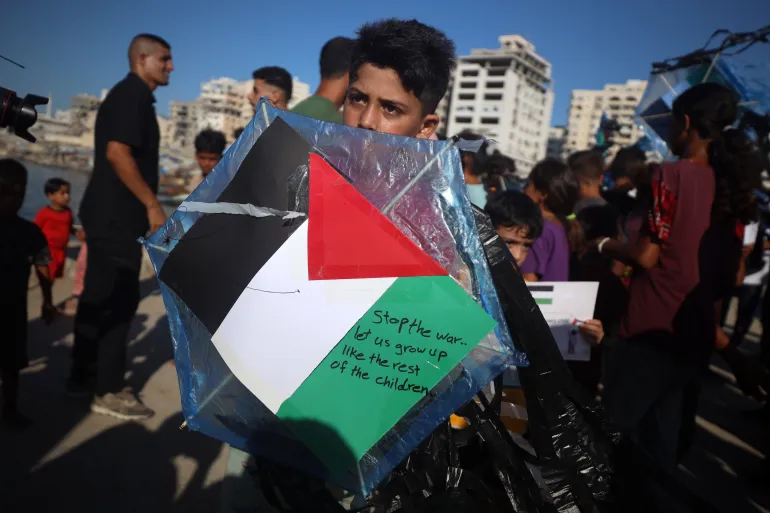
Israel says paper kites drifting out of Gaza must be treated like drones, even though its military found no explosives or other dangerous material on those recovered. For children living among tents and ruins, a cheap homemade toy has now become another source of fear.
In Gaza, where homes have been reduced to rubble, schools have been destroyed or damaged and hundreds of thousands of children have spent almost three years surrounded by death and displacement, a kite is one of the few toys that requires almost nothing.
It can be fashioned from scraps of plastic, paper, sticks and string, with the breeze from the Mediterranean doing the rest. For a child living in a tent, it offers a brief illusion of freedom above a territory whose people remain confined on the ground, yet now even that small pleasure has become dangerous.
Parents and community representatives in Gaza have told children to stop flying kites after Israel’s political and military leadership warned that objects crossing the perimeter would trigger forceful action. Some children have reportedly torn up or put away their kites because their families fear they could be attacked, or that their neighbourhoods could be bombed and evacuated.
A Sky News report from Gaza recorded the warning in the words of the children it reached. One boy said, according to the report’s English subtitles:
“Today we wanted to fly our kites and suddenly my brother came and told me not to. He said my dad would take it away and break it. It’s because the Israelis just banned kites. I said, ‘Why?’ They’ve already taken away everything we do for fun.”
Another child described how little remained outside the tents:
“There’s no school, no entertainment, nothing. We just sit in our tents. I hope we can fly kites again like we used to, and just be happy.”
Their testimony transformed an argument about border security into something immediate and domestic: a brother carrying a warning, a father preparing to destroy a toy and children asking why another form of play had been taken from them.
The warning followed reports that several kites had drifted from Gaza into the Israeli community of Nahal Oz. The Israeli military inspected them and, according to subsequent reporting, found “no suspicious elements” and “no danger”. They were not carrying incendiary devices or explosives.
That did not moderate the response from Israel’s Defence Minister, Israel Katz. In a social media statement issued alongside Prime Minister Benjamin Netanyahu, Katz said the Israel Defense Forces had been instructed to adopt a policy of “zero tolerance and zero containment” toward kites and balloons launched from Gaza.
“A balloon and a kite shall be treated the same as a drone, with or without explosives,” Katz declared.
The distinction contained in those final words is the source of the alarm. Israel is not merely reserving the right to intercept an incendiary device or an explosive payload. Its defence minister has explicitly said that a kite may be treated as a military threat even when it carries no explosive at all.
The government also warned that it could expand assassination operations and order further evacuations from areas it identifies as launch sites. The language effectively places children flying ordinary kites inside a military framework, regardless of whether the objects are demonstrably harmless.
British journalist and commentator Owen Jones addressed the controversy in a sharply critical edition of his podcast, arguing that the threat must be understood within the wider record of Palestinian children killed, injured, orphaned, displaced and deprived of basic services during Israel’s assault on Gaza.
Jones’s central contention was that an apparently absurd story about a powerful military confronting children’s toys is not absurd to the children who must decide whether play could bring an air strike. His commentary also challenged media reports that presented the dispute principally as an Israeli security and electoral issue, rather than as a threat experienced by a traumatised civilian population.
From Toy to “Security Threat”
Israel says its concern is rooted in a real precedent. During the Great March of Return demonstrations in 2018 and 2019, some Palestinians attached burning material to kites and balloons and allowed the wind to carry them across the perimeter. The devices caused fires in fields and woodland in southern Israel.
That history is repeatedly invoked by Israeli officials when kites appear near Gaza’s boundary. Israeli communities close to the territory also remain deeply traumatised by the events of 7 October 2023, when Hamas fighters, members of other Palestinian armed groups and unaffiliated Palestinians breached the perimeter, attacked civilian communities and military positions, and took approximately 250 soldiers and civilians captive.
Israeli authorities ultimately placed the number of civilians, security personnel and foreign nationals who died during the Palestinian assault and the chaotic Israeli military response at approximately 1,190. That total should not be presented as the number killed exclusively by Palestinian attackers. A United Nations Commission of Inquiry found that Israeli forces applied the so called Hannibal Directive in several locations and killed at least 14 Israeli civilians. Subsequent Israeli reporting documented orders to fire on vehicles returning towards Gaza, despite the risk that they carried captives, as well as tank fire during a hostage standoff at Kibbutz Be’eri. The full number of Israelis killed by Israeli fire remains unknown, meaning the number directly killed by Palestinian attackers was lower than the overall official death toll, although the available evidence does not establish a definitive figure of approximately 1,050.
Those facts provide important context for Israeli fears. They do not, however, erase the difference between an incendiary device and an ordinary kite. The Israeli military was able to inspect the latest objects and establish that they contained no suspicious material. A modern surveillance and targeting apparatus can also distinguish a visible flaming payload from a lightweight toy carried by the wind.
Hamas denied organising the recent kite launches and described them as the activity of children trying to find fragments of childhood among the ruins. Israel, in turn, accused Hamas of reviving earlier tactics and cynically exploiting children.
Local popular committees overseeing displacement camps and shelters subsequently urged families to prevent kite flying. The committees said the appeal was not intended to restrict children, but to protect their lives. Reuters reported that the request was coordinated with the Hamas authorities.
The result is that children who had no role in the political decision making of Hamas or Israel are once again carrying the consequences. The object in their hands may be harmless, but the threat directed at it is not.
The Great March of Return
The history of incendiary kites cannot be separated from the history of the protests during which they appeared.
The Great March of Return began in March 2018 as a mass mobilisation against Israel’s blockade of Gaza and in support of the claimed right of Palestinian refugees to return to the homes and land from which they or their families were expelled. Although some participants threw stones, approached or damaged the fence, used incendiary devices or engaged in armed activity, the United Nations commission that investigated the demonstrations described them as civilian in character.
Israeli forces responded with tear gas, rubber coated bullets and extensive sniper fire. By the end of the protest period, UN humanitarian officials recorded 214 Palestinians killed, including 46 children, and more than 36,100 injured, including nearly 8,800 children. More than 8,000 people were hit by live ammunition. One Israeli soldier was killed and seven Israelis were injured during the demonstrations.
The United Nations Commission of Inquiry examined the earlier period through the end of 2018 and found that Israeli snipers had shot more than 6,100 demonstrators with live ammunition. It said it had reasonable grounds to believe that snipers fired on children, journalists, health workers and people with disabilities despite seeing that they were recognisable as such.
The pattern of wounds also became a defining feature of the demonstrations. Amnesty International reported that about 80 per cent of live ammunition injuries were to the lower limbs. Gaza’s hospitals treated shattered bones, extensive tissue damage and infections, while many patients required repeated surgery or amputation.
Incendiary kites did cause property and environmental damage inside Israel. Yet the casualty figures show the vast imbalance in human cost surrounding the protests. Reviving the imagery of 2018 without recalling the Palestinians killed and maimed during the same period produces a partial history, one that transforms an Israeli security memory into the entire story and removes the conditions in Gaza from view.
Childhood Under a Ceasefire
The present warnings have landed in a territory where childhood has already been profoundly altered.
By February 2026, UNICEF reported that at least 21,289 children had been killed in Gaza since October 2023, based on reported casualty data. At least 44,500 children had been injured. The agency cautions throughout its reporting that these are reported figures compiled during a conflict in which bodies remain under rubble and full verification is extraordinarily difficult.
In an October 2025 assessment, UNICEF said 64,000 children had reportedly been killed or maimed, including at least 1,000 babies. The agency said the figure could not account for children who died from preventable illness or remained buried beneath destroyed buildings.
The current ceasefire, announced on 10 October 2025, reduced the scale of major military operations and allowed more aid and commercial supplies to enter. It did not bring an end to killing.
On 6 August 2026, UNICEF said at least 300 children had reportedly been killed during the first 300 days of the ceasefire, an average of one child each day. “A ceasefire that leaves an average of one child dead each and every day is failing children,” said Edouard Beigbeder, UNICEF’s regional director for the Middle East and North Africa.
The United Nations Office for the Coordination of Humanitarian Affairs reported 1,259 Palestinian fatalities and 4,148 injuries between the announcement of the agreement and 12 August. By the week of the kite dispute, Reuters placed the reported Palestinian death toll above 1,280, alongside four Israeli soldiers killed during the same broad period.
The timing of the kite warning made it more than an abstract threat. Israeli strikes on 23 August killed at least two Palestinians, including a boy aged four, and injured seven others, according to Palestinian health officials cited by Reuters. The following day, medics reported that Israeli fire killed two more young children. Israel said it was attacking Hamas targets and responding to security threats; its military did not confirm the circumstances of every child’s death.
For families in Gaza, these distinctions arrive after nearly three years of bereavement, repeated displacement and bombardment. Many children have lost parents, siblings or extended family. Many are homeless, living in overcrowded tents without reliable sanitation, health care or education. Some have amputations, burns, spinal injuries or untreated illnesses. Almost every child has been exposed to experiences that would be considered exceptional trauma anywhere else.
UNICEF says prolonged hostilities and repeated displacement have left almost every school in Gaza destroyed or severely damaged. Approximately 658,000 school aged children need restored access to learning. For many, ordinary routines that help a child understand the world, including school, play, sleep, family meals and a stable home, have disappeared together.
Restrictions affecting childhood long predate the present war. At different stages of Israel’s blockade, goods barred or severely restricted have included toys, footballs, crayons, children’s books, notebooks, A4 paper, computers, musical instruments, school furniture, chocolate, sweets, nappies and baby bottles. Humanitarian organisations have also reported the rejection or delay of neonatal ventilators, oxygen cylinders, water filtration equipment, wheelchairs and other essential medical supplies. Israel has justified many restrictions by classifying goods as nonessential or potentially usable for military purposes. The Israeli human rights organisation Gisha documented the shifting prohibitions, while aid organisations criticised a system they described as opaque, inconsistent and far broader than internationally accepted controls on items with both civilian and military uses.
A kite in this setting is not merely a toy. It is one of the few activities still available to a child without a school, a playground or money. This explains why the order to put kites away has resonated far beyond the handful of objects that crossed the perimeter.
Hunger’s Long Shadow
The humanitarian situation has improved in some respects since the 2025 ceasefire. More food and nutritional support have entered Gaza, and acute malnutrition among children in accessible areas has fallen from its worst levels.
The improvement should not be mistaken for recovery. A population survey conducted between 31 May and 15 June 2026 found that 12.2 per cent of children under five were affected by chronic malnutrition, or stunting. Stunting reflects the cumulative effects of poor nutrition and illness and may cause irreversible harm to physical growth, cognitive development, learning and health.
Only 22.4 per cent of children aged between six and 23 months received a minimum acceptable diet, while 73 per cent had consumed unhealthy food during the previous day. More than a third of children under five had suffered diarrhoea during the preceding two weeks.
UNICEF said the survey covered accessible areas containing about 83 per cent of Gaza’s population, following a substantial expansion in assistance. It warned that the relatively low level of acute malnutrition did not mean the nutrition crisis had ended. The findings instead suggested that sustained aid had prevented a further deterioration among people humanitarian workers could reach.
The distinction matters. Children may no longer show the same immediate signs of starvation recorded during the famine of 2025, yet the damage accumulated during months of deprivation does not vanish when more food arrives. Stunting, developmental delay and chronic illness can accompany a child for life.
Water, Injury and the Destruction of Civilian Life
The kite controversy also unfolded as Israel intensified strikes across Gaza, including attacks on religious sites and infrastructure.
Palestinian officials said an Israeli strike hit a municipal desalination plant in Gaza City’s Sheikh Radwan neighbourhood, cutting a source of drinking water used by thousands of residents and displaced families. Israel said it did not deliberately target the plant. Its military also said it had struck weapons storage facilities used by Hamas inside two mosques, alleging that assault rifles, explosives and ammunition had been concealed there.
Palestinian accounts said the targets included the historic Abu Salim Mosque in Deir al Balah and a makeshift prayer hall constructed from wood and nylon. Video showed extensive destruction and religious texts scattered among the debris. Under international humanitarian law, civilian infrastructure and places of worship are protected from attack, but that protection may be lost when a site is used for a military purpose. Even then, an attacker remains bound by the rules of distinction, proportionality and precautions to protect civilians. The existence and military significance of Israel’s claimed weapons stores require independent scrutiny.
The destruction of water infrastructure is especially serious in Gaza. OCHA reported on 14 August that 90 per cent of the population experienced moderate to high water insecurity in early July, up from 84 per cent a month earlier. Families faced frequent and unpredictable interruptions to safe water for drinking, cooking and hygiene.
The control of water extends beyond pipes and desalination plants to the Mediterranean itself. In July 2025, IDF Arabic language spokesman Colonel Avichay Adraee reiterated that strict security restrictions applied along Gaza’s entire coast and declared that “entry into the sea is prohibited”. He urged fishermen, swimmers and divers to stay out and warned that entering the sea exposed them to danger. The Times of Israel reported an important qualification: in practice, the prohibition was enforced against fishing and people heading into deeper water, not Palestinians merely cooling off at the water’s edge.
It was not an isolated order. UN humanitarian monitors recorded that Israel prohibited all fishing off Gaza on 4 May 2019, after first reducing the permitted southern fishing zone from 15 to six nautical miles. The following month, Israel imposed a full naval closure, reportedly in response to incendiary balloons. Gisha’s chronology records a sweeping ban on fishing from June to October 2006 after the capture of Israeli soldier Gilad Shalit, while its wider documentation shows fishing limits repeatedly shifting between narrow zones and complete closure.
The precise point is not that Palestinians have always been barred from standing on the sand. Israel has repeatedly prohibited Palestinians in Gaza from fishing, sailing, swimming or otherwise entering the sea, sometimes across the entire coastline. Restrictions on standing or gathering on the beach itself have been less uniform and have often depended on local evacuation orders or military zones.
For families unable to obtain enough safe water for drinking and washing, the juxtaposition is bleakly absurd. Residents can be denied reliable freshwater while also being told not to enter the Mediterranean beside their own coastline. The sea offers neither potable water nor an unrestricted route beyond Gaza; it becomes one more part of ordinary life governed by a shifting military order.
The same report described the enormous burden of permanent injury. A quarter of Palestinians injured since October 2023 were estimated to be living with potentially life changing conditions, including amputations, spinal cord injuries and traumatic brain injuries. Children accounted for 18 per cent of amputations and 31 per cent of spinal cord and traumatic brain injuries, while specialised paediatric rehabilitation was unavailable inside Gaza.
Overall, approximately two per cent of Gaza’s prewar population, equivalent to roughly one person in every 50, was estimated to be living with a severe conflict related injury.
These figures give substance to Jones’s argument that the dispute cannot be reduced to the flight path of a few kites. The children holding the strings live inside a society in which disabling injury, contaminated water, hunger, homelessness and bereavement have become widespread.
A UN Finding of Deliberate Attacks on Children
The strongest element of Jones’s commentary concerned the allegation that Palestinian children have not merely died as an incidental consequence of war, but have been deliberately targeted.
In June 2026, the United Nations Independent International Commission of Inquiry reported that Israeli authorities and security forces had deliberately targeted Palestinian children and committed genocide and other atrocity crimes. Its findings drew upon detailed case studies and a wider assessment of conduct in Gaza.
Israel has consistently rejected allegations of genocide and intentional attacks on civilians. It says its war is directed against Hamas, that Hamas embeds military activity within civilian areas, and that the IDF uses warnings and other precautions to reduce civilian harm. Israeli officials have also accused UN bodies of institutional bias and disputed the methodology and legal conclusions of international investigations.
The Commission’s conclusions nevertheless form part of a growing body of international legal scrutiny. In November 2024, the International Criminal Court issued arrest warrants for Netanyahu and his then defence minister, Yoav Gallant. The judges found reasonable grounds to believe that both men bore criminal responsibility for the war crime of starvation as a method of warfare and for crimes against humanity including murder, persecution and other inhumane acts. The warrants concern allegations, not convictions, and both men reject the charges.
Katz’s declaration that he is “not Yoav Gallant” was presented as a promise that the current defence minister would not repeat what he characterised as the permissive policies preceding 7 October. He said Israel had established a security zone cleared of residents and militant infrastructure, with Israeli forces controlling territory to protect soldiers and nearby communities.
For Palestinians and international rights monitors, that “clean” security zone has another meaning. It represents extensive destruction of homes and civilian infrastructure, forced displacement and the permanent contraction of the land in which Gaza’s population can live. UN experts reported in late 2025 that at least 92 per cent of housing units had been destroyed or damaged, more than 90 per cent of the population had been displaced and large areas had been placed under evacuation orders or incorporated into Israeli controlled zones.
Nasser Hospital and the Battle Over Evidence
Jones also placed the kite controversy within what he described as a repeated cycle: an attack produces public outrage, Israel issues an immediate security justification, contradictory evidence emerges later, and the correction receives far less attention than the original claim.
The strike on Nasser Hospital in Khan Younis on 25 August 2025 has become one of the clearest examples.
Israeli fire struck an exterior staircase used by journalists, killing Reuters cameraman Hussam al Masri. A subsequent strike hit as journalists, medical workers and rescuers gathered at the scene. Twenty two Palestinians were killed, including five journalists, and dozens were injured. Images of the second strike were broadcast live.
Israel initially said troops had targeted a camera used by Hamas for surveillance. Netanyahu called the deaths a tragic mishap, while the military said it did not deliberately target journalists and began an investigation.
The camera belonged to Reuters, and later investigations found no public evidence tying it to Hamas. Reuters reconstructed the attack and reported that troops had fired without the approval required under Israeli military procedures. It also found that the second strike hit the staircase while responders were recovering Masri’s body.
One year later, the Associated Press reported that the Israeli military had produced no concrete evidence linking the camera or any of those killed to Hamas. An Israeli soldier familiar with internal discussions told the agency, on condition of anonymity, that none of the six people Israel later identified as militants had been the intended targets of the strikes.
Among the dead was Mariam Abu Dagga, a visual journalist who worked for the Associated Press and other news organisations. Her photographs documented injured and malnourished children inside the same health system that was being steadily dismantled around her.
The absence of accountability a year later reinforces the concern that delayed corrections cannot repair the consequences of an attack. Nor can they compete easily with an official claim issued immediately, when international attention is greatest and military authorities possess the information needed to shape the first news cycle.
When the Story Becomes Reputation Management
Media framing sits at the centre of the controversy. The BBC headline, “Israel warns of ‘forceful’ response to kites flown from Gaza,” accurately described the official announcement, but critics argued that the neutral construction obscured the radical imbalance between the actor issuing the threat and the children affected by it.
Sky News carried the translated words of both children who spoke in its report, allowing their fear, frustration and hope to remain part of the story. It also noted the electoral context. Katz and Netanyahu face an Israeli election, and their forceful language allows them to present themselves to voters as uncompromising guardians of border security.
That political context is relevant, but it can also become a form of distance. Describing threats against children’s kites as an electoral message risks translating a question of civilian protection into campaign strategy. It explains what the politicians may hope to gain without fully confronting what Palestinian families stand to lose.
The same tension appeared in recent comments by Hillary Clinton. The former US secretary of state said there should be no doubt about “how seriously Netanyahu has damaged, first and foremost, Israel”, as well as global perceptions of the country. She added that the damage to Israel’s image “has to be repaired.”
Jones objected that such language treats Palestinian suffering as a reputational problem for Israel and its principal ally. In his reading, the first moral question should concern the people killed, injured and deprived of their homes, not the damage their suffering has done to the standing of the state responsible.
Clinton’s defenders would argue that her comments were part of a broader attempt to distinguish opposition to Netanyahu’s decisions from opposition to Israel itself, and that preserving space for that distinction is politically important in the United States. The criticism remains potent because her formulation placed Israel first and perception second, while the Palestinians whose lives produced the shift in global opinion were not named in the quoted passage.
The Meaning of a Kite
Israel has the right to protect its civilians from genuine attack, including incendiary devices, explosives and drones. That right does not remove its obligations to distinguish military threats from civilian objects or to protect children from harm. A kite carrying a burning payload and a kite made by a child in a displacement camp are not the same object merely because both can cross the same boundary.
The dispute is therefore about far more than paper, plastic and string. It is about the ease with which every aspect of Palestinian life can be absorbed into a security narrative, and the extent to which that narrative is allowed to override visible evidence.
The current kites were inspected, no explosives were found and, according to Israel’s own military, they posed no danger. Yet children have been warned to stop playing, parents have confiscated toys, and entire communities have heard threats of strikes and displacement.
For children who have already lost homes, relatives, schools, health, food and clean water, the sky had remained one of the few places where imagination could travel beyond Gaza’s confines. Israel’s new doctrine has placed even that sky under suspicion.