


Human rights lawyer Chris Sidoti tells Declassified UK that Western governments should investigate returning dual nationals, suspend military cooperation with Israel and examine whether weapons supplies have made states such as Britain complicit in international crimes
Every member of the Israeli military who participated in operations connected to Gaza after 7 October 2023 should be treated as a potential suspect in war crimes, crimes against humanity and genocide, according to one of the lawyers responsible for the most authoritative United Nations investigation yet conducted into Israel’s assault on the Palestinian territory.
Chris Sidoti, a veteran Australian human rights lawyer and member of the UN Independent International Commission of Inquiry on the Occupied Palestinian Territory, said military service alone would not establish guilt. It should, however, trigger an investigation into the individual’s unit, conduct, orders and possible connection to crimes committed during what the Commission has described as a campaign of deliberate destruction.
“Anyone who has served in the Israeli military, that is on the ground, in the air or at sea, in relation to the operations in Gaza, must be considered a suspect in the commission of war crimes, crimes against humanity and the crime of genocide,” Sidoti told Declassified UK in an exclusive interview.
His intervention has particular significance for Britain, where more than 2,000 citizens were found to have served in the Israel Defense Forces during the Gaza campaign. It also comes as the Metropolitan Police conducts a fresh assessment of allegations against identifiable British nationals accused of involvement in grave international crimes.
Sidoti was careful to draw a firm distinction between suspicion and criminal guilt.
“Suspicion is very different from conviction,” he said. “Suspicion means that investigation is warranted, and if the evidence is there about some form of individual connection, then prosecution is warranted.”
A conviction could not lawfully be based on the fact of military service alone. Prosecutors would have to prove an individual connection to a criminal act, an unlawful order or another legally recognised form of participation.
“I have no hesitation in saying that anybody who has served in the military in relation to the Gaza operation is under suspicion and should be investigated,” Sidoti said. “But the question then of individual criminal responsibility is a matter to be resolved by prosecution, by a court, and must involve some individual connection to the events alleged.”
The UN finding of genocide
Sidoti has served on the Commission since it was established by the UN Human Rights Council in 2021 and was reappointed in November 2025. Its mandate is to investigate violations of international human rights and humanitarian law in Israel and the occupied Palestinian territory, including possible war crimes, crimes against humanity and genocide.
In September 2025, the Commission concluded that Israeli authorities and security forces had committed genocide against Palestinians in Gaza. It found reasonable grounds to believe that four of the five genocidal acts contained in the 1948 Genocide Convention had been perpetrated: killing members of the protected group, causing serious bodily or mental harm, deliberately inflicting conditions of life calculated to bring about physical destruction, and imposing measures intended to prevent births.
The Commission also concluded that statements by senior Israeli leaders, considered alongside the pattern and scale of military conduct, demonstrated genocidal intent. Its 72-page legal analysis described genocide as having been committed under the direction of Israel’s political and military leadership.
Israel categorically rejected the report, accusing the Commission of bias and maintaining that its forces were conducting a lawful war against Hamas following the attacks of 7 October 2023. Hamas led attacks in southern Israel that day which killed approximately 1,200 people and resulted in 251 hostages being taken into Gaza. The Commission has separately found that Hamas and other Palestinian armed groups committed war crimes, including intentionally attacking civilians and taking hostages.
Israel says its military targets Hamas and other armed groups, takes measures to reduce civilian casualties and investigates credible allegations of misconduct. It denies possessing any intention to destroy the Palestinian population.
The International Court of Justice is considering South Africa’s case alleging that Israel breached the Genocide Convention, but has not yet delivered a final judgment on the merits. Sidoti rejected the argument, advanced repeatedly by British ministers and most recently by Prime Minister Andy Burnham, that governments should avoid reaching their own conclusions until a court has ruled.
Sidoti acknowledged that the Commission is not a court and cannot issue criminal convictions. However, he said it possesses a specific UN mandate to investigate precisely these allegations.
“The reports that we produce are the most authoritative reports short of having an actual verdict from a court,” he told Declassified UK.
The Commission reached its conclusion on the basis of a “reasonable grounds” standard after examining witness testimony, medical material, satellite imagery, military conduct, statements by Israeli officials and thousands of photographs and videos, including material posted publicly by Israeli soldiers.
A final ICJ judgment may take years. Sidoti’s argument is that the absence of a completed court case does not relieve governments of their separate obligation to assess the risk of genocide, prevent further crimes and investigate suspects who fall within their jurisdiction.
More than 73,000 Palestinians have been reported killed in Gaza since October 2023, according to the territory’s Health Ministry, with thousands more believed to remain beneath destroyed buildings. Reuters reported in August 2026 that the confirmed toll had exceeded 73,000. The Ministry’s overall figure does not distinguish between civilians and combatants, although separate published lists identify thousands of children, women and elderly people among the dead.
Sidoti described the campaign as a military strategy of “total destruction” which had produced a real death toll substantially greater than the number of people directly killed by bombs, shells and gunfire.
“I haven’t encountered this before in my work and in my lifetime,” he said. “We have seen such a deliberate policy of total destruction being implemented. It is a scorched earth policy that the Israeli military, under the command of its government, commenced on the 7th of October 2023.”
More than 2,000 Britons served in Israel’s military
The immediate challenge for Britain concerns its own citizens.
In February 2026, Declassified UK revealed that 1,686 British–Israeli nationals and another 383 people holding British, Israeli and at least one additional nationality were serving in the IDF as of March 2025. The total of 2,069 formed part of a much larger group of more than 50,000 Israeli soldiers holding at least one other nationality.
The figures were not collected by the British government. They were obtained through a freedom of information request submitted to the Israeli military by lawyer Elad Man of the Israeli transparency organisation Hatzlacha.
The Commission relied upon Declassified UK’s investigation when considering the accountability of dual nationals.
“The figures that the Israeli Defense Forces themselves have produced in response to that freedom of information request, and the results that Declassified UK have made available generally, have been extremely significant,” Sidoti said.
The data revealed the inadequacy of earlier figures which counted only British citizens serving as overseas volunteers without Israeli nationality. That narrower category contained just 54 people and excluded the much larger population of British–Israeli dual citizens subject to Israeli military service.
The Commission’s May 2026 report called upon states to investigate and prosecute, where possible, members of the Israeli armed forces and reserves suspected of international crimes, including dual nationals, and to sanction those found responsible. The recommendation appears in the Commission’s official report to the Human Rights Council.
This does not mean that all 2,069 British passport holders committed crimes or even entered Gaza. Some may have served in administrative, medical or other roles far removed from combat. Sidoti’s position is that the nature and totality of the campaign create sufficient grounds for the British authorities to establish where each person served and whether their activities were connected to suspected crimes.
That process could involve identifying units, examining operational records, obtaining witness testimony, preserving social media material and determining whether individuals participated directly in attacks, detention operations, forced displacement, destruction of civilian property or the obstruction of humanitarian relief.
The Metropolitan Police reopens its assessment
The question is already before Britain’s specialist war crimes investigators.
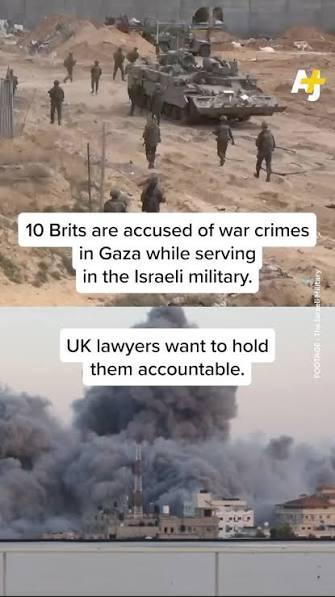
A 240-page submission compiled by the Public Interest Law Centre and the Palestinian Centre for Human Rights alleged that ten UK nationals, including dual citizens, were involved in crimes while serving in Gaza. The allegations included wilful killing, extermination, attacks against civilians and forcible population transfer.
The Metropolitan Police initially narrowed its assessment to four identifiable British nationals before informing the organisations in April 2026 that it would not proceed with a criminal investigation. It said an effective investigation could not be conducted and there was no realistic prospect of conviction.
That decision was reversed after a British–Palestinian campaigner represented by the Public Interest Law Centre threatened judicial review proceedings. In July, the Met informed the organisation that its War Crimes Team would conduct a fresh scoping exercise.
A scoping exercise is not a criminal charge or a finding of guilt. It is a preliminary assessment intended to establish whether the available information justifies a full investigation.
The Met reportedly acknowledged that numerous international bodies believed actions committed in Gaza could amount to war crimes. Lawyers have suggested that potential evidence could include information held by British intelligence agencies, the Foreign Office and the Royal Air Force, which conducted surveillance flights over Gaza during the conflict.
British law already provides a possible route to prosecution. Section 51 of the International Criminal Court Act 2001 makes genocide, crimes against humanity and war crimes offences under the law of England, Wales and Northern Ireland. The legislation gives British authorities jurisdiction over relevant conduct committed overseas by UK nationals, UK residents and members of the British armed forces. Scotland has corresponding legislation.
The Crown Prosecution Service confirmed this extraterritorial reach in March 2026, explaining that the Act applies to offences committed abroad by British nationals or residents. The Metropolitan Police itself states that the UK has a responsibility under international treaties to investigate and prosecute core international crimes and that a UK resident suspected of responsibility anywhere in the world may be investigated in Britain.
The evidential threshold for prosecution nevertheless remains demanding. Investigators must connect an identifiable person to a specific crime or establish another recognised form of criminal responsibility, such as ordering, assisting or knowingly contributing to criminal conduct. For genocide, prosecutors must also prove the required intent associated with the alleged mode of responsibility.
Sidoti’s argument is not that these safeguards should be discarded, but that they cannot be applied unless the authorities first investigate.
Should Britons be permitted to join foreign armies?
Sidoti also questioned why Western governments allow their citizens to serve in foreign state armed forces accused of grave international crimes while imposing far more extensive restrictions on people joining non-state armed groups.
Britain has wide-ranging legislation dealing with travel for terrorist purposes and membership of proscribed organisations. Comparable legislation covering service in a foreign state military is far less comprehensive.
The Foreign Enlistment Act 1870 prohibits certain forms of service in the armed forces of a foreign state at war with another state at peace with Britain, although the antiquated legislation has rarely been tested and has historically presented serious enforcement difficulties.
Sidoti called for clear, generally applicable legislation covering participation in all foreign armed forces rather than a law directed specifically at Israel.
“Why should we allow our nationals to participate in the Israeli Defense Forces any more than in the Russian military or the military fighting the war in Sudan and committing war crimes there?” he asked.
Declassified UK and the International Centre of Justice for Palestinians organised an open letter urging the government to record the movements of British nationals who served in the IDF and conduct independent investigations. More than 26,000 people signed it.
Critics accused the campaign of singling out Israel and Jewish dual nationals. Sidoti rejected that objection by proposing a law that would apply without distinction to every foreign military.
“The legislation should cover all foreign armed forces,” he said. “It should not single out Israel because this should be a standing provision. If it doesn’t single out Israel, then it can’t be claimed to be antisemitic.”
The same principle, he argued, should govern investigations. Nationality, ethnicity or religion cannot constitute evidence of criminality, but neither should they provide immunity where credible allegations and jurisdiction exist.
Britain’s undisclosed military agreement with Israel
Sidoti’s criticism extended beyond dual nationals to the broader military relationship between Britain and Israel.
The two countries signed a military cooperation agreement in December 2020. The British government’s 2030 Roadmap for UK–Israel Bilateral Relations states that the agreement brings together defence activity involving medical training, organisational design, military education, strategic dialogue and professional working groups.
The complete agreement has never been published. In response to a parliamentary question, the Ministry of Defence said its security implications required it to remain classified.
Declassified UK reported in October 2025 that the agreement had continued without amendment during the Gaza campaign. Asked whether such cooperation should concern the British public, Sidoti replied that every form of cooperation with the IDF now raised legal questions.
“Any cooperation with the Israeli Defense Forces concerns me under the current circumstances, any form of cooperation whatsoever,” he said.
Sidoti argued that the Commission’s findings created strong grounds to conclude that the most serious international crimes had been committed by Israeli forces under government command.
“In those circumstances, I consider it would be legally improper for states to be involved with the Israeli Defense Forces at this stage,” he said. “Any kinds of cooperative arrangements raise questions of complicity, and that’s a very serious issue.”
Arms supplies and the question of British complicity
Britain partially suspended approximately 30 arms export licences in September 2024 after a government assessment concluded that certain equipment presented a clear risk of being used to commit or facilitate serious violations of international humanitarian law.
However, the suspension covered only a fraction of approximately 350 licences then in existence. The government preserved other exports and maintained an exemption for British components entering the international F-35 fighter aircraft programme, even though Israel operates F-35 aircraft in Gaza. The government’s own announcement of the partial suspension acknowledged the risk while defending continued participation in the multinational aircraft programme.
Sidoti distinguished between political statements supporting Israel and the positive material assistance required for legal complicity.
Comments by former prime minister Keir Starmer during the early stages of the assault, including his suggestion that Israel had a right to cut off water and power subject to international law, had caused widespread outrage. Sidoti said that, in his assessment, those comments did not reach the demanding legal threshold for direct and public incitement to genocide.
The supply of weapons presented a different issue.
“Complicity requires some form of positive action,” Sidoti explained. “The provision of weapons to a military that is undertaking actions that constitute international crimes could constitute complicity. There are questions that need to be investigated and resolved.”
Whether a particular minister, official or state is legally complicit would depend upon the assistance supplied, its effect, the knowledge available at the time and the precise legal test applied. Sidoti did not claim that British complicity had already been established by a court. He said the continued provision of military equipment created a credible question that required investigation.
The attack on the International Criminal Court
Sidoti also accused Britain and other members of the International Criminal Court of failing to defend the institution against an escalating campaign of American pressure.
The UK is a founding state party to the Rome Statute and has repeatedly described itself as a firm supporter of the ICC. In November 2024, the Court issued arrest warrants for Israeli Prime Minister Benjamin Netanyahu and former defence minister Yoav Gallant, alleging war crimes and crimes against humanity connected to the deprivation of essential supplies and attacks against Gaza’s civilian population. Israel rejects the allegations and contests the Court’s jurisdiction.
The United States, which is not a member of the Court, has responded by sanctioning judges, prosecutors and other officials. On 18 August 2026, Washington added ICC President Tomoko Akane and senior trial lawyer Abdoulaye Seye to the sanctions list. The measures freeze assets within the American financial system and can severely restrict access to banking and other services.
Nine of the Court’s 18 judges and several senior prosecutorial officials have now been sanctioned. The ICC described the latest measures as a flagrant attack upon judicial independence.
US Secretary of State Marco Rubio has called ICC personnel “lunatics and crazies” and declared that Washington would impose consequences for attempts to investigate American or Israeli officials. His administration has openly discussed dismantling the Court and encouraging member states to withdraw.
Sidoti said state parties were not doing enough to meet their obligations.
“I don’t think any of the state parties to the Rome Statute of the International Criminal Court are doing enough to defend the Court and to support the Court,” he said. “They have obligations to do so under the Rome Statute itself. I’m not just talking about political responsibility. I’m talking about legal obligation.”
The British government has reaffirmed its support for the Court’s independence and said it will not imitate American sanctions. Sidoti argued that verbal expressions of support were inadequate in the face of a coordinated attempt to intimidate judges, obstruct investigations and weaken the institution’s ability to function.
Suspicion is not guilt, but inaction is a choice
Sidoti’s argument rests upon a principle that has often been applied to conflicts elsewhere: citizenship should not shield a suspected perpetrator from investigation, and alliance with the state whose military is accused should not prevent domestic authorities from examining the evidence.
Treating returning soldiers as potential suspects would not remove the presumption of innocence. Nor would it mean arresting thousands of people without evidence. It would require governments to establish who served in Gaza, where they were deployed, which units they joined, what those units did and whether there is evidence connecting particular individuals to unlawful conduct.
The distinction is fundamental. Collective guilt has no place in criminal law, but collective refusal to investigate can create impunity on an enormous scale.
For Britain, the issue is no longer hypothetical. Thousands of its citizens served in the Israeli military. A UN Commission has concluded that genocide was committed. British legislation provides jurisdiction over crimes committed abroad by British nationals and residents. Specialist police officers are already reconsidering evidence against several identifiable people.
Meanwhile, Britain continues to maintain a classified military agreement with Israel and has stopped short of a comprehensive arms embargo.
Sidoti’s intervention therefore presents the Burnham government with a question that cannot be indefinitely transferred to courts which may take years to deliver final judgments. Courts determine guilt, but governments, police forces and prosecutors decide whether evidence will be collected, suspects investigated and proceedings permitted to begin.
If the international legal order is to mean the same thing in Gaza that Britain says it means in Ukraine, Sudan and elsewhere, the test will not be found in ministerial declarations of support for justice. It will be found in whether the law is allowed to reach those who fought, those who commanded, and those who knowingly supplied the machinery through which the destruction was carried out.