


From Shai Masot’s 2017 “take down” conversation to the 2026 row over sponsored travel, undeclared interests and opaque funding, the controversy is not whether lobbying exists. It is whether Britain’s rules tell the public enough about who finances political access and how that access may shape policy.
In a London restaurant in October 2016, an Israeli embassy official asked a British civil servant whether he could give her the names of MPs he wanted her to “take down”.
The official was Shai Masot, then serving as a senior political officer at the embassy. The politician he identified was Sir Alan Duncan, a Foreign Office minister and outspoken critic of Israeli settlement building in the occupied West Bank. Maria Strizzolo, a civil servant who had previously worked for Conservative minister Robert Halfon, responded by suggesting that close inspection might uncover “a little scandal”.
The exchange, secretly recorded by an undercover reporter for Al Jazeera and broadcast in January 2017, was not an allegation reconstructed years later. It was captured on camera. The Israeli ambassador, Mark Regev, apologised to Duncan, the embassy called Masot’s comments “completely unacceptable”, and Masot left his post. The Foreign Office said the remarks did not represent the embassy or the Israeli government and announced that it considered the matter closed. The episode was reported at the time by The Guardian, while Al Jazeera later reported Masot’s resignation.
The footage revealed more than one reckless conversation. In another exchange, Masot said that more than £1 million was available to support visits to Israel by Labour politicians and activists. That statement did not establish that the money was ultimately transferred or spent as described, but it exposed the proximity between an embassy official and the party networks that cultivate British political support for Israel.
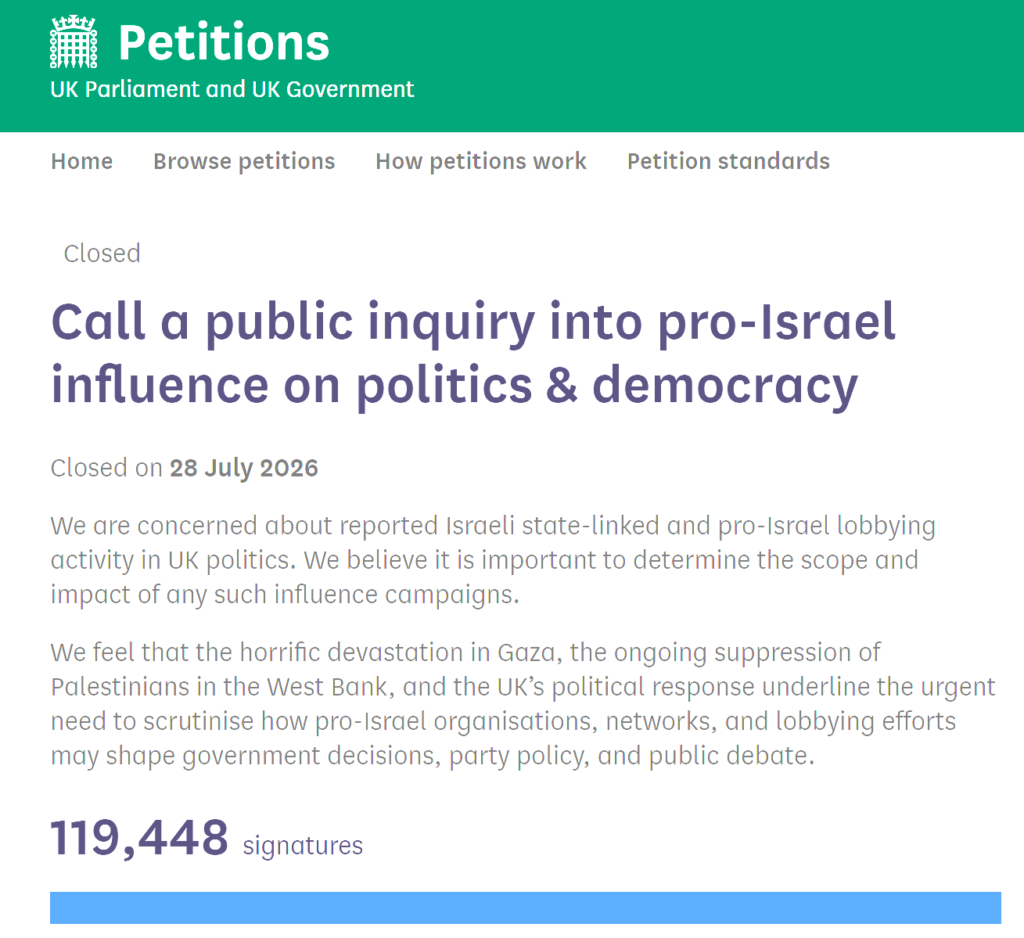
Nine years later, the argument has returned to Parliament with unusual force. A petition calling for a public inquiry into “pro-Israel influence on politics and democracy” attracted 119,448 signatures and was debated in Westminster Hall on 22 June 2026. The government rejected a dedicated inquiry, insisting that existing rules and broader reviews of foreign influence were sufficient. Supporters of the petition said the question was one of transparency. Opponents said its framing echoed antisemitic conspiracy theories about hidden Jewish power.
That dispute contains a danger that responsible reporting must confront directly. British Jews are not responsible for the actions of the Israeli government, and Jewish political participation is not evidence of foreign interference. At the same time, Israeli state activity, organised advocacy for Israeli policy, donations, sponsored travel and access to ministers are legitimate subjects for the same scrutiny applied to every other government, industry and pressure group.
The evidence does not support the crude claim that one lobby “controls” Westminster. It does show something more prosaic and, in institutional terms, more significant: a deeply established network that has cultivated relationships inside Britain’s largest parties for decades, frequently without disclosing the sources of all the money that sustains it.
Labour’s bridge to Israel becomes a party battleground
Labour Friends of Israel was founded in 1957, when support for the young Israeli state sat comfortably within much of the British left. Labour politicians and trade unionists looked at the kibbutz movement, the Histadrut trade union federation and the dominance of Israel’s Labor movement and saw a country that could be presented as social democratic, collectivist and aligned with organised labour.
Harold Wilson became one of Israel’s most committed advocates in British politics and later served as president of LFI. The organisation was not originally built as an insurgent faction operating against Labour’s leadership. It was part of the party’s mainstream foreign policy culture.
The political terrain gradually changed. Israeli governments moved sharply to the right, settlement building expanded, the occupation became permanent rather than temporary, and Labour’s membership grew more attentive to Palestinian dispossession and statehood. LFI increasingly became a site of conflict between a pro-Israel parliamentary tradition and a membership whose sympathies were moving towards Palestine.
The rupture was most visible under Jeremy Corbyn. LFI became a prominent internal opponent of the leadership, while Corbyn’s supporters accused pro-Israel organisations of using allegations of antisemitism to delegitimise criticism of Israel. Genuine cases of antisemitism inside Labour, inflammatory rhetoric by some activists and an increasingly bitter factional war made the boundary between legitimate scrutiny and prejudice harder to defend in public debate.
Under Keir Starmer, the balance shifted again. Senior figures associated with LFI returned to the centre of power, while the party leadership emphasised the security of Israel and the eradication of antisemitism inside Labour. An analysis by Declassified UK in 2024 said that 13 of the then 25 members of Starmer’s cabinet had received donations or other support it classified as pro-Israel. That figure should be read carefully. It combined different categories, including sponsored visits and donations from British individuals with declared links to pro-Israel organisations. It did not mean that 13 ministers had received money from the Israeli state, nor did it prove that any donor had purchased a policy outcome.
Andy Burnham’s arrival in Downing Street on 20 July 2026 has altered the rhetoric without severing the institutional links. Burnham apologised for Labour’s early response to the destruction of Gaza, saying the party had been too slow to call for a ceasefire and promising greater pressure on the Israeli government. Yet his appointment of James Purnell as chief of staff revived questions about continuity. Purnell chaired LFI between 2002 and 2004 and, immediately before joining Burnham’s team, led the consultancy Flint Global.
The National subsequently reported that 39 per cent of Burnham’s cabinet, excluding Burnham himself, had been identified as current or past LFI supporters on the most recent publicly available records. The qualification matters because LFI no longer publishes a complete list of parliamentary supporters, making current affiliations difficult to establish independently.
Burnham himself was publicly associated with LFI during the 2015 Labour leadership contest, when he described himself as a friend of Israel, opposed the Boycott, Divestment and Sanctions movement and supported targeted action against settlement goods rather than a general boycott. His more critical position in 2026 demonstrates that political affiliation is not a permanent command structure. It also shows why transparency is necessary: voters should not have to reconstruct past relationships from archived web pages and scattered declarations.
LFI presents its mission in markedly different terms from its critics. It says it supports a negotiated two-state settlement, advocates for Israeli and Palestinian peacebuilders and seeks stronger economic, political and security relations between Britain and Israel. Crucially, LFI says it receives no money from the Israeli government or embassy and makes no donations to Labour MPs. It says parliamentarians declare the value of its delegations through the Electoral Commission and the Register of Members’ Financial Interests.
Those statements are important. So is the unanswered question beneath them: if the organisation’s work is funded by private supporters, why should the identities of those supporters remain largely beyond public view when the organisation is financing access for lawmakers?
The Conservative machine built by Stuart Polak
Conservative Friends of Israel was established in 1974, but its modern power is closely associated with Stuart Polak, now Lord Polak, who led the organisation for a quarter of a century and remains its honorary president.
CFI concentrated on an enduring feature of parliamentary life: new MPs often arrive with little direct experience of foreign affairs and quickly rely on established networks for briefings, travel and introductions. The result was formidable reach. A 2009 Channel 4 investigation reported that about 80 per cent of Conservative MPs were CFI members, a figure the organisation was still citing in 2014. The number is historic rather than a verified measurement of the present parliamentary party, but it illustrates the scale CFI publicly claimed at the height of Conservative power.
Its influence was visible in personnel as much as membership. By the time David Cameron entered Downing Street in 2010, CFI supporters occupied positions across the government and parliamentary party. Polak’s ability to arrange access was demonstrated again in 2017, when it emerged that he had organised meetings between then International Development Secretary Priti Patel and senior Israeli officials during an unofficial visit. Patel resigned after failing to disclose the meetings properly.
CFI is open about the importance it attaches to travel. Its own website says it has taken hundreds of Conservative MPs to Israel. The organisation describes itineraries that include briefings from the Israel Defense Forces, security specialists and journalists, as well as meetings with Israeli and Palestinian politicians, business figures and civil society groups. It argues that these visits deepen knowledge, expose parliamentarians to Israel’s security concerns and strengthen bilateral ties.
The same programme can be described in two ways without either description being wholly false. To CFI, it is political education. To critics, it is agenda setting: a carefully constructed encounter in which the sponsoring organisation decides which borders are visited, which officials are authoritative and which experiences become the MP’s frame of reference.
That distinction is central. A sponsored delegation does not buy a vote. It can, however, define the facts and relationships through which an inexperienced parliamentarian first understands a conflict.
The network expands beyond the two largest parties
Pro-Israel organisation in Westminster is not confined to Labour and the Conservatives, although the structures differ from party to party.
Liberal Democrat Friends of Israel was created in 1988 through the merger of the older Liberal Friends of Israel and the SDP Friends of Israel. It is a recognised Liberal Democrat organisation and states that it supports Israel’s security alongside an independent Palestinian state. The party’s federal structure gives ordinary members far more direct influence over policy than is customary in Labour or the Conservatives, producing recurring tension between leadership networks and conference decisions.
That grassroots power has produced policy well to the left of LDFI’s traditional emphasis. In 2024, Liberal Democrat conference backed the immediate recognition of Palestine, an end to trade with illegal settlements and the suspension of arms exports to Israel. The conference motion passed as federal party policy. Liberal Democrats for Peace in the Middle East, a separate party group, has also provided an organised counterweight to the pro-Israel network.
Reform UK has developed comparable infrastructure at remarkable speed. Reform Friends of Israel financed a September 2025 visit by deputy leader Richard Tice, while the Reform Jewish Alliance was formally launched in February 2026. The two bodies are not identical. Reform Friends of Israel concentrates on the bilateral relationship and sponsored travel, while the Jewish Alliance presents itself as a voice for British Jewish members inside the party. At its launch, chairman Gary Mond said the alliance would address antisemitism, national security and “shared British values”.
The alliance also revealed tensions inside the Jewish community. Jewish activists from Na’amod disrupted Nigel Farage’s launch speech, accusing Reform of using Jewish support to legitimise hostility towards other minorities. The Guardian reported the confrontation and Farage’s defence of the organisation.
On the populist right, support for Israel is usually framed less through Labour Zionism or the peace process and more through civilisational politics, intelligence cooperation, border control and opposition to Islamist movements. Israel is presented as a fortified Western ally in a hostile region. That framing fits Reform’s domestic political message and creates a natural route between foreign policy advocacy and the party’s campaigning on immigration and security.
The Green Party occupies the opposite end of the spectrum. It has no comparable Friends of Israel organisation at parliamentary level and has repeatedly supported an end to UK arms sales, sanctions, divestment and boycotts targeting Israeli institutions and companies linked to the occupation. Green conference reaffirmed support for BDS in 2024. Green and independent MPs therefore operate largely outside the sponsored travel system built by the principal pro-Israel groups, although they remain subject to advocacy from Palestinian, humanitarian and anti-war organisations.
The first instrument of influence: sponsored travel
The most visible mechanism in this network is the parliamentary delegation.
Commons rules require MPs to register relevant financial interests and benefits promptly, normally within 28 days. The register is intended to reveal anything that a reasonable person might consider capable of influencing an MP’s words or actions. Sponsored travel is therefore not secret, and it is not inherently improper. Gulf governments, defence interests, trade organisations, think tanks and humanitarian charities all pay for parliamentary visits.
The question is what the disclosure system reveals and what it does not. A register entry may identify the destination, dates, sponsor, stated purpose and estimated value. It rarely shows who ultimately financed the sponsoring organisation, how the itinerary was constructed, which briefing papers were distributed or whether an MP later intervened on an issue discussed during the trip.
Declassified UK analysed declared interests in the Parliament that ended in 2024 and reported that 180 of 650 MPs had received funding from organisations or individuals it classified as pro-Israel. Its dataset counted more than 240 funded visits worth over £500,000, with the combined value of travel and donations exceeding £1 million.
Those numbers are substantial, but their meaning requires care. Declassified used a broad category that included Friends of Israel organisations, Israeli state institutions and British donors associated with pro-Israel advocacy. The total does not establish that all the funds were coordinated or foreign in origin. Nor does correlation prove causation: an MP may accept a trip because they already support Israel rather than support Israel because they accepted a trip.
The public record nevertheless demonstrates why enforcement matters. Labour MPs Cat Eccles and Peter Prinsley joined an LFI-funded “solidarity” delegation in May 2025, meeting Israeli President Isaac Herzog, opposition leader Yair Lapid, deputy foreign minister Sharren Haskel and reserve major general Yair Golan. Other participants declared the visit at a value of up to £2,600 per person, but Eccles and Prinsley failed to register it within the required period.
The Parliamentary Commissioner for Standards opened investigations. Prinsley accepted that he had breached the rules, apologised and had the matter resolved through the rectification procedure in August 2025. The commissioner later concluded that Eccles had also breached the code; she acknowledged the breaches and apologised to the House.
The late filings do not show that either MP changed a vote or acted at LFI’s direction. They do show that even the limited transparency Parliament requires can fail until journalists or campaigners compare delegations with the register.
The issue is now following Reform. Tice registered a 2025 trip to Israel financed by Reform Friends of Israel, reportedly worth more than £6,000. During the June 2026 Westminster Hall debate, he praised Israeli science, medicine, artificial intelligence and entrepreneurship without verbally declaring the trip at the start of his speech. The Parliamentary Commissioner for Standards opened an investigation on 28 July. The commissioner has not yet reached a conclusion, and the existence of an inquiry is not a finding of misconduct. Tice has said the complaint concerns whether he should have referred to his registered interest and has attacked his critics as antisemitic and anti-Israel. The Financial Times reported the connection between the inquiry, the speech and the trip.
The second instrument: money, networks and access
Neither LFI nor CFI needs to function as a conventional political action committee. Influence in Westminster is often exercised through relationships rather than a cheque issued by the advocacy organisation itself.
Party conference receptions, private briefings, business lunches and leadership events bring together MPs, donors, diplomats, advisers and campaign professionals. A politician gains access to people who can provide money, endorsements, expertise or introductions. A donor gains access to a politician who may eventually become a minister. The arrangement can remain entirely legal while generating a durable alignment of interests.
Political donations in Britain must come from permissible sources and, above the relevant thresholds, be reported. The Electoral Commission publishes declared donations and loans. Yet public registration answers only the first question: who gave the money? It does not necessarily reveal the donor’s policy objectives, the networks through which the introduction was made or the private assurances exchanged around the relationship.
This is where language becomes particularly important. Describing a British Jewish donor as “pro-Israel” solely because they are Jewish is both analytically worthless and antisemitic. The category is meaningful only when based on evidence such as a donor’s stated political activity, leadership of an advocacy organisation, funding of a relevant campaign or public support for a particular policy.
Even then, a donation proves access, not a purchased vote. The more defensible question is whether large donors and well-resourced advocacy networks enjoy opportunities that ordinary constituents, Palestinians under occupation and less wealthy campaign groups cannot match.
The third instrument: a transparency gap built into the rules
All-party parliamentary groups must be open to members from different parties, maintain a public register and disclose specified financial and administrative support. Parliament tightened those rules after repeated scandals involving foreign governments and commercial interests.
CFI and LFI are not APPGs. Companies House records show that Conservative Friends of Israel Limited and Labour Friends of Israel Ltd are active private companies limited by guarantee. They must file corporate information, but they are not required to publish a comprehensive list of all donors equivalent to the information expected from a regulated political party or parliamentary group.
That distinction became the subject of a formal complaint in January 2026. Campaigner Andrew Feinstein reported LFI to the Electoral Commission, arguing that it may fall within the rules for a members’ association because senior politicians have publicly described themselves as LFI members. If an organisation is legally treated as a members’ association and receives reportable political donations, additional disclosure obligations can arise.
The complaint is an allegation rather than a regulatory finding. LFI rejects the suggestion that it conceals Israeli state finance and explicitly states that it receives no money from the Israeli government or embassy. The dispute nevertheless exposes a real structural ambiguity: politicians can describe themselves as members of a body that does not publish its current membership or full donor list, while the body finances political travel and operates at the centre of party life.
The cleanest answer would be a rule that applies across the board. Any organisation that sponsors parliamentary travel, provides significant benefits or regularly arranges access to ministers should disclose its major funders, whether it advocates for Israel, Palestine, Saudi Arabia, the arms industry, fossil fuel companies or trade unions.
From access to policy: influence is easier to show than causation
The hardest claim to prove is that lobbying caused a particular parliamentary vote. Voting records can show that MPs supported the same position as a pressure group. They cannot, on their own, show why.
The Economic Activity of Public Bodies (Overseas Matters) Bill offers a useful example. Introduced by the Conservative government in 2023, it sought to prevent councils, universities and other public bodies from making procurement or investment decisions based on moral or political disapproval of a foreign state. The legislation was widely understood as an attempt to curb the Boycott, Divestment and Sanctions campaign against Israel.
LFI submitted written evidence opposing BDS while also criticising defects in the bill. Pro-Israel organisations argued that local boycotts singled out Israel and fuelled antisemitism. Human rights groups, including Liberty and Human Rights Watch, argued that the legislation would restrict freedom of expression and ethical investment. The bill contained an exceptional provision preventing ministers from exempting Israel, the occupied Palestinian territories or the occupied Golan Heights from its protections.
The measure passed its Commons third reading by 282 votes to 235 in January 2024. It did not, however, become law. It stalled in the Lords and was lost when Parliament was prorogued in May 2024. Any account claiming that the anti-boycott bill “passed” without that qualification confuses passage through one chamber with enactment.
The episode still demonstrates the reach of the argument promoted by Friends of Israel organisations, but it also shows the limits of a simple control narrative. The proposal arose from a Conservative manifesto commitment, attracted opposition from Conservatives as well as other parties and ultimately failed.
Arms exports provide another test. Advocacy groups supportive of Israel have repeatedly emphasised Israel’s right to defend itself, the dangers posed by Hamas and Iran, and the importance of British Israeli defence cooperation. Palestinian rights groups, international lawyers and humanitarian organisations have argued that continuing military trade risks British complicity in violations of international humanitarian law.
Policy has moved, but only partially. In September 2024, the Labour government suspended around 30 licences after concluding that certain exports presented a clear risk of being used to commit or facilitate serious violations of international humanitarian law. Official data published in February 2026 said 29 licences were initially suspended and six more were subsequently suspended or amended as new information emerged. Other licences, including components entering the global F-35 programme, remained outside the general suspension except for direct exports to Israel.
The outcome satisfied neither side. Israel’s supporters said the suspension weakened an ally confronting terrorism. Human rights groups said the exemptions left Britain connected to aircraft used in Gaza. What it does not show is a government mechanically obeying one lobby. It shows policy negotiated inside a dense field of legal advice, strategic alliances, commercial interests, party pressure and organised advocacy.
The same is true of Palestinian recognition. The source transcript from which this feature was developed presents recognition as an unfulfilled demand. That was true before September 2025, but it is no longer accurate. The United Kingdom formally recognised the State of Palestine on 21 September 2025, more than 75 years after recognising Israel.
Recognition was a major departure from the old Westminster position that statehood should wait for a negotiated settlement. It did not end arms cooperation, the occupation or the destruction in Gaza, but it proved that the broad pro-Israel consensus can be challenged when public pressure, international events and internal party politics become powerful enough.
The 2026 debate Parliament did not want
The petition for an inquiry forced MPs to confront two questions at once: whether pro-Israel advocacy receives inadequate scrutiny, and whether singling it out reproduces a historic prejudice against Jews.
Several MPs supporting greater scrutiny explicitly condemned antisemitism and distinguished the Israeli government from Jewish people. Tahir Ali cited the Masot recording and urged stronger disclosure rules covering any foreign state. Independent MP Iqbal Mohamed referred to the Declassified analysis of donations and travel. Other speakers questioned government contact with the Israeli arms company Elbit Systems and demanded greater transparency around defence lobbying.
Opponents said the petition’s language was itself dangerous. Labour MP Alex Davies-Jones accepted the case for examining lobbying, donations and foreign influence, but argued that the same standard must be applied to every country. Peter Prinsley, who declared his LFI membership, said the petition repackaged the ancient allegation that Jews secretly manipulate political institutions. Conservative and Reform speakers made similar arguments.
The government rejected the inquiry. Cabinet Office minister James Frith said advocacy for Israel was a normal part of democratic life and warned against treating the world’s only Jewish state as uniquely suspect. The full disagreement is recorded in Hansard.
The official response pointed to existing ministerial transparency releases, the register of consultant lobbyists, parliamentary codes of conduct, the Ethics and Integrity Commission’s review of lobbying and the Rycroft review of foreign financial influence. These are not meaningless safeguards. They are also fragmented, threshold dependent and often incapable of showing the ultimate sources behind organisations that finance political access.
The government’s strongest objection was that Israel had been singled out while Russia, China, Iran, Gulf monarchies and corporate interests also seek influence. That argument supports a universal transparency regime more convincingly than it supports doing nothing. If country specific scrutiny risks prejudice, Parliament can require the same disclosure from every organisation that finances foreign policy advocacy.
A democratic question, not a conspiracy theory
Lobbying is not, by itself, a scandal. Environmental organisations lobby the Greens, trade unions lobby Labour, business associations lobby every governing party, arms manufacturers court defence officials, and foreign embassies seek sympathetic parliamentarians. Democracy could not function without citizens and organisations making arguments to those in power.
The democratic problem begins when access is unequal and its financing incomplete. A new MP may receive a multi-day programme of military briefings, ministerial meetings and border visits funded by an organisation whose principal donors remain unknown. The public may learn the approximate value of the trip but not who paid into the organisation, who designed the itinerary or what continuing relationships followed. If registration is late, even that limited information may appear only after an investigation.
None of this justifies claims that Israel, Jews or “Zionists” secretly command British politics. Such claims collapse distinct people and institutions into a collective enemy and draw on a murderous history of antisemitic fantasy. They also weaken legitimate investigation by replacing documented relationships with insinuation.
The record supports a narrower and more credible conclusion. Friends of Israel organisations have spent decades building disciplined networks inside Britain’s principal political parties. They sponsor travel, convene donors and politicians, provide briefings, cultivate future ministers and defend policies favourable to Israel. They are effective because their work is mostly legal, professional and conducted in plain sight.
Their critics should therefore demand rules rather than myths: disclosure of major funders behind sponsored travel, publication of current parliamentary affiliations, searchable records connecting benefits with later declarations, and a single standard for every foreign policy lobby regardless of the country or cause it represents.
The question is not whether an MP can be “bought” by a flight, a hotel room or a conference reception. It is whether repeated access, organised over years and financed without full public visibility, creates a political environment in which some perspectives arrive at the cabinet table already familiar and authoritative, while others remain outside the room.
Westminster’s lobbying system is working. The unresolved question is whom it allows to work it most effectively, and why the public is still denied all the information required to judge the result.