


Internal records show how donor warnings, an organised pressure campaign and political intervention preceded the university’s reversal, which faculty condemned as an attack on academic freedom
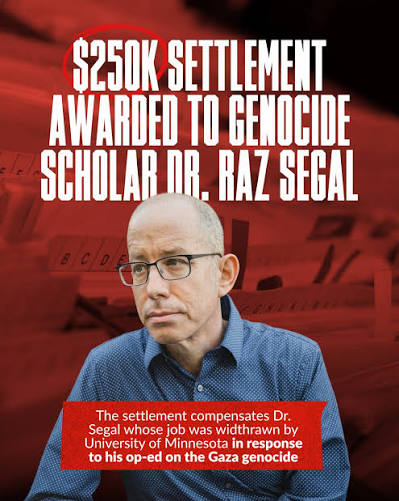
The University of Minnesota has paid Israeli American Holocaust and genocide historian Raz Segal $250,000 after withdrawing a prestigious job offer amid fierce opposition to his public conclusion that Israel’s assault on Gaza constituted genocide.
The settlement, announced on 6 August 2026, ends Segal’s outstanding legal claims against the university but does not restore the appointment he lost. The agreement contains no admission of liability or wrongdoing by either party, and it does not amount to a judicial finding that the university acted unlawfully.
Yet correspondence obtained through a public records request provides an unusually detailed account of how academic decision making can bend under pressure from donors, political organisations and legislators. The documents show university officials moving within days from defending a faculty led appointment process to abandoning its chosen candidate after warnings that Segal’s appointment could cost the institution financial and political support.
Segal had not merely been shortlisted for the role. On 5 June 2024, the university sent him a formal offer to become director of its Center for Holocaust and Genocide Studies, occupy the Stephen C. Feinstein Chair and join the history department as a tenured associate professor. The faculty appointment remained subject to the university’s normal tenure review process, but the directorship and employment package followed an extensive search in which Segal had emerged as the clear favourite.
Five days later, interim university president Jeff Ettinger withdrew the offer.
The university initially described its intervention as a pause intended to allow additional community voices to be heard. The letter sent to Segal was more definitive: his 5 June offer was “hereby withdrawn.” More than two years later, the directorship remains unfilled.
A scholar shaped by Holocaust history
Segal is Jewish, holds Israeli and American citizenship and is the grandchild of four Holocaust survivors. He is an associate professor of Holocaust and genocide studies at Stockton University in New Jersey, where he holds an endowed professorship in the study of modern genocide and directs the university’s master’s programme in Holocaust and genocide studies.
His scholarship includes two books examining the Holocaust in Hungary and the Carpathian region. His work has focused on the experiences of people subjected to state violence, the relationship between genocide and settler colonialism, and what he describes as the political mobilisation of Holocaust memory.
It was in that professional capacity that Segal intervened publicly in the opening days of Israel’s war on Gaza.
On 13 October 2023, six days after the Hamas led attack in southern Israel, the progressive Jewish publication Jewish Currents published his essay “A Textbook Case of Genocide.” Segal argued that the combination of mass bombing, forced displacement, a complete siege and statements by senior Israeli officials demonstrated both prohibited genocidal acts and an intention to destroy Palestinians in Gaza as a group.
His assessment rested partly on then defence minister Yoav Gallant’s announcement that Gaza would receive no electricity, food, water or fuel, accompanied by dehumanising language about those Israel was fighting. Segal connected those declarations to the killing of civilians, the infliction of serious physical and psychological harm, and the deliberate creation of conditions threatening the population’s survival, three categories of conduct specified in the Genocide Convention.
The timing and certainty of Segal’s conclusion made the article highly controversial. His critics argued that declaring genocide less than a week after the Hamas attack was a reckless academic judgment made while Israelis were still identifying the dead and searching for hostages.
However, the article did not excuse the killing of Israelis. It explicitly described the Hamas attack as the mass murder of civilians and a war crime under international law. That language is significant because Segal’s alleged justification of Hamas would later become central to the campaign against his Minnesota appointment.
The preferred candidate
The University of Minnesota opened its search for a new director of the Center for Holocaust and Genocide Studies during the 2023 to 2024 academic year. Records later obtained by the Center for Constitutional Rights show that Segal received strong support at several stages of the process.
In April 2024, history department chair Sarah Chambers wrote that there was almost unanimous and enthusiastic support for giving Segal a tenured home in the department if he became director. Search committee members praised his scholarship, international relationships, fundraising ability and ambition for the centre. One member described his presentation as “breathtaking.”
The records also reveal some reservations. Committee members discussed how Segal might work with people who strongly disagreed with him, although they differed over how much weight the concern should carry. It was not enough to prevent the committee from selecting him as its preferred candidate.
The university made its offer on 5 June.
Two days later, professors Bruno Chaouat and Karen Painter resigned from the centre’s fourteen member advisory board. Chaouat, a former director of the centre, accused Segal of justifying Hamas’s atrocities and blaming Israel for the 7 October attack. Painter later said that she had grave concerns about Israel’s conduct in Gaza but did not consider Segal an appropriate person to lead the centre. She also argued that the selection process had failed to provide sufficient consultation with the wider Jewish community.
Their resignations rapidly turned an academic appointment into a public controversy.
“Clearly, we’ve been heard”
On 9 June, the Jewish Community Relations Council of Minnesota and the Dakotas issued an action alert calling on supporters to stop Segal’s appointment. The organisation described him as a prominent anti Zionist with extremist views and told readers that the appointment could still be blocked if university leaders faced a “massive outcry.”
The alert supplied the email addresses of Ettinger, Provost Rachel Croson and the university’s regents, along with suggested language for opponents to send. The JCRC later said the appeal generated hundreds of messages.
Ethan Roberts, the organisation’s deputy executive director, has maintained that the dispute was not about Segal’s freedom to express controversial views. He said the question was whether someone holding those views was suitable to lead a public facing centre with established relationships among Holocaust survivors, their descendants, Jewish students and community organisations.
That distinction did not satisfy Segal’s supporters. They argued that determining a genocide scholar’s fitness for an academic leadership post on the basis of his professional analysis was itself a political test, particularly after faculty experts had completed a legitimate selection process.
The JCRC’s own account leaves little doubt about the purpose and immediate result of its mobilisation. On 11 June, after Ettinger had intervened, the organisation thanked supporters, reported that it had been invited to meet the interim president and declared: “Clearly, we’ve been heard.”
Jewish opinion was not uniform. Jewish faculty members and community organisations also wrote in support of Segal. Beth Gendler, executive director of the progressive group Jewish Community Action, warned university leaders against accepting the claim that Minnesota Jews spoke with a single voice on the appointment.
Donors warn that money could disappear
The public records add a financial dimension that was largely hidden when the controversy first erupted.
One donor wrote to the chair of the university’s governing board that Segal, described in the message as a blatant anti Zionist, could not be allowed to head a Holocaust studies institution. The donor warned that people would withdraw their pledges if the university failed to act.
Lynne Redleaf, another donor, told Ettinger that Segal’s appointment would almost certainly bring fundraising for the centre to a halt. She cited his descriptions of Israel as an apartheid and settler colonial state and compared his appointment to placing a defender of racial segregation in charge of an African American studies department.
Ettinger replied that the warning was “timely and helpful.” Redleaf later declined to comment publicly on the correspondence.
Another email sent on 10 June, only hours before the offer was withdrawn, warned Ettinger that Jewish donors would withdraw support from the university. Natan Paradise, then director of the university’s Center for Jewish Studies, separately alerted an official to what he described as an anticipated volley of donor objections coordinated with the JCRC. Paradise also warned that the atmosphere risked becoming so toxic that the university would be unable to recruit anyone for the post.
The JCRC has said it encouraged members of the community to express their views but did not organise donors. The final decision, Roberts emphasised, belonged to the university.
From defence to retreat
The internal correspondence documents a striking change in the university’s position.
When reporters first began asking about the appointment, communications staff prepared responses explaining that Segal had been enthusiastically recommended following broad consultation. One draft stated that the university did not use political litmus tests when hiring and instead sought the strongest available scholars.
That defence was removed. On 8 June, a senior communications official warned colleagues that defending Segal too strongly could create additional risk. Officials also asked Segal to confirm that he was Israeli after receiving allegations that he was anti Israel. Segal responded that he had been born and raised there and that close relatives, friends and colleagues still lived in the country.
On 10 June, Ettinger sent Segal a two paragraph message. Additional members of the university community, he said, wanted to provide their perspective on the hiring. Because the directorship was a leadership and community facing role, those voices needed to be heard. The offer was therefore withdrawn while the university determined its next steps.
According to a faculty account summarised in the Center for Constitutional Rights’ briefing guide, Ettinger subsequently acknowledged in a meeting that Segal had become controversial because of his speech about events in the Middle East and the objections generated by the appointment.
Local political pressure continued after the decision. On 13 June, Republican state representative Marion Rarick and 69 other legislators wrote that they were elated the university had suspended Segal’s hiring. Because the letter came after the 10 June withdrawal, it cannot have caused the original decision, but it demonstrated the political environment surrounding the university and rewarded its reversal.
A revolt inside the university
The intervention produced a significant backlash from academics who saw it as an attack on both academic freedom and faculty governance.
University faculty argued that the College of Liberal Arts had conducted the search under established rules and that central administrators had no legitimate basis for overturning its decision. The university’s Academic Freedom and Tenure Committee, its local chapter of the American Association of University Professors, the College of Liberal Arts Assembly and the system wide Faculty Senate all criticised the administration’s actions.
The Faculty Senate passed votes of no confidence in both Ettinger and Croson. The votes were not unanimous, but their passage demonstrated the depth of the rupture between faculty and university leadership. An international open letter condemning the decision eventually attracted more than 1,100 signatures, including signatures from Israeli academics.
In October 2024, the national American Association of University Professors called for Segal’s offer to be reinstated. It argued that institutions must resist demands from donors, politicians, trustees and outside groups when those demands compromise academic freedom and shared governance.
The disagreement exposed two competing conceptions of the centre. Segal’s opponents treated it as an institution whose director needed the confidence of established Jewish community partners. His supporters saw it primarily as an academic body whose credibility depended on intellectual independence, especially when studying contemporary mass violence.
For them, allowing external stakeholders to veto a scholar because of his conclusions created an obvious danger. If donors could determine acceptable analysis of Gaza, they argued, similar campaigns could target scholarship about slavery, colonialism, race, climate change or any other politically charged field.
Legal claims settled, but no reinstatement
On 31 July 2024, the Center for Constitutional Rights submitted a public records request on Segal’s behalf. Selected records were released in August 2026, providing the basis for the organisation’s argument that the public university had retaliated against Segal because of constitutionally protected speech.
No court ultimately ruled on that allegation. The university instead agreed to pay $250,000 to settle all of Segal’s outstanding claims. Its public statement stressed that neither side had admitted wrongdoing and said the institution remained committed to its educational mission and thoughtful inquiry across its departments, programmes and centres.
The settlement therefore has limits. It is not a legal precedent, an apology or a formal acknowledgement that the First Amendment was violated. At the same time, a payment of that size represents a meaningful concession to a scholar who had not yet started work and whom the university declined to reinstate.
Segal said he had wanted the original offer restored, but university officials made clear that reinstatement was not available. He has also said that the controversy and the stigma created by the withdrawn offer may have damaged his prospects of obtaining comparable academic leadership positions in the United States.
For the Center for Constitutional Rights, the settlement represents a victory for academic freedom. For the university, it closes the dispute without accepting liability. For Segal, it provides compensation without returning what was taken from him.
An assessment that no longer stands alone
Segal’s October 2023 conclusion was presented by opponents of his appointment as an extreme and discredited position. Subsequent developments have made that characterisation increasingly difficult to sustain, even though the legal question remains contested and the International Court of Justice has not issued a final judgment on the merits of South Africa’s genocide case against Israel.
On 31 August 2025, the International Association of Genocide Scholars adopted a resolution declaring that Israel’s policies and actions in Gaza met the legal definition of genocide. The resolution received 86 percent of votes cast, although the association later disclosed that 28 percent of its membership participated.
On 16 September 2025, the United Nations Independent International Commission of Inquiry on the occupied Palestinian territory concluded that Israel had committed genocide against Palestinians in Gaza. Israeli authorities rejected that finding, as they have consistently rejected allegations of genocide and maintained that their military campaign targets Hamas rather than the Palestinian population.
Segal has said that he wishes his original warning had proved mistaken. Instead, he argues, the destruction of Gaza has confirmed the dangers he identified during the first week of the war.
His experience has also followed him to Stockton University. In August 2026, Sahan Journal reported that language describing the assault on Gaza as genocide had been removed from the website of the master’s programme he directs after a complaint from the university’s largest donor. Stockton did not respond to the publication’s request for comment.
That development makes the Minnesota settlement more than a retrospective employment dispute. It illustrates an ongoing struggle over who is permitted to define genocide, whether universities will protect scholars who reach politically unacceptable conclusions, and how much influence donors should exercise over academic research and leadership.
The University of Minnesota has paid to resolve Segal’s claims, but it has not publicly conceded that withdrawing his offer was wrong. Its faculty’s objections remain unanswered, the centre still lacks the director selected through its academic process, and the documents now available leave a lasting question about the institution’s priorities.
When academic judgment collided with donor power, which one did the university protect?