


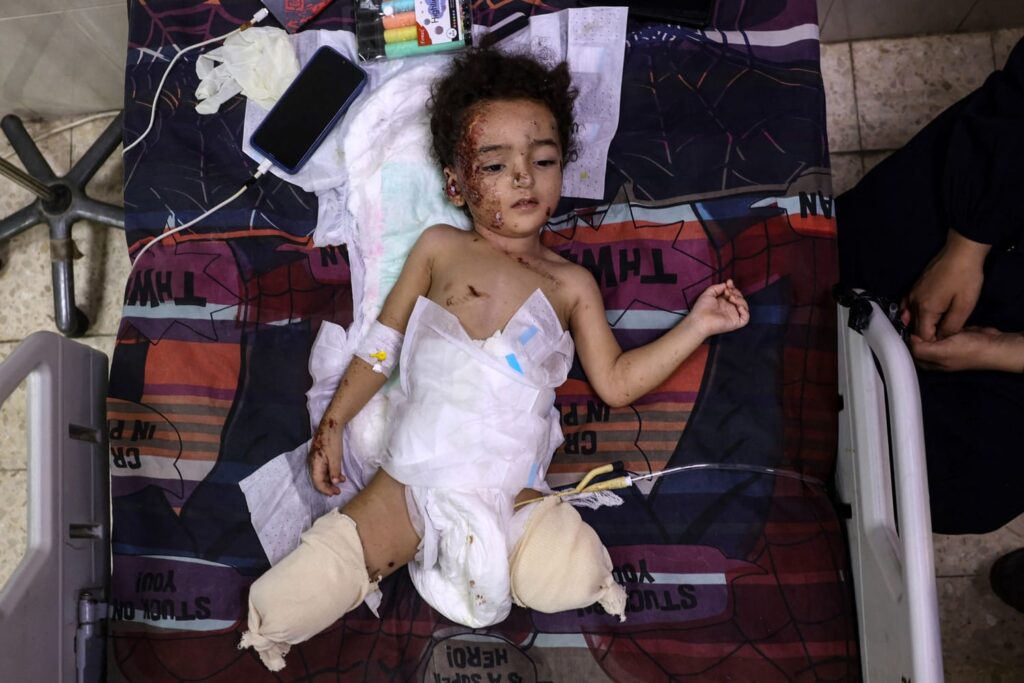
More than 20,000 Palestinian children had already burned alive, starved to death or been crushed and suffocated under rubble during Israel’s unrelenting genocide before the October 2025 ceasefire. UNICEF now says at least another 300 children have been reported killed in the 300 days since the agreement took effect. The promised end to violence has instead become another measure of international failure.
By 10 October 2025, when the latest Gaza ceasefire came into effect, more than 20,000 Palestinian children were already dead.
They had been killed in homes and tents, in schools used as shelters, in hospitals and refugee camps, while sleeping beside their families and while queuing for food or water. Some were killed by bombs and artillery, while others were shot or died from hunger, disease and the destruction of the medical system that might once have saved them.
The ceasefire was supposed to bring that killing to an end. Instead, exactly 300 days after it began, the United Nations Children’s Fund delivered another devastating calculation: at least 300 children had been reported killed in Gaza during those 300 days.
That is an average of at least one Palestinian child killed every day under an agreement presented to the world as a suspension of military operations.
“A ceasefire that leaves an average of one child dead each and every day is failing children,” UNICEF Regional Director for the Middle East and North Africa Edouard Beigbeder said in the agency’s 6 August 2026 statement.
Hundreds more children have been injured, many severely. UNICEF said families are now crowded into roughly one third of the Gaza Strip, sheltering among destroyed buildings, rubble and accumulated waste while malnutrition, disease, unsafe water and damaged sanitation systems continue to threaten children who have survived the bombing.
The expression “one child every day” is an average rather than a claim that one child died on every individual calendar day. The deaths have frequently come in clusters, with siblings and other members of the same families killed together. That qualification does not make the figure less shocking. It reveals that even during what diplomats called a ceasefire, the cumulative killing of children never stopped.
More than 20,000 children before the ceasefire
The pre ceasefire figure is not an approximation drawn from a campaign slogan. A detailed breakdown issued by Gaza’s Ministry of Health and reproduced by the United Nations Office for the Coordination of Humanitarian Affairs recorded 20,179 children killed between 7 October 2023 and 7 October 2025. Children represented 30 per cent of all recorded Palestinian fatalities.
Among them were 1,029 babies under the age of one and 5,031 children younger than five. Another 44,143 children had been injured. The same official data documented 157 children who died from malnutrition related causes. OCHA published the figures in its October 2025 humanitarian update.
The figure may still understate the true loss. Thousands of people remained missing beneath destroyed buildings, while the official count did not fully capture indirect deaths caused by the collapse of health care, lack of medicines, contaminated water and prolonged deprivation. A Reuters examination of the casualty system found that the Ministry of Health count was based on hospital and identity records and continued to be treated as credible by United Nations agencies, although the destruction of Gaza’s institutions made comprehensive counting increasingly difficult.
In plain moral language, Israel had murdered more than 20,000 Palestinian children before the ceasefire. The word “killed” is the clinical language of casualty tables, but for Palestinian families, campaigners and many observers of the war, “murdered” more honestly conveys what happened. These children did not die in a natural disaster or an unavoidable accident. They died during an Israeli military campaign that repeatedly used powerful explosive weapons in one of the most densely populated places on earth, alongside a siege that restricted food, water, fuel and medical supplies.
Whether each individual death constitutes murder in the strict criminal law sense requires evidence and judicial determination. The wider allegation, however, can no longer be dismissed as rhetoric unsupported by serious legal findings. In September 2025, the United Nations Independent International Commission of Inquiry concluded that Israeli authorities and security forces had committed four of the five acts defined as genocide by the Genocide Convention, including killing members of the protected group and deliberately inflicting conditions of life calculated to bring about physical destruction.
Israel categorically rejected that finding, accused the commission of bias and said its objective was to dismantle Hamas while minimizing civilian harm. Israel has consistently maintained that it does not deliberately target civilians and has accused Hamas of operating among Gaza’s population. The commission, which is independent and does not speak for the United Nations as a whole, said the pattern of military conduct and statements from senior Israeli officials demonstrated an intent to destroy Palestinians in Gaza, at least in part.
Commission chair Navi Pillay also issued a warning to governments that continued to treat Gaza as somebody else’s responsibility: “The absence of action to stop it amounts to complicity.”
Children reduced to numbers
Behind the figure of 20,179 are children whose lives cannot be represented by a graph.
In May 2025, an Israeli strike hit the Khan Younis home of paediatrician Dr Alaa al Najjar while she was working at Nasser Hospital. Nine of her ten children were killed. Their names were Yahya, Rakan, Ruslan, Jubran, Eve, Revan, Saydeen, Luqman and Sidra. The youngest was still a baby and the eldest was 12. Her husband, Dr Hamdi al Najjar, was critically wounded and later died. Their surviving son, Adam, underwent repeated surgery. Israel said the strike had targeted suspected militants near its forces and that reports of civilian casualties were being examined. Reuters documented the attack and its aftermath.
In July 2025, one year old Mohammed was killed while his mother, Donia, waited for nutritional supplies at a UNICEF supported distribution point in Deir al Balah. Nine children and four women were among 15 Palestinians reported killed in the strike. Donia survived with critical injuries and was later seen in hospital holding her son’s tiny shoe. UNICEF described the attack as unconscionable.
These deaths were not isolated from the policies imposed around them. By the summer of 2025, children were being killed while seeking food, while sheltering in tents and while receiving medical treatment. UNICEF warned in May that children were being killed and maimed “in their parents’ arms,” while its July assessment stated that children were starving and “the world is watching it happen.” UNICEF’s warning on starvation.
A ceasefire that did not provide safety
The 10 October 2025 agreement envisaged a suspension of military operations, increased humanitarian access and a phased political process. Large scale fighting slowed, but airstrikes, shelling and gunfire did not end. Israeli troops remained deployed behind the so called Yellow Line, controlling more than half of Gaza, while both Israel and Hamas accused the other of violations.
The child toll began climbing almost immediately. By 21 November, UNICEF said at least 67 children had been killed in conflict related incidents during the first six weeks of the truce. By 13 January 2026, it had recorded reports of more than 100 child deaths, including at least 60 boys and 40 girls. UNICEF stressed that this count covered only cases for which sufficient details were available and that the real number was probably higher. Its January briefing said bombing and shooting had slowed but had not stopped.
By 29 July 2026, Gaza’s Ministry of Health had reported 1,209 Palestinian fatalities and 3,943 injuries since the ceasefire announcement. OCHA continued to record airstrikes, shelling, military activity, stray gunfire and dangers from explosive remnants of war. Its 31 July situation report warned that children remained exposed to overlapping threats from violence, unsafe shelter, disease, contaminated water and the collapse of basic services.
UNICEF’s August statement does not publish a list of all 300 children or attribute every individual death to a named perpetrator. That is an important qualification for precise reporting. It does not alter the surrounding evidence that Israeli attacks continued throughout the ceasefire period. Reuters reported on 6 August that Israeli strikes had killed approximately 1,200 Palestinians since the truce, citing Palestinian health officials. Israel said its operations were responses to threats and accused Hamas of rearming, recruiting fighters and rebuilding tunnels in breach of the United States backed plan.
The result for Gaza’s children is a ceasefire that reduced the intensity of death without guaranteeing the elementary condition that gives the word meaning: that civilians should no longer be killed.
The world did not lack warnings
The international community cannot credibly argue that it did not know what was happening.
In July 2025, UNICEF Executive Director Catherine Russell told the Security Council that Gaza’s children wondered why the world had failed them. “And make no mistake, we have failed them,” she said. Russell called the failure a betrayal of children’s rights.
Two months later, United Nations relief chief Tom Fletcher told world leaders that Gaza’s famine had been “enabled by indifference, sustained by complicity.” He said Gaza’s children were trapped in a graveyard, killed while sleeping, playing, seeking medical care or queuing for food and water. His September 2025 address was framed not merely as testimony, but as an expression of shame at the repeated failure to act.
United Nations High Commissioner for Human Rights Volker Türk was equally direct. “The international community is failing in its duty. We are failing the people of Gaza,” he told the Human Rights Council. Türk called for an end to arms transfers that risked violating the laws of war and demanded maximum pressure for a ceasefire and humanitarian access. His September 2025 statement asked why governments were not taking decisive steps to prevent genocide and atrocity crimes.
These were not retrospective warnings delivered after the killing was over. They were issued while children were dying, while weapons continued to reach Israel and while governments with the power to impose meaningful costs declined to do so.
The International Court of Justice ordered Israel in March 2024 to ensure the unhindered provision of food, water, fuel, shelter and medical care at scale, and to ensure that its military did not obstruct urgently needed assistance. The Court described the measures as binding obligations under the Genocide Convention. In November 2024, the International Criminal Court issued arrest warrants for Israeli Prime Minister Benjamin Netanyahu and former defence minister Yoav Gallant after finding reasonable grounds concerning alleged war crimes and crimes against humanity. Israel rejected the Court’s jurisdiction and the allegations.
Diplomatic action repeatedly stopped short of enforcement. On 4 June 2025, the United States vetoed a Security Council resolution demanding an immediate, unconditional and permanent ceasefire, although all 14 other Council members supported it. Washington cast another lone veto against a ceasefire resolution on 18 September. The United Nations record of the September vote shows that every other member voted in favour.
Weapons also continued to flow. According to the Stockholm International Peace Research Institute, the United States supplied 68 per cent of Israel’s major arms imports during 2021 to 2025, with Germany providing another 31 per cent. Deliveries during the wider war included combat aircraft, guided bombs and missiles from the United States.
The world therefore did not literally do nothing. Governments issued statements. General Assembly resolutions were passed. Courts made orders. Investigators gathered evidence. Protesters filled streets across the world, humanitarian workers continued operating at immense personal risk and some governments imposed limited restrictions.
But nothing the most powerful states did was sufficient to stop Israel’s campaign, compel compliance with international law or protect Gaza’s children. Condemnation without consequences became a ritual performed alongside the continuing supply of weapons and diplomatic protection. In that essential sense, the world failed to stop the killing even when its own institutions described the danger, identified legal obligations and warned of complicity.
An arithmetical indictment
The latest UNICEF figure should be read alongside the 20,179 children already recorded dead before the ceasefire. The first number documents the destruction produced during two years of Israeli assault. The second shows that the political agreement advertised as an end to the war never delivered dependable safety.
The Hamas led attacks of 7 October 2023, in which approximately 1,200 people were killed in Israel and hostages were taken into Gaza, included grave crimes against civilians. Those crimes did not remove Israel’s obligations under international humanitarian law, grant permission to punish an entire population or make Palestinian children legitimate targets.
More than 20,000 children were killed before the ceasefire. At least 300 more were reported killed during its first 300 days. Hundreds more were wounded, while an entire generation continues to live with bereavement, disability, displacement, hunger and the destruction of its schools and hospitals.
The figures leave governments with a question more serious than whether the agreement can still be described as a ceasefire. The question is how many Palestinian children can be killed after the promise of peace before the states that arm, finance and protect Israel are forced to acknowledge their own responsibility.
Gaza’s children were promised an end to the violence. Instead, the world has given them another statistic.