


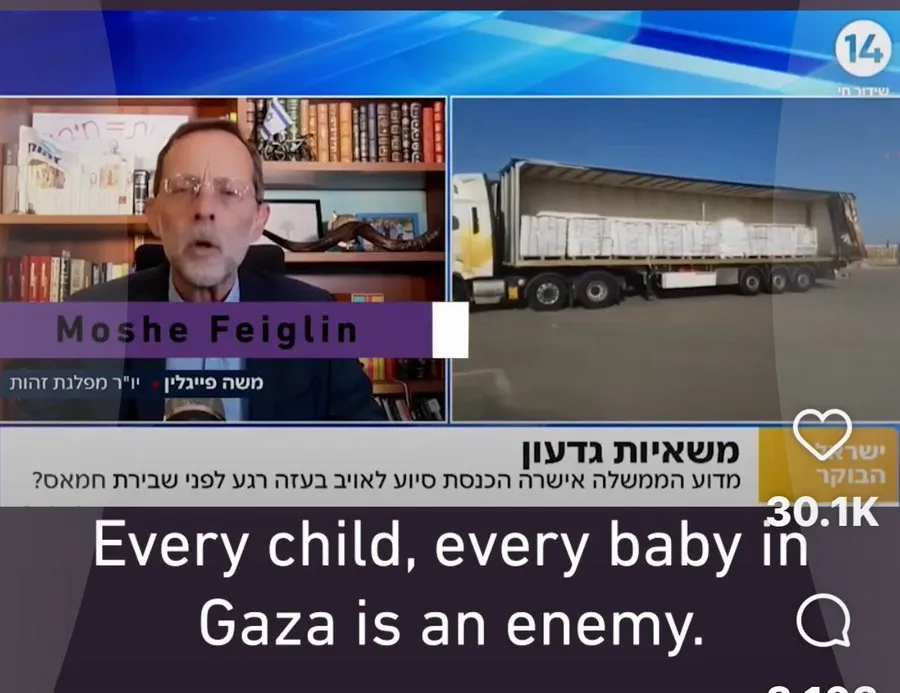
When 17-year-old Eitan Newman asked Moshe Feiglin what would happen to Palestinians who refused to leave Gaza, the veteran politician finally supplied the missing definition: Israel would deprive them of water until departure was no longer a choice. Feiglin’s own record shows that this was not an accidental admission, but the latest expression of a programme he has promoted for decades.
A political euphemism survived years of Israeli public debate until a 17-year-old asked the question that experienced television interviewers had repeatedly failed to pursue.
If the proposed removal of Gaza’s Palestinian population is really “voluntary emigration,” Eitan Newman wanted to know, what happens to the person who does not volunteer?
Newman, a teenager from Ra’anana appearing on the Knesset Channel programme First Vote on 2 August 2026, put that question to Moshe Feiglin, the former Likud parliamentarian, former deputy speaker of the Knesset and present leader of the Zehut party. The official description of the programme said Feiglin was in the studio making controversial remarks about Arab citizens and Gaza, although it did not capture the significance of the interrogation that followed. The full broadcast remains available through the Knesset Channel’s official archive.
Newman began by stripping away the argument over terminology. Call it ethnic cleansing, transfer or voluntary emigration, he said in substance, but explain what an Israeli government would do to a Gazan who refused to go. Would soldiers load that person onto a truck, where would they take him, and what would happen if he continued to resist?
Feiglin initially answered a different question, asserting that the overwhelming majority of Gazans wanted to leave. Newman immediately returned to the minority who did not. Feiglin said they would have to be encouraged because anyone remaining would eventually murder Israelis. Newman again insisted that this did not answer the question.
“You’ll make him leave,” Feiglin finally replied.
Newman asked what “make” meant. Feiglin said every possible means could be used and supplied an example: Israel could shut off the person’s water. When Newman asked whether somebody who still refused could be left to die, Feiglin replied that the person would become thirsty and would have to leave to obtain a cup of water.
Newman then pushed the premise to its conclusion. Was this, in effect, a plan to kill everyone who stayed? Feiglin fell silent. Newman waited, asked again whether the choice was departure or death, and demanded to know whether the people subjected to the policy were not human beings. Feiglin did not answer the question directly. He instead accused Newman of treating Israelis as murderers while presenting what he called an “Islamo-Nazi terror entity” as the victim.
Newman explained that he was asking about Feiglin’s policy because voters needed to understand what the politician would do if elected to the Knesset. Feiglin invoked his family’s loss. He told Newman that he had a grandson of the teenager’s age whose brother lay beneath a grave marker because of such questions. The reference was to Sergeant Yair Levin, Feiglin’s 19-year-old grandson, who was killed with three other Israeli soldiers in a booby-trapped building in Rafah in June 2024. Contemporary reporting identified Levin as a trainee in the Givati Brigade’s reconnaissance unit and described the circumstances of the fatal explosion. The Times of Israel reported the soldiers’ deaths and the initial IDF account.
Newman asked whether Feiglin was therefore holding him responsible for Levin’s death. Feiglin denied that, but blamed what he called Newman’s “twisted worldview,” saying that concern for the rights of the “murderous entity” had led to the disaster. Newman again stated the implication as he understood it: some two million people were to die if they would not depart. Feiglin closed by accusing the teenager of listening only to himself.
The exchange mattered because Newman refused to be diverted by a change of subject, a family tragedy or an accusation of disloyalty. Every time Feiglin substituted a justification for an answer, the teenager restored the original question: what happens to the person who says no?
A teenager conducts the interview that television abandoned
Writing in Haaretz on 6 August, columnist Gideon Levy described the encounter as an interview of a kind no longer seen on Israeli television. It had not happened on Uvda, the celebrated investigative programme, or Meet the Press, nor amid the television panels Levy dismissed as idle and foolish. It occurred on a remote Knesset Channel youth programme. Levy contrasted Newman’s persistence with the country’s famous presenters, naming Yonit Levy, Danny Kushmaro, Ben Caspit, Amit Segal, Raviv Drucker and Ayala Hasson among those who, in his view, should study what the teenager had done. Levy’s column presented the translated exchange and argued that Newman had exposed the lie inside the phrase “voluntary emigration”.
Levy’s conclusion was that a conventional network interview would probably have allowed Feiglin to say “voluntary emigration” before moving to familiar electoral questions. Newman instead demanded the missing operational detail and obtained it: thirst would be manufactured as an instrument of expulsion. Levy called what the questioning uncovered a full-blown, Nazi-type solution, a description aimed not at Feiglin’s personality but at the policy sequence he had just articulated.
This is precisely why the interview was more than a moment of good television. It converted an abstraction into a physical sequence. First comes the demand to leave, then the deprivation of water, then the presentation of departure as the person’s own decision. The truck is almost beside the point because the coercion occurs before anybody is placed inside it.
International criminal law does not limit force to a soldier physically carrying a civilian across a border. The International Criminal Court’s Elements of Crimes says that “forcibly” may include threats, duress, psychological oppression, abuse of power and exploitation of a coercive environment. The ICC’s official text sets out that broader definition of coercion. Article 49 of the Fourth Geneva Convention prohibits individual or mass forcible transfers and deportations of protected people from occupied territory, while Article 7 of the Rome Statute includes deportation or forcible transfer among crimes against humanity when the necessary contextual elements are established. The ICRC’s updated commentary explains Article 49, and the Rome Statute provides the relevant definition.
Whether a particular operation meets every legal element would require a judicial assessment of evidence, context and individual responsibility. The basic point, however, is not difficult: a person deprived of water until he abandons his home has not made an uncoerced migration decision.
The readers asked who Feiglin really was
The comments beneath Levy’s column quickly moved beyond praise for Newman. The page listed 14 comments; among those reproduced with the article, a reader using the name CV posted twice to object to the description of Feiglin as merely a “right-wing politician.” CV argued that he should be understood as an explicit Jewish supremacist with a long record of advocating the removal of non-Jews and subordinate rights for those who remained. The commenter directed readers to the “Controversies and criticism” section of Feiglin’s French-language Wikipedia page, which retained material and quotations not then presented as fully on the English page.
The same reader pointed to Feiglin’s sedition conviction, his remarks about Hitler and his treatment of Baruch Goldstein, the Israeli settler who murdered 29 Palestinian worshippers and wounded 125 in Hebron’s Ibrahimi Mosque in 1994. CV argued that in other historical settings Feiglin would have been a Ku Klux Klan leader in the segregated American South or an enthusiastic Nazi in 1940s Germany. The analogy was the commenter’s, not a factual label adopted here. The commenter’s wider question was not simply why Feiglin believed these things, but how a state describing itself as a liberal democracy had repeatedly brought him into an elite position and close to power.
Another reader, Pasternak, responded to Feiglin’s insistence that Palestinians could be made to leave by invoking the history of what happened when Nazi efforts to remove unwanted populations encountered practical difficulty. The comparison was stark and deliberately offensive, but it reflected the same concern Newman had forced into the open: what is the endpoint when the targeted population will not go?
The French page is not itself sufficient evidence for every claim, and one of its cited reports even repeated an incorrect death toll of 23 for Goldstein’s victims. The established number murdered inside the mosque was 29. Nevertheless, the page supplied a useful trail to Feiglin’s own texts, television recordings and contemporaneous Israeli, French, British and international reporting. Following those citations reveals not an isolated outburst in 2026, but a continuous political project.
From anti-Oslo sedition to an unequal state
Feiglin first became nationally prominent through Zo Artzeinu, or This Is Our Land, the movement he co-founded to obstruct the Oslo peace process through mass civil disobedience. The campaign organised road blockades across Israel and Feiglin was convicted of sedition in 1997, receiving a prison sentence that he served through community work. The historical record contains his blunt description of the strategy: “We will do all that it’s possible to do, including breaking the law.” The conviction and the movement’s activities are also summarised in the Hebrew biographical record, whose citations lead to contemporaneous legal and press reporting.
During the same political period, former Israeli minister and Haaretz columnist Yossi Sarid reported that Feiglin had described Adolf Hitler as an “unparalleled military genius” and praised the order, public administration and cultural tastes associated with his rule. The fuller reported passage referred to Nazi Germany’s physical and ideological transformation, orderly youth, an exemplary regime, a proper justice system, public order, music and painting. Feiglin later said that recognising what he considered Hitler’s military ability did not mean that he admired him, and he argued that the quotation had been used out of context. The disputed context should be reported, but it does not erase the words. Sarid revisited the quotation in Haaretz in 2008, while Alain Gresh reproduced the French rendering and the surrounding controversy for Le Monde diplomatique.
Gresh also reported that Feiglin had hailed Goldstein’s massacre as an “act of resistance.” Later summaries have sometimes softened that claim by saying Feiglin condemned the killing while declining to condemn Goldstein’s motivation. The safest conclusion is therefore carefully attributed: Le Monde diplomatique reported praise for the act, while other accounts describe a qualified or internally contradictory position. What is beyond dispute is the identity of Goldstein and the enormity of the crime that became the object of that political dispute: the Kach supporter shot dead 29 Muslims at prayer. A later history of Kahanism recounts the massacre and its political legacy.
The French page also pointed to a 2019 Le Monde account of Feiglin’s earlier programme. It recorded a call in 2000 to remove Palestinians from Nablus, his continued celebration of Goldstein’s memory, his demand for the complete “Judaisation” of the Temple Mount and his later parliamentary proposal to annex the occupied territories. Under that proposal, Palestinians who refused Jewish sovereignty would be encouraged to emigrate; those who remained would receive permanent residence, while only a small number could eventually receive full citizenship after a prolonged examination. Jean-Pierre Filiu’s Le Monde account preserves that policy history.
By 2004, Feiglin was stating his view of citizenship and sovereignty in terms that went well beyond normal conservative politics. In an interview with The New Yorker, he challenged the premise that non-Jews should influence the policy of a Jewish state, said the historic Jewish aspiration was for a Jewish rather than a democratic state, and made democracy subordinate to the state’s defining values. In the same interview he compared teaching democracy to an Arab with teaching a monkey to speak, called Arab culture one of thieves and robbers, insulted the Prophet Muhammad and portrayed Arabs as inherently destructive. Jeffrey Goldberg’s report, “Among the Settlers,” records the exchange.
That statement supplies the ideological structure behind the policies. Political rights are not treated as equal entitlements arising from citizenship; they are conditional upon the purposes of an ethnically defined state. The French page’s reference to “Jewish leadership” is therefore not merely the name of Feiglin’s former Likud faction. It describes a programme in which Jewish sovereignty is permanent and non-Jewish political standing is restricted, conditional or encouraged to disappear through emigration.
Water as a weapon was already in the programme
The most important historical link to Newman’s interview appeared in 2008, when an extreme policy document vanished from the website of Feiglin’s Jewish Leadership movement shortly after he won a high position in Likud primaries. Haaretz reported that the manifesto proposed leaving the United Nations, creating a parliamentary upper chamber reserved exclusively for Jews, denying Palestinian national existence, encouraging Arab emigration and cutting water supplies to Palestinians. The contemporaneous Haaretz report described the removed manifesto.
Feiglin was quoted saying that Arabs would have to seek national self-determination in Arab states and that Israel would encourage and assist their emigration. The programme would have left Palestinians with human rights but no civil rights, while a new upper chamber of parliament reserved for Jews held decisive national authority. This makes his 2026 suggestion neither novel nor reactive. The teenager asked how a government would force departure, and Feiglin reached for a mechanism already associated with his earlier platform: shut off the water.
Britain had already decided in 2008 that Feiglin should be excluded from the country because his presence was not conducive to the public good. A Home Office letter referred to conduct assessed as fomenting or justifying terrorist violence, provoking serious criminal activity and fostering hatred capable of producing inter-community violence. Feiglin replied by accusing Britain of welcoming Hezbollah-linked figures and supporting terrorism. Ynet reported the exclusion and Feiglin’s response. In 2025, Feiglin said he remained barred from Britain.
Paying Palestinians to leave
In January 2013, shortly before entering the Knesset, Feiglin proposed annexing the West Bank and paying each Palestinian family $500,000 to emigrate. He argued that Israel was already spending roughly ten per cent of gross national product maintaining Oslo’s two-state framework through walls, missile defences and security, and that the same money could finance departure to what he described as a better future. The Jewish Chronicle recorded Feiglin’s speech and the proposed sum, while the Times of Israel reported the same proposal.
The offer was monetary, but it sat within an annexation programme that denied Palestinians collective political sovereignty over the land. Even before the deprivation of basic necessities entered the discussion, “voluntary” already meant choosing departure within a political system designed to eliminate the other meaningful national option.
The 2014 Gaza blueprint
During Israel’s 2014 assault on Gaza, Feiglin published a step-by-step proposal under his own name. The document is especially important because it connects every element that later reappeared in Newman’s interview: an ultimatum to what Feiglin called the “enemy population,” an instruction to leave for Sinai, attacks on infrastructure without regard for human shields or environmental damage, total siege, conquest, elimination, annexation, emigration incentives and Jewish settlement.
Feiglin wrote that civilians could go to Sinai and that this would mark the limit of Israel’s humanitarian effort. He proposed maximum conventional force against military and infrastructure targets, said nothing should enter Gaza, and declared that Israel should remain there forever. Following conquest, Gaza would become sovereign Israeli territory, be populated by Jews and even help solve Israel’s housing shortage. Palestinians deemed uninvolved in anti-Israel activity would be offered an international emigration package, while those remaining would initially receive permanent residence and could later seek citizenship if they accepted the rule and way of life of the Jewish state. Feiglin’s complete seven-part outline remains published by Israel National News.
A longer Facebook proposal sent to Prime Minister Benjamin Netanyahu added tent encampments near Sinai until destination countries could be found, the cutting of electricity and water to populated areas, the killing of combatants and “their supporters,” loyalty oaths for those who remained, the return of Israeli settlers and the rebuilding of Gaza City as an Israeli tourism and commercial centre. The Times of Israel reported that proposal in August 2014.
When CNN’s Wolf Blitzer challenged Feiglin over reports that he had advocated concentration camps, Feiglin rejected the Nazi terminology and described the proposed sites as sheltered tent areas. That semantic defence did not alter the sequence he had published: concentrate the civilian population, destroy existing areas, find foreign destinations and permanently resettle Gaza with Jews.
Beirut, Dresden, Hiroshima and “Hebrew Gaza”
Feiglin’s rhetoric continued after he left parliament. Following the catastrophic Beirut port explosion of 4 August 2020, he thanked God for what he presented as a celebration for the Jewish festival of Tu B’Av, speculated that the blast had not been accidental and said everybody was entitled to be glad it had occurred in Beirut rather than Tel Aviv. In a radio interview, he said he hoped Israel was responsible. Middle East Monitor reproduced the Facebook and radio remarks. The French page compressed the episode into two phrases, describing his reaction as a “spectacular pyrotechnic display” and a “gift from God,” but the underlying report shows a much more extensive celebration.
After the Hamas-led attacks of 7 October 2023, Feiglin told Al Jazeera that there was only one solution: the complete destruction of Gaza before invasion, comparable to Dresden and Hiroshima without a nuclear weapon. The recording is preserved in Al Jazeera’s video report. On 12 October 2023, he also said that if the purpose of Israel’s operation was not destruction, occupation, expulsion and settlement, then nothing had been achieved, a statement later documented in reporting on genocidal rhetoric in Israeli broadcasting.
In June 2024, Feiglin again invoked Hitler during an Israeli television discussion, quoting the Nazi leader’s determination not to leave a single Jew and applying the structure of that statement to the population of Gaza. He said Israel could not live alongside even one person in the territory whom he classed as an Islamist Nazi, called for a return to Gaza and demanded that it be made Jewish. Haaretz reported the Channel 12 broadcast, while Al Jazeera preserved the video and its “Hebrew Gaza” context.
In May 2025, appearing on Channel 14, Feiglin explicitly widened the category of enemy beyond Hamas to include every Palestinian child and infant in Gaza. He demanded conquest, settlement and a territory in which not one Palestinian child remained. He also claimed that a child given milk would grow up to rape the donor’s daughters and murder the donor’s children. These were not paraphrases by an opponent; the remarks were reported in Hebrew by the religious news site Kipa from the Channel 14 broadcast and were subsequently carried internationally.
From the fringe to official policy
The most consequential part of this history is not that Feiglin has repeated himself. It is that positions once associated with an agitator convicted of sedition later became an organised state project.
Israel’s government approved a bureau in March 2025 to facilitate what it called the voluntary emigration of Palestinians from Gaza, with Defence Minister Israel Katz saying it would arrange supervised passage to destination countries. In May 2026, Katz said the plan would be implemented at the appropriate time and in the appropriate manner. Israeli human rights organisations responded that living conditions which deny survival, freedom and dignity cannot produce a genuinely voluntary departure. Haaretz reported the creation of the emigration bureau, and The Guardian reported Katz’s renewed commitment in May 2026.
Feiglin, meanwhile, is not merely commenting from retirement. In May 2026 he agreed to contest the forthcoming election on a joint list with Michael Ben-Ari, the former Otzma Yehudit chairman. The Jerusalem Post reported the alliance. Ben-Ari was barred from the 2019 election after Israel’s Supreme Court found a critical mass of repeated anti-Arab statements demonstrating incitement to racism as a dominant objective. An English summary of the Israeli Supreme Court judgment records that finding.
Nor was Feiglin always marginal within Likud. He won 23.21 per cent in the party’s 2012 leadership contest against Benjamin Netanyahu, entered parliament in 2013 and served as a deputy speaker of the Knesset. Contemporaneous reporting recorded his 23 per cent result, and an official 2014 Knesset release lists Feiglin as deputy speaker.
The question raised in the comments beneath Levy’s column can therefore be answered. Feiglin came near power because a substantial political organisation repeatedly admitted, promoted and institutionalised him. His ideas were not hidden from voters. They were stated in manifestos, primary campaigns, newspaper interviews, parliamentary speeches, Facebook plans and television studios. The more disturbing development is that the vocabulary of those manifestos moved into ministerial announcements and government offices.
The word that collapsed under one follow-up question
Newman’s achievement was to refuse the assumption that the adjective “voluntary” could settle a factual question. He tested the word against a human being who stayed in his home and declined the offer to leave. Once that person entered the discussion, the policy could no longer remain a benign travel programme.
Feiglin’s answer was water deprivation. His historical record supplied the rest: siege, encampment, bombardment, annexation, conditional status, destination countries and Jewish resettlement. The teenager did not insert those ideas into Feiglin’s mouth, because they were already present across more than two decades of the politician’s public statements.
Levy called the interview a ray of light on a television landscape darkened by propaganda. Its value also lay in something elementary that journalism too often abandons under political pressure: Newman listened closely enough to notice that his question had not been answered, and he possessed the nerve to ask it again.
The result was a definition. “Voluntary emigration,” when the person who stays is denied water, is not voluntary. It is forced removal conducted through a coercive environment, with the victim’s final act of survival presented as consent.
Sourced quotation and policy record
The entries below identify the substantive Feiglin quotations and policies raised by the supplied column, its displayed reader comments, the French-language page and the underlying sources that could be traced. It is not a claim to catalogue every statement Feiglin has ever made. Short excerpts are followed by fuller paraphrases where the original statement is lengthy, and translations from Hebrew or French are identified as English renderings.
1995: Breaking the law to stop Oslo
Exact excerpt: “We will do all that it’s possible to do, including breaking the law.”
Context and source: Feiglin was describing the civil-disobedience campaign that blockaded Israeli roads in opposition to the Oslo Accords. He was convicted of sedition in 1997. The quotation was reported contemporaneously and is preserved through the citations collected in the French biographical page.
1995: Hitler and Nazi Germany
Exact excerpt: “Hitler was an unparalleled military genius.”
Full substance: Feiglin was reported as saying that Nazism elevated Germany physically and ideologically, transformed disordered youth, and produced public order, an exemplary regime and a proper justice system. He also referred approvingly to Hitler’s musical taste and painting before saying the Nazis were not merely a gang of thugs. Feiglin later said that judging Hitler a military genius did not amount to admiration and argued that the passage had been stripped of its intended context about democracy and legitimacy.
Sources: Yossi Sarid in Haaretz and Alain Gresh in Le Monde diplomatique.
1990s and 2000s: Baruch Goldstein
Exact excerpt reported by Le Monde diplomatique: “act of resistance.”
Context and qualification: Gresh reported that Feiglin used this approving description for Goldstein’s 1994 massacre of Palestinian worshippers. Other summaries say Feiglin condemned the killings while declining to condemn Goldstein’s motivation, so the precise position should remain attributed rather than flattened into an uncontested quotation. Goldstein murdered 29 worshippers and wounded 125.
Source: Le Monde diplomatique.
1990s and 2000s: “Jewish leadership” as the political objective
English rendering from the French page: “bring Jewish leadership to the State of Israel.”
Full substance: This was the stated objective of Manhigut Yehudit, the organisation Feiglin founded and later operated as a faction inside Likud. In his wider programme, Jewish sovereignty was not simply constitutional symbolism; it determined who could exercise decisive national power.
Source trail: French-language biography and cited organisational history. This wording is documented on the French page, but the original linked organisation material is no longer consistently accessible, so it is labelled as a page-level quotation rather than independently verified primary text.
2004: Non-Jews and democracy
Exact excerpt: “Why should non-Jews have a say in the policy of a Jewish state?”
Full substance: Feiglin said Jews had dreamed of a Jewish state rather than a democratic state and argued that democracy should serve the state’s defining values rather than undermine them.
Source: The New Yorker, “Among the Settlers”.
2004: Arabs, democracy and culture
Exact excerpt: “You can’t teach a monkey to speak.”
Full substance: Feiglin completed the analogy by saying an Arab could not be taught to be democratic. He then characterised Arab culture as thieving, denigrated the Prophet Muhammad and said Arabs destroyed what they touched. These statements were made in the same interview as his rejection of equal non-Jewish influence over a Jewish state.
Source: The New Yorker, “Among the Settlers”.
2004: Teaching Israel’s history and the Nakba
English rendering from the French page: Feiglin argued that Israel’s history should not be taught from an Arab point of view, with particular reference to the Nakba.
Source assessment: The French-language biography preserves this position. Its underlying citation was not available in a form that permitted independent checking, so the wording is reported as a French-page claim, not as a separately authenticated quotation.
2004: Expulsion of Arabs considered hostile
English rendering from the French page: “expulsion, if necessary.”
Full substance: The page attributes to Feiglin support for transferring to Jordan Arabs he regarded as hostile to Israel.
Source assessment: The French-language biography and its citation trail preserve the statement, but the cited contemporaneous article could not be accessed for direct verification. It is therefore included with an explicit evidence limitation.
2004 and 2008: Emigration and Palestinian national rights
Exact excerpt: “They will have to seek the right to self-determination in Arab states.”
Full substance: Feiglin’s programme denied a separate Palestinian national claim, called for Israel to encourage Arab emigration and assist those who left, promised Palestinians “human rights without civil rights,” and proposed an institutional order in which decisive national authority was reserved for Jews. A related 2004 interview promoted “voluntary transfer” to neighbouring Arab states.
Source: Haaretz on Feiglin’s removed manifesto.
2005: Citizenship and voting for Jews abroad
Full substance: The French page records Feiglin’s proposal that Jews anywhere in the world who wanted Israeli citizenship should receive both citizenship and the vote, whether or not they lived in Israel. The point is relevant because it contrasts political inclusion based on Jewish identity with his proposed removal or conditional status for Palestinians already living under Israeli control.
Source trail: French-language biography and citation. The older underlying link no longer resolves, so this is retained as a clearly labelled French-page claim rather than presented as independently verified primary evidence.
2008: Britain’s exclusion decision and Feiglin’s response
Exact excerpt from the Home Office letter: “Your presence would not be conducive to the public good.”
Feiglin’s response, in substance: He accused Britain of welcoming prominent terrorists and said its policy encouraged and supported terrorism.
Source: Ynet/Reuters.
2013: Paying West Bank Palestinians to emigrate
Exact excerpt: “We can give every Arab family in Judea and Samaria $500,000.”
Full substance: Feiglin proposed redirecting the money Israel spent maintaining the Oslo framework and security infrastructure into payments intended to induce Palestinian families to emigrate to Western countries.
Sources: Jewish Chronicle and Times of Israel.
2014: Ultimatum, siege, conquest and Jewish resettlement of Gaza
Exact excerpts: “Sinai is not far from Gaza and they can leave” and “Gaza is part of our Land.”
Full substance: Feiglin proposed one warning to Gaza’s “enemy population,” maximum attacks on military and infrastructure targets, total siege, conquest and elimination of armed opponents. Palestinians deemed uninvolved could leave with financial assistance; Gaza would be annexed, permanently retained and populated by Jews. Those who remained would receive conditional permanent residence and could later seek citizenship after accepting the rule and way of life of the Jewish state.
Source: Feiglin’s own published outline.
2014: Tent encampments, water cuts and destination countries
Exact excerpt: “until relevant emigration destinations are determined.”
Full substance: In the longer proposal, civilians would be moved into tent camps near Sinai, existing populated areas would lose electricity and water, countries would be found to receive emigrants, and Gaza would be reconstructed as Israeli territory after the return of Jewish settlers.
Source: Times of Israel.
2020: The Beirut port explosion
Exact excerpt: “We are all allowed to rejoice that it exploded in the port of Beirut.”
Full substance: Feiglin thanked God for what he portrayed as a Tu B’Av celebration, speculated that the explosion was not an accident, compared its destructive effect to a nuclear bomb without radiation, said he hoped Israel was responsible, and expressed relief that it struck Beirut rather than Tel Aviv.
Source: Middle East Monitor.
October 2023: Dresden and Hiroshima
Exact excerpt: “complete destruction of Gaza, before invading it.”
Full substance: Feiglin called for destruction comparable to Dresden and Hiroshima while specifying that a nuclear weapon need not be used.
Source: Al Jazeera video.
October 2023: The declared objective of the operation
Exact excerpt: “destruction, occupation, expulsion, and settlement.”
Full substance: Feiglin said an operation that did not pursue all four objectives would have achieved nothing.
Source: The Guardian on statements broadcast by Channel 14.
June 2024: Hitler, expulsion and a “Hebrew Gaza”
Exact excerpt: “We can’t live here if one ‘Islamo-Nazi’ remains in Gaza.”
Full substance: Feiglin prefaced the statement with a quotation attributed to Hitler about leaving no Jew alive, then demanded Israel’s return to Gaza, the removal of Palestinians and the transformation of the territory into what he called Hebrew Gaza.
Sources: Haaretz and Al Jazeera video.
May 2025: Every child as an enemy
Exact excerpt: “Every child, every baby in Gaza is an enemy.”
Full substance: Feiglin said the enemy was not merely Hamas or its military wing, called for Gaza’s conquest and settlement, insisted that no Gazan child should remain, and described this as the only victory.
Source: Kipa’s Hebrew report of the Channel 14 broadcast.
May 2025: Milk for a Palestinian child
Exact excerpt in English translation: “In 15 years he will rape your daughters and slaughter your children.”
Context: Feiglin was attacking the delivery of humanitarian aid and referred to a child being given milk.
Source: Kipa’s Hebrew report.
August 2026: What happens to the Gazan who refuses
Exact excerpts: “You’ll make him leave” and “Then he’ll be thirsty.”
Full substance: Pressed by Eitan Newman, Feiglin said every possible means could be used, offered shutting off water as an example, and said thirst would force a Palestinian to leave in search of a drink. When Newman asked whether the alternative was departure or death, Feiglin attacked the teenager’s worldview rather than withdrawing the proposal.
Sources: Official Knesset Channel broadcast and Gideon Levy’s translated account in Haaretz.
Source assessment
The 2026 Knesset Channel recording, Feiglin’s 2014 signed outline, the Channel 12 and Channel 14 recordings, and his recorded Al Jazeera interview constitute the strongest primary or near-primary evidence. The 2008 and 2014 Haaretz reports, the Times of Israel, Ynet/Reuters, Kipa, The New Yorker, Le Monde diplomatique and other contemporaneous outlets provide secondary documentation and translations. The French-language Wikipedia page was used as a research map rather than as the sole authority for contested claims. Where the available accounts conflict, particularly over Feiglin’s treatment of Baruch Goldstein and the claimed context of his 1995 Hitler remarks, that conflict has been stated rather than concealed.