


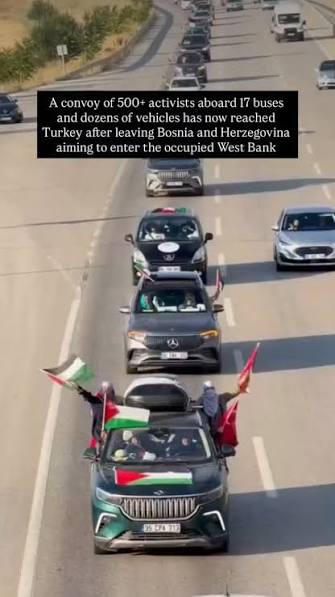
Hundreds of activists are travelling towards the occupied West Bank in a civilian convoy linking the memory of the Srebrenica genocide with demands for action over Gaza. After crossing the Balkans and reaching southeastern Turkey, the movement now faces its most difficult challenge: securing passage through Iraq, Jordan and the Israeli-controlled border into Palestine.
A multinational civilian convoy that began its journey in Bosnia and Herzegovina has reached southeastern Turkey after travelling through Albania and Greece, holding rallies and public meetings intended to return Gaza and the occupied West Bank to the centre of international attention.
Known as the Palestine Convoy, the movement brings together activists, doctors, civil society representatives and volunteers from Europe, North America, the Middle East and North Africa. Organizers say more than 500 people from approximately 20 countries have participated in its principal activities, while the convoy’s website lists supporting delegations from 31 countries.
The journey began with an international assembly in Sarajevo on 25 July, followed by a rally and commemoration in Srebrenica on 26 July. Participants then travelled through Albania and Greece before entering Turkey through the İpsala border crossing on 30 July.
After public events and training programmes in Istanbul and Sakarya, the convoy continued through Ankara, Konya and Adana. On 5 August, it was welcomed at a rally outside Adana’s Central Mosque, where local speakers described the journey as an attempt to prevent Gaza from disappearing from international consciousness.
The convoy left Adana the following morning and headed towards Gaziantep, where another public rally was planned. Its organizers’ live tracking service placed the convoy in Gaziantep on 6 August, with further Turkish stops planned before an attempted crossing into Iraq.
A journey beginning in Srebrenica
Srebrenica was chosen as the convoy’s symbolic starting point because of the massacre of more than 8,000 Bosniak Muslim men and boys by Bosnian Serb forces in July 1995, a crime recognized as genocide by international courts.
The organizers have characterized the journey as a route “from one genocide to another,” connecting the failure of the international community to protect the people of Srebrenica with its continuing failure to stop the destruction and mass killing in Gaza.
Participants gathered to remember the victims of the 1995 genocide before setting out towards Palestine. For the Bosnian members of the convoy, this was intended to transform remembrance into action, with Srebrenica presented not simply as a historical tragedy but as a warning about the consequences of international indifference.
Dr Hüseyin Durmaz, the convoy’s principal spokesperson, said the participants had prayed for those killed in Srebrenica and reflected upon the silence that allowed the massacre to take place.
Speaking after the convoy entered Turkey, Durmaz said the activists did not want to repeat that silence while Palestinians were being killed, displaced and deprived of humanitarian assistance.
The decision to begin in Srebrenica therefore gives the convoy a significance extending beyond the delivery of a political message. It challenges the familiar international promise of “never again” by asking what that promise means when governments continue arming, protecting or declining to restrain a state accused of committing mass atrocities.
Across the Balkans and into Turkey
Following the Srebrenica commemoration, the convoy travelled through Sarajevo, Tirana and Thessaloniki, holding rallies, motorcades and public discussions along the way.
In Thessaloniki on 29 July, supporters organized a motorcade through the city, a solidarity gathering at Kamara and a public discussion entitled “Convoy Against the Silence.” The convoy crossed from Greece into Turkey through the İpsala gate the following day.
According to a 30 July report by Turkey’s Demirören News Agency, 85 members of the European contingent were present when it crossed into Turkey. They were welcomed by civil society organizations carrying Turkish and Palestinian flags before continuing towards Istanbul.
That figure requires some explanation because widely circulated social media posts have repeatedly stated that more than 500 activists departed from Bosnia in 17 buses and dozens of other vehicles. The available reporting indicates that the initial European travelling contingent was considerably smaller, with additional participants and vehicles joining during the Turkish stages of the journey.
The convoy follows what its organizers call a “snowball” model in which national and local delegations merge at different points along the route. Numbers consequently fluctuate as some activists accompany the convoy for one stage while others undertake the longer journey towards Jordan.
In Istanbul, the European vehicles were joined by participants arriving from other countries. The convoy then travelled to Sakarya, where the organizers held several days of seminars, mission briefings and security training.
Participants were divided into Turkish and international groups for separate sessions covering visas, border requirements, convoy discipline, security procedures and possible obstruction during the journey through Iraq and Jordan. The organizers also screened participants and emphasized that the action must remain peaceful and coordinated.
On 3 August, Anadolu Agency reported that more than 500 activists representing 20 countries had participated in the Sakarya programme.
The convoy then left for Ankara, where another public gathering was held, before continuing to Konya and Adana. Supporters accompanied the vehicles through several Turkish cities, turning individual convoy stops into local demonstrations of solidarity.
Three principal objectives
Durmaz has identified three immediate objectives behind the journey.
The first is to draw attention to the danger of further mass displacement, destruction and annexation in the occupied West Bank. Durmaz summarized this demand by declaring that the movement would not allow the West Bank to become “a new Gaza.”
The second objective is to return Gaza to the international agenda. Organizers argue that political discussions about ceasefires and diplomatic negotiations have allowed the continuing humanitarian emergency to receive less attention, even though Palestinians remain surrounded by destruction, displacement and severe restrictions on essential supplies.
The third objective is to build a lasting international network by bringing activists into direct contact with communities along the route. Rather than treating the convoy as an isolated protest, its leadership wants the relationships established during the journey to produce further campaigns, boycotts, political pressure and civilian mobilizations.
The convoy also opposes what its organizers describe as discriminatory Israeli death-penalty legislation directed at Palestinian prisoners. Its published demands call for an end to occupation and annexation, the protection of Palestinians from forced displacement and the meaningful enforcement of international law and United Nations resolutions.
The movement’s political position is broader than some of the more neutral descriptions circulating on social media.
On its official website, the organization defines Palestine as all the territory between the Jordan River and the Mediterranean Sea, explicitly including Gaza, Jerusalem, Hebron, Nablus, Jenin, Jaffa, Haifa, Acre, Nazareth and Beersheba.
It rejects the geographical and political fragmentation of Palestinians into separate categories associated with Gaza, the West Bank, East Jerusalem and the territory that became Israel in 1948. The convoy consequently presents itself as a movement concerned with the whole Palestinian question rather than a campaign restricted to humanitarian conditions inside Gaza.
Who is behind the convoy?
The Palestine Convoy describes itself as an independent civil initiative that is not affiliated with a political party, government or established umbrella organization.
Its coordinator, Cengiz Aslan, is a Turkish entrepreneur who has previously helped arrange medical treatment for people wounded in regional conflicts. Aslan also organized logistics for the Turkish delegation that participated in the 2025 Global Sumud Flotilla.
Spokesperson Hüseyin Durmaz is a medical doctor, writer and civil rights activist who previously participated in the Global March to Gaza and Global Sumud Flotilla.
International coordination is being led by Fatma Ezzahrae El Hbibi, a Tunisian civil society activist and volunteer with the Tunisian Red Crescent. French activist Sébastien Michelot is involved in international mobilization and advocacy, while Bosnian activist Ilday Husović has coordinated delegations and logistical arrangements in Bosnia and Herzegovina.
The leadership insists that participants must remain nonviolent and respect local laws in every country through which they travel. Volunteers are required to register, undergo an interview and participate in security and operational training.
The convoy’s published vehicle rules permit cars, motorcycles, minibuses and buses, with limits on the number of passengers carried in each vehicle.
Humanitarian mission or political mobilization?
The convoy is regularly described as a humanitarian mission, and at least one ambulance is travelling with it. Nevertheless, the available public documentation does not identify a substantial cargo of humanitarian supplies.
No detailed aid manifest, cargo tonnage, medical supply inventory, Palestinian receiving organization or distribution agreement has been published. On the presently available evidence, the convoy is best understood as a civilian political mobilization carrying a humanitarian message rather than a conventional aid delivery organized in cooperation with United Nations agencies or established relief organizations.
Its immediate effects have been political and symbolic. It has brought activists from numerous countries together, generated public rallies across several states, obtained regional media coverage and created opportunities for local communities to demonstrate support for Palestine.
Whether it produces more concrete results will depend upon what happens during the final stages of its journey.
The road through Iraq and Jordan
The convoy’s revised itinerary envisages stops in Şanlıurfa, Diyarbakır and Mardin before reaching the Habur crossing between Turkey and Iraq.
After entering Iraq, it plans to pass through Duhok, Erbil, Kirkuk, Baghdad, Fallujah and Ramadi before approaching the Trebil crossing into Jordan. Further stops are planned at Ruwaished and Amman.
The current schedule published by the organizers anticipates reaching the King Hussein Bridge between Jordan and the occupied West Bank on 17 August, followed by an intended arrival in Ramallah on 18 August.
This is an accelerated version of the original timetable, which scheduled the convoy’s arrival in the West Bank for 21 August.
However, the route beyond Turkey remains provisional. There has been no publicly disclosed confirmation that the Iraqi, Jordanian or Israeli authorities have approved the passage of the convoy as an organized group.
Obtaining individual visas does not necessarily guarantee that a large political convoy will be permitted to cross each frontier with its vehicles, flags, ambulance and public campaigning apparatus intact. Negotiations with national authorities may determine how much of the convoy can continue and under what conditions.
The most difficult point is likely to be the King Hussein Bridge, known on its western side as the Allenby crossing.
Although the bridge connects Jordan with the occupied West Bank, entry through the terminal is controlled by Israeli authorities. The Israeli Airports Authority states that tourist groups should coordinate their arrival in advance.
Israeli border officials can refuse entry to individual foreign visitors. Activists with a documented history of Palestine solidarity campaigning may face questioning, detention or exclusion.
Even if Jordan allows the convoy to approach the bridge, the participants cannot enter the West Bank without passing through Israeli-controlled immigration and security procedures.
Organizers prepare for a border camp
The possibility of being stopped is not treated by the organizers as the automatic end of the mission.
Under the convoy’s published border contingency plan, participants would establish a protest camp at the point where their progress was blocked, maintain the mobilization and continue negotiations with the relevant authorities.
Such an outcome could transform the convoy from a travelling demonstration into a prolonged border confrontation, attracting greater international media attention while placing additional pressure on Jordan and Israel.
A decision by Israel to prevent hundreds of peaceful international activists from entering the West Bank could itself become part of the convoy’s political message, illustrating how Israeli authorities control access to occupied Palestinian territory.
However, maintaining a large protest camp would require food, water, sanitation, medical support and legal representation. It would also depend upon the Jordanian authorities permitting an extended demonstration near one of the country’s most politically sensitive border crossings.
Measuring the convoy’s impact
The convoy cannot by itself end the occupation, open Gaza’s crossings or reverse the policies of governments that continue to support Israel. Its practical power comes from its ability to create public attention, connect international movements and impose political costs upon authorities that attempt to obstruct a peaceful civilian initiative.
Its immediate achievements are visible in the rallies held across Bosnia and Herzegovina, Albania, Greece and Turkey. Each stop has allowed local organizations to transform the passing convoy into a wider public event, while the journey has generated images of Palestinian flags crossing borders that Palestinians themselves are frequently prevented from crossing.
The convoy also challenges the argument that ordinary people are powerless when governments and international institutions fail to act. Its participants have chosen to travel thousands of miles towards one of the most tightly controlled borders in the world, knowing that they may ultimately be denied entry.
Yet the distinction between symbolism and material assistance remains important. The convoy has not reached Palestine, delivered humanitarian aid or established a corridor into Gaza. Claims about its size and international reach also originate largely from the organizers and sympathetic media and should be presented with appropriate attribution.
Its decisive stage therefore lies ahead.
If the convoy reaches Ramallah, it will have completed an extraordinary civilian journey through several countries and across some of the region’s most difficult borders. If it is stopped in Iraq, Jordan or at the Allenby crossing, the resulting confrontation may become the event through which the convoy obtains its greatest international visibility.
Either outcome will reinforce the central message carried from Srebrenica: remembrance has little meaning if it does not produce action when another population is being subjected to mass killing, displacement and destruction.
Thirty-one years after the Srebrenica genocide, the participants are attempting to turn that lesson into a physical journey towards Palestine. Whether they are allowed to complete it will now depend upon governments whose commitment to peaceful protest, humanitarian solidarity and freedom of movement is about to be tested.