


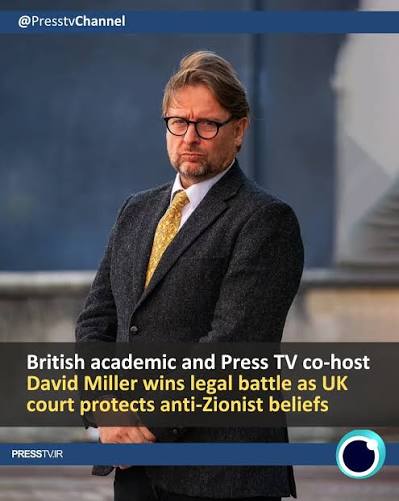
Employment Appeal Tribunal upholds finding that the University of Bristol unlawfully discriminated against the sociology professor, strengthening protection for people who oppose Zionism while drawing a clear distinction between belief and conduct
The right to oppose Zionism has received its most important protection yet under British employment law after the Employment Appeal Tribunal upheld a ruling that the University of Bristol unlawfully discriminated against Professor David Miller because of his philosophical beliefs.
In a judgment delivered on 4 August 2026, the appeal tribunal rejected the university’s attempt to overturn the central findings of the original case. It confirmed that Miller’s belief that political Zionism is inherently racist, imperialistic and colonial, and should therefore be opposed, qualified for protection under Section 10 of the Equality Act 2010.
Responding in a statement released through his lawyers, Miller called the outcome a “remarkable and extremely welcome vindication”. The statement placed the legal result within the much wider battle over Palestine advocacy, academic freedom and the treatment of critics of Israel in British institutions.
The decision means that an employer cannot lawfully dismiss, suspend, deny promotion to or otherwise disadvantage a worker because that person holds or legitimately expresses a qualifying belief opposing Zionism. Public controversy, organised complaints or pressure from outside organisations will not, by themselves, allow an employer to disregard equality law.
The ruling is nevertheless more carefully defined than some of the initial claims made about it. It does not declare every conceivable form of opposition to Zionism automatically protected, and it does not place every statement made in the name of anti Zionism beyond professional discipline. Its central principle is that a coherent and genuinely held political belief can be protected, even when it is deeply controversial or offensive to others, while threatening, harassing or otherwise unlawful conduct can still be restricted.
That distinction makes the judgment both powerful and potentially far reaching. It strengthens the legal position of workers and academics who speak about Zionism, Israel and Palestinian rights, while requiring employers to distinguish opposition to a political ideology from misconduct directed at particular individuals.
The dismissal that began a five year legal battle
Miller was employed as Professor of Political Sociology at the University of Bristol from September 2018 until his summary dismissal on 1 October 2021. His academic work examined propaganda, lobbying, corporate power and the activities of political movements, including organisations connected with Israel and Zionism.
Controversy began in 2019 after Miller identified parts of the Zionist movement as one of what he described as five pillars driving Islamophobia. Complaints were submitted to the university, including complaints concerning teaching material that connected Zionist organisations with campaigns directed against critics of Israel.
The dispute intensified in February 2021 following public comments in which Miller described Zionism as a racist and imperialist ideology, accused pro Israel organisations of trying to prevent legitimate teaching and research, and criticised the Union of Jewish Students and Bristol Jewish Society.
Miller said Jewish student organisations were political lobbying groups and argued that some Jewish students were being used as political instruments by the Israeli state. He also accused the Union of Jewish Students and university Jewish societies of participating in campaigns intended to silence criticism of Israel and Zionism.
The university received a substantial volume of correspondence demanding disciplinary action. It appointed retired professor George Banting to investigate and commissioned independent barrister Aileen McColgan KC to examine whether Miller’s statements had crossed the boundaries of lawful and acceptable expression.
McColgan reported in May 2021 that there was no formal case to answer that Miller’s statements had exceeded those boundaries. Banting nevertheless recommended disciplinary proceedings, principally because Miller’s public comments had been directed at Jewish students and student organisations.
Following a disciplinary hearing, Professor Jane Norman, then Dean of the Faculty of Health Sciences, concluded that Miller had committed gross misconduct. He was dismissed without notice, and an internal appeal was subsequently rejected.
Miller brought claims for direct discrimination because of philosophical belief, harassment, unfair dismissal and wrongful dismissal. He argued that the university had punished him not simply for the way he had referred to students, but because his opposition to Zionism formed a material part of its reason for dismissing him.
Was UK Lawyers for Israel involved in Miller’s dismissal?
The published court record does not support saying that UK Lawyers for Israel was a party to Miller’s employment case or a formally identified complainant in the process that led to his dismissal. Neither the 108 page Employment Tribunal judgment nor the Employment Appeal Tribunal ruling names UKLFI.
The organisations identified in the original judgment were different. In March 2019, the university received a complaint from the Community Security Trust, which said that two Jewish undergraduates had contacted it about Miller’s lecture on Islamophobia. In April 2019, the president of Bristol Jewish Society and the president of the Union of Jewish Students submitted a further complaint. The tribunal later recorded a large volume of external correspondence following Miller’s February 2021 comments, but did not identify UKLFI as the body directing that correspondence.
That does not mean pro Israel pressure was irrelevant to the history. It means the organisations must be named accurately. UKLFI, the Community Security Trust, the Union of Jewish Students and the Campaign Against Antisemitism are separate bodies. Treating them as interchangeable would obscure who actually did what and would turn a documented account into an allegation the judgments do not prove.
The Campaign Against Antisemitism did become directly involved with Miller later, but in separate criminal proceedings rather than the Bristol employment litigation. In June 2025, the CAA announced that it had commenced a private prosecution alleging that three posts on X were menacing communications under Section 127 of the Communications Act 2003. Miller indicated a not guilty plea. The prosecution concerns later publications and does not alter the EAT’s decision about the lawfulness of his 2021 dismissal.
The original tribunal victory
After hearing evidence over seven days in October and November 2023, a Bristol Employment Tribunal ruled in February 2024 that Miller’s anti Zionist beliefs met the legal test for protection.
Following that first victory, Miller said he was “very proud that we have managed to establish that anti-Zionist views qualify as a protected belief under the UK Equality Act”. He described recognition of the belief as his principal reason for bringing the case and said he hoped the decision would guide future disputes.
The tribunal considered the five criteria established in the earlier case of Grainger plc v Nicholson. A philosophical belief must be genuinely held, must be more than a temporary opinion based on the information currently available, must concern a substantial aspect of human life, must possess sufficient seriousness and coherence, and must be worthy of respect in a democratic society without conflicting with human dignity or the fundamental rights of others.
The tribunal found that Miller’s beliefs had played a significant part in his research, teaching and life for many years. His position was not simply an opinion about a particular action by the Israeli government. It was a broader philosophical and political belief concerning Zionism as an ideology and the rights of Palestinians living within the territory of historic Palestine.
The protected belief was defined with particular care. Miller believed that political Zionism, understood as an ideology supporting the establishment and maintenance of a Jewish state in the territory formerly comprising the British Mandate of Palestine, was “inherently racist, imperialistic and colonial”. He consequently believed that political Zionism “ought therefore to be opposed”.
The tribunal found that the university’s decision makers had been influenced by Miller’s expression of those beliefs. His references to students and student organisations were intertwined with his description of Zionism, and evidence showed that similar criticism of students had not previously been treated as gross misconduct when it was not expressed in an anti Zionist context.
It therefore concluded that Miller’s protected belief had a “material impact” on the dismissal decision. His dismissal and the rejection of his internal appeal were direct discrimination under the Equality Act. The dismissal was also unfair under the Employment Rights Act 1996 and wrongful because the university had dismissed him without notice.
The original decision was not an unqualified endorsement of everything Miller had said. The tribunal found that some comments directed specifically at students and student organisations were blameworthy and could legitimately have resulted in a warning or another disciplinary sanction short of dismissal. It reduced the basic and compensatory awards for unfair dismissal by 50 percent because of Miller’s contributory conduct.
That finding would become important during the university’s appeal.
Bristol’s nine grounds of appeal
The University of Bristol advanced nine grounds before the Employment Appeal Tribunal, many containing numerous additional arguments. The appeal was heard on 12 and 13 November 2025 by a panel led by Lord Fairley, President of the Employment Appeal Tribunal, alongside Nick Aziz and Dr Gillian Smith MBE.
The university challenged the finding that Miller’s beliefs qualified for protection, the conclusion that those beliefs contributed to his dismissal and the tribunal’s assessment that dismissal was disproportionate. It argued, among other points, that Miller’s views were political opinions rather than philosophical beliefs, lacked sufficient coherence and were not worthy of respect in a democratic society.
The appeal tribunal rejected those arguments.
It held that political beliefs are not excluded from the Equality Act merely because they concern subjects of intense political controversy. Beliefs connected with socialism, communism, free market capitalism or a single political cause can potentially qualify for protection. The crucial question is whether the particular belief satisfies the established legal criteria.
The judges also rejected the suggestion that a belief informed by academic or empirical research must be no more than a provisional opinion. Research can reinforce a philosophical belief without depriving it of legal protection, and a belief does not have to control every aspect of a person’s life. It is sufficient that it affects one important part of that person’s life.
In one of the judgment’s most significant passages, the appeal tribunal concluded that Miller’s formulation was legally coherent. An ideology advocating a state for one population within a territory containing a large population of another people could coherently be described as racist. An ideology involving migration supported by an imperial power and the displacement of an indigenous population could similarly be characterised as colonial and imperialistic.
This was not a judicial declaration that Miller’s interpretation of history was objectively correct. The judges stated directly: “Whether the claimant’s beliefs are right or wrong is not the issue.” Their finding was that the belief was intelligible, coherent and capable of meeting the relatively modest threshold required for protection.
The EAT also upheld the finding that Miller did not hold antipathy towards Jewish people or Judaism and did not support violence as a means of opposing Zionism. During the original proceedings, the university had confirmed that it was not alleging that Miller was dismissed because anything he had said was antisemitic or unlawful under the Equality Act.
Against that background, the judges found no error in the conclusion that Miller’s beliefs passed the legal threshold of being “worthy of respect in a democratic society”.
Why Bristol’s dismissal was discriminatory
The appeal tribunal upheld the finding that two factors had operated together in the university’s decision. The first was Miller’s expression of his beliefs about Zionism. The second was the language he used about students and student organisations.
Those factors could be separated. The university was entitled to take legitimate concerns about comments directed at students into account, but it was not entitled to allow hostility to Miller’s underlying political belief to influence the sanction.
The original tribunal had found that the university could have pursued its legitimate objectives through a warning or another less restrictive response. Miller’s comments were lawful, did not incite violence and were not found to pose an actual threat to anyone’s safety. Dismissal therefore went beyond what was necessary and produced a severe chilling effect on academic and political expression.
In language directed squarely at the responsibilities of a university, the tribunal said an academic institution should be prepared to “weather criticism and reputational damage” arising from scholars exercising their rights to “speak and think freely and lawfully”. It concluded that a less intrusive sanction could have protected the university’s legitimate interests without ending Miller’s employment.
The EAT found no legal error in that assessment. The university’s attempt to reopen the factual findings was rejected, and the rulings that the dismissal and failed internal appeal amounted to direct discrimination remained in place.
The decision carries particular weight because the Employment Appeal Tribunal is a superior court of record determining employment law appeals across Great Britain. The ruling does not add the words “anti Zionism” to the Equality Act as a separate protected characteristic. Instead, it establishes important appellate authority that a coherent anti Zionist worldview can qualify under the existing protected characteristic of religion or belief.
Protection for belief is not immunity for conduct
Miller’s post judgment statement was emphatic. He described the litigation as a “long fight to defend myself” and called the result a “victory for the entire anti-Zionist movement”. He said he now wanted his career reinstated and to be “free to work in higher education”. His solicitor, Zillur Rahman of Rahman Lowe, called the outcome a comprehensive victory and said an appellate authority had now recognised Miller’s belief as protected.
The central claim is justified, but the judgment contains limitations that employers, campaigners and journalists will need to understand.
It does not mean every person who describes themselves as anti Zionist will automatically succeed in a discrimination claim. A claimant must still identify the belief relied upon, demonstrate that it is genuinely held and show that it satisfies the legal tests of seriousness and coherence.
Nor does the decision mean that everything said while expressing that belief is immune from discipline. The context, tone, audience, effect on other people and the responsibilities attached to a worker’s position can all be considered. An employer may respond proportionately to harassment, threats, discrimination or breaches of clearly defined professional obligations.
The tribunal itself maintained that distinction in Miller’s case. It upheld findings that his public comments about students and student societies were blameworthy and contributed to his dismissal. It also upheld the 50 percent reduction in the basic and compensatory awards for unfair dismissal.
Miller’s own challenge to those findings was unsuccessful. All three grounds of his appeal were dismissed, including his allegation that the investigating officer had harassed him by recommending disciplinary proceedings.
The judgment also does not establish that anti Zionism can never overlap with antisemitism. It decides the status of Miller’s particular beliefs and the circumstances of his dismissal. Future cases involving hostility towards Jewish people, antisemitic language or conduct directed at individuals because they are Jewish would raise different legal questions.
The Union of Jewish Students urged institutions not to interpret the judgment as a licence for abuse. Responding after the appeal, it said: “A narrow legal finding on expressions of a philosophical belief in the workplace is not a moral endorsement of conduct or those beliefs.” The organisation said universities must continue to protect Jewish students from discrimination and harassment.
The judicial warning concerned the CAA, not UKLFI
The distinction between the Campaign Against Antisemitism and UK Lawyers for Israel is particularly important because the extraordinary judicial rebuke and warning about future applications described by critics relates to the CAA.
In December 2025, District Judge Michael Snow quashed a summons obtained by the CAA in a private prosecution of comedian Reginald D Hunter. In his published judgment, Snow found that the CAA had presented a misleading and partial summary, repeatedly failed to meet its disclosure obligations and sought to have Hunter cancelled. He called the prosecution “abusive” and said the organisation was not “playing it straight”, but was using the criminal justice system for “improper reasons”.
The judge then directed that the CAA must disclose and attach his judgment to all its future applications. That is the source of the claim that a pro Israel campaign group now carries a warning from an earlier judge when it brings new cases. It was a striking safeguard, designed to ensure that another court considering an application from the CAA would see Snow’s findings about candour and motive.
The CAA rejected the criticism through its prosecutor, who maintained that it had complied with its duty of candour. In March 2026 it applied for permission to seek judicial review of Snow’s decision, arguing that the ruling was irrational, procedurally incorrect and legally mistaken. No published determination of that challenge was located by 6 August 2026, so the feature should not present the dispute as finally exhausted.
The CAA’s separate prosecution of Miller therefore deserves close scrutiny, especially after the Hunter ruling, but it remains a live case and Miller is entitled to the presumption of innocence. A partisan description such as “vindictive” may express the view of Miller or his supporters; the stronger reportable fact is that, in the Hunter case, a judge made specific findings of abusive process, improper purpose and deficient disclosure.
UKLFI’s pressure campaigns face regulatory scrutiny
UKLFI has not received the same judicial finding in a published British court ruling located for this feature. It is, however, facing a separate and serious regulatory complaint about the methods it uses against organisations and individuals associated with Palestine solidarity.
In August 2025, the Public Interest Law Centre and European Legal Support Center submitted a complaint against UKLFI director Caroline Turner to the Solicitors Regulation Authority. They alleged that eight letters sent between January 2022 and May 2025 formed a pattern of vexatious or legally baseless threats intended to intimidate or silence lawful public participation. They also asked the regulator to examine whether UKLFI was, in substance, operating as an unregulated law firm. The SRA confirmed that it was investigating before deciding its next steps; reporting in May 2026 said that investigation remained open.
Those are allegations in a regulatory complaint, not findings of misconduct. UKLFI said the allegations were unfounded, denied that its work amounted to abusive litigation and argued that it responds to genuine concerns raised by Jewish members of the public across healthcare, education, retail and the arts. Any fair account must carry that denial while recognising why the investigation matters: legal letters can achieve suspensions, cancellations and reputational damage long before any court tests the underlying claims.
That asymmetry is at the centre of the criticism. The recipients of a complaint must often spend money, obtain representation and defend their employment or professional registration, while the campaigning organisation can describe referral to a regulator as an achievement even where the allegation is later rejected. Calling the entire practice nefarious would be an editorial characterisation. Describing the documented pattern, the open SRA investigation and the outcomes of individual complaints allows readers to reach their own conclusion.
Doctors removed from practice, and what the evidence does and does not prove
UKLFI’s healthcare complaints provide concrete examples of that power, although the outcomes are mixed and do not prove the sweeping claim that the organisation has endangered British patients.
In December 2024, consultant neurologist Dr Rehiana Ali received an 18 month interim suspension after UKLFI complained to the General Medical Council about her social media posts. UKLFI itself reported that its complaints led to the order, while correctly acknowledging that an interim suspension was not a finding of misconduct. Ali, who had worked in the NHS for about two decades, later claimed that almost 200 neurology appointments had to be cancelled, including appointments for patients who had already waited between 12 and 18 months. That figure appears in Ali’s own account of the case and has not been independently verified.
At a review in July 2025, the medical tribunal lifted Ali’s suspension. It said there was no information before it suggesting that she posed a real risk to public safety and found continued restriction unnecessary and disproportionate at that interim stage. The GMC investigation continued, but the reversal is significant: a specialist doctor had been removed from practice for months before the tribunal decided that an interim restriction was no longer justified.
UKLFI also says it submitted complaints about British Palestinian trainee trauma and orthopaedic surgeon Dr Rahmeh Aladwan beginning in early 2024, followed by further material in March 2025. A first interim tribunal declined to restrict her practice, but a second tribunal imposed a 15 month suspension in November 2025 after considering additional posts and an alleged escalation in tone. The tribunal did not decide whether the allegations were true; it assessed whether unrestricted practice posed sufficient risk while the GMC investigation continued. It was told there was no information suggesting an immediate danger to patients, but concluded that the alleged material could undermine confidence in her and the profession.
Aladwan has denied racist and hateful conduct. She was subsequently charged with four counts of inviting support for Hamas and two counts of stirring up racial hatred, and a criminal trial is scheduled for March 2027. Those allegations are unproved and the pending prosecution means her case cannot responsibly be presented as either a vindication of UKLFI or a concluded example of baseless censorship.
The clearest completed medical case concerns British Palestinian reconstructive surgeon Professor Ghassan Abu-Sittah. A UKLFI complaint led to GMC allegations that an Arabic newspaper article and two social media reposts supported violence, terrorism or antisemitism. In January 2026, an independent Medical Practitioners Tribunal found the relevant facts not proved and cleared him of all misconduct allegations. Abu-Sittah accused UKLFI of “trying to destroy my life” and described the process as part of a lawfare strategy designed to intimidate, silence and exhaust advocates for Palestinians.
UKLFI said the tribunal’s conclusion was shocking and maintained that the material brought the medical profession into disrepute. It denied responsibility for the GMC’s subsequent High Court appeal, although it made its own referral to the Professional Standards Authority. The GMC and that authority were still challenging the tribunal outcome in the latest published material located for this feature.
These cases establish that UKLFI complaints have helped trigger proceedings that temporarily removed NHS clinicians from practice and imposed substantial defence costs. They also show that some allegations have failed or that restrictions have later been reversed. What they do not establish is that UKLFI caused measurable injury to patients or placed British taxpayers as a class in danger. The public interest concern is narrower but still serious: taking scarce specialists out of clinics can reduce capacity and cancel care, so regulators should test politically charged complaints promptly, independently and proportionately rather than allowing an interim process to become punishment before adjudication.
A decisive result on liability, with compensation unresolved
Although the university lost every challenge to the central findings on protected belief, discrimination and unfair dismissal, it achieved limited success on one part of its ninth ground.
The original tribunal had estimated that there was a 30 percent chance Miller would have been lawfully dismissed by October 2023 because of social media statements he made in August of that year. The EAT found that the tribunal had not adequately explained either why a lawful dismissal would have been possible or why the probability should be assessed at precisely 30 percent.
That issue has been returned to the original tribunal for reconsideration during the remedy hearing. It concerns the calculation of Miller’s losses rather than the finding that his 2021 dismissal was unlawful.
Compensation for the discrimination claim has yet to be determined. Miller has also expressed the hope that he will return to his former position at Bristol, but the appeal judgment does not itself order his reinstatement. His proposed return therefore remains an objective for the remedy stage rather than an accomplished result.
The university said it was “disappointed with its findings” while maintaining that it remained committed both to student welfare and to freedom of speech and expression. It said those freedoms must be exercised consistently with its codes of conduct and expected standards of behaviour.
Wider consequences for universities and employers
The ruling is likely to affect universities, political organisations, media companies, charities and other employers dealing with workplace disputes concerning Israel and Palestine.
Employers will need to examine complaints with particular care and avoid assuming that controversy proves misconduct. They will have to identify precisely whether an objection concerns the underlying political belief, a lawful manifestation of that belief or separate conduct capable of proportionate restriction.
Institutions will also need to guard against applying different standards to opposing political positions. If support for Zionism and a Jewish state is permitted, comparable expression of a coherent belief opposing Zionism cannot be penalised merely because it generates complaints or reputational pressure.
For academics, the decision reinforces the importance of freedom to research, teach and speak about politically contentious subjects. Universities retain responsibilities towards students and may enforce proportionate standards, but they are expected to tolerate lawful criticism and reputational controversy arising from academic work.
The case is widely being described as a landmark, although the official Government case database lists it as “Not landmark”. Whatever terminology is used, its practical importance is difficult to dismiss. The original 2024 judgment had recognised Miller’s belief at first instance. The 2026 decision subjects that finding to appellate scrutiny and leaves the central legal conclusions intact.
Miller’s description of the proceedings as a victory “against the Zionist movement” remains his political interpretation. The legal defendant was the University of Bristol, and the tribunal did not adjudicate the conduct of Zionism or any global movement as a separate party.
What it did decide is nevertheless consequential: opposition to Zionism can constitute a serious and coherent philosophical belief protected by British equality law, and an employer that allows hostility to that belief to influence disciplinary action may be committing unlawful discrimination.
The final compensation and any question of reinstatement remain unresolved, but the central principle has survived appeal. In workplaces across Britain, people cannot lawfully be punished merely because they hold a qualifying belief that Zionism is racist, colonial and imperialistic and should be opposed.