


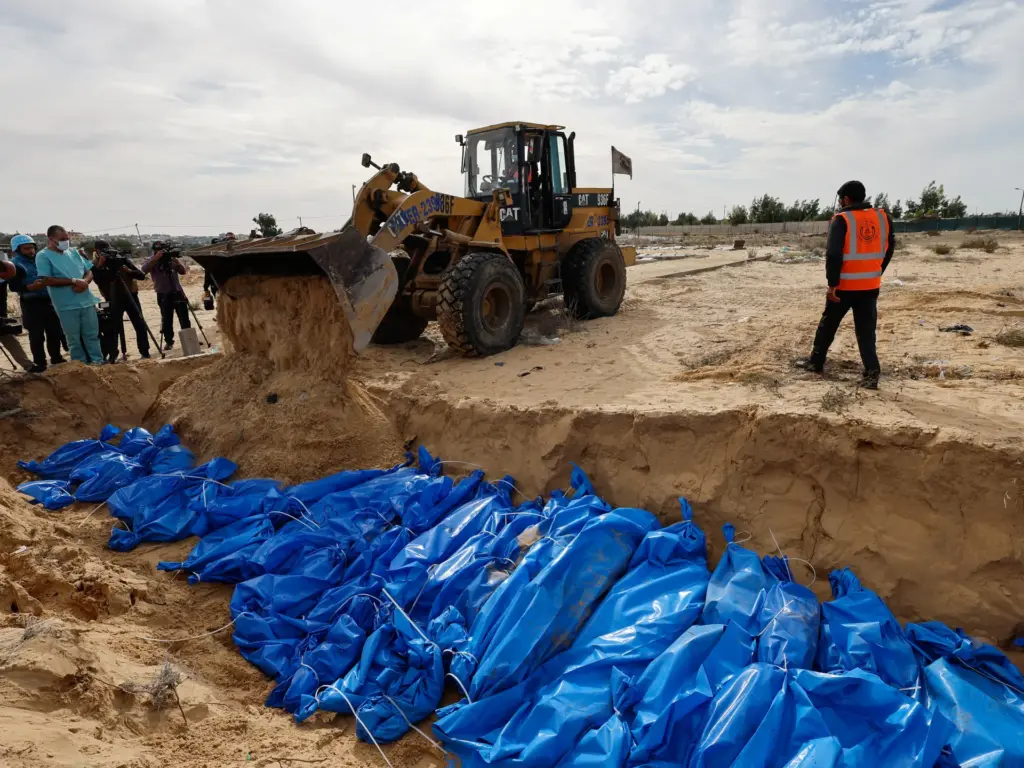
The mass burial of members of the Hassayna and Abu Sharia clan has exposed a second catastrophe beneath Gaza: thousands of people remain missing, forensic teams are working with rudimentary equipment, and Israel has still offered no public explanation of what it was targeting when the family’s homes were destroyed.
For nearly three years, the dead of the Hassayna and Abu Sharia clan lay beneath the ruins of their homes in Gaza City. On Tuesday, 112 of them were finally carried through the streets and buried, their remains placed in rows beneath Palestinian flags as surviving relatives confronted a grief that had been suspended since the opening weeks of Israel’s war in Gaza.
Palestinian authorities described the ceremony as the largest mass funeral of the war. The dead included 44 children, 38 women and seven people with disabilities, according to a list cited by the BBC. Some of the stretchers bore photographs, restoring a face and an individual history to remains that had been reduced by time, bombardment and decomposition to what recovery workers could preserve.
The funeral marked the end of a seventeen day operation involving 40 workers, but it did not complete the search. Dozens of relatives are still believed to lie under the same wreckage, while thousands of other Palestinian families across Gaza continue to wait for news of people who disappeared beneath collapsed homes, shelters and apartment blocks.
The ceremony was therefore more than a burial. It was an accounting, however incomplete, for a single attack that all but destroyed one extended family, and a warning that Gaza’s recorded death toll remains only the visible portion of a much larger human loss.
Three apartment buildings destroyed as families slept
The strike took place in the Sabra neighbourhood of Gaza City on 22 November 2023, six weeks after the Hamas led attack on southern Israel in which about 1,200 people were killed and 251 were taken hostage. It came during a day of intense Israeli bombardment and only two days before the first temporary truce of the war took effect.
According to Palestinian authorities, Israeli aircraft struck a cluster of three apartment buildings in which members of the extended Hassayna family, also known as the Abu Sharia clan, had gathered for shelter. Two buildings were completely destroyed and the third was partly demolished.
Reuters reported that 308 members of the extended family were killed while residents slept. About half of the dead were recovered and buried earlier, while 153 were listed as remaining beneath the rubble before the latest search began.
The scale of the loss is difficult to absorb as a statistic. Omar al Hassayna, now 65 and living in Egypt, lost his wife, four adult sons and four grandchildren. The oldest grandchild was four years old and the youngest only a few months old. Watching the funeral from Cairo, he described those being buried as “pieces of me” whom he had seen repeatedly in his thoughts and dreams.
For other survivors, the recovery reopened the physical space in which their families had disappeared. Nahed al Hassayna returned to what had been a living room and found a school bag belonging to Omar and a shoe belonging to Ibrahim. Yousef Abu Sharia told the BBC that he had lost his mother, father, uncle, cousins and the rest of his immediate family beneath the same wreckage.
The concentration of such losses within one family reflects the social geography of Gaza. Most Palestinians in the territory descend from refugees displaced from towns and villages during the creation of Israel in 1948. Extended families frequently built homes close together, sharing adjoining buildings or several floors of the same apartment block. What sustained kinship and mutual support through decades of displacement also meant that a single large explosion could kill several generations at once.
The Hassaynas had lived in Sabra for decades and were known as a Bedouin clan with deep roots in the community. The strike did not merely kill individual relatives. It tore through an entire structure of grandparents, parents, children, cousins, family memory and practical support.
A recovery carried out with one bulldozer and bare hands
In the immediate aftermath of the attack, relatives and neighbours recovered whoever they could reach. Civil Defence teams said they were unable to conduct a full operation because reaching the area required coordination with Israel through an intermediary and because the danger from continuing military activity was too great.
The comprehensive search did not begin until July 2026. Footage recorded at the start of the operation showed a single bulldozer removing large sections of concrete before workers shifted to shovels, gloved hands and more delicate tools. The International Committee of the Red Cross supported the effort with protective equipment, body bags, training and the rental of two of the very few excavators available for such work in Gaza.
The recovery team spent seventeen days going through the remains of the buildings. Human remains had decomposed or become skeletonised, making visual identification impossible in many cases. Civil Defence spokesman Mahmoud Basal said relatives and forensic workers relied on clothing, old injuries, distinguishing marks, jewellery and necklaces bearing names. Metal plates inserted during earlier medical treatment provided another means of recognition.
This is identification under conditions far removed from a properly equipped forensic laboratory. Gaza’s surviving hospitals have lacked the equipment and materials needed for large scale DNA testing, while personal belongings and the location of remains can be disturbed by explosions, weather, animals and later movement of rubble. Every month that passes removes more of the evidence needed to restore a name to the dead.
The latest operation recovered 112 of the 153 people previously listed as missing at the site. Civil Defence believes dozens remain below the debris. The search team has now moved on to other accessible locations, carrying the same limited machinery into a territory where the number of suspected burial sites runs into the thousands.
Sixty million tonnes of ruins and scarcely one per cent cleared
The scale of that work is almost beyond comprehension. The United Nations estimates that Israel’s military campaign generated more than 60 million tonnes of debris across Gaza. By 23 July 2026, only about 630,000 tonnes had been cleared from roads and essential facilities, according to the UN Office for the Coordination of Humanitarian Affairs. That amounts to just over one per cent of the total.
The debris is not ordinary construction waste. It can contain unexploded weapons, asbestos, hazardous materials, family possessions and human remains. Clearing it requires heavy machinery, fuel, spare parts, explosive ordnance specialists, forensic expertise and secure access, all of which remain severely restricted.
UN agencies say restrictions on the entry of machinery and components, shortages of fuel and engine oil, continued insecurity and the inaccessibility of large areas have slowed the work. Civil Defence estimates that with ten properly equipped excavators, bulldozers and cranes, recovery in accessible areas could be completed in months. Instead, teams often work with shovels, pickaxes, wheelbarrows and their hands.
The ceasefire that began in October 2025 reduced the overall intensity of the war without ending Israeli strikes. It also left Israeli forces in control of more than half of Gaza, a share that Reuters reported had expanded to roughly two thirds by August 2026. Recovery operations are largely confined to the remaining territory, where most of Gaza’s population is now crowded into tents, temporary shelters and damaged buildings.
The contrast is stark. The machinery needed to uncover the dead is scarce, while military bulldozers have continued to operate in Israeli controlled areas. Humanitarian workers have warned that the movement of debris without forensic supervision can scatter remains and destroy the contextual evidence required for identification.
Nobody knows the true number beneath the rubble
The Gaza health ministry said at least 73,377 Palestinians had been killed since 7 October 2023 by the day of the funeral. The United Nations has regularly used the ministry’s figures while attributing them to their source, and international reporting has noted that its wartime casualty records have historically proved broadly reliable.
That total remains a minimum because most deaths are recorded when a body reaches a hospital or morgue, or when identification is later approved. People still beneath the debris cannot always be entered into the confirmed count.
Estimates of the missing vary because they measure different things. Gaza health officials told the Associated Press that relatives had formally reported more than 7,400 people as buried beneath rubble. Reuters cited an estimate of about 8,000. Other humanitarian and forensic specialists have suggested that the number could lie between 10,000 and 14,000.
None of those figures can be treated as final. In some attacks, every close relative who might have reported a missing person was also killed. Records were destroyed, families were repeatedly displaced, communications collapsed and some bodies were buried quickly in unmarked or temporary graves. Other people may have been detained, separated from relatives or killed in places that survivors cannot safely reach.
The missing therefore occupy an uncertain space between the living and the officially dead. Families cannot complete religious and cultural mourning, obtain death certificates, settle inheritance or property matters, or in some cases secure assistance for children who have been orphaned. For psychologists, this is a form of ambiguous loss in which grief cannot reach a recognised conclusion because the central fact of death has not been formally established.
The ICRC has warned that thousands of families are still waiting for news and that Gaza’s limited forensic capacity is making identification increasingly difficult. International humanitarian law requires parties to a conflict to take all feasible measures to account for missing people, search for and collect the dead, preserve identifying information and inform families of what is known about their relatives’ fate.
These are not ceremonial obligations. A body that remains under a collapsed home for years represents a continuing failure to provide a family with truth, dignity and the possibility of burial.
The unanswered question: what was Israel targeting?
Nearly three years after the Sabra strike, the central military question remains unanswered. The BBC asked the Israel Defense Forces what had been targeted but had received no response by the time of publication. Reuters could not locate a contemporaneous Israeli statement explaining the attack, and the military did not immediately answer its request for comment.
The absence of a public explanation does not by itself establish that no military objective existed. It does, however, prevent independent scrutiny of the intelligence, weapon choice, expected civilian presence, warning procedures and proportionality assessment that should have preceded an attack capable of collapsing several crowded residential buildings.
The laws of war require armed forces to distinguish between civilians and combatants, direct attacks only at military objectives, take feasible precautions to reduce civilian harm and cancel an attack when the expected civilian loss would be excessive in relation to the anticipated military advantage. The presence of a fighter in a building does not remove the protection owed to every civilian around that person, nor does it transform an entire residential block into one military target.
The Sabra strike has not been the subject of a public, independent investigation. It would therefore be wrong to declare a final legal finding about this specific incident without evidence that remains in Israeli military files or beneath the ruins. It would be equally wrong to treat the killing of more than 300 people from one clan as self explanatory or to accept silence in place of an account.
The broader pattern has already drawn grave findings. In a 2024 investigation of six separate attacks carried out during the same opening months of the war, the UN Human Rights Office examined the suspected use of bombs weighing between 250 and 2,000 pounds against residential buildings, a school, refugee camps and a market. It concluded that the pattern indicated possible repeated violations of the principles of distinction, proportionality and precautions in attack. The Sabra bombing was not one of the six incidents examined, but its scale and the continued absence of an Israeli explanation demand the same level of scrutiny.
An Associated Press investigation into ten other strikes between October and December 2023 documented more than 500 deaths, many within the same extended families, and reported that it found no evident military target in the cases it examined. Those findings helped establish that the destruction of entire family lines was not an isolated feature of the war.
In June 2026, an independent UN commission of inquiry concluded that Israeli forces had deliberately targeted Palestinian children and that the conduct formed part of genocide and other international crimes. Israel rejected the commission’s report as a defamatory and biased exercise, maintaining that its forces seek to minimise civilian harm while fighting Hamas. Israel has also repeatedly accused Hamas of operating from civilian areas, an allegation that does not remove Israel’s separate obligations under international humanitarian law.
Whatever label courts may ultimately apply, the evidence from Sabra is concrete: three residential buildings were struck, more than 300 members of an extended family were reported killed, 112 people have only now been buried, and dozens are thought to remain beneath the site. No publicly identified target has been offered to explain that destruction.
A funeral, but not yet an ending
For the surviving members of the Hassayna and Abu Sharia clan, Tuesday’s funeral provided a grave, a prayer and a place at which mourning could finally begin. It also forced them to experience the attack again, this time through rows of small and adult sized shrouds carried across a city still dominated by ruins.
The recovery of the 112 should not be mistaken for the closing of a chapter. It is the opening of an archive that has been inaccessible beneath concrete: evidence of who died, where they died, how families were destroyed and how long the living were denied the ability to bury them.
Across Gaza, similar archives remain sealed under more than 60 million tonnes of wreckage. Each excavation may alter the official death toll, but the significance of the work cannot be reduced to numbers. It returns names to people who vanished, allows relatives to replace uncertainty with knowledge and preserves evidence that may one day be required by investigators and courts.
The funeral in Gaza City was described as the largest of the war because 112 bodies were buried together. Its deeper meaning lies in why such a funeral became possible and necessary: an entire clan was struck in its homes, the dead remained unreachable for almost three years, and a devastated civil defence service had to search for them with scarcely more than one bulldozer, rented excavators and human hands.
The flags have now been folded over fresh graves, but the questions remain above ground. Who authorised the strike, what military objective was claimed, what precautions were taken, and why were so many civilians left beneath the ruins for so long? Until those questions are answered, the burial of the Hassayna and Abu Sharia families is not only an act of mourning. It is evidence waiting for accountability.