


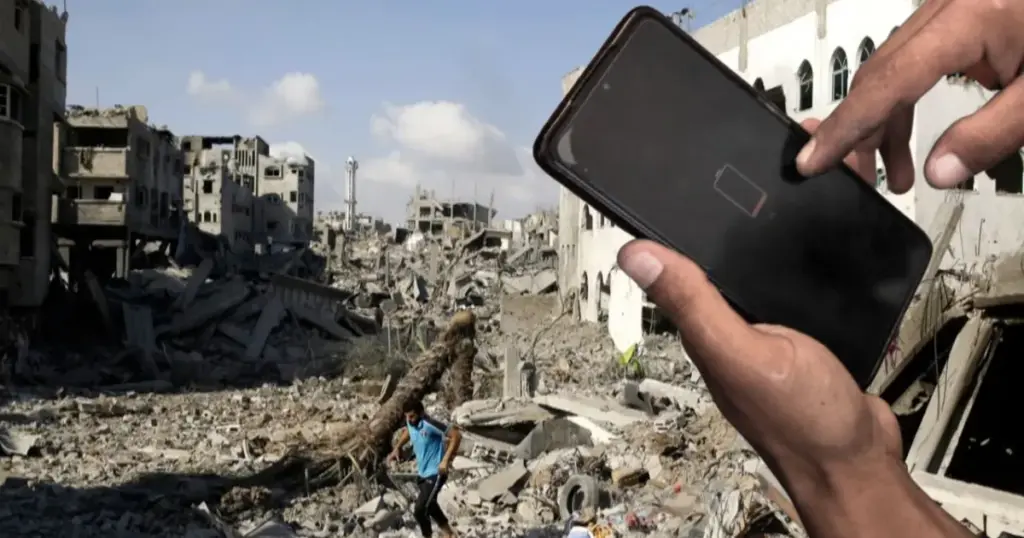
Israel’s chilling mobile phone ultimatums in Lebanon appear to be the culmination of a digital system of mass surveillance, artificial intelligence and remote killing developed and refined against the Palestinian population of Gaza.
“Do you want to die alone or with family?”
That is how the ultimatum has been widely summarised. It is a question that offers no possibility of survival, surrender or appeal. The person answering the mobile phone is told that Israel has selected him for death and that a drone is already watching. His only remaining choice is whether to move away from his relatives before the missile arrives.
The words have recently been reported in Lebanon, where at least two men were allegedly called immediately before Israeli drones killed them. Yet the machinery that makes such a call possible was not created in southern Lebanon. Its essential components have been developed, tested and deployed on a far greater scale in Gaza.
For years, Israel has intercepted Palestinian mobile communications, tracked smartphones, mapped social relationships and accumulated enormous quantities of personal information about Gaza’s population. During the war that followed the Hamas led attacks of 7 October 2023, these capabilities were combined with artificial intelligence systems capable of producing potential targets at unprecedented speed.
The result was a digital kill chain in which a Palestinian’s mobile phone could help identify him, classify him, associate him with other people, reveal when he entered his family home and ultimately provide the location at which he could be attacked.
In Gaza, the mobile phone has served as a warning device, tracking beacon, intelligence source and instrument of intimidation. Palestinian journalists received calls demonstrating that Israeli officers knew where they were. Families were bombed after reporters were threatened. An automated system reportedly notified the military when people placed on target lists returned home to their wives and children.
The exact Lebanon style ultimatum has not yet been independently documented as a standard practice inside Gaza. Everything required to produce it, however, was already there.
The death call was made in Gaza before it was ever answered in Lebanon.
When the mobile phone rings before the bomb
The connection between mobile phone calls and Israeli air strikes has existed in Gaza for years.
Israel describes individual calls as an important measure intended to protect civilians. An officer may call the owner, caretaker or occupant of a building and announce that everyone must leave because the property is about to be attacked. In some cases, a small munition known as a “roof knock” hits the structure before a much larger bomb destroys it.
During Israel’s May 2021 assault on Gaza, Reuters documented the experience of Jamal Nasman, the 67 year old caretaker of a 13 storey building in Gaza City’s Rimal district.
An Israeli officer called Nasman on his mobile phone and told him that the building would be attacked. Nasman was effectively recruited into the military operation, becoming the intermediary between the officer preparing to destroy the tower and the families desperately attempting to escape.
He moved through the area warning residents while remaining in contact with the caller. Once the building and surrounding properties appeared empty, small missiles struck the roof. The tower was then destroyed. Israel said Hamas maintained intelligence and military offices inside it. Residents in other parts of Gaza told Reuters that many buildings were attacked without comparable warning. Reuters documented the call and subsequent destruction on 14 May 2021.
In previous wars, such calls were central to Israel’s claim that it was attempting to distinguish between civilians and military targets. Yet the call also transferred an extraordinary burden onto the Palestinian receiving it. A civilian could suddenly become responsible for clearing an apartment block containing hundreds of people, including children, older residents, people with disabilities and hospital patients who had nowhere else to go.
After 7 October 2023, that dilemma expanded across the entire Gaza Strip.
The Israeli military said that during the opening stages of the war it conducted more than 25,000 live mobile phone conversations with Palestinians in or near targeted areas. It also issued millions of prerecorded calls, text messages and leaflets.
These communications were delivered while Israel was cutting electricity, attacking mobile and internet infrastructure and ordering more than one million people to leave northern Gaza. Roads were congested or damaged, fuel was scarce and supposedly safe areas were themselves being bombed.
A warning is only meaningful when civilians understand it, have sufficient time to act and possess a genuinely safer place to which they can flee. Human rights organisations have repeatedly stressed that issuing a warning does not relieve an attacking military of its obligations to distinguish between civilians and military targets, avoid disproportionate harm and take every feasible precaution.
In Gaza, there was frequently nowhere safe to go.
The mobile phone as a tracking device
The same mobile phone through which Israel delivered its warnings was also producing information about its user.
Every call creates metadata. Every connection to a cell tower provides an approximate location. A mobile phone can reveal its unique device identifiers, the SIM card it contains, the people contacted by its user and patterns of movement between homes, workplaces and neighbourhoods.
A smartphone can provide considerably more. Applications, location services, Wi-Fi connections, social media accounts, photographs, contact lists and device activity can all add further information to a digital profile.
Individually, these pieces of information may prove very little. When combined with aerial surveillance, facial recognition, intercepted conversations, social media, population records and existing intelligence files, they can be used to construct a detailed account of a person’s life.
Israel has exercised extensive control over Palestinian mobile and internet infrastructure for decades. Palestinian networks depend upon frequencies, equipment, gateways and permits that are subject to Israeli control. This has allowed Israeli intelligence agencies to conduct surveillance on a scale far beyond monitoring particular people already suspected of committing an offence.
In such an environment, replacing an old mobile phone with a new smartphone does not necessarily remove the danger. The new device immediately begins connecting to mobile towers, Wi-Fi routers, cloud accounts, messaging services and existing contacts. Even when the contents of encrypted communications cannot be read, the surrounding metadata can still reveal patterns of association and movement.
That reality helps explain why the sudden arrival of thousands of advanced smartphones in Gaza during late 2025 caused such suspicion.
Why smartphones, but not food or medicine?
In December 2025, The National reported that large quantities of Apple’s newly released iPhone 17 were entering Gaza after the market had been deprived of new devices for approximately two years.
The phones appeared at a time when many Palestinian families remained in tents, food supplies were inadequate and medicines, fuel, construction materials and other essential goods continued to face severe restrictions.
In Nuseirat refugee camp, mobile phone shop owner Mohammed Zaqoul said customers were queuing to purchase the iPhone 17 Pro Max despite a price of approximately 7,000 shekels, or $2,200. He claimed that individual shipments contained more than 10,000 phones and that dozens of shipments had entered Gaza.
Those figures were his estimate rather than independently published import statistics. Nevertheless, the visible availability of expensive new smartphones in a devastated and impoverished territory generated an understandable question among Palestinians: why were advanced mobile devices entering when baby formula, medicine, tents, fuel and cement remained scarce?
Zaqoul said many buyers came from relatively narrow sections of Gaza’s wartime economy, including traders, social activists, community initiative organisers, international organisation employees and families who had retained or accumulated sufficient income during the war.
For some young Palestinians, the latest iPhone represented normality, aspiration and a refusal to surrender every element of ordinary life to destruction. For journalists, activists and aid workers, the device also offered a high quality camera, editing tools and access to social media through which Gaza’s condition could be documented for the outside world.
Palestinian journalist Mohammed Awad told The National that opinion inside Gaza had divided into two broad camps. Supporters argued that activists and community organisations needed modern smartphones to produce clear photographs and videos for news organisations, humanitarian agencies and international donors. Critics saw the purchase of a $2,200 luxury product amid displacement and hunger as morally jarring, arguing that the same money could support families facing urgent humanitarian need.
Journalist and researcher Hamza Al Shobaki raised a darker concern. Given Israel’s long history of monitoring Palestinian communications, he questioned why sophisticated smartphones were being permitted to enter while essential supplies remained restricted. He suspected the influx might enable further intelligence gathering and the tracking of resistance members, community leaders and civilians.
The National reported the controversy surrounding the influx of iPhone 17 devices on 1 December 2025.
There is no publicly verified evidence that the iPhones described in the report had been modified, infected with surveillance software or deliberately admitted for an Israeli intelligence operation. A new iPhone is not automatically an Israeli tracking device, and modern smartphones contain important security protections.
The concern cannot simply be dismissed, however, because a device does not have to be secretly altered before it contributes information to a surveillance system. Mobile tower connections, network records, cloud accounts, location services, application data and patterns of communication can all produce intelligence depending upon what access an intelligence agency possesses.
Israel’s September 2024 operation against Hezbollah, in which thousands of pagers and other communications devices exploded across Lebanon, provided an especially terrifying reason for people throughout the region to treat new electronic equipment with suspicion. That operation involved devices physically compromised before reaching their users and does not prove that the iPhones entering Gaza had been similarly manipulated. It did, however, demonstrate that communications hardware could become part of an Israeli military operation long before its intended user switched it on.
For Gaza’s population, the controversy therefore went beyond whether anyone should purchase a luxury smartphone during a humanitarian catastrophe. It concerned whether the mobile phone, one of the few remaining means of documenting the destruction and speaking to the outside world, could simultaneously expose its user to the surveillance system directing the war.
The smartphone had become both a lifeline and a possible liability.
Millions of Palestinian calls stored in the cloud
An investigation published jointly by The Guardian, +972 Magazine and Local Call on 6 August 2025 revealed that Israel’s Unit 8200 had constructed a system capable of storing millions of mobile phone calls made by Palestinians in Gaza and the occupied West Bank.
According to leaked documents and interviews with Israeli intelligence and Microsoft sources, the project followed a 2021 meeting between Unit 8200 commander Yossi Sariel and Microsoft chief executive Satya Nadella. The military sought access to the enormous storage capacity offered by Microsoft’s Azure cloud platform because its own servers could not retain the volume of intercepted communications being collected.
The resulting system became operational in 2022. It allowed Unit 8200 to store huge numbers of Palestinian conversations for extended periods, creating an archive that could later be searched and analysed.
This meant that a Palestinian did not necessarily have to be under active investigation when a conversation occurred. Once stored, the call could be retrieved months or years later if the person, a relative, a neighbour or one of their mobile contacts attracted the attention of Israeli intelligence.
Sources familiar with the system said intercepted communications were used during the Gaza war to help identify bombing targets and construct networks of association. The archive could reveal who had spoken to whom, when the contact occurred and the approximate location of the mobile device. The Guardian investigation described the project as capable of processing surveillance on an unprecedented population wide scale.
Microsoft initially maintained that its own investigation had found no evidence that its services were being used to harm Palestinians. Following publication of the intercepted calls investigation, the company conducted a further review and disabled certain cloud storage and artificial intelligence services supplied to Unit 8200 in September 2025.
Microsoft said its policies prohibited the use of its technology for the mass surveillance of civilians. The company’s broader commercial relationship with the Israeli military continued, but its action added considerable weight to concerns about how Palestinian communications had been collected and used.
Lavender and the production of human targets
Mass surveillance generates more information than human analysts can examine. Artificial intelligence offered Israel a way to process that information and convert it into target recommendations.
On 3 April 2024, +972 Magazine and Local Call revealed the existence of an Israeli intelligence system known as Lavender. Their investigation was based on interviews with six Israeli intelligence officers who had served during the Gaza war and possessed direct knowledge of the military’s use of artificial intelligence.
According to those sources, Lavender analysed surveillance information and assigned Gaza residents a score representing the probability that they were associated with Hamas or Palestinian Islamic Jihad. During the early weeks of the war, the system reportedly marked as many as 37,000 Palestinians as suspected fighters.
The list was not limited to senior commanders or people believed to be planning imminent attacks. It reportedly included thousands of alleged low ranking members whose individual military importance was limited.
Data capable of increasing someone’s suspicion score could include their social relationships, mobile phone contacts, membership of a messaging group, repeated changes of device or address, or the similarity of their behaviour to patterns associated with known members of an armed organisation.
The fundamental danger is that association is not the same as participation.
A civilian may speak regularly with a relative who belongs to Hamas. A journalist may contact members of an armed group while gathering information. A doctor may receive calls from fighters requiring treatment. A civil defence worker may repeatedly appear at sites connected with military activity because rescuing casualties is part of the job.
An algorithm trained on patterns of association can interpret all these activities as evidence of militancy.
One intelligence source said Palestinians frequently changed or shared mobile phones during the war. Devices were lost under rubble, batteries could not be charged and displaced families relied upon any functioning phone they could find. If a device associated with a suspected person was handed to a brother, son, wife or neighbour, the system could follow the device rather than the intended target.
The intelligence officers said human review was sometimes reduced to confirming that the selected individual was male. They described a process driven by pressure to produce targets quickly, with little time to examine the underlying evidence.
The Israeli military strongly disputes this account. In a response published on 18 June 2024, it said Lavender was a database that organised and cross referenced existing intelligence rather than an artificial intelligence system capable of independently selecting people for attack.
The military said inclusion in Lavender could not constitute the sole basis for designating someone as a combatant. It maintained that trained analysts must independently examine the available information, authorised officers must approve target determinations and commanders must assess proportionality and anticipated civilian casualties before every strike. The Israeli military published its response to the Lavender reporting here.
The dispute is not over whether Israel possesses Lavender or uses extensive data processing in Gaza. Israel acknowledges both. The dispute concerns whether the human oversight described in official statements existed meaningfully during an exceptionally intense bombing campaign and whether analysts genuinely reviewed the information behind tens of thousands of potential targets.
“Where’s Daddy?” Waiting for the target to go home
Once a system has produced the name of a suspected person, the military must locate that individual before attacking.
According to the Israeli intelligence sources, a separate automated system known as “Where’s Daddy?” was used to track people placed on target lists. The software reportedly monitored thousands of individuals simultaneously and alerted military personnel when one of their mobile devices entered a particular location.
That location was frequently the family home.
The name “Where’s Daddy?” encapsulated the logic of the system. The military waited for a marked Palestinian man to return to his wife, children, parents or siblings because a home provided a fixed location that could be identified and bombed more easily than a person moving through the streets.
The sources said this was not necessarily because military activity was taking place inside the home. The house was selected because the target could be located there.
In practice, the process transformed the family residence into an extension of the individual whom Israel wanted to kill. Everyone inside became part of a calculation measuring how many civilian deaths could be accepted in exchange for the anticipated military value of striking the suspected person.
For alleged low ranking targets, intelligence sources claimed that attacks during the opening stages of the war could be authorised despite an expectation that numerous civilians would also be killed. Entire buildings could be destroyed to kill one person, sometimes using unguided bombs with a wider destructive effect.
The sources also described delays between a location alert and the air strike. A person could leave the house after the system recorded the arrival of the associated device, yet the building might still be bombed hours later because no final verification had been conducted. The intended target would survive while an unrelated family was killed.
Human Rights Watch investigated Lavender, Habsora, Israel’s mobile evacuation monitoring and a tool performing the reported function of “Where’s Daddy?”. Its September 2024 analysis concluded that the systems depended upon faulty data and inexact approximations that could place civilians at grave risk.
The organisation stressed that mobile phone location data is not sufficiently accurate by itself to establish that a particular person is inside a particular building at the moment of attack. A mobile device is not a human being, and the presence of a smartphone cannot prove who is holding it. Human Rights Watch published its technical and legal findings on 10 September 2024.
The call that tells journalists they are being watched
Palestinian journalists have experienced the connection between mobile phone surveillance, threats and targeted strikes with particular intensity.
On 22 November 2023, Al Jazeera correspondent Anas al-Sharif reported receiving repeated calls from Israeli military officers ordering him to stop reporting and leave northern Gaza. WhatsApp voice messages sent to his smartphone demonstrated that the senders knew his location.
On 11 December, an Israeli air strike hit the al-Sharif family home in Jabalia and killed his 90 year old father, Jamal.
The Committee to Protect Journalists said it was deeply alarmed by a pattern in which Gaza journalists reported receiving threats before members of their families were killed. CPJ documented the calls to al-Sharif and the subsequent attack on his family home.
Al-Sharif continued reporting from northern Gaza. Israel later accused him of leading a Hamas cell, an allegation he, Al Jazeera and press freedom organisations rejected. On 10 August 2025, Israel deliberately struck a media tent outside Al-Shifa Hospital, killing al-Sharif and several other journalists. Israel acknowledged that he had been the target.
The progression was chilling. First came the calls telling the reporter to stop. Then came smartphone messages revealing that his location was known. His father was killed in the family home. Finally, al-Sharif himself was killed in a targeted attack.
A young journalist named AlHassan Hamad experienced a similar sequence.
According to his father, Hamad received death threats through calls and messages from an Israeli mobile number in April 2024. The family home in Jabalia was subsequently struck by a missile that penetrated three floors and set the building on fire.
Hamad continued filming the Israeli assault. On 6 October 2024, he climbed onto the roof of his home to document a new incursion into northern Gaza. A missile fired by a drone killed him.
His father told CPJ that only small fragments of his son’s remains could be recovered. Media Town director Ashraf Mashharawi separately confirmed that Hamad had received threatening messages from Israeli mobile numbers.
The Israeli military denied responsibility for the threats and said it had never deliberately targeted journalists. It described Gaza as an active combat zone presenting inherent dangers to reporters. CPJ’s record of Hamad’s killing includes the witness testimony and Israeli response.
Hossam Shabat, another of the few journalists remaining in northern Gaza, also described receiving mobile phone calls from the Israeli military. He was ordered to evacuate on some occasions and instructed to carry Israeli warnings to civilians sheltering around hospitals on others.
Israel later accused Shabat of being a Hamas sniper. Shabat rejected the allegation and said the accusation placed his life in danger.
On 24 March 2025, an Israeli drone struck his car near the Indonesian Hospital in Beit Lahia, killing him. Witnesses described it as a direct, single missile attack.
These cases are not identical to the death calls reported in Lebanon. The journalists were not necessarily told during their final conversations that a missile would arrive within seconds. They nevertheless establish the underlying pattern: threatening mobile calls, knowledge of the recipient’s location, attacks on family homes and eventual targeted killing.
When the warning becomes part of the weapon
The mobile phone call occupies a central place in Israel’s presentation of its Gaza operations. It is frequently offered as evidence of humanitarian restraint, demonstrating that civilians were warned before a building was destroyed.
Yet a warning does not make an otherwise unlawful attack legal.
International humanitarian law protects civilians unless they directly participate in hostilities. Journalists, medical personnel, civil defence workers, government employees, relatives of fighters and political supporters do not lose that protection merely because an artificial intelligence system identifies similarities between their behaviour and that of an armed operative.
Even when Israel correctly identifies a lawful military target, it remains required to consider the lives of civilians nearby. It must refrain from an attack when the expected civilian harm would be excessive compared with the concrete and direct military advantage anticipated.
A few seconds of warning cannot remedy an incorrect identification. It cannot reveal what information produced an algorithmic score or offer the recipient an opportunity to challenge it. It cannot determine whether the mobile phone is being held by the person Israel intends to kill.
In a conventional warning call, a civilian is told to leave a building before it is attacked. In a death call, the caller is telling the target that leaving will not help because the surveillance system will follow the smartphone.
The person is given no opportunity to surrender. He is not informed of the allegations against him and no independent court examines the evidence. The intelligence service that selected him also controls the drone and determines when the missile will be fired.
The choice between dying alone and dying with family is therefore not a humanitarian choice. It is a death sentence accompanied by an instruction to reduce the number of witnesses and additional casualties.
The Gaza prototype reaches Lebanon
On 16 February 2026, 62 year old Ahmad Turmus received such a call on his mobile phone while visiting relatives in Talloosah, southern Lebanon.
According to family members interviewed by Los Angeles Times correspondent Nabih Bulos, the caller identified himself as an Israeli officer and asked whether Turmus wanted to die with those around him or alone.
Turmus answered “alone,” left the house and entered his car. Less than 30 seconds later, two missiles struck the vehicle.
Israel acknowledged targeting Turmus, alleging that he was involved in rebuilding Hezbollah infrastructure. His family described him as a former fighter who had moved into an administrative liaison role, coordinating municipal repairs and civil defence activity. What evidence caused Israel to designate him as a military target remains unknown. The Los Angeles Times published its investigation on 4 May 2026.
A second incident reportedly occurred in April 2026 when Ahmed Abdul Abbas received a similar mobile call while travelling with relatives. Footage appears to show him leaving their vehicle and running into a field before a drone strike kills him. Middle East Eye reported that Abbas had been told he could die alone or allow the others in the vehicle to die with him. The precise contents of the call have not received the same level of independent verification as the Turmus case.
Lebanon provided the world with the explicit words of the death call. Gaza provided its architecture.
Gaza supplied the population subjected to comprehensive mobile phone interception. It supplied millions of stored conversations and extensive networks of association. It became the testing ground for Lavender, Habsora and a tracking system designed to notify the military when a marked person entered his family home.
It also supplied the extraordinary contradiction of a society deprived of food, medicine, shelter and reconstruction materials while shipments of the latest smartphones appeared in its shops. For Palestinians suspicious of Israel’s surveillance capabilities, the question was unavoidable: why was a device capable of generating such extensive personal data entering more easily than the materials needed to keep people alive and rebuild their homes?
There is no evidence that every smartphone in Gaza is compromised or that the iPhone shipments were part of a covert operation. There is extensive evidence, however, that Israel possesses the capacity to intercept Palestinian communications, follow mobile devices and incorporate digital information into decisions about arrest, displacement and lethal attack.
In Gaza, the smartphone became both a source of intelligence and a method of control. It warned civilians that their homes would disappear, told journalists that their locations were known and provided signals that could direct bombs towards individual people.
Lebanon has now revealed the final stage in its starkest form. The target’s mobile phone rings. A voice confirms that the surveillance system has found him. A drone watches while he separates himself from his relatives and waits for the missile.
The call may be answered in Lebanon, but it was made in Gaza.