


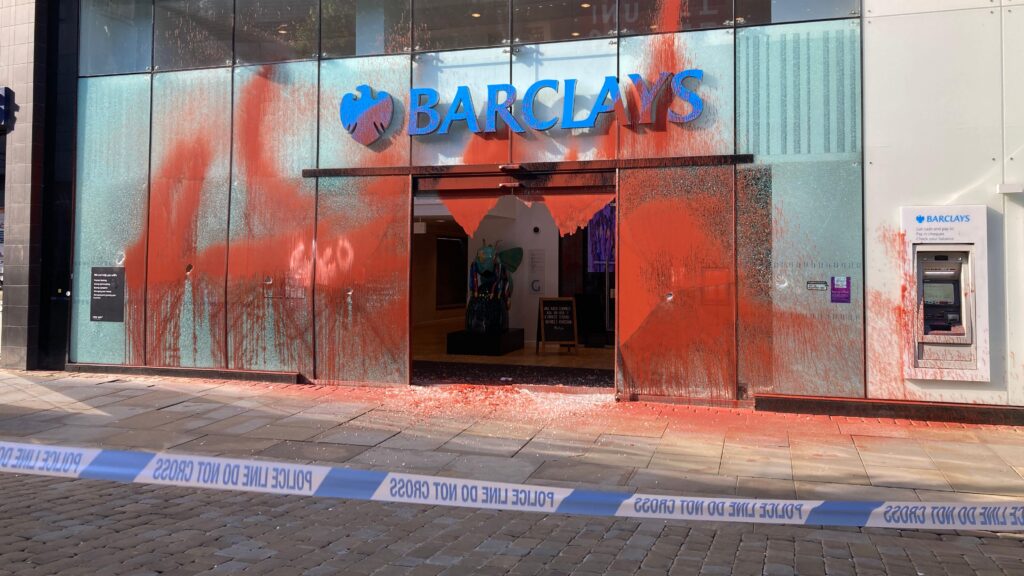
Five activists convicted of damaging a Barclays branch learned only after their trial that they could be sentenced under Britain’s terrorism framework, raising profound questions about jury trials, political protest and the influence of an Israeli arms manufacturer
Five Palestine Action activists convicted of breaking windows and spraying red paint over a Barclays Bank branch face the possibility of years in prison, extended detention rules and 15 years of police monitoring after a judge indicated that their offences could be treated as having a “terrorist connection”.
The five were prosecuted for criminal damage rather than terrorism. Terrorism was not raised before the jury, and, according to the defendants and subsequent reporting, they were not warned during the trial that a conviction could lead to them being sentenced through Britain’s counterterrorism framework.
The possibility emerged only after the jury returned its verdicts.
For Huda Ammori, the cofounder of Palestine Action, this amounted to a “secret legal ambush” and represented the latest stage of what she described as an “absolute war” against the direct action movement.
Speaking to Richard Sanders on the 31 July edition of Double Down NewsWatch, Ammori accused the British state of steadily expanding the application of terrorism legislation, intimidating defence lawyers, restricting what juries may hear and protecting the commercial interests of Elbit Systems, the Israel based weapons manufacturer that has been Palestine Action’s principal target.
“They are silencing the defendants, the defence, silencing the press and silencing the public,” Ammori said. “They are showing how far they’re willing to go to crack down on the freedoms of their own citizens in order to protect a foreign weapons manufacturer.”
Her allegations go beyond the fate of five defendants in Lancashire. Hundreds of Palestine Action related prosecutions are reportedly still moving through the courts, while the group’s proscription under the Terrorism Act remains the subject of a Supreme Court challenge.
The result could determine whether politically motivated damage to property, committed without a terrorism charge or terrorism conviction, becomes routinely punishable through legal provisions created for terrorist offending.
The Barclays Five
Brendon O’Hagan, 28, Amanda Kelly, 31, Hmeera Atiqnisar, 31, Mohammed Malik, 28, and Alma Yaniv, 70, were convicted at Preston Crown Court of causing £212,000 worth of damage to the Barclays branch in St James’s Street, Burnley, on 5 August 2024.
Windows were broken and red paint was thrown across the building during an action protesting against Barclays’ financial relationship with Elbit Systems. Yaniv, the oldest defendant, was accused of driving other participants to and from the scene.
Barclays later disposed of the Elbit shares associated with the controversy. The bank has maintained that the holdings related to client driven transactions and that it was not itself an investor in the Israeli company.
Following the convictions, Judge Philip Parry asked the prosecution and defence to make submissions on whether the offences had a “terrorist connection”. The judge reportedly attached the recent sentencing judgment from another Palestine Action case involving Elbit’s factory at Filton.
The Crown Prosecution Service supported applying the terrorism provisions, arguing that the relevant connection emerged from admissions made by the defendants during the trial. Those admissions reportedly concerned their affiliation with Palestine Action and their intention to contribute to a broader political campaign against Barclays.
The case is especially controversial because the action occurred almost a year before Palestine Action was proscribed. It was not among the incidents publicly identified by the Home Secretary when the government justified banning the organisation.
“At no point during our trial did the prosecution seek to pursue anything to do with terrorism,” Malik said after the verdict. “The jury were kept completely in the dark and were not told that, if convicted, we could be sentenced as terrorists.”
The five are scheduled to be sentenced on 4 September. The CPS and the judiciary declined to comment when approached by The Guardian, which first reported the proposed terrorism finding. The Guardian’s report on the Burnley case
Ammori stressed that the defendants have not been charged with belonging to a proscribed organisation, since the incident occurred before proscription, and have not been convicted of a terrorism offence.
Under ordinary sentencing principles, she argued, criminal damage involving broken windows and paint might result in a suspended sentence, community order or comparatively short period of imprisonment, depending on the damage, culpability and circumstances.
A terrorism connection changes that landscape dramatically.
How a criminal damage conviction acquires a terrorist connection
The mechanism being considered does not transform the original conviction into a separate terrorism offence. Instead, Section 69 of the Sentencing Act 2020 permits a judge to find that certain offences have a “terrorist connection”.
Under the statutory definition applied in the Filton case, an offence may meet that threshold if it involves serious damage to property, is designed to influence a government or intimidate a section of the public, and is committed to advance a political, religious, racial or ideological cause.
Once such a finding is made, the connection must be treated as an aggravating factor. It can also trigger a special custodial sentence, longer minimum periods in prison, Parole Board involvement, an additional licence period and automatic terrorism notification requirements.
A defendant does not need to have been charged with terrorism, and a jury does not need to decide whether the statutory terrorism definition has been met. That question can be determined by a judge following conviction.
This division between the jury’s verdict and the judge’s later finding is at the centre of the controversy.
The jury in Burnley was asked whether the defendants had committed criminal damage. It was not asked whether their actions were designed to intimidate the public or influence government for a political purpose. Nevertheless, the defendants’ own explanations of their motives may now be used to establish precisely those elements at sentencing.
Ammori described the process as fundamentally deceptive.
“They were on trial for criminal damage,” she told Sanders. “They didn’t even know that terrorism was on the cards until after they were convicted.”
The CPS position is that the relevant evidence became clear only through what the defendants said during the trial. Critics respond that this means political motivation, often presented to explain or mitigate direct action, can instead become the basis for an exceptional sentencing penalty.
Akiko Hart, director of Liberty, said the case demonstrated how Britain’s broad terrorism definition captures conduct that most people would not ordinarily describe as terrorism. Labour MP John McDonnell argued that trying protesters under the ordinary criminal law and then sentencing them through terrorism legislation could not be regarded as fair.
The apparent disparity with other protest cases has intensified those concerns. Seven Extinction Rebellion activists received suspended sentences after causing more than £100,000 worth of damage by breaking windows at Barclays’ London headquarters. Their offences were not found to have a terrorist connection.
The Filton precedent
The Burnley judge’s intervention followed the sentencing of Charlotte Head, Leona Kamio, Fatema Zainab Rajwani and Samuel Corner for an August 2024 action at Elbit Systems UK’s Filton facility near Bristol.
The Filton case involved conduct considerably more serious than the damage at Barclays. Activists used a converted prison van to drive through perimeter barriers and a loading bay shutter before damaging equipment inside the factory. An insurance payment of £1.175 million was made in relation to the destroyed property.
Corner was also convicted of grievous bodily harm after striking Police Sergeant Kate Evans with a sledgehammer, fracturing vertebrae in her spine. The court found that he did not intend to cause really serious injury, but that his actions were unjustified and caused serious, lasting harm.
Those facts are important. The Filton prosecution cannot accurately be reduced to a case involving paint or property alone.
Nevertheless, none of the four was charged with or convicted of a terrorism offence. Mr Justice Johnson expressly acknowledged that Palestine Action was not proscribed at the time, that supporting it was then lawful and that the vast majority of its activities did not satisfy the statutory definition of terrorism.
He nonetheless found that the criminal damage had a terrorist connection because the defendants intended to cause serious property damage, influence the British government, intimidate Elbit employees and advance a political or ideological cause.
Section 69 consequently required him to treat that connection as an aggravating factor. The judge said the defendants’ desire to prevent the death and suffering of Palestinian civilians significantly reduced the sentencing increase that might otherwise have been imposed, but did not excuse their conduct.
Head and Kamio received special custodial sentences of six years, less 45 days credited in relation to curfew restrictions. Rajwani received five years and eight months, also less 45 days. Corner received a total sentence of eight years and eight months, comprising three years and eight months for grievous bodily harm and a consecutive five year special custodial sentence for criminal damage.
All four must serve two thirds of the custodial portion of their special sentences before the Parole Board can consider release. They will then remain subject to an additional year on licence and 15 years of terrorism notification requirements.
Those requirements include informing police about changes to addresses, relationships, bank accounts, electronic devices and other personal details. Mr Justice Johnson’s complete sentencing remarks
Amnesty International UK called the decision a dangerous development for the right to protest, arguing that conscientious political motivation had effectively been converted from possible mitigation into a terrorism related aggravating factor. Amnesty International’s response to the Filton sentences
The significance of the precedent became visible almost immediately when Judge Parry cited the Filton ruling in the Burnley case.
Ammori fears the same approach could now be considered in numerous unresolved Palestine Action prosecutions, including cases involving actions that occurred several years before the organisation was banned.
“If this happens in this case, there are hundreds of people facing criminal damage trials for Palestine Action cases which happened before the ban,” she said. “Is there now a chance that they may also be considered for terrorist sentences? It is all up in the air.”
What the juries were not told
In Filton, unlike Burnley, the defence teams knew that the proceedings had been designated as having an apparent terrorism connection. Reporting restrictions prevented the public from knowing, while the jury was not informed.
The official sentencing judgment records that the preliminary terrorism ruling was made at the prosecution’s request. It also states that the defendants asked for the reporting restriction to remain in place because they feared publicity could prejudice their trial.
That detail complicates claims that the information was hidden exclusively at the state’s initiative. It does not, however, resolve the broader constitutional question: whether a jury should convict someone without knowing that its verdict may activate consequences associated with terrorism.
Ammori believes growing public awareness of this mechanism may already be influencing juries. She pointed to an increasing number of acquittals and trials in which juries have been unable to agree.
It is impossible to establish why any individual jury acquitted or failed to reach a verdict, since jurors’ deliberations are secret. Ammori nevertheless suggested that jurors may be becoming more cautious after learning that a criminal damage conviction can lead to consequences far beyond those discussed during a trial.
The process also creates a dilemma for defendants. Explaining that an action was intended to stop weapons production, pressure government or protect Palestinian civilians may help a jury understand the moral reasoning behind it. The same explanation can later support a judicial finding that the conduct was politically motivated and designed to exert influence, satisfying elements of the statutory terrorism definition.
Elbit Systems and the lobbying trail
Ammori argues that the prosecutions cannot be separated from years of lobbying by Elbit Systems and its representatives.
Documents obtained through freedom of information requests revealed a series of meetings involving the Home Office, Elbit representatives and other officials.
A private secretary’s note from March 2022 recorded a meeting between then Home Secretary Priti Patel and Elbit Systems UK chief executive Martin Fausset. The note said that, although police were operationally independent, Home Office officials had been in contact with them about Palestine Action.
A briefing prepared for an April 2023 meeting between Elbit and then Home Office minister Chris Philp said that a director from the Attorney General’s Office would attend to represent the CPS. The document also stated that the CPS itself had declined to participate in order to preserve its operational independence.
The meetings were intended, in the language used in the disclosed papers, to “reassure” Elbit about the government’s response to the campaign against its factories.
Palestine Action described the contacts as evidence of collusion between government, police, prosecutors and a private arms company. The Home Office rejected that characterisation, stating that it respected the operational independence of the police and judiciary. Elbit Systems UK said it was proud to supply the British armed forces. Reporting on the disclosed Home Office documents
Ammori identified a further interdepartmental meeting in June 2024 as a turning point, claiming that officials discussed whether Palestine Action could be proscribed even though its earlier actions had not generally been treated as terrorism.
The later High Court judgment on proscription confirmed that officials regarded the proposed use of the Terrorism Act as “relatively novel”. The Joint Terrorism Analysis Centre described Palestine Action as primarily employing direct action tactics that commonly resulted in graffiti, occupation, lock ons, petty vandalism and minor property damage. The High Court found that only a very small number of the group’s hundreds of actions met the broad statutory terrorism definition.
The government nevertheless argued that Palestine Action’s methods were escalating, that the group operated covertly and that ordinary criminal prosecutions could not adequately disrupt it as an organisation.
The ban and the continuing Supreme Court battle
Palestine Action was proscribed on 5 July 2025 after activists entered RAF Brize Norton and sprayed red paint into two military aircraft.
The order placed the group on the same statutory list as organisations responsible for mass casualty violence. It also made membership, inviting support and certain supportive expressions criminal offences carrying severe penalties.
The government bundled Palestine Action into the same parliamentary order as the Maniacs Murder Cult and the Russian Imperial Movement, two extreme right wing organisations. MPs therefore had no opportunity to approve the bans separately.
In February 2026, the High Court ruled that the proscription was unlawful and disproportionate. The court concluded that the Home Secretary had failed to apply her own policy correctly and that the ban caused a serious interference with freedom of expression and association.
The Court of Appeal reversed that decision on 15 June, holding that the Home Secretary was entitled to proscribe the group and that the High Court had not given sufficient weight to escalation, secrecy and national security considerations. Liberty’s analysis of the two judgments
On 30 July, the Supreme Court granted Ammori permission to appeal. The ban remains in force while the litigation continues. Roughly 3,000 people have been arrested for displaying support for Palestine Action since proscription, according to Reuters. Reuters report on the Supreme Court appeal
The Burnley and Filton cases remain legally distinct from the ban because the underlying actions occurred while Palestine Action was lawful. Their importance lies in demonstrating that proscription is not the only route by which terrorism law can enter an ordinary protest trial.
The Iran story and the manufacture of suspicion
Ammori also accused sections of the mainstream media of helping create public consent for the ban through insinuations about foreign influence.
During a BBC interview shortly before proscription, presenter Laura Kuenssberg repeatedly asked then Business Secretary Jonathan Reynolds whether there might be foreign influence behind Palestine Action. Footage playing during the exchange showed activists using electric scooters and repurposed fire extinguishers to spray paint over aircraft at RAF Brize Norton.
Reynolds said he could not rule foreign influence out, while offering no evidence that it existed.
Days later, The Times reported that the Home Office was investigating whether Palestine Action had received Iranian funding through intermediaries. A subsequent intelligence assessment disclosed in court said the organisation was primarily financed through donations, crowdfunding and merchandise.
The independent reviewer of terrorism legislation, Jonathan Hall KC, who supported proscription, later described the Iran narrative as an unfounded insinuation.
Private Eye subsequently reported that Georgia Pickering, managing director of CMS Strategic, had been heard claiming credit for placing the story. CMS Strategic worked for Elbit Systems, although the company categorically denied any involvement in the report. The Home Office also said it did not recognise the Iran funding claims when approached for comment. Report on the alleged placement of the Iran story and CMS Strategic’s denial
Ammori argued that the insinuation accomplished its political purpose even after being undermined.
“They just ask the question, ‘Could there be foreign influence?’” she said. “They know it is completely baseless, but it creates the suggestion. You avoid lying directly, but you make the insinuation.”
Sanders stopped short of accusing Kuenssberg of knowingly lying, describing the exchange instead as “astonishingly bad journalism”. Ammori maintained that independent media had performed a vital role in reporting courtroom developments that larger broadcasters and newspapers either ignored or presented primarily through the state’s counterterrorism narrative.
The barrister placed in the dock
The prosecution of Rajiv Menon KC has deepened fears that the crackdown is reaching beyond activists and into the defence profession.
Menon represented Charlotte Head during the first Filton trial. In his closing speech, he referred to Bushell’s Case of 1670, the historic judgment that established that jurors could not be punished for returning a verdict according to their own convictions.
He also reminded jurors that a judge could not direct them to convict.
Mr Justice Johnson had previously ruled that defence lawyers could not invite jurors to disregard the law, ignore their oath or apply “jury equity” by acquitting according to conscience. He subsequently found that parts of Menon’s speech breached those directions.
The first attempt to pursue contempt proceedings was overturned by the Court of Appeal because the Administrative Court lacked jurisdiction to initiate the case in the manner used. Johnson then referred the matter through a different Crown Court procedure, and a new contempt hearing was scheduled for 28 July.
The Court of Appeal stayed that hearing at the last moment so that Menon’s further jurisdictional challenge could be determined. The proceedings remain live, but no court has found Menon guilty of contempt. Current procedural status of the Menon case
The court’s position is that Menon has a case to answer because repeated noncompliance with judicial directions may have created a real risk of impeding the administration of justice. It also alleges that his references to Elbit being “protected” and “wined and dined in the corridors of power” could have suggested that the court was biased.
Menon and his supporters argue that prosecuting a barrister over a closing speech threatens fearless advocacy and will make defence lawyers afraid to advance forceful arguments in politically sensitive trials.
Riel Karmy Jones KC, chair of the Criminal Bar Association, said lawyers were already changing speeches because they had become uncertain and frightened about what they could safely say. Shami Chakrabarti, Helena Kennedy KC, Gareth Pierce and families represented by Menon in the Hillsborough proceedings have also expressed alarm. Legal reaction to the proceedings against Menon
Ammori warned that the prosecution could create a ripple effect across the remaining Palestine Action cases.
“When barristers see a very senior barrister being prosecuted, they are going to think twice about defending activists to the best of their ability,” she said. “That has a huge chilling effect, particularly when a conviction for criminal damage may now lead to a terrorism connection.”
She also criticised the opacity surrounding internal judicial communications and the limited application of ordinary freedom of information procedures to judges and courts. Ammori argued that the absence of disclosure prevented the public from establishing whether communications had taken place between judicial and other state bodies.
Her suggestion that this could enable corruption was an allegation about systemic opacity, rather than evidence that any judge in the Burnley or Filton proceedings acted corruptly.
A challenge for Andy Burnham
Sanders argued that Prime Minister Andy Burnham, who entered Downing Street on 20 July, must confront the use of terrorism sentencing in protest cases if he wishes to retain moral credibility.
Ministers cannot direct a judge’s decision in an individual case, and judicial independence must be protected. A government can, however, review legislation, prosecution policy and the breadth of the statutory terrorism definition.
The political contrast is striking. Burnham has been reviewing plans created under the Sentencing Act 2026 that could allow some people convicted of rape, sexual offences and serious violence to leave prison earlier as the government struggles with overcrowding. The Prime Minister has since indicated that he wants serious sexual offenders excluded or subjected to greater safeguards.
At the same time, political activists convicted of property damage may face special custodial sentences, Parole Board restrictions and 15 years of terrorism notification.
The offences and legal circumstances are not directly comparable, but Sanders said the juxtaposition exposed a system in which prison capacity arguments could favour the earlier release of dangerous offenders while terrorism provisions were being expanded against political protesters.
Was the campaign worth the cost?
At the end of the interview, Sanders asked Ammori whether Palestine Action’s campaign had been worth the imprisonment, prosecutions and long term restrictions now facing its participants.
Ammori answered that repression demonstrated the effectiveness of the movement rather than its failure.
She credited Palestine Action with forcing the permanent closure of Israeli weapons manufacturing sites in Britain and inflicting extensive commercial losses on Elbit Systems. She also claimed that the Filton activists destroyed approximately 40 pieces of weapons related equipment, including quadcopter drones.
Those claims about the equipment’s intended destination and potential use were not adjudicated by the criminal court. Mr Justice Johnson said it was not the court’s role to determine whether Elbit had acted unlawfully, while making clear that the company was entitled to legal protection for its property.
For Ammori, however, the moral context remains inseparable from the criminal cases.
“There isn’t any struggle where there isn’t a huge amount of struggle along the way,” she said. “Every obstacle we overcame got us closer to victory, and I still believe that today.”
The question now facing Britain is no longer simply whether Palestine Action activists committed criminal damage. Juries have already answered that question in a number of cases.
The deeper issue is whether political damage to property, prosecuted before an ordinary jury under the ordinary criminal law, should acquire terrorism consequences after conviction through a decision the jury was never asked to make.
If the Burnley five receive such sentences on 4 September, the Filton ruling will no longer appear to be an exceptional response to a violent factory incursion. It will have become a template capable of reaching broken bank windows, red paint and potentially hundreds of earlier acts of direct action.
That would mark a profound change in the relationship between protest, political motivation and terrorism law in Britain, with consequences extending far beyond Palestine Action and the war in Gaza.