


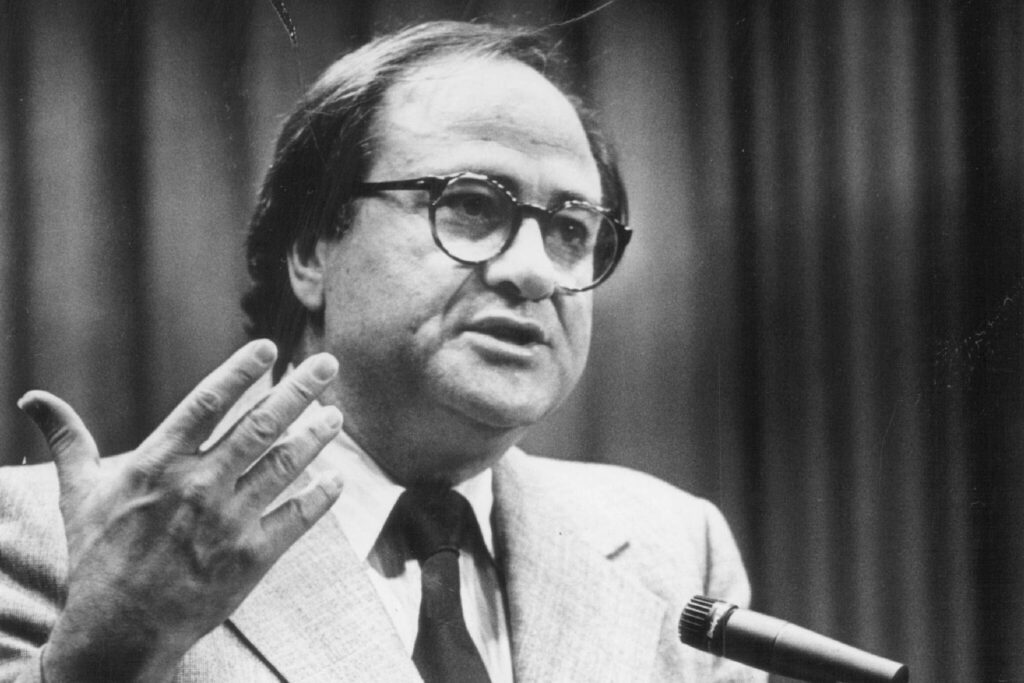
A CIA-released file preserves a sitting senator’s warning that Washington was allowing another country’s priorities to shape American policy. Nearly half a century later, the occupation has been declared unlawful by the world’s highest court, Gaza has been devastated, pro-Israel campaign spending has reached extraordinary levels, and the United States has entered direct war with Iran.
A warning hidden in plain sight
On 16 January 1978, a short transmittal slip moved through CIA headquarters. “Per our conversation today concerning Senator Abourezk’s article in PENTHOUSE,” the typed note said. Attached was an article with a title that left no doubt about its argument: “The Relentless Israeli Propaganda Machine.” The author was not an anonymous official or an activist writing from the political margins. He was James George Abourezk, the serving Democratic senator from South Dakota.[1]
The document’s presence in a CIA archive (full version shown at footer of this article) does not mean that the agency commissioned, endorsed or classified Abourezk’s conclusions. It means that somebody inside the agency considered the article worth circulating. The distinction matters. This was a published magazine article, preserved in a government file and released decades later under the identifier CIA-RDP81M00980R002000090173-0. Its historical significance lies in how early, how publicly and how comprehensively a sitting American senator described the political machinery surrounding the United States relationship with Israel.
Abourezk’s thesis was stark. American policy in the Middle East, he argued, was being shaped less by a dispassionate assessment of American interests than by an organized system of lobbying, political finance, intimidation and media framing. That system protected Israel from meaningful consequences as it occupied territory, displaced Palestinians and attacked neighboring countries. If Americans continued to ignore it, he warned, they could eventually find themselves paying for Israel’s wars, suffering the economic consequences of interrupted oil supplies and sending their own forces into a regional confrontation.
Read in 1978, the article could be dismissed as angry, polemical or politically impossible. Read in July 2026, it is difficult to avoid the central question it raises: how did Abourezk see so much of the structure that would define the next half century, and why did Washington refuse to change course?
The senator America was encouraged not to hear
Abourezk was born in Wood, South Dakota, in 1931, one of five children of Lebanese immigrants. His family belonged to the Greek Orthodox Christian tradition, and he remained a Greek Orthodox Christian throughout his life. Arabic was spoken at home, and he learned English only after beginning elementary school. He grew up on the Rosebud Indian Reservation, served in the United States Navy from 1948 to 1952 and later trained as a civil engineer and lawyer.
He entered the House of Representatives in 1971 and the Senate in 1973, becoming the first Arab American to serve in the upper chamber. His record makes it difficult to reduce him to a single foreign policy controversy. He became a major advocate for Native sovereignty, chaired the Senate Indian Affairs Committee and was the principal author of the Indian Child Welfare Act. He also helped advance Native self determination and religious freedom, and challenged US support for abusive overseas police programs.
That background is important because Abourezk wrote about Israel as a legislator who understood how pressure was applied inside Congress. He had seen colleagues sign letters they privately disliked, watched campaign finance narrow the boundaries of acceptable debate and experienced the political cost of questioning a favored ally. His Arab heritage gave him a personal connection to the region, but his case was explicitly directed to American citizens: the policy was being carried out in their name, with their taxes, their weapons and potentially their soldiers.
His religion also matters. Abourezk was not attacking Judaism, and he expressly rejected the racist claim that Jews collectively owned or controlled the press. His argument concerned a state, a lobby and a political system. That distinction remains essential. Antisemitism is a real and dangerous form of racism, while criticism of the Israeli government, Zionism, occupation or a lobbying organization is political speech. Treating those categories as interchangeable protects neither Jewish people nor democratic debate.
The warning, then and now
| Abourezk’s 1978 warning | The position by July 2026 |
|---|---|
| Occupation and territorial expansion would continue while Washington supplied political and military protection. | The ICJ has found Israel’s continued presence in the occupied Palestinian territory unlawful. UN reporting says Israeli control and access restrictions now cover most of Gaza. |
| Congress would remain unusually vulnerable to organized pro-Israel pressure and campaign finance. | AIPAC’s political committee reported more than $46 million in disbursements from January 2025 through June 2026, after AIPAC linked entities passed $100 million in the 2024 cycle. |
| American media would foreground Israeli suffering while marginalizing Palestinian and Lebanese victims. | Israel has barred independent foreign correspondents from Gaza. CPJ documented 209 journalists and media workers killed by Israel in Gaza or Israeli detention by June 2026, after reviewing and removing ineligible cases. |
| Unconditional support could draw the United States into a wider Middle Eastern war and threaten energy supplies. | US forces began a major bombing campaign against Iran in February 2026. Congress was still debating a resolution to end those hostilities in July as shipping and oil routes came under pressure. |
The occupation became the permanent system
Abourezk argued that the Palestinian question began with dispossession and could not be resolved while refugees, occupation and territorial acquisition were treated as secondary issues. He warned that US military and diplomatic backing removed the pressure Israel would otherwise face to stop expanding into Arab land.
The occupation he described has not ended. In its July 2024 advisory opinion, the International Court of Justice concluded that Israel’s continued presence in the occupied Palestinian territory was unlawful. It said Israel must end that presence as rapidly as possible, cease new settlement activity, evacuate settlers and provide reparations. The Court also found that other states must not recognize as lawful, or provide aid and assistance to maintain, the situation created by the occupation. Israel rejected the opinion as one-sided and maintains that security and final status questions must be resolved through negotiation.
By July 2026, the expansion Abourezk feared was no longer confined to the West Bank and East Jerusalem. The UN Office for the Coordination of Humanitarian Affairs reported that Israeli restrictions and more direct control covered 64.9 per cent of Gaza, while Israeli leaders had ordered expansion toward 70 per cent. Palestinians were being confined to shrinking areas, with landfills, farmland, water infrastructure and humanitarian facilities inside zones that were inaccessible or dangerous to enter. In the West Bank, OCHA reported that settlement expansion, demolitions, settler violence and movement restrictions continued to drive displacement. More than 1,260 settler attacks causing casualties or property damage had been documented across 250 Palestinian communities in the first half of 2026.
What Abourezk described as a continuing land grab has therefore acquired an authoritative legal description and a much larger physical reality. The world’s highest court has called the continuing occupation unlawful, yet the state with the greatest leverage over Israel has continued to provide weapons, money and diplomatic protection.
Gaza went beyond his darkest warning
Any honest account of the present crisis must acknowledge the Hamas-led attack of 7 October 2023, in which approximately 1,200 people were killed and around 250 were taken prisoner. Israel says its military campaigns have been required to defeat Hamas, prevent another attack, protect its population and recover the hostages. Those facts and objectives do not remove the legal duties governing the conduct of war, occupation, civilian protection or humanitarian relief.
By early December 2025, the Gaza Ministry of Health had reported more than 70,000 Palestinians killed and more than 170,000 injured. The UN’s 2026 humanitarian appeal said nearly all of Gaza’s 2.1 million people had been repeatedly displaced. By June 2026, more than 70 per cent of the population depended on trucked water. Even after the October 2025 ceasefire, OCHA reported more than 1,100 additional Palestinian fatalities by mid July 2026, while continuing strikes, access restrictions and insecurity drove further displacement.
International legal scrutiny has reached a level that would have been almost unimaginable when Abourezk wrote. In November 2024, the International Criminal Court issued arrest warrants for Israeli Prime Minister Benjamin Netanyahu and former defence minister Yoav Gallant, alleging war crimes and crimes against humanity. In September 2025, the UN Independent International Commission of Inquiry concluded that Israel had committed genocide in Gaza. Israel categorically rejected that conclusion, accused the commission of bias and continues to contest the genocide allegation. The separate state responsibility case brought by South Africa remains before the International Court of Justice and has not reached a final merits judgment.
Abourezk wrote about southern Lebanese villages bombed with American supplied aircraft while their victims received little attention in the United States. Gaza has magnified that warning beyond anything contained in his article: entire urban districts have been destroyed, nearly a whole population has been displaced, famine was confirmed in parts of the territory during 2025 and the legal vocabulary now includes alleged extermination, starvation as a method of war and genocide.
Weapons without effective consequences
Abourezk asked what Americans were supporting when billions of tax dollars and sophisticated weapons were transferred to Israel. The scale is now far greater. Under the memorandum of understanding signed in 2016, the United States committed, subject to congressional appropriation, to provide $38 billion in military assistance between fiscal years 2019 and 2028. The US Government Accountability Office describes Israel as historically the largest recipient of American security assistance.
The same GAO report said the State Department considered it reasonable to assess that US defence articles had been used by Israeli forces in ways inconsistent with international human rights obligations or established civilian harm practices. It found that the State Department had received hundreds of civilian harm reports but had not developed the coordinated action plan required by its own process. In plain terms, the United States continued supplying the weapons while its mechanism for responding to credible civilian harm allegations remained incomplete.[10]
This is precisely the pattern Abourezk identified: mild official protest followed by another shipment. The language of concern changes, the weapons become more destructive and the monitoring procedures become more elaborate, but leverage is repeatedly withheld.
The lobby became an election industry
The most controversial part of Abourezk’s article concerned organized political pressure. He described legislators who privately complained about lobbying tactics while publicly returning to the approved position. His language was sweeping, and his assertion that the lobby “takes its orders from Israel” should be understood as his claim, not as an established fact about every pro-Israel organization or Jewish American. AIPAC is an American organization, its political contributions come through American donors and committees, and political support for Israel has religious, strategic, ideological and electoral sources that extend far beyond Jewish communities.
Yet the measurable financial power surrounding the issue has grown dramatically. A review of Federal Election Commission data found that AIPAC and its linked entities passed $100 million in spending during the 2024 election cycle. The spending included major interventions in Democratic primaries against incumbent members of Congress who had criticized Israel’s conduct in Gaza. For the 2025 to 2026 cycle, the AIPAC political action committee reported $46.3 million in disbursements through 30 June 2026, including almost $44 million in contributions to other committees.[11][12]
None of this requires a secret conspiracy. It is disclosed political power operating inside an American campaign finance system that permits extraordinary concentrations of money. Abourezk’s warning was that politicians understand the consequences of defiance before they cast a vote. The size and sophistication of today’s operation make that warning more concrete, not less.
The propaganda argument in the age of closed borders and synthetic media
Abourezk accused the American press of showing Israeli victims vividly while rendering Arab victims invisible. Media coverage is more diverse today than it was in 1978, and Palestinian journalists, independent outlets and social media have broken many old information monopolies. At the same time, the conditions under which Gaza has been reported are extraordinary.
As of 25 June 2026, the Committee to Protect Journalists had documented 209 journalists and media workers killed by Israel in Gaza or in Israeli detention since 7 October 2023. CPJ published that figure after removing eight people later established to have been Hamas or Palestinian Islamic Jihad combatants, along with twelve other names removed for separate reasons. It also said outside researchers had been unable to conduct in person verification because Israel continued to bar international correspondents from entering Gaza independently.[13]
The modern propaganda system is not limited to sympathetic editorials or official military statements. In 2024, researchers and technology companies exposed a network of fake social media accounts linked to a Tel Aviv political marketing company. The accounts posed as Americans and targeted members of Congress with messages supporting Israel’s Gaza campaign. Reporting citing Israeli officials said the operation was commissioned by Israel’s Ministry of Diaspora Affairs; the ministry denied involvement. The campaign reportedly achieved little genuine engagement, but it illustrated how the attempt to manufacture American consent had entered the age of artificial intelligence and coordinated false personas.
Abourezk could imagine newspapers declining to publish stories and television networks repeating military releases. He could not have imagined a battlefield from which foreign reporters were excluded, hundreds of local journalists were killed and state-linked messaging could be generated at scale by machines while pretending to come from American citizens.
When criticism is treated as a threat
One of Abourezk’s most persistent complaints was that criticism of Israeli policy could be recast as hostility toward Judaism. Nearly five decades later, the boundary between combating antisemitic discrimination and regulating political speech about Israel remains fiercely contested.
The January 2025 White House executive order on campus antisemitism instructed federal agencies to identify civil, criminal and immigration measures that could be used against unlawful antisemitic harassment and violence. The administration said it was protecting Jewish students from genuine intimidation, discrimination and assault. The American Civil Liberties Union, while affirming that antisemitic harassment is already illegal, warned that proposals relying on an overbroad definition could censor protected criticism of Israel and Palestinian rights.[15][16]
The danger runs in both directions. Antisemitic abuse must never be disguised as political criticism, and Jewish people must not be held collectively responsible for the actions of Israel. Equally, a foreign government must not be insulated from scrutiny by treating opposition to occupation, settlement or military action as inherently anti-Jewish. Abourezk’s central point survives precisely because the distinction is still being fought over.
The regional war he feared is no longer hypothetical
At the beginning of his article, Abourezk warned that the Arab Israeli conflict could embroil the United States in a war involving a major power, disrupt oil supplies and force American troops into the Middle East. His final paragraph returned to the possibility of a nuclear confrontation, closed energy routes and direct US military deployment.
By 2026, the United States was no longer merely arming an ally. On 28 February, American forces began Operation Epic Fury, a major bombing campaign against Iran conducted in the context of the escalating Israel-Iran war. The White House said the operation was intended to destroy Iranian missiles, its navy, its ability to support regional armed groups and its pathway to a nuclear weapon. By July, renewed fighting had killed American service members, placed shipping and oil routes under pressure and produced another congressional debate over a War Powers Resolution directing the president to remove US forces from hostilities against Iran.
The causes of the US Iran war cannot honestly be reduced to a single lobby or a single alliance. They include decades of hostility between Washington and Tehran, Iran’s nuclear program, regional armed groups, attacks on US personnel, Israeli security doctrine and decisions made by successive American administrations. Nevertheless, the outcome Abourezk feared is now a matter of public record: the United States has entered direct hostilities in the same regional system from which he warned it could no longer separate itself.
A diagnosis, not a perfect prophecy
It would be careless to treat every sentence Abourezk wrote in 1978 as established history. Some casualty figures and historical interpretations in the article reflected the sources available to him at the time. Some of his language generalized about “the lobby” or “the press” where a modern investigation would distinguish among organizations, donors, editors, political parties and government agencies. Israel and its supporters disputed his account then and would dispute much of it now.
The strength of the article is therefore not that every detail functions as prophecy. It is that Abourezk identified the structure: dispossession left unresolved; occupation protected from consequences; military aid delivered despite civilian harm; politicians disciplined by organized spending; official narratives amplified by restricted reporting; criticism blurred with racism; and American interests gradually subordinated to an alliance treated as beyond ordinary debate.
On each of those central questions, the reality of 2026 is more severe than the future he described. The occupation has lasted another forty eight years and has been declared unlawful. Settlements have multiplied. Gaza has been devastated and partitioned into zones of control. The death toll has risen above 70,000 according to local health authorities cited by the UN. Independent foreign access has been blocked, while more journalists have been killed. American weapons remain indispensable. Campaign spending is counted in tens and hundreds of millions. The United States itself is bombing Iran.
The long afterlife of dissent
Abourezk left the Senate in January 1979 and founded the American-Arab Anti-Discrimination Committee the following year. He continued challenging US policy toward Israel and defending Arab Americans against discrimination. His willingness to dissent also connected him to wider free speech battles. In 2003, he sued the website Probush.com after it included him on a “traitor” list. Actress and political activist Jane Fonda and historian Roxanne Dunbar-Ortiz later joined the litigation as plaintiffs. The case was settled in 2005. The surviving account does not establish that Fonda’s involvement concerned Israel specifically; it belongs to the broader story of political dissent being branded disloyal.
Abourezk died in Sioux Falls on 24 February 2023, his ninety second birthday, months before the 7 October attack and the destruction that followed. He did not live to see how closely the political system he described would reproduce itself during the greatest catastrophe in modern Palestinian history.
The warning was addressed to Americans
The final target of Abourezk’s article was not Israel. It was American passivity. He believed that politicians behaved as they did because most citizens were disengaged, while organized supporters of Israel applied constant pressure. His proposed remedy was democratic rather than conspiratorial: Americans should learn the history, examine what their money and weapons were supporting, contact their representatives and insist that US policy be determined by US interests and universal principles.
That message is almost half a century old. What was once a warning about where the road might lead has become an account of where the road did lead, although on a scale more destructive than he appears to have imagined. The manipulation Abourezk described did not require every American to believe every Israeli claim. It required only enough confusion, fear, money and political discipline to prevent US leverage from being used when it mattered.
His article ends with a sentence that now reads less like a conclusion than an indictment: nothing will change unless the public demands it. In 1978, James Abourezk was already telling Americans that they were being recruited into another country’s project and would eventually bear its costs. By 2026, those costs were visible in the ruins of Gaza, the expanding map of occupation, the silencing of journalists, the corrosion of American political debate and the arrival of American forces in another Middle Eastern war.
PRIMARY SOURCE | COMPLETE CORRECTED TRANSCRIPT
THE RELENTLESS ISRAELI PROPAGANDA MACHINE
By Senator James Abourezk | Penthouse, 1978
Source: CIA-RDP81M00980R002000090173-0. Editorial note from the corrected transcript: the text was proofread against the scanned pages. Repeated CIA release stamps, magazine page numbers, decorative pull quotes, handwritten annotations and duplicated page furniture were omitted. Original wording, spelling, figures and claims were otherwise preserved.
The author has represented South Dakota in the Senate since 1972. He is not seeking re-election this year because, he says, “nothing ever really changes. It’s the system itself.”
The periodic flare-up of the Arab-Israeli conflict is a matter of no small consequence to the United States. To those people who have an emotional or political interest in the Middle East, the struggle there takes on the dimensions of an Armageddon. To the majority of the American people, what appears to be modern tribal warfare serves only as a minor irritant each time the shooting begins. Why, it is asked, are the Arabs and Israelis fighting over purely desert land? How can Israel, a nation of some 3 million people, hold military superiority over some 100 million very unfriendly neighbors?
The struggle in the Middle East is of greater significance to Americans than most realize. What happens there will determine for us the shape of our own future—whether or not we will be embroiled in war or confrontation with the Soviet Union, whether or not the price and supply of oil will bankrupt the Western powers, including the United States, and whether or not we can maintain our moral position against one nation’s taking another’s territory by force of arms.
BRIEF HISTORY OF THE MIDDLE EASTERN CONFLICT
In 1894 the Arab world was in the final 20 years of what was to have been 400 years of military occupation by the Ottoman Turkish Empire. The Arabs, who had contributed so much to art, medicine, and science during Europe’s Dark Age, were themselves experiencing a dark age under the stern heel of Turkish rule. The year 1894 was the year an Austrian Jew, Theodor Herzl, first gave expression to the theory of Zionism, the hope that Jews would find a homeland, ending the historical abuses against them by host countries throughout the world. The Zionist movement grew, considered a variety of different locations for the homeland, then eventually agreed on Palestine. Palestine had been the center of the Jewish tribes 1,800 years earlier and seemed the logical location to the Zionist leaders. One major problem existed. Palestine was populated with Arabs who had lived there virtually from the beginning. However, Zionist leaders totally ignored the Arab presence there and moved with total and single-minded concentration toward the establishment of an exclusive Jewish state.
At the outset of World War I, British and Arab leaders agreed that if the Arabs rose up against the Turks (then allied with Germany), the Arabs would be granted their independence after the war. This was the period of the new “Arab Awakening,” and the alliance was readily agreed to by Arab leaders. The exploits of Lawrence of Arabia provided some interesting stories resulting from this alliance.
But at the same time the British promised independence to the Arabs, they were making other deals inconsistent with these promises. In 1916 a secret British-French agreement was made to divide up the postwar Middle East between Britain and France. Political connivance did not stop there. In the next year British Foreign Secretary Lord Balfour promised the Zionist movement that Palestine would become a “homeland for the Jews,” provided that the rights of the Arabs living there were not adversely affected. In 1917, of those living in Palestine, 96 percent were Arabs and 4 percent were Jews.
The Zionist movement used the Balfour Declaration as a basis for the immigration of Jews into Arab Palestine following the war. When the Arabs saw the full effects of their betrayal by the British and the obvious intentions of the Zionists, they protested, often violently, but without noticeable effect. In 1922 the Balfour Declaration was written into the League of Nations mandate, and continued Jewish immigration into Palestine became official British policy. Immigration and protest led to riots and killings until 1939, when Britain, threatened by war with Germany, became anxious to ease the pressure building in Palestine and reversed itself. Although under limited quotas after 1939, Jewish immigration continued, especially during the war years, when Jews were attempting to escape Europe and Hitler’s genocidal policies. Jewish terrorist groups, most notably Menachem Begin’s Irgun, and the Stern gang, formed to retaliate against Arabs, now turned their terrorism against the British, the goal being eventually to drive the British out of Palestine. After World War II an exhausted Britain had had enough of the conflict raging in Palestine and announced that on May 15, 1948, it would withdraw its forces and end its mandate over the area.
The world Zionist movement had by then shifted its political focus to the United States, the new world power, a strategy that was to produce excellent results. In November 1947 the U.N. General Assembly voted to partition Palestine between Arabs and Jews. To understand the extent of political chicanery used by the Zionist movement to achieve its ends, and the anger of the Arabs, one must consider the proposal voted on by the United Nations. Although Jews constituted only 30 percent of the population, much of it by illegal settlement, the U.N. plan proposed for them a 56 percent slice of Palestine. Arabs, who made up 70 percent of the population, were to get only 44 percent of their own homeland. In 1947 outright Jewish ownership of land was no more than 5 percent.
The General Assembly vote so outraged the Arabs that riots broke out as far away as the southern tip of Aden. As a result of Arab protests, the U.N. Security Council never got around to voting on ratification of the partition plan, and the United States delegate began working on a U.N. trusteeship plan for Palestine. But unknown even to him, the issue of a Jewish state was being plunged into American politics. Harry Truman was in deep political trouble as he approached the 1948 presidential elections. He could not afford to lose the support of American Jews, because of both votes and money. Thomas Dewey, the Republican candidate for president, was making much of the establishment of a Jewish state, threatening to strip Truman and the Democrats of their traditional Jewish electoral support. As terrorism by the Irgun and the Stern groups escalated in Palestine, in Washington, D.C., Truman made preparations to support the creation of Israel.
On May 14, one day before the announced British withdrawal from Palestine, Israel declared itself to be an exclusive Jewish state. Eleven minutes later, against the counsel of his foreign-policy advisers, President Truman extended U.S. recognition to Israel. Thus, thirty-one years after British promises of independence for Palestine, the Arabs witnessed the ultimate betrayal—the establishment, in their midst, of a new colony by the world’s big powers, controlled, not by Middle Eastern natives, but by Europeans. Hundreds of thousands of Palestinian Arabs who had lived in peace on their own land were destined never to see their homeland again. What had begun as the Zionist movement’s clever manipulation of American and British politicians ended as a mechanism for the death and suffering of countless numbers of human beings in the Middle East.
Although Israel’s claim was that of a socialist democracy implanted amidst the monarchies and dictatorships of the Arab world, no public expression was given to the question of how such a democracy could also be an exclusive Jewish state while the Arabs held a numerical majority within the new boundaries. The question was soon resolved without debate and without the necessity of a vote.
The genesis of that resolution began in April 1948, in a small Palestinian Arab village called Deir Yassin. Amid general fighting between Arabs and Jews, the terrorists of the Irgun and Stern groups decided to attack Deir Yassin. It is claimed today by Israeli historians that the attack was only intended to put the villagers to flight. Whatever the intent, the action changed the entire demography of the Middle East, resulting in the status existing today. As the terrorist attack began and Arab defenders of the village returned fire, the Jewish terrorists moved from house to house, blindly spraying the interiors with automatic-weapons fire. Then dynamite was thrown into the houses, with Irgun and Stern gunmen shooting down anyone who escaped the dynamite. No one was spared, whether defender or women and children. Any Arab who moved was shot, even those who had already surrendered. The terrorists then tried to burn the bodies. They stuffed some bodies into a well in an effort to hide them from the International Red Cross representatives, who came on the scene the next day. Later 250 bodies were buried, and a few dazed survivors were loaded into a truck and unceremoniously dumped in Jerusalem.
Word of the Deir Yassin massacre spread like wildfire throughout Palestine, and as the fighting continued through 1948, the fear engendered by the words “Deir Yassin” and a general fear of being caught in the fighting eventually drove more than 700,000 Palestinian Arabs out of Palestine. After that, Jewish terrorists had only to repeat the name of the village to drive out the Arabs.
By the end of 1948, Israel had a Jewish majority. The ill-equipped and poorly trained Arab armies, both regulars and irregulars, had lost. Three quarters of a million Palestinians, who had once had their own homes on their land in Palestine, found themselves homeless, living in the inhumane squalor of refugee camps. Israel has never allowed them to return.
Thus were the seeds of eventual world conflict sown. Barely three years after the big powers had formed the United Nations—for the purpose, they said, of putting an end to war and the taking of territory by war—they became openly committed to supporting, in the case of Israel, an exception to their rule. In searching for reasons for their action, one cannot dismiss the feelings of guilt held by the big powers because they had refused to provide a haven for Jews attempting to escape from Hitler. But the question asked to this day by the Arabs is: Why should they be made to pay for someone else’s sins? Although both guilt and sympathy played a part in the events leading up to the establishment of Israel, political chicanery provided the grease for the skids on which Israel rode to its creation.
Israel proved that, under certain circumstances, crime pays! And with the precedent established in 1948, Israel has continued to rob the Arabs of their lands, with both the approval and the active support of the U.S. government.
ISRAEL’S LOBBY IN WASHINGTON
One well-known axiom in political circles is that the noisiest wheel gets the most grease. That old saw is especially true when it refers to Washington’s attitude toward the Middle East. U.S. policy on the Mideast is virtually directed by Tel Aviv. So long as the public ignores U.S. government actions in the Middle East, Israel will continue to dictate our policies there. When a politician gets no message from his constituents on a particular issue, he is completely free to vote and act as he chooses. Thus the only real pressure on politicians concerning the Middle Eastern question comes from the Israeli lobby. Always capable of raising money for political campaigns, the lobby enlists the active aid of American Jews in every state of the Union. It takes its orders from Israel and then lays down the party line to the American Jewish community in a variety of ways—newsletters, community newspapers, and synagogue speeches. American Jews want desperately to help Israel; so they rely on the Israeli lobby to tell them how. Highly organized, smart, and constantly alert, the Israeli lobby uses political intimidation if everything else fails.
If a member of Congress should be so foolish as to withhold his support from an issue desired by the lobby, telegrams and phone calls immediately start pouring in from contributors, campaign workers, and others expressing their concern. Few politicians can hold out for long under such pressure. Liberals are made to feel guilty about not supporting the needs of a “small nation surrounded by hostile Arabs.” The worst kind of intellectual terrorism is reserved for those politicians who dare to question Israel on its policies. Israel has so wrapped itself in its state religion, Judaism, that any criticism of its politics is immediately branded as criticism of its religion. Thus the critic is accused of anti-Semitism, a charge that has served to silence even the mildest questioning of Israel’s policies. In fact, it has become much easier for American politicians to criticize their own government than to criticize Israel or its policies.
The Israeli lobby has neither qualms nor scruples when the objective is to silence an effective critic. It has used direct threats of political reprisal on recalcitrants. It has contacted Jewish contributors, warning them that the politician in question does not deserve the support of American Jews. It generates hate mail to target politicians, and even bomb threats have been used to prevent speeches critical of Israel from being given.
Politicians ordinarily courageous on such issues as the Vietnam War, busing, abortion, or what have you are reduced to meek puppets in the face of a threat from the Israeli lobby. Many of the seventy-six senators who signed the lobby’s letter to President Ford in 1975 privately complain about the tactics to obtain their signatures on the letter. Such private grumbling has changed nothing publicly, however, since those same senators have renewed their public support for Israel.
THE UNDERDOG IMAGE AND THE AMERICAN PRESS
The notion advanced by some that American Jews own the press is a racist canard and should be rejected as an argument. But it is clear that for various reasons, a great many members of the press are sympathetic to Israel, providing the ease with which propagandists for Israel are able to maintain their point of view, exclusive of all others.
It has been fashionable from the beginning to write stories favorable to Israel and unfavorable to the Arabs. Israel was depicted at the outset as an underdog, and Americans will by nature side with that particular role. With exceptions, journalists will write only what is fashionable, fearing that different concepts boldly stated will subject them to ridicule. Author Timothy Crouse has described this phenomenon as “pack journalism,” and former Sen. Eugene McCarthy has likened most American journalists to a flock of blackbirds sitting on a fence. When one flies away, the rest will follow. Although times are changing, stories about a “good” Israel are still in vogue, and those who write anything to the contrary are suspect.
Thus the optic through which Americans view the Middle Eastern struggle is almost exclusively Israeli. That overly one-sided point of view would not be possible without the generous help of the American media—newspapers, television, radio, and the movie industry. Some of the most glaring examples will demonstrate the distortions that exist and the subsequent ease with which the history of the struggle has been revised to make Israeli aggression appear to be self-defense.
If we are to realize how consistently the drums of Israeli propaganda have beat into our consciousness, the comparison must be made between our image of the Middle Eastern conflict and its reality. The propaganda foundation upon which Israel’s house of cards has been built is that the United Nations created Israel. When that lie is repeated again and again and eventually accepted as truth, apologists for Israel can successfully appear righteous, especially with the generous cooperation given to Israeli propagandists by the American press.
The fact is that the U.N. vote in 1947 was nonbinding. The fact is that Israel created itself while sighting down the barrel of the gun. But the myth of U.N. creation has been repeated so often that even high-school textbooks have picked it up and repeated it. This “big lie” technique has been used very effectively to stand the truth on its head, making the Arabs look like aggressors and Israel a beleaguered defender.
THE AMERICAN PRESS HAS FAILED THE AMERICAN PEOPLE
Americans, I am convinced, are the most fair-minded people in the world. Given both sides of any story, they will almost always make a fair and just decision. But the American people have heard only one side of the Middle Eastern story. The result has been to make it easier for American politicians to support Israel’s objective of expanding deeper and deeper into Arab territory. The critical importance of American political, military and financial support is not lost on Israeli propagandists.
Incredibly, once it was made to appear that the 1948 war was only the fruit of Arab aggression, continued land grabbing became no problem. Consider the familiar Israeli argument that the Golan Heights is “vital” to Israel’s security. Following the truce in 1948, the Huleh Valley, just below the Golan Heights, became neutral territory, awarded to neither side in either the fighting or the truce agreement that followed. It was populated with Arab farmers. Unable to defend themselves, they became immediate targets of Israel’s expansionism. Israeli military forces removed the Arab farmers from the land and replaced them with Israeli farmers. Syria reacted to the provocation by periodically shelling the valley from the Golan Heights. Few Americans heard about the land grab; however, all of us have been led to believe that because of the so-called barbarity of the Syrians, the Israelis were justified in conquering and holding the Golan Heights.
It is understandable that Americans would not object too strenuously to the furnishing of arms to Israel, since the American press has led us to believe that such arms are only for self-defense. But if you happened to live anywhere near Israel and happened to have something Israel wants, such as land or water, your feelings about arms for Israel might change.
Following rejection of a U.S. plan for delivering water from Lebanon to Israel, in 1965 the Lebanese began construction of a dam to irrigate farms in arid, southern Lebanon. Israel’s air force summarily bombed the construction units, preventing the building of the irrigation project. No mention was ever made in the American press of this clear act of aggression.
Although Americans were treated to week-long newspaper headlines and lead stories, on the network news, of each Palestinian terrorist raid into Israel, the national shame of the news media was its total blackout of coverage of Israel’s five-year-long campaign of terror bombing in the south of Lebanon. The networks occasionally treated us to the reading of verbatim Israeli military press releases issued following a raid, but real news coverage was nonexistent. From 1970 to 1975, U.S. jets with Israeli Air Force markings dropped napalm, phosphorous, and antipersonnel fragmentation bombs, the most destructive explosives, on civilian villages and Palestinian refugee camps throughout southern Lebanon. Hundreds of innocent men, women, and children were killed, and each time the American press reported the raids as “a search for terrorists.” Some 400,000 Lebanese civilians moved into camps surrounding Beirut to escape the bombing. In fact, this campaign terror served as the major catalyst for the Lebanese civil war, which took 55,000 lives.
News coverage of acts by Palestinians has been delivered into American homes with deadly efficiency. Without exception, we all have been sickened at the sight of Israeli deaths. But where was the coverage of the destruction rained on Lebanese peasant villages and on refugee camps overflowing with innocent women and children? The clear implication carries the most vicious racist overtones—that the life of an Israeli child is far more valuable than the life of an Arab child.
In 1975 author Noam Chomsky nominated the people of southern Lebanon as “non-people” of the year, a grim accolade arising from the total lack of press and government interest in their slaughter. Sadly, many of the same Americans who marched in the streets and who went to jail to protest identical American bombing in Vietnam cheered each time they learned of Israel’s destructive raids. But the bombing of southern Lebanon was not all. During that same period of time, Israel’s commandos destroyed all the civilian aircraft they could find on the runway at Beirut airport; sent an assassination team into Beirut and murdered four Palestinian intellectuals; shot down “by mistake” a Libyan civilian airliner, killing all 104 persons aboard; and, again “by mistake,” assassinated a diplomat in Stockholm. All of this committed in the name of democracy and self-defense? If you read only the American press, of course, you would believe it.
And if you have oil within reach of Israel, your luck will most likely run out. The press cooperated by remaining silent when Israeli gun boats prevented Egypt, in 1976, from drilling for offshore oil in Egypt’s own territory in the Red Sea. Even the U.S. State Department’s mild protest of such an open violation of international law was barely reported in our press.
One of the most outrageous recent examples of press malfeasance was the Washington Post’s story of CIA payments secretly made to King Hussein of Jordan. The story caught on nationally and led the news for nearly a week. But the fact is that while Jordan was receiving less than $10 million over a twenty-year period, Israel was given some $80 million by the CIA. Of all the press coverage reporting Jordan’s payments, only the Wall Street Journal carried a small item reporting the payments to Israel. The Washington Post admitted that it knew of the payments to Israel, but the excuse for not reporting the story was that they “seemed to be under different circumstances.”
The Washington Post had a different reason for totally blacking out the massive London Sunday Times investigation and report of Israel’s torture of West Bank Arabs. On inquiry, the Post’s foreign editor said that the story had been done by another newspaper, and it was not the practice of the Post to use stories from other papers.
A majority of the U.S. press has not only blacked out the reports of torture but also virtually ignored Israel’s beatings, imprisonment without charges, forced relocations, and deportation of Arabs in the occupied territories.
The U.S. government might bring itself to protest the establishment of Israeli settlements on the West Bank, but the protests ring hollow when we, at the same time, deliver yet another shipment of sophisticated weapons to Israel.
CAN OUR MIDDLE EASTERN POLICY CHANGE?
Only the United States has enough leverage on Israel to bring a halt to its territorial expansion, a prerequisite to bringing peace to the area. The Arabs are now willing to concede to Israel all the territory taken from them prior to 1967, but national pride and the question of a homeland for the displaced Palestinians require that the territories taken by Israel in 1967 be returned. There is something to be said as well for adherence to the U.N. principle against the taking of territory by force.
Americans should examine more closely just what it is we are supporting when we send billions of tax dollars to Israel. By doing so, we give our stamp of approval to a nation that arrogantly acquires land from other nations by force, steals water resources and oil resources, has consigned hundreds of thousands of refugees to a subhuman existence in squalid camps throughout the Middle East, kills by bombing or assassination anyone whom it thinks stands in its way, and sells armaments to such nations as South Africa, Bolivia, and Iran. Is this the standard of human rights the people of the United States should adhere to? Obviously not.
The Middle Eastern conflict began with the Palestinian refugees and must end with them. In view of his own history as a terrorist, Israel’s Prime Minister Begin must find it difficult to hold a straight face when he refuses to deal with the Palestinian Liberation Organization (PLO) on the grounds that its members are “terrorists.” But, again, Mr. Begin’s self-righteous lectures have been faithfully repeated in the American press, with hardly a questioning tone.
With virtually the entire U.S. press corps acting as Israel’s propaganda machine in America, U.S. government policy is not likely to change much in the future. With its continued U.S. military, financial, and political support, no matter how much America’s interests are endangered, Israel will continue its grab for territory.
If and when the day comes that our oil supplies are shut off or we find ourselves in nuclear confrontation with Russia or we are forced to send American troops to the Middle East, it will be difficult for the public to find who was responsible for a generation of foreign-policy mistakes. The press will, of course, disclaim responsibility for itself. The politicians will, as always, point their fingers elsewhere. But this is one crisis Americans can avoid before it happens. The American public can easily influence the direction of our foreign policy in the Middle East. It can do so by demanding that Washington use the leverage it has to bring about a settlement of the Middle Eastern conflict. The decision must be based on what is in the interest of the United States, not on what is good for Israel. But nothing will change unless the public demands it.