


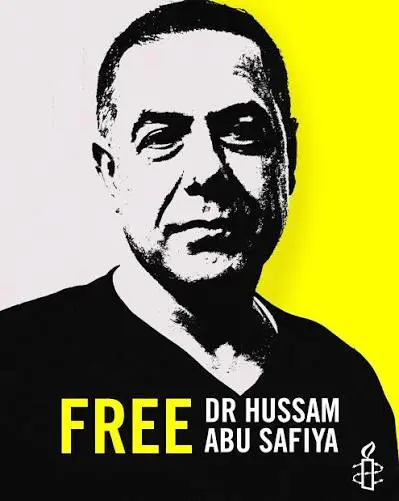
When Nasser Odeh walked into the visiting room at Israel’s Rakefet prison on the afternoon of July 2, he was prepared for a difficult encounter. He had represented Dr. Hussam Abu Safiya for months, had seen him through transfers and solitary confinement, and had grown accustomed to the gaunt face and tired eyes of his client.
But the man shackled to the chair in front of him was almost unrecognisable.
Abu Safiya—once the defiant, white-coated director of Kamal Adwan Hospital in northern Gaza, whose video pleas from a besieged emergency room made him a symbol of Palestinian medical resilience—could barely breathe. He struggled to sit upright. Fresh, severe injuries covered his head, around his eyes, and across his ears and neck. He repeatedly seemed on the verge of losing consciousness.
“The individual I encountered during this latest visit was not the same person I had previously met,” Odeh said in a joint statement with Physicians for Human Rights Israel (PHRI). “His physical and psychological state, the severe injuries visible on his body, and his personal testimony leave no room for doubt: his life is in immediate danger.”
Abu Safiya, 53, has now spent 18 months in Israeli detention without charge or trial—held under the Unlawful Enemy Combatants Law, a provision that allows indefinite administrative detention with periodic judicial reviews. Last month, Israel’s Supreme Court rejected his appeal against his ongoing incarceration, despite the absence of any criminal charges.
In that meeting, Odeh said, Abu Safiya spoke in a frightened, hesitant whisper. He told his lawyer that he was being subjected to daily beatings at Rakefet, that he had lost consciousness several times as a result, and that he believed his captors intended to kill him.
“They brought me here to kill me,” Odeh quoted him as saying. “I don’t see myself surviving. This is the end.”
A doctor who stayed when others fled
Before his detention, Abu Safiya had become one of the most recognisable faces of Gaza’s wartime collapse. He led Kamal Adwan Hospital through an 85‑day siege by Israeli forces, frequently posting anguished videos from inside the facility as it came under repeated bombardment. He continued to treat patients even after his own son was killed in an October 2024 raid, and days later he himself sustained injuries from an airstrike on the hospital. He refused to evacuate.
When Israeli troops stormed the hospital on December 27, 2024, they forced him out at gunpoint. He was last seen walking through the rubble of the streets around the facility, shortly before his arrest. His detention was met with international outcry, but successive appeals for his release—from medical organisations, human rights groups, and foreign governments—have gone unanswered.
Since his capture, Abu Safiya has been moved between multiple prisons. In late May, he was transferred from Ketziot prison to the Ganot complex and placed in solitary confinement without explanation, according to Odeh. There, Abu Safiya described being attacked by guards wielding hammers and batons, shortly after he appeared via video link at a Supreme Court hearing challenging his detention.
On June 24, he was moved again—this time to the Rakefet facility, a subterranean prison built in the 1980s to hold organised crime figures. It was closed years ago on the grounds that it was inhumane, but was reopened on the orders of far-right National Security Minister Itamar Ben‑Gvir. Prisoners there never see daylight. Other Palestinian detainees have reported feeling breathless and choking in unventilated, overcrowded cells—conditions that are even more perilous for a man with Abu Safiya’s injuries.
A baby, a checkpoint, and a pattern of denial
Abu Safiya’s case, harrowing as it is, does not stand alone. On the same day his lawyer issued his urgent plea, another tragedy unfolded in the occupied West Bank that underscored what rights groups call a systematic assault on Palestinian healthcare.
A four‑month‑old baby, Ahmad Maarouf Zaid, died after Israeli forces blocked his family from crossing the Ein Ayoub checkpoint to reach a waiting ambulance, his family told the Guardian. The infant, born after years of IVF treatment and described as healthy for most of his short life, developed a high fever on Sunday morning. The family called emergency services; an ambulance was dispatched to the camp’s gate. But when Ahmad’s parents approached, four Israeli soldiers—who had been firing teargas at people in the area—ignored their desperate pleas and barred them from crossing.
The family drove the severely ill baby on unpaved, mountainous back roads to Ramallah themselves, delaying treatment by more than an hour. It was too late.
“This baby needed oxygen. If he had been allowed to reach an ambulance and get to the hospital, his life could have been saved,” said the boy’s uncle, Arafat Ahmad Zaid. “There are no words to describe the pain of watching your own child die in your arms while knowing there is nothing you can do to save him. That is the ultimate suffering. That is the ultimate humiliation.”
The Israeli military denied blocking the family, but video footage of the incident, shared widely on social media, showed soldiers ignoring the family’s pleas as teargas canisters burst nearby.
Milena Ansari, PHRI’s director for the area, drew a direct line between these events: “The reports of a newborn dying after delays at a West Bank checkpoint, the arrest of a physician providing medical care, and the deepening humanitarian crisis in Gaza should not be understood as isolated incidents. They reflect a broader pattern in which the conditions necessary to realise Palestinians’ right to health are being systematically undermined.”
A prison that was once deemed too cruel
Rakefet, where Abu Safiya now languishes, is a name that has become synonymous with Israel’s harshest detention practices. Built deep underground, it was originally intended to isolate the country’s most dangerous criminals, but was shuttered after human rights groups and even prison officials condemned it as inhumane. Its reopening under Ben‑Gvir has been heavily criticised.
For a man with fresh head wounds, difficulty breathing, and a history of losing consciousness, the environment is potentially lethal. The Israel Prison Service, however, has denied all allegations of abuse.
“The Israel Prison Service rejects allegations of abuse, torture, starvation, or denial of medical treatment,” a spokesperson said in a statement. “All prisoners and detainees are held in accordance with the law and receive medical care based on Ministry of Health guidelines.” The service declined to comment specifically on Abu Safiya’s health, citing privacy concerns.
But Odeh and PHRI are not convinced. They have petitioned for Abu Safiya’s immediate transfer to a different facility and for an urgent independent medical examination—calls that have so far been ignored.
“The information we have received raises grave and immediate concerns for Dr Hussam Abu Safiya’s life,” said Naji Abbas, head of PHRI’s prisoners and detainees department. “If the authorities do not intervene immediately, there is a real risk that Dr Abu Safiya will not leave detention alive.”
A glimpse of a man fading away
Abu Safiya was seen for the first time in more than a year in June, when he briefly appeared on a video screen during a Supreme Court hearing. Journalists’ footage captured a brittle, handcuffed figure in white prison garb, his face pale and gaunt, with lash‑like marks on both arms. That image spread rapidly online, reigniting calls for his release—but the court rejected his appeal days later.
Today, he remains in a place where prisoners never see the sun, where the air is thick and stale, and where, according to his lawyer, he is too frightened to speak freely even in a private meeting.
“I have visited Dr Abu Safiya several times since his detention,” Odeh said, “but the individual I encountered during this latest visit was not the same person I had previously met. His life is in immediate danger.”
As the international community marks yet another grim anniversary of the Gaza war, Abu Safiya’s fate hangs in the balance. He is one of at least 14 Palestinian doctors currently held in Israeli prisons—health workers who, like him, once devoted themselves to saving lives, now trapped in a legal limbo that rights groups say has become a torture camp.
The question, as night falls over the Rakefet facility, is whether the world will hear his plea before it is too late.