


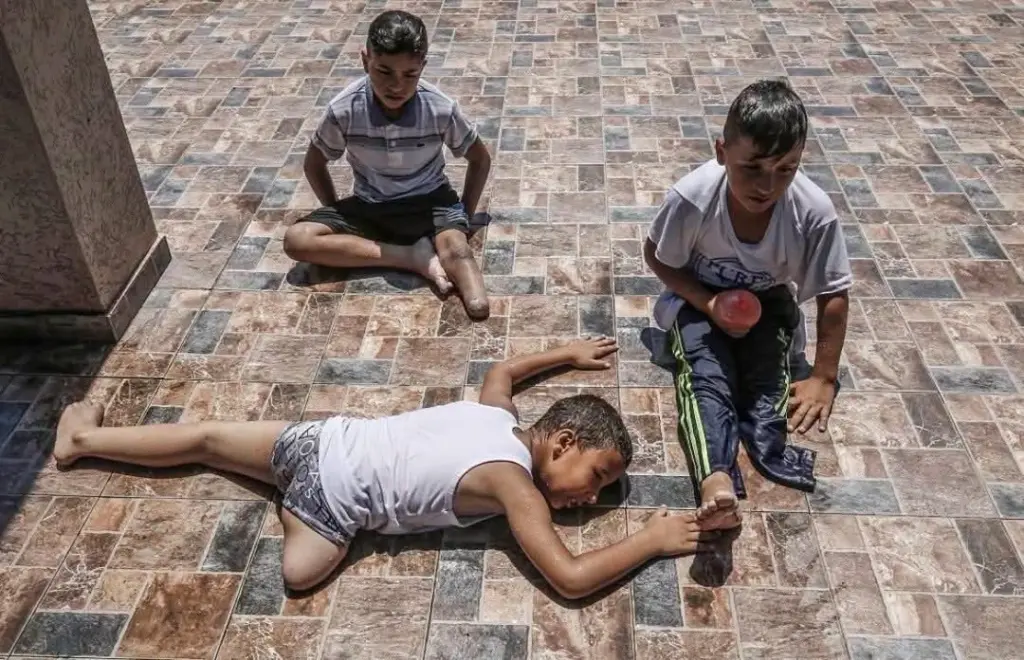
The United Nations commission of inquiry has concluded that Israel set out to kill, starve, maim and break the children of Gaza – and that the campaign amounts to genocide. A reading of the commission’s 89-page report, and of an interview with one of the three jurists who wrote it.
The phrase that gives the report its title was not written by a lawyer. A doctor said it, somewhere in the wreckage of Gaza’s health system, reaching for words to describe what he was treating: the essence of childhood has been destroyed. The United Nations commission investigating the war took the sentence and made it the masthead of an indictment.
On 18 June 2026, the Independent International Commission of Inquiry on the Occupied Palestinian Territory and Israel published its findings on what the war has done to Gaza’s children. The conclusion, set out across eighty-nine pages and several hundred numbered paragraphs, is the gravest a body of its kind can reach: that Israeli authorities and security forces have committed genocide, crimes against humanity and war crimes in Gaza, and war crimes in the occupied West Bank, by deliberately targeting the young. It is the commission’s second genocide finding in nine months, and where the first, last September, rested on the destruction of the population as a whole, this one rests on a narrower and colder proposition – that the children were not caught in the war, but chosen by it.
‘Much of the harm suffered by Palestinian children was not incidental,’ the commission states, ‘but intended to destroy the existence of the Palestinians in Gaza as a group.’ Because children embody the biological and social continuity of a people, it argues, killing them is a way of killing the people’s future. That is the architecture of the charge.

The arithmetic of a generation
The numbers are difficult to hold in the mind, and the commission is careful to say they are almost certainly undercounts. Between 7 October 2023 and 7 October 2025, it records, at least 20,179 Palestinian children were killed and 44,143 injured as a direct result of the hostilities in Gaza – thirty per cent of all those killed, and a higher proportion of children than in any previous round of fighting. UNICEF’s running tally, cited in the report, puts the figure higher still, at more than 21,000 by early 2026. Among the dead were 5,031 children under the age of five, of whom 1,029 had not reached their first birthday and some 420 were newborns. Save the Children estimates a further 5,160 children lie buried, uncounted, beneath the rubble. UNICEF has called Gaza the most dangerous place in the world to be a child, and the commission quotes the verdict without contradiction.
Chris Sidoti, the Australian jurist who is one of the commission’s three members, put the toll in plainer terms in a broadcast interview as the report was released. Speaking to Michael West’s The West Report, he described a death count that the figures understate. More than twenty thousand children, he said, had been killed directly by the violence; around twenty-two thousand bodies of children had by now been identified and counted. Beyond them were the children still under the rubble, those whose bodies had never been identified, those simply listed as missing – and beyond those again, the tens of thousands more who had died indirectly: of infectious disease in a place where the hospitals had been destroyed, of wounds that could not be treated, of the extreme malnutrition produced by the siege. There are, he said, ‘tens of thousands more children who have died as a consequence of this fighting,’ over and above the bodies already counted.
A question of method
What lifts the report above the grim accountancy of casualty figures is its account of method – of how the children died. Two patterns run through it.
The first is the saturation bombing of the places where families shelter. On 25 December 2023, the commission notes, the Israeli military stated that it was no longer being ‘selective’ or ‘accurate’ in its strikes, but was now focused on causing ‘maximum damage.’ The commission reads that statement, set against the conduct that followed, as a de facto blanket permission to bomb civilian areas. The consequences were arithmetic: children, with their smaller bodies and thinner skin, are seven times more likely than adults to die in a blast, and entire families were erased across two, three, even four generations. On 23 May 2025 in Khan Younis, two airstrikes on a single home killed nine of a family’s ten children and their father; both parents were doctors. When a March 2025 pause in the fighting was broken without warning, more than 170 children were killed by midday; over the following fortnight the strikes killed at least 322 children and injured 609 – the equivalent, the commission notes, of killing or wounding a hundred children a day.
The second pattern is the one Sidoti called the more chilling, because it is precise. Across Gaza, the commission documents, Palestinian children were shot deliberately and individually, one at a time, by snipers and by quadcopter drones. The wounds tell the story: single gunshots, carefully aimed, to the head or the upper body, with no one else nearby harmed. Seventeen doctors who served in Gaza’s hospitals described to the commission a consistent stream of such cases. ‘Based on the clustering of injuries and the targeted body parts,’ one of them said, ‘I assess that the Israeli soldiers have been deliberately shooting teenage boys in a game of target practice – a different body part being targeted on different days.’ Sidoti put it the same way: snipers and quadcopters killing children with ‘one shot only to the head or the upper torso,’ and nobody else around them touched. It was not the chaos of crossfire, the report insists. It was selection.
The individual cases are the report’s spine, and some of them are now known beyond Gaza. On 29 January 2024, five-and-a-half-year-old Hind Rajab was trapped in a car in Tel al-Hawa with the bodies of six relatives; the commission’s reconstruction, built on forensic and audio analysis, concludes that the 401st Brigade fired on the car from close range knowing children were inside, then shelled the Red Crescent ambulance sent to rescue her, killing its two paramedics. Hind’s body was recovered twelve days later. Others never reached the news at all: the fifteen-year-old shot in Khan Younis as he stepped from his house holding a white cloth, then shot twice more as he tried to rise, his twenty-year-old brother killed as he ran to him; the ten-day-old baby shot through the head by a quadcopter as his mother breastfed him in their tent; the four-year-old girl shot in the head as she ate, the only person in her family to be hit. In one set of 168 further cases the commission examined, at least eighty-eight children died; seventy had been shot by quadcopters and twenty by snipers; seventy-three had been shot in the head.
After May 2025 a new category appeared: children shot on their way to collect food. Doctors began treating children with gunshot wounds at or near the aid distribution sites run by the Israeli- and US-backed Gaza Humanitarian Foundation. Israeli soldiers themselves described the shooting. ‘Around one a.m. there were a couple of teenagers just sprinting away,’ a foundation truck driver recounted; ‘two soldiers ran after them, took two shots, and the two heads just snapped backwards and dropped.’ Another soldier offered a sentence the commission lets stand on its own: ‘obviously, fingers are light on the trigger.’

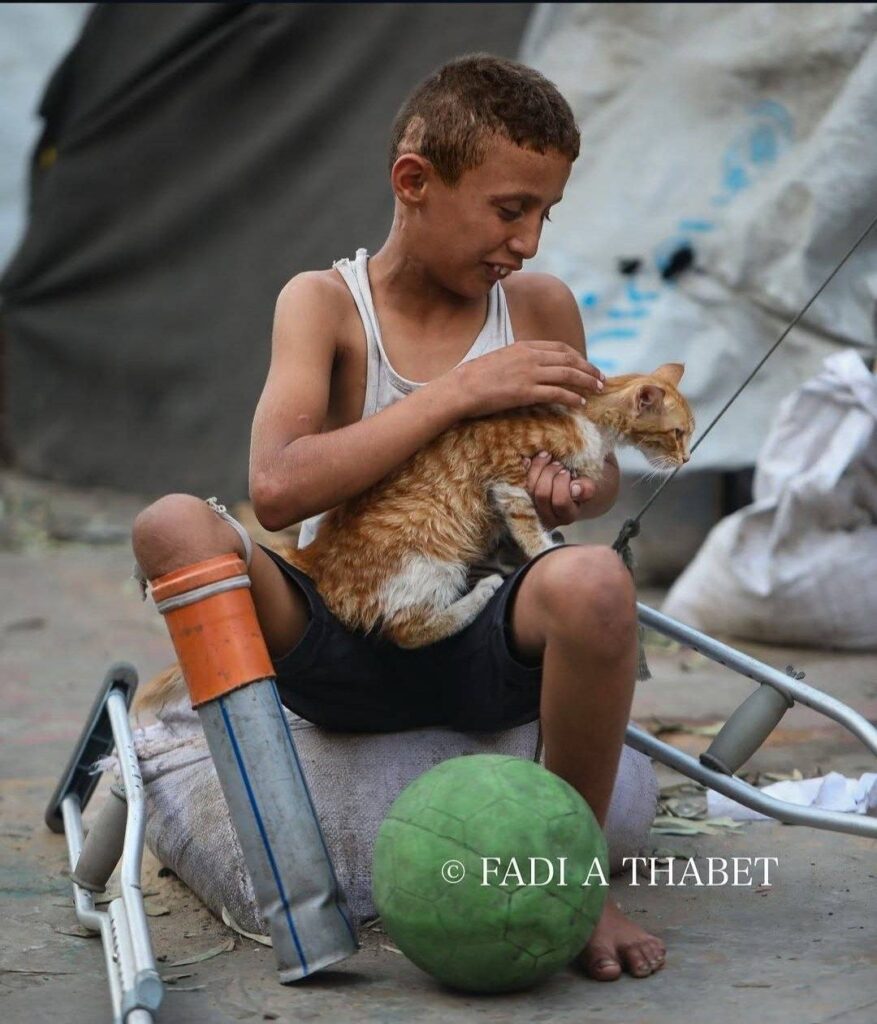
The weapon that does not hesitate
The instrument of much of this killing is new. In July 2025 an Israeli television channel broadcast its own military’s account of the quadcopters deployed in Gaza – small drones carrying high-resolution day-and-night cameras and a remote firing system. Their operators, the segment boasted, could strike with an accuracy ‘no human sniper, no matter how skilled, can achieve’; the weapon ‘does not hesitate, does not stop, and almost never makes mistakes.’ Using it, an officer said, was like ‘watching a video game.’ The unit that flies the most advanced of them is known as the Ghost Unit. A soldier in a separate documentary, Breaking Ranks: Inside Israel’s War, described what the screen does to the conscience: ‘the drones, in my opinion, are what most dehumanises the other side. You see everything on a screen. You drop the bomb. It feels like a game.’ The drones are built by Israeli and international arms firms; in 2025 the Israeli defence ministry established a dedicated administration for artificial intelligence and autonomous weapons.
Intent, and the chain of command
A genocide finding turns on more than atrocity. The 1948 Convention requires intent – the specific aim of destroying a group, in whole or in part – and it is the hardest thing in international law to prove. It is also where this report goes furthest. The commission first found genocidal intent last September; the new evidence, Sidoti said, does not merely repeat that conclusion but hardens it. ‘There is a clear chain of command,’ he told The West Report, ‘and it does go right to the top.’ This was not a matter of rogue soldiers, he stressed, though it was that too: ‘those at the top have issued clear orders as to the nature of this campaign.’ Pointing to the deliberate targeting of neonatal wards and the destruction of incubators, he reached the same conclusion – ‘an intent that children should die.’
For evidence of that intent, the commission turns to the words of Israel’s own political class, recorded with names and dates. In the Knesset on 21 February 2024, the Likud member Hanoch Milwidsky declared: ‘You will die, your children will die, your grandchildren will die – there won’t be a Palestinian state.’ He was, as Sidoti observed, far from alone. The commission cites the deputy speaker of the Knesset, Nissim Vaturi, who in October 2023 urged that Gaza be erased and that not a child be left there, and who in January 2025 added that ‘every child born there is already a terrorist, from the moment of his birth.’ It cites the legislator Merav Ben-Ari – ‘children in Gaza brought it on themselves’; the national security minister Itamar Ben-Gvir, demanding that anyone approaching the border fence ‘must be shot,’ with ‘no apologies and no hesitation’; the member who called three hundred babies in a maternity ward ‘all born terrorists’; and the former Likud politician Moshe Feiglin, who told a television interviewer in May 2025: ‘Every child, every baby in Gaza is an enemy … We need to conquer Gaza and colonise it and not leave a single Gazan child there. There is no other victory.’
The soldiers, in their own testimonies, describe the order reaching the ground. The newspaper Haaretz recorded soldiers who had turned the killing into a competition, counting their dead and logging them as ‘terrorists’; one admitted shooting an unarmed sixteen-year-old, after which his battalion commander congratulated him. In Breaking Ranks, a soldier recalled a routine: ‘we saw two teenagers pushing some sort of cart, and the first shot was directly to the head.’ Soldiers told the filmmakers they did not worry about international law in Gaza, because they believed they would never be prosecuted.
Beyond Gaza: the West Bank
Until here this is a Gaza story, and the report’s gravest findings are Gaza’s. But it broadens, deliberately, into the West Bank, where the same logic operates at a lower intensity and without the cover of a declared war. Between October 2023 and October 2025, the commission records, Israeli forces killed 213 Palestinian children in the West Bank and East Jerusalem – 206 of them boys, a ratio it reads as a policy of treating Palestinian boys as ‘terrorists’ or ‘future terrorists.’ The killing came in the course of military operations with names borrowed from another vocabulary – ‘Operation Summer Camps,’ begun in August 2024; ‘Iron Wall,’ begun in January 2025 – that brought airstrikes and tanks to the towns of the northern West Bank for the first time in two decades.
The youngest of the dead was a two-year-old girl, shot in the back of the head as she ate dinner with her family near Jenin in January 2025. Days later, in Tulkarem, a ten-year-old boy was shot at his father’s door; the soldier who fired, the boy’s father said, told him: ‘I am the one who shot your son. God willing, he will die.’ The boy died ten days later. The commission ties several such killings to a policy, reported by Haaretz, of opening fire on anyone ‘messing with the ground’ – a category broad enough, it notes, to include a child bending to pick up a stone. The cruelty is sometimes unhurried. In November 2025, in the Al-Faraa camp in Tubas, a fourteen-year-old boy lay bleeding on the ground for at least forty-five minutes, pleading for help, while around ten soldiers stood over him. In footage the commission reviewed, the boy throws his cap toward the soldiers to get their attention; one kicks it back. A soldier places a stone beside him, in what the commission concludes was an attempt to frame the killing as a response to stone-throwing. The boy died; his body was withheld from his family.
Alongside the soldiers are the settlers. Settler violence against Palestinians has surged since October 2023 – more than a thousand attacks in the first half of 2025 alone, the highest monthly average since the UN began counting in 2006 – and children are among its targets. The commission documents settlers abducting two small children, a girl and a boy under five, at knifepoint and tying them to a tree; settlers abducting and sexually assaulting two fifteen-year-old shepherds; settlers beating a deaf sixteen-year-old until his hearing aid fell out. The state, it finds, is not a bystander to this but a partner: arming settlers, shielding them, and sharing their objective of driving Palestinians from the land. ‘Settler violence,’ the commission concludes, ‘functions not as a deviation from state policy but as a means of implementing it.’
In Israeli custody
The same disregard follows Palestinian children into Israeli custody. Hundreds have been swept up in the mass arrests that followed October 2023 – boys aged twelve and over singled out, separated from their families, held with grown men, and treated, the commission writes, as suspects of ‘terrorism’ on the strength of their gender and nationality. By the end of 2025, more than half of the Palestinian child detainees held by the Israeli Prison Service were in administrative detention – imprisoned indefinitely, without charge – a record number. The conditions the commission documents – blindfolding and shackling, beatings to the head and genitals, dogs set on detainees lying face-down, electrocution, starvation, the denial of medical care – it characterises as torture. A fifteen-year-old held at Sde Teiman, the only child among seventy adults in his cell, described being made to stand for hours with his hands raised, his wrists cuffed until they bled; he called his twenty-three days there ‘the worst days of my life.’ Another fifteen-year-old described fifty-four days of interrogation and torture, including being electrocuted through a needle pushed into his shoulder. For one boy the transfer to an Israeli prison began with a sentence from a soldier: ‘you are going to Israel; you are going to hell.’
For one child, custody was fatal. In March 2025 a seventeen-year-old from Ramallah died in Megiddo Prison. He had entered it the previous September, his father said, fit and healthy; the post-mortem found severe, prolonged malnutrition, muscle wasting, and untreated colitis and scabies – conditions, the commission notes, that are easily treated. He had, in effect, been starved. His family learned of his death from a news report, and his body, like so many others, was withheld. The commission found that the prison authorities had caused his death, amounting to the war crimes of torture and wilful killing.

Sexual violence as a method of war
Among the gravest and most carefully handled of the commission’s findings is its account of sexual and gender-based violence against children. During mass arrests and evacuations, it documents, Palestinian boys and girls were forced to strip in public, in front of family and community, and were photographed and filmed in their underwear – a practice, it notes, that spread rapidly through Israeli messaging groups after October 2023. In detention, children, including boys, were subjected to sexual assault, genital violence and sexual threats. The commission is restrained in its detail and unambiguous in its conclusion: that this violence was used not against individuals alone but as a method of intimidation and collective punishment, a systematic, state-enabled assault on children’s bodies and dignity, amounting to war crimes and crimes against humanity. Its gravity, the report observes, is deeper when the victim is a child, ‘at a stage of life when the body, mind and sense of self are still developing.’
The clinic and the cradle
It is in Gaza’s hospitals that the report’s title was born, and it is there that some of its most harrowing findings lie. All three of Gaza’s specialist children’s hospitals were forced to close in the first two months of the war. At Al-Nasr Paediatric Hospital, after the power was cut and the staff ordered out under fire, the decomposing bodies of four premature babies were later found in the neonatal unit, still attached to the ventilators that had failed them – footage the commission, the Washington Post and CNN all separately verified. The number of working incubators in Gaza fell from 178 to 54. Babies were laid three and four to an incubator; others died of a cold the hospitals could no longer keep out.
The commission documents the deliberate destruction, in December 2023, of Gaza’s largest fertility clinic, and a measurable collapse in the chances of being safely born: a forty-one per cent fall in births, a tripling of the rate at which women die in childbirth and miscarry, and a generation of newborns arriving premature, underweight, or with the congenital defects that follow a mother’s malnutrition. ‘In over thirty-five years of my medical career,’ one paediatrician told the commission, ‘I have never seen mothers helplessly resorting to such risky and poor feeding … in Gaza.’ It was a doctor, summarising all of this, who said that the essence of childhood had been destroyed.
Starvation as policy
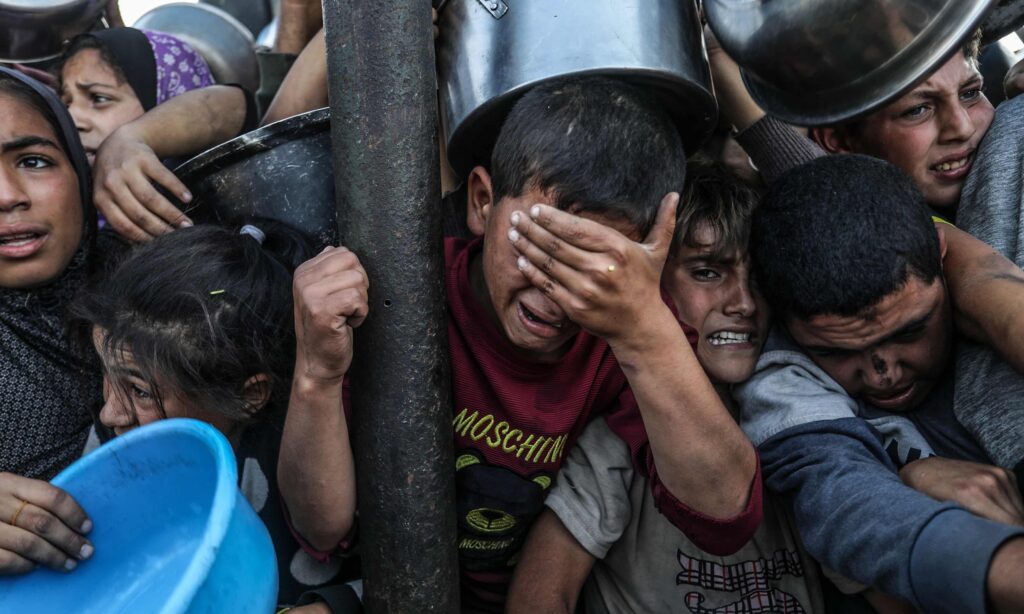
The hunger was not a by-product. The commission had already found, in an earlier report, that Israel was using starvation as a method of war, and the new report traces what that did to children. On 22 August 2025, after twenty-two months of warnings, famine was formally confirmed in Gaza – the first time, the commission notes, that a famine had ever been officially declared in the Middle East. Nearly 95,000 children were treated for acute malnutrition in 2025; the deadliest month for malnutrition deaths was July, when twenty-four children under five died. The deprivation killed in quiet ways: a twelve-year-old with coeliac disease who wasted away when gluten-free food was blockaded; a nine-year-old who died because the formula that would have saved her could not be brought in. A thirteen-year-old boy, severely injured in an earlier strike, told the commission what survival had required: ‘At one point we had to eat cat food and grind donkey food to make bread. It tasted disgusting, but we had to eat to survive.’ The siege also undid Gaza’s public health: polio, eradicated from the territory for twenty-five years, returned in a ten-month-old baby who within a year could no longer move his legs.
The ruined classroom
The war reached the classroom too. Of Gaza’s 564 school buildings, 459 were directly hit; more than ninety-seven per cent of schools have been damaged or destroyed, and an entire cohort of children has now missed three years of formal education. Universities were levelled – the commission cites a projected setback of sixty-nine years to Gaza’s human development index, and a brain drain of a generation denied the chance to learn. Some of the destruction was filmed by the soldiers who carried it out. In one video, titled by its maker ‘It’s always fun to blow up schools,’ a soldier says, just before the detonation: ‘In my childhood, I’ve always dreamed of blowing up my school. Today I’m blowing up a school. Wow.’

Mocking the symbols of childhood
That video belongs to a wider pattern the commission found impossible to dismiss as the work of individuals: at least thirty-five instances of soldiers filming themselves mocking and desecrating the symbols of childhood. A doll with its eyes taped shut and a teddy bear hung by its neck from a ceiling fan. A soldier in full combat gear riding a child’s wooden toy horse through a wrecked apartment. A teddy bear strung from the barrel of a tank. Soldiers brandishing a child’s trophy – ‘You lost the trophy. We won! Not you, we!’ That these were filmed and posted, the commission writes, with the evident knowledge of commanders and without consequence, is itself evidence: of impunity, and of a military culture of degradation that works by destroying the things essential to children’s lives.
The charge, and the names
The legal findings gather all of this into a single charge. The commission concludes that Israel has committed the crimes against humanity of extermination, murder, persecution, enforced disappearance, torture and sexual violence; the war crimes of wilful killing, the destruction of hospitals and schools, the use of starvation, and outrages upon personal dignity; and the crime of genocide – by killing Palestinian children, by causing them serious bodily and mental harm, and by deliberately inflicting conditions of life calculated to bring about the group’s physical destruction. It does not leave the perpetrators abstract. Across its conclusions it names the specific Israeli units it holds responsible for individual killings: the Kfir Brigade for the two boys gathering firewood; the 401st Brigade for Hind Rajab; the 98th Division for the boy with the white flag; the Ghost Unit for the breastfed baby and the four-year-old girl; the Menashe Brigade for the two-year-old; the Ephraim Brigade for the boy whose shooter wished him dead. And it records, in its methodology, that it sent the Israeli government thirteen requests for information and access, and received not a single reply.
A third genocide
Sidoti brings a rare vantage to a finding of this kind. This is the third time in his career, he told The West Report, that he has been drawn into an investigation raising the spectre of genocide. As an Australian Human Rights Commissioner he helped write the Bringing Them Home report into the forced removal of Indigenous children from their families, which found that policy to be genocide. As a UN investigator he examined the violent expulsion of the Rohingya from Myanmar in 2017 and 2018. What sets Gaza apart, he said, is the specificity. In Myanmar, children died alongside their parents in attacks on villages; there was no sign of children being singled out. In Gaza, the commission found, they were – ‘the specific targeting and killing of children in the way that we have in Gaza.’ Where the evidence runs out, the commission and its members decline to go further: asked whether Israel’s parallel campaign in Lebanon might also amount to genocide, Sidoti said simply that he did not know – it lay outside the commission’s mandate, and he had not investigated it, though he admitted being ‘struck by similarities in the tactics.’
Israel’s answer
Israel rejected the report wholesale. Its foreign ministry called the document a ‘libellous sham’ and ‘a propaganda piece,’ condemned the commission as a body built to vilify the Jewish state, and accused it of erasing the Israeli children murdered and abducted on 7 October and of ignoring Hamas’s use of children as human shields. Israel’s leaders have consistently denied any genocidal intent, maintaining that their forces act in self-defence, to defeat Hamas and free hostages, and within the law. There was, too, a manoeuvre Sidoti described with some contempt. Under the commission’s procedures Israel received the report in draft and was invited to respond; it offered no comment, he said, but instead circulated an eighteen-page rebuttal to diplomatic missions in Geneva before publication, an attempt to discredit the findings before anyone had read them. ‘It says nothing new,’ he said. ‘It’s just the usual excuse-making … the usual lies that we’ve come to expect.’ The hostility is ritual, he added: ‘they scream abuse at us every time we appear before the United Nations.’ What was new, this time, was that a UN official had screamed back.
The findings on 7 October
The commission has not turned its gaze on Israel alone, and Sidoti was at pains to say so. It has previously found that Hamas and other Palestinian armed groups committed war crimes and crimes against humanity on 7 October 2023, when about 1,200 people were killed in southern Israel and 251 taken hostage – among them, the new report records, forty Israeli children. Sidoti described those killings in detail: a baby under two shot dead in its mother’s arms; five teenagers, a girl and four boys aged sixteen and seventeen, killed at Zikim Beach as they sheltered in a toilet block, along with a fisherman and a soldier who tried to defend them. ‘These are war crimes,’ he said. The commission has passed the names of suspected perpetrators, Israeli and Palestinian alike, to the International Criminal Court.
What, if anything, changes
The harder question is what any of it changes. The commission’s three jurists do not formally speak for the UN, and their report carries moral and evidentiary weight rather than the force of law. The Security Council, Sidoti said bluntly, is ‘totally dysfunctional’ and will not act; responsibility now falls to individual governments. The legal machinery grinds on regardless – the International Court of Justice is years into South Africa’s genocide case against Israel, which Israel calls ‘wholly unfounded,’ and the International Criminal Court is the destination for the commission’s lists of names. But accountability, in Sidoti’s account, is also arriving by quieter routes. Legal organisations and some police forces, he said, are already tracking the movements of Israeli soldiers implicated in possible crimes; court cases are ‘underway right now.’ He pressed, too, beyond individuals to institutions – the military, the government, the settlements – and to the money that sustains them. Investing in a company like Elbit Systems, which has profited from the war, amounts in his telling to ‘funding the commission of war crimes against the Palestinian people’; ‘no one should be investing in them, and … nobody should be trading with them.’ The report’s own recommendations run in the same direction – an arms embargo, targeted sanctions on ministers, officers and violent settlers, the arrest of anyone the ICC indicts, and Israel’s listing among the world’s persistent perpetrators of grave violations against children.
No way back
If there is a thesis beneath the report, Sidoti drew it, pointedly, from Israel’s own prime minister. In the days after 7 October, Benjamin Netanyahu said there would be no returning to the world that existed before that date. He was right, Sidoti said – ‘about the only thing he said that is actually not a lie.’ But the rupture, in the commissioner’s telling, was completed less by what Hamas did on a single morning than by what the Israeli state has done in the years since. ‘All the natural sympathy that Israel had has been destroyed,’ he said, ‘by the actions of the Israeli government and the Israeli military.’ In a hundred years of this conflict, he went on, ‘there has never been a period of such uncontrolled violence … and there is no going back.’ Israel can expect, he said, scrutiny and calls for accountability ‘like never before.’
The commission’s report ends not with the law but with the children it is written for: the cohort growing up without limbs, the orphans with no surviving family, the babies who will never be born, the schoolrooms turned to rubble, and the particular, irreplaceable thing a doctor named when he said that the essence of childhood had been destroyed. The hardest crime in international law to prove has, in the judgement of the three jurists who investigated it, been proven. Its victims are children.
This feature draws on the report of the Independent International Commission of Inquiry on the Occupied Palestinian Territory and Israel, ‘The essence of childhood has been destroyed’ (A/HRC/62/CRP.2, 18 June 2026), and on an interview given by Commissioner Chris Sidoti to Michael West’s The West Report. Casualty figures are the commission’s own, drawn from the Gaza health ministry and United Nations agencies, which the report treats as broadly reliable and likely to understate the true toll.