


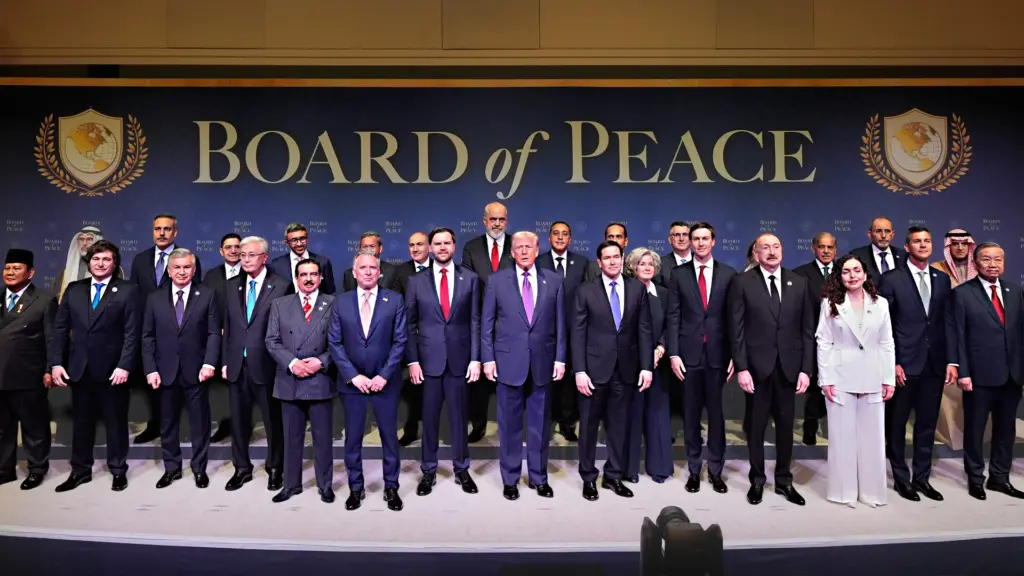
New documents reveal the Board’s roadmap demands total disarmament of Palestinian resistance – while Israel violates the ceasefire more than 3,300 times and expands its occupation of Gaza.
More than eight months after President Donald Trump touted his ceasefire deal as the end of the Gaza war, Israel has killed over 1,000 Palestinians in the Strip – an average of 13 violations per day of the agreement it signed, according to Palestinian reports shared with mediators and obtained by Drop Site News. Yet the central focus of international negotiations remains not Israel’s relentless attacks, nor its blockade of aid, nor its expanding occupation, but rather one thing: forcing the Palestinian resistance to surrender its weapons.
Internal documents obtained by Drop Site reveal that Trump’s private “Board of Peace” – a body that states can join for $1 billion – is attempting to achieve through diplomacy what Israel could not accomplish through 15 months of genocidal war: the complete dismantling of Palestinian armed resistance and the abandonment of the Palestinian national liberation struggle.
The Board’s 15-point “roadmap”, first presented to Hamas and other Palestinian factions in April, has been met with a counterproposal from Palestinian negotiators on June 13. The Board’s “High Representative”, Nickolay Mladenov, delivered his response last week. Taken together, the two documents expose a chasm between Palestinian demands for a path to statehood and the Board’s push for what Palestinian officials call “the surrender that Netanyahu failed to achieve through war”.
A Ceasefire in Name Only
When Trump secured UN Security Council endorsement for his Gaza plan in November 2025 – an unprecedented move that wrapped his private Board’s authority in UN legitimacy – the agreement seemed to offer a path out of the devastation. But Israel immediately made clear it had no intention of respecting the terms. It continued killing Palestinians on a near-daily basis and began limiting the entry of life essentials agreed upon in the ceasefire.
Since the October 2025 agreement, Israel has committed at least 3,338 ceasefire violations, according to Palestinian reports shared with mediators. More than 1,000 Palestinians have been killed and over 3,200 wounded in Israeli attacks since the deal entered into force. Israel has severely restricted the movement of Palestinians and the entry of humanitarian supplies, permitting only 36 per cent of the agreed quantity of aid to enter the Strip.
Israeli forces have also continued expanding the “yellow line” separating occupied areas further westward. Prime Minister Benjamin Netanyahu recently pledged to expand Israeli occupation to 70 per cent of Gaza and said the ultimate aim is to conquer the entire territory. Israel has built and fortified 38 military bases in eastern Gaza, paved roads leading to the bases, and erected 25 kilometres of massive earth berms to physically divide the enclave.
“There’s so much that could have been done since October of 2025 to stop Israel,” said Diana Buttu, a Palestinian human rights lawyer who served as an adviser to the PLO during the Oslo negotiations. “We were, back in October of 2025, the only people in the world that had to negotiate an end to genocide. And here we are now in June of 2026, still negotiating an end to genocide.”
Mladenov: The Man Behind the Board’s Demands
The Board’s point man in these negotiations is Nickolay Mladenov, Bulgaria’s former Defence and Foreign Minister who served as UN Special Coordinator for the Middle East Peace Process from 2015 to 2020. He serves as director general of a research academy that trains diplomats from the United Arab Emirates, Israel’s closest Arab ally, and was until his appointment a visiting fellow at the Washington Institute for Near East Policy, a pro-Israel think tank established by veterans of AIPAC.
In some recent negotiations with Hamas, Mladenov has been joined by a senior Trump adviser, Rabbi Aryeh Lightstone, a hardline supporter of Israel who played a key role in the 2020 Abraham Accords.
“Mladenov continues to approach the file from a perspective close to the Israeli position,” said Hazem Qassem, Hamas’s spokesperson in Gaza, arguing that Mladenov’s attempts to alter terms previously agreed upon with regional mediators from Qatar, Egypt, and Turkey has “hindered efforts to reach a final agreement”.
A senior Hamas official, speaking on condition of anonymity, told Drop Site: “Mladenov’s latest response reflects the occupation’s unwillingness to reach an agreement, despite the movement’s compliance with all the demands placed upon it and the significant flexibility it has demonstrated across various issues, including the question of weapons.”
The Documents: Two Visions for Gaza’s Future
The Palestinian negotiators’ proposed amendments to the Board’s roadmap, delivered on June 13, insist that resolving the issue of weapons can only be addressed as part of a “process that guarantees the Palestinian people’s right to establish a Palestinian state and exercise their right to self-determination”. The Board’s draft says only that Palestinian disarmament “shall create conditions for a credible pathway”.
Hamas’s draft states that the process should lead to self-determination and Palestinian statehood “in accordance with international law and relevant United Nations resolutions.” Mladenov’s version removes both references, instead describing the outcome as “creating conditions for a credible pathway” toward self-determination and statehood.
The Palestinian negotiators also proposed a clear reunification of Gaza and the West Bank, writing that the Board would be responsible for “overseeing the orderly transfer of governance” to the National Committee for Gaza Administration (NCAG), which would ultimately hand power back to the Palestinian Authority as part of a process “leading to the establishment of a Palestinian state and the realisation of self-determination”.
Mladenov’s draft ignores these points entirely and does not mention the Palestinian Authority at all.
“Even the one entity, the one Palestinian political body that has achieved international legitimacy and that has worked directly with Israel is being ignored in this agreement as part of that strategy to ensure that there’s no continuity with any kind of Palestinian body,” said Abdullah Al-Arian, an associate professor of history at Georgetown University in Qatar.
Disarmament: The Core Demand
The most consequential issue in the exchanged documents concerns the future of Palestinian weapons. Trump and Netanyahu have falsely claimed that Hamas is violating the deal by not immediately surrendering its weapons, and Israel has cited this as a justification for continuing its attacks.
In their June 13 response, Hamas and the Palestinian factions proposed a gradual process for the registration and storage of heavy weapons in parallel with Israeli withdrawal from Gaza, contingent upon the completion of the first phase of the agreement, the entry of the NCAG, the deployment of the International Stabilisation Force (ISF), and the dismantling of Israel-backed armed militias in the Strip.
Mladenov’s revised text, however, substantially altered both the scope and sequencing. It expanded the provision from “heavy weapons” to include weapons depots, tunnels, military production facilities, and added a final condition stipulating that upon completion, Hamas and other Palestinian factions would no longer “hold, store, control or have access to any weapons”. The revisions transform the provision from a mechanism governing specific categories of weapons within the context of a long-term truce into a roadmap for the comprehensive dismantlement of Palestinian armed resistance.
Senior resistance officials have repeatedly expressed willingness to “freeze” and store weapons as part of a long-term truce that would ultimately lead to the establishment of a Palestinian state with its own army. But they insist that neither Hamas nor any single faction possesses the authority to negotiate away the weapons of the Palestinian people – maintaining that resistance is a right guaranteed under international law and that any future arrangements must be reached through Palestinian national consensus.
According to both Israeli and US assessments, the rockets and missile stockpiles of Hamas and Palestinian Islamic Jihad have been largely spent or destroyed during the war. Netanyahu himself acknowledged in February: “There’s practically no heavy weapons in Gaza. There’s no artillery. There’s no tanks. There’s nothing.” As part of his campaign to entirely strip Palestinians of any weapons, Netanyahu portrayed assault rifles as the greatest threat: “The heavy weapon, the one that does the most damage, is called an AK-47.”
A Buffer Force – or an Occupation Force?
Hamas’s draft envisioned the International Stabilisation Force primarily as a buffer force separating Israeli troops from areas administered by the NCAG, monitoring compliance with the ceasefire, and protecting the delivery of life essentials. Mladenov retained those functions but significantly expanded the force’s mandate to include training Palestinian police and “support[ing] the decommissioning process”.
Hamas proposed that Israeli forces withdraw in phases “until they are outside the borders of the Gaza Strip” with the ISF assuming positions in areas vacated by Israeli forces. Mladenov’s response limits Israeli withdrawal only to “Gaza’s perimeter” and says it would occur only with “verified progress” in the weapons decommissioning process.
“It is clear that Mladenov is conveying the Israeli vision of the agreement and attempting to impose it on us – under the threat of renewed war – the continuation of the current humanitarian catastrophe, and ongoing killings,” said the senior Hamas official.
Israeli-Backed Militias: Death Squads in Gaza
Alongside its bombardment and territorial expansion, Israel has increasingly relied on a network of Palestinian militias operating in areas under Israeli control in Gaza. At least five such groups, established between April and September 2025, have emerged across the enclave, collectively numbering a few hundred fighters. Operating largely behind the “yellow line”, these militias have received Israeli weapons, intelligence, logistical support, and, in some cases, medical treatment inside Israel.
Israel’s support for the militias was publicly acknowledged by Netanyahu last June, when he said the government had “activated” powerful local clans in Gaza on the advice of “security officials” to assist in the fight against Hamas.
Among the most prominent groups are the Popular Forces (now headed by Ghassan al-Dahini in eastern Rafah); the Strike Force Against Terror, led by former Palestinian Authority security officer Hussam al-Astal in Khan Younis; and the Free Homeland Forces under Shawqi Abu Nuseira in central Gaza. Several of the militia leaders and members have a history of criminal activity, looting and smuggling aid, collaboration with Israel, as well as ties to extremist groups, including ISIS.
The militias have increasingly carried out raids, assassinations, and abductions, while establishing armed checkpoints in coordination with Israeli forces. Palestinians travelling through Rafah since the ceasefire have reported being stopped by gunmen affiliated with the Popular Forces and subjected to harassment, beatings, and theft.
Hamas’s proposal calls for the immediate dismantling of these militias and the confiscation of their weapons upon implementation of the agreement. Mladenov, however, proposed approaching the disarmament of these Israeli-sponsored forces in a similar manner to Palestinian resistance movements, permitting them to gradually decommission and store their weapons under the authority of the NCAG.
The Road Ahead: A Grim Outlook
Hamas officials say the Palestinian factions are currently reviewing Mladenov’s reply to their proposed terms. Qassem stated they are “formulating a unified and responsible response that prioritises the interests of the Palestinian people and supports efforts to end the ongoing genocidal war in the Gaza Strip.”
But Buttu said history shows that regardless of how the Palestinian negotiators respond – and even if they reach an agreement – Israel will continue to set its own rules.
“Israel can keep going for months and months and they will continue to be in the driver’s seat and they don’t care. And in fact, it’s kind of better for them if this continues to go on for months and months because then they can just continue their attacks with the excuse that there’s still discussions happening,” Buttu said.
“They’ve completely ignored genocide, they’ve completely ignored the bigger picture of what’s happening to the two million people that are in Gaza. And if we don’t agree on every single word and every single I that’s dotted and T crossed, then Palestinians are just going to continue to starve.”
Al-Arian believes the central Israeli aim remains the total erasure of the Strip as a Palestinian territory.
“All of this serves the Israeli interest, which is in the long term to find a way to either ethnically cleanse the population and to reoccupy it and possibly resettle it,” Al-Arian said. “Unfortunately it’s quite grim absent any kind of external intervention.”