


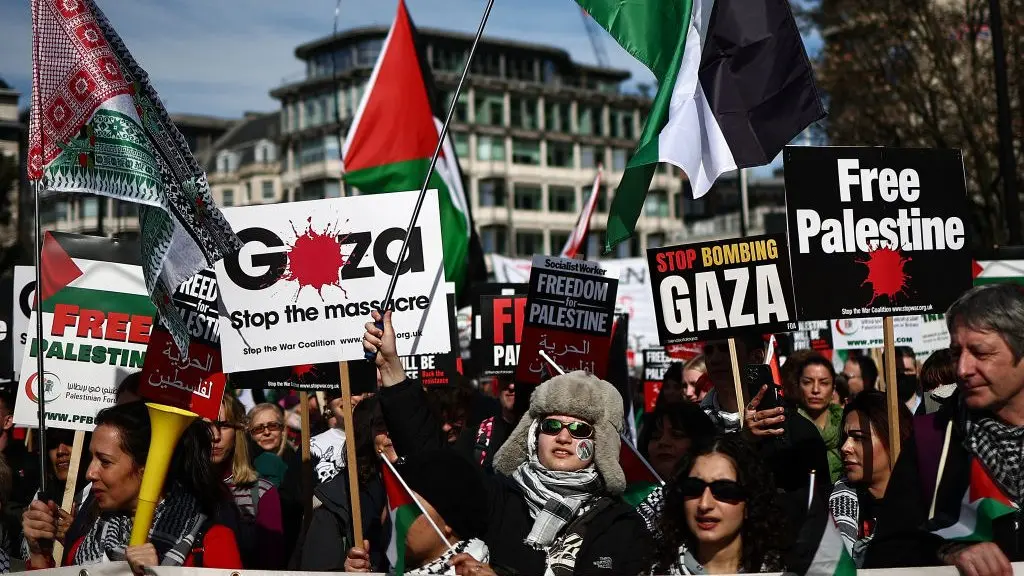
As police and politicians intensify attacks on Gaza solidarity marches – and a far-right rally is given the run of central London – organisers are fighting back with legal action, defiance, and a warning: weaponising antisemitism will not silence the movement
The room has the makeshift feel of a war room. Behind Chris Nineham, as he joins the video call from his home office, a concrete wall suggests a certain prison-chic aesthetic. “Appropriate,” observes interviewer Owen Jonesdryly, “given the general direction of travel.”
Nineham, vice chair of Stop the War and one of the key organisers of Britain’s Palestine solidarity demonstrations, has been here before. He has watched the cycle repeat: mass mobilisation, media vilification, political crackdown. But something feels different this time.
“There’s a massive onslaught against the protest against Israel’s genocide, apartheid, and occupation,” he says. “It’s an onslaught which comes from the media and political establishments. It’s very clear where it’s heading. It’s heading in the direction of banning all protests.”
These are strong words. But the evidence, Nineham insists, is mounting by the day.
The Golders Green attack – and the political response
On 5 May 2026, two Jewish men – aged 34 and 76 – were stabbed in Golders Green, a northwest London neighbourhood with a large Jewish population. The attacker, a man named Sudan who had been released from a psychiatric hospital just days earlier, is also accused of attempting to murder a third person: a Muslim man he had known earlier that day. Sudan has been charged not with terrorism offences but with three counts of attempted murder and one count of possession of a bladed article.
Within hours, Prime Minister Keir Starmer delivered a stark warning. “If you stand alongside people who say ‘globalise the intifada’,” he said, “you are calling for terrorism against Jews, and people who use that phrase should be prosecuted.”
For critics, the leap was instant and unmistakable. A violent attack by a clearly unwell individual – with a history that reportedly includes stabbing a police officer nine times nearly two decades ago – was being weaponised to target an entire protest movement.
James Schneider, former communications director for Jeremy Corbyn and now communications director of Progressive International, describes the pattern in blunt terms. “Weaponising antisemitism means taking Jewish fear and Jewish pain and using it for political purposes that benefit the state,” he says. “Instead of focusing on what should be done to keep people safe, it is used to try to shut down protest and opposition to British state support for Israel’s crimes.”
Schneider, who is Jewish, acknowledges the gravity of the attack. “If someone specifically comes to a very Jewish area and specifically attacks two visibly Jewish people, it’s completely right to view that as antisemitic violence.” But he warns against the political exploitation that followed. “The attempt to turn this into a political weapon to bash those opposed to British state policy – including many Jewish people – is obviously the wrong thing to do.”
The government has announced a Downing Street antisemitism summit and additional funding to protect Jewish institutions. Schneider calls this “the good stuff”. But he adds: “The attempt to silence political debate you don’t like from the pulpit of the state is not just morally wrong. It creates a hierarchy of racism. It is a form of anti-Palestinian racism. And it will further drive antisemitism.”
Why? Because, he argues, “if you create the idea that Jewish safety here is related to support for the crimes of a foreign state – Israel, which commits an unbelievable litany of crimes – then you are pushing the antisemitic idea that Jews and Israel can be conflated.”
The synagogue lie
The most recent flashpoint with the Metropolitan Police came when Commissioner Sir Mark Rowley claimed that march organisers “set out with an intent to march near synagogues” and that “even that intent causes me concern.”
Nineham is adamant: “He knows this isn’t true. We have never, ever intentionally wanted to march near a synagogue. There isn’t a single example of any route we have ever suggested to the police which marches directly past a synagogue.”
The dispute centres on a familiar artery of London protest: the route from the BBC’s headquarters on Portland Place to Trafalgar Square. The nearest synagogue sits approximately 350 metres away. The Palestine movement had assembled at the BBC three times previously without incident. On one occasion, organisers voluntarily amended their route to increase the distance.
Rowley’s characterisation, Nineham argues, represents something more sinister than simple error. “He must know this isn’t true. He has access to all the emails, all the recordings of meetings. This is a flagrant untruth – a lie, to be honest – as part of a wider campaign.”
The Metropolitan Police have been asked repeatedly for “corroborated examples of anyone from our demonstration threatening or causing intimidation to a Jewish person.” According to Nineham: “They haven’t been able to provide us with one instance.”
‘Hate marches’ and the erasure of Jewish voices
The accusation that has most stung organisers is the persistent labelling of the protests as “hate marches” – a descriptor deployed by Conservative politicians, echoed in sections of the media, and now seemingly adopted as operational framing by police.
For Nineham, the characterisation is absurd. The marches draw Christians, Muslims, Jews, and people of no faith. Thousands of Jewish people attend, some wearing kippahs, others in Orthodox clothing, many carrying banners that proudly assert their Jewish identity while declaring solidarity with Palestinians.
“What we’re talking about is people of all backgrounds going out onto the streets to say we don’t want to see innocent people in Gaza, the West Bank, Lebanon, Iran being massacred systematically. That’s the opposite of a hate march. These are expressions of humanity.”
M. Hilton, a Jewish organiser and writer based in London, co-founder of Na’amod UK (Jews against Israeli occupation and apartheid), has been on the ground at these marches as part of the Jewish bloc. She describes her experience as a “necessary moral duty”.
“I can say that I have felt it was a necessary moral duty to go on these marches, particularly as Israel has wrought so much destruction on Gaza. What you can see from those marches is how many other Jewish people feel the same way. There was a lot of solidarity.”
She acknowledges that “there have been some problematic signs and problematic people who join those marches” and insists such behaviour must be addressed. But she warns against the broader campaign to paint the entire movement as inherently antisemitic.
“What the government is doing is essentially saying the only way to fight antisemitism is to be anti-human rights, to crack down on our civil liberties. That is also dangerous for Jews because we are likely to foot the blame for that. Every time the government says we need to ban protests to support the Jewish community, you’re putting a target on our backs.”
Hilton points to data from the Jewish Policy Research Institute, released in October 2025, showing that 40% of Jewish people between 16 and 29 no longer identify as Zionist. “The Jewish community is politically diverse. When you don’t reflect that political reality, it shows how minorities – not just Jews – are used as political footballs for whatever the intentions of the state are at that time.”
She finds the media and political establishment’s dismissal of Jewish protesters particularly galling. Some have been called “brainwashed”, “naive”, or “useful idiots”. “I find it astounding that people cannot understand how Jewish people are just like everyone else – many are really concerned and outraged about what Israel is doing because they care about human beings. I don’t see any contradiction between my Jewish values and standing up for Palestine. It’s part of my Jewish values.”
The Tommy Robinson double standard
Perhaps the most glaring illustration of what Nineham calls “the sheer hypocrisy and double standards” comes from comparing how authorities treat the Palestine protests with how they treat far-right mobilisations.
On the same weekend as the next planned Palestine solidarity march – scheduled for 16 May, the day after Nakba Day, marking the mass displacement of Palestinians during Israel’s founding – Tommy Robinson, the convicted criminal and former English Defence League leader, is organising a demonstration in central London.
Robinson’s rhetoric is unambiguous. He has said: “Extremist Muslims are the snake in the grass. Moderate Muslims are the grass.” At a recent rally, speakers declared: “Islam does not belong in Europe and Islam does not belong in the UK.” Elon Musk, appearing at the event, told the crowd: “Whether you choose violence or not, violence is coming to you. You either fight back or die.”
While the Palestine march has been relegated to “a much less favourable route,” Nineham says Robinson’s demonstration “has been given the whole political centre of London – from Kingsway to the Strand to Whitehall to Parliament Square.”
When Conservative leader Kemi Badenoch was asked whether she would consider banning the Tommy Robinson march, she deflected: “Is he creating a climate of intimidation and violence that is resulting in two people murdered in Heaton Park, two people nearly murdered in Golders Green? I’m not saying we shouldn’t have a right to protest. There is something specific that is happening at these [Palestine] marches that is different.”
Hilton reacts with frustration. “Do I think the far right have caused violence and murder in this country? Yes. But this shows how the political establishment, when there are horrific crimes like this, takes the opportunity to clamp down on civil liberties.”
She notes that the rise of far-right politics threatens all minority communities – asylum seekers, trans people, migrants, Muslims, and Jews alike. “The far right are overtly antisemitic as well. We know that antisemitism fuels the far right. It’s one of the biggest agitators. So it’s very concerning to see how many politicians see this as an opportunity for political football, not serious care for minority communities.”
Research into UK media coverage, Nineham notes, has found that the term “hate marches” has been applied exclusively to protests against Israel’s actions in Gaza. “It has never appeared in coverage of overtly anti-Muslim protests led by a repeatedly convicted criminal.”
Legal action looms
The organisers have had enough. Nineham confirms that a legal letter has been issued to the Metropolitan Police, challenging Rowley’s remarks as defamatory. The commissioner went beyond the route claims, suggesting “a whiff of antisemitism” around the movement.
“We’ve just issued a legal letter going through the way we believe Mark Rowley has defamed us as organisers.”
It is an extraordinary escalation – protest organisers suing the country’s most senior police officer – but it speaks to the depth of frustration.
Schneider adds a stark statistic: “2,700 peaceful protesters have been arrested for holding up a sign with seven words on it showing solidarity with Palestinians facing genocide. Counter-terror police are overstretched – there’s an epidemic of terrorism arrests, just not an epidemic of terrorism.”
The politics of fear
Why this intensity of response to demonstrations that, whatever one thinks of their politics, have remained largely peaceful? Nineham’s answer is blunt: “They’re scared.”
The government, he argues, knows it has lost the argument on the substance. Polling consistently shows that a majority of the British public support a ceasefire and oppose the government’s continued backing of Israel’s military campaign.
“When you actually think about it, it’s a tremendously toxic and unpleasant ideological manoeuvre. They’re weaponising completely justified concern about antisemitism – concern that I share – in order to defend a beleaguered government that is actually involved in a war crime.”
Schneider agrees. “The overwhelming majority of British people don’t support British state policy, which is to support grave crimes against the Palestinian people. They will use whatever mechanisms they can to render that kind of protest illegitimate by definition.”
‘You’re not going insane’
For those who have watched the past months unfold – the protests, the vilification, the double standards, the steady erosion of protest rights – the experience can be disorienting. Jones puts it directly: “Maddening – people feel like they’re going insane.”
Nineham’s response is emphatic: “You’re not insane. We are the sane ones in a world of insanity.”
He draws a parallel with November 2023, when then-home secretary Suella Braverman attempted to ban a Remembrance Day weekend protest. The demonstration went ahead and became one of the largest in British history.
“I believe that the fact they are moving into this mode of really serious suppression is going to mean the demonstration is even bigger than it otherwise would have been.”
Hilton offers a final warning. “Banning these protests is not the way to go and is not morally justifiable. The government moved so quickly from an attack by an individual in Golders Green to blaming the Palestine movement. Those leaps are morally unjust, and they will only generate more animosity towards Jewish people, because we are seen as the justification for taking away civil liberties.”
The next march is scheduled for 16 May, assembling on Exhibition Road at midday. Nakba Day falls the previous day. For the Palestinian community in Britain and their allies – including the thousands of Jews who will march with them – the symbolism will be potent.
“We should understand that this is a product of the fact that their attempt to criminalise the movement and marginalise it has failed,” Nineham says. “All their arguments about backing Israel have literally just fallen apart. What they’re left with is pure lies on the one hand and repressive actions on the other.”
*The Palestine Solidarity demonstration will assemble on Exhibition Road, London, at 12 midday on Saturday 16 May. A separate far-right demonstration led by Tommy Robinson is scheduled to take place in central London on the same day.*