


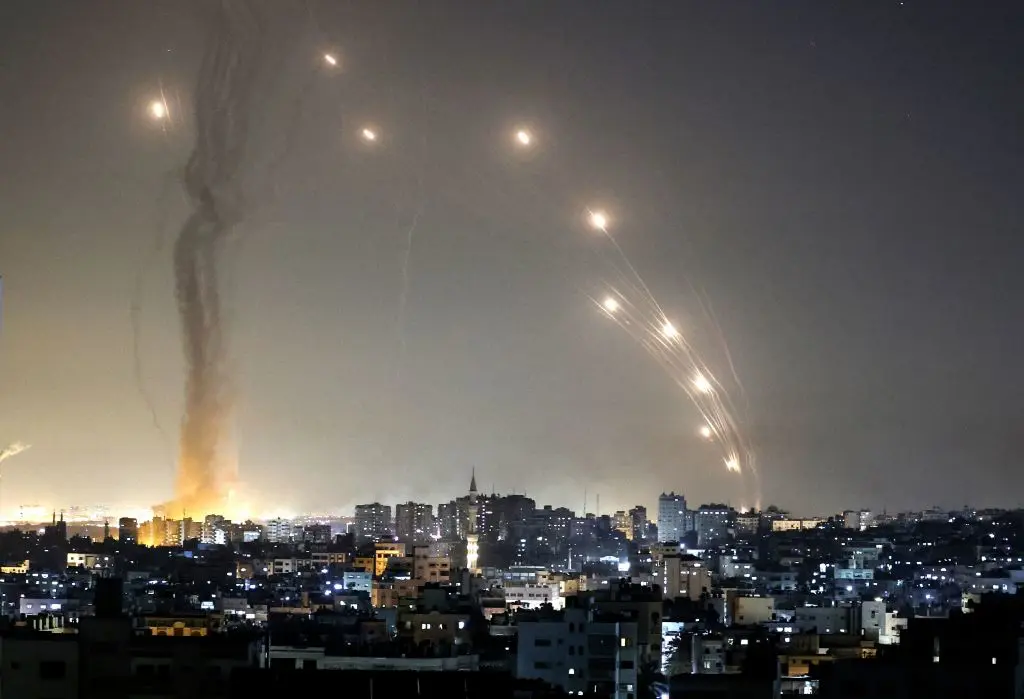
A stark and controversial warning from former senior U.S. military official Lawrence Wilkerson is fueling renewed debate over the trajectory of the Middle East war: that Israel, long seen as the region’s dominant military power, may be entering a period of acute strategic vulnerability—one that could, in the short term, threaten its very existence as a state.
Drawing on battlefield developments, political fractures, and escalating regional tensions, Wilkerson paints a picture not of gradual decline, but of rapid destabilisation driven by overextension, miscalculation, and an increasingly volatile geopolitical environment.
A War Expanding Beyond Control
At the centre of the crisis is the widening conflict involving Israel, Iran, and multiple regional fronts. What began as a contained confrontation has, according to Wilkerson, evolved into a multi-theatre war stretching from Gaza to Lebanon and beyond.
He argues that Washington—under Donald Trump—has become deeply entangled in a conflict it neither fully understands nor can easily exit. The administration’s shifting timelines, military posturing, and lack of coherent strategy suggest, in his view, a leadership “buying time” rather than executing a defined plan.
“If I were to be absolutely honest with you… I think it’s Trump trying to buy back time that he knows is running out,” Wilkerson said. “He’s in it deeply… and he has not the tools to extricate himself.”
This uncertainty is compounded by Israeli decision-making under Prime Minister Benjamin Netanyahu, whom Wilkerson accuses of driving escalation while offering no viable political off-ramp.
Signs of Strain Inside Israel
Perhaps most striking are claims of internal Israeli stress. According to Wilkerson, the Israeli military—once considered nearly invincible in conventional regional warfare—is now facing serious operational challenges.
He cites:
- Heavy losses in Lebanon, including destroyed armored columns
- Continued inability to decisively defeat Hamas in Gaza
- Growing manpower shortages, with reservist mobilisation faltering
- Reports of morale collapse among commanders and local officials
“These developments are not isolated,” he suggests, but part of a deeper crisis. “Israel is in turmoil right now,” Wilkerson said, adding that “it’s becoming extremely dangerous to be in Israel in any capacity other than in a bomb shelter.”
He pointed to battlefield setbacks in Lebanon, where Hezbollah fighters have reportedly been able to disable Israeli tank formations. “They’ve taken out seven or eight Merkavas already in a single column,” he said, describing a situation where “they’re not having a good time of it.”
The Demographic and Strategic Reality
Underlying the military pressures is a deeper structural issue: scale. Israel, with a relatively small population, is attempting to sustain simultaneous conflicts across multiple fronts while maintaining internal stability.
Wilkerson highlighted the implications of repeated mobilisation efforts. “You just called up 300,000—30% of whom didn’t show up,” he noted. “Where are you going to find these other 400,000?”
In this context, he raises a stark possibility: that Israel’s current trajectory could lead not merely to defeat in a single conflict, but to a broader collapse of its ability to function as a coherent state.
“I hate to say this… but Israel is going to disappear as a Jewish state in the Levant,” he said. “And Netanyahu is going to be the presider over that disappearance.”
The Nuclear Shadow
If the conventional battlefield looks grim, the strategic horizon is even more alarming.
Wilkerson warns that both Israel and the United States may consider the use of nuclear weapons if faced with an existential defeat—an outcome he describes as increasingly plausible under current conditions.
“I still think that Netanyahu is the most apt person to use—not one—but multiple nuclear weapons when he gets in a real bind,” he said.
At the same time, he cited expert assessments suggesting Iran may be closer than previously believed to acquiring nuclear capability.
“We’re in a new ball game very shortly,” Wilkerson warned. “Iran will have not one or two but three or four or five… nuclear weapons.”
The result is a scenario in which:
- Israel faces mounting conventional pressure
- Iran potentially gains nuclear leverage
- The U.S. risks escalation into direct confrontation with other nuclear powers
“What do you think’s going to happen when that happens?” he asked. “We’re talking about the three predominant nuclear powers in the world… facing one another.”
Economic Collapse as a Force Multiplier
Beyond the battlefield, the war is already reverberating through the global economy.
The disruption of critical shipping routes—particularly through the Strait of Hormuz—has led to widespread instability.
“We are disturbing the world economy in such significant and profound ways right now that it might not recover for years,” Wilkerson said. “There is a really good chance we’ll go into depression.”
He pointed to the cascading effects of global supply chain disruption, warning that even a rapid end to hostilities may not reverse the damage already done.
“It’s almost as if… we are bringing this to a head in a way that does not look good,” he added.
“The Short-Term End”?
Wilkerson’s most controversial assertion is that Israel may not simply be weakened—but could face a near-term existential crisis.
“I’ve been predicting it for a long time,” he said. “Israel is going to disappear.”
Such claims remain highly disputed and sit far outside mainstream geopolitical analysis. However, they reflect a growing current of concern among some observers that the convergence of military overreach, regional backlash, and internal fragmentation could produce outcomes once considered unthinkable.
Is There an Exit?
Despite the bleak outlook, Wilkerson identifies a theoretical path out of the crisis: de-escalation led by the United States.
“I think the best thing to do is declare victory and leave,” he said. “Lift the sanctions… let Iran rebuild its state.”
This would involve:
- Declaring victory and withdrawing from the conflict
- Ending sanctions on Iran
- Allowing regional powers to stabilise independently
- Forcing a halt to Israeli military operations
Yet he concedes this scenario is unlikely.
“It’s not going to happen,” he admitted. “I’m pipe dreaming.”
A Region—and a State—at a Crossroads
Whether or not one accepts Wilkerson’s most dramatic conclusions, his analysis underscores a critical reality: the Middle East is entering a phase of unprecedented volatility.
Israel, long defined by military dominance and strategic deterrence, now faces a convergence of threats that challenge those foundations.
“We’re walking down a very dangerous road right now,” Wilkerson warned. “And we’re walking down it… with fools.”
The question is no longer simply how the war will end—but what will remain when it does.
If current trajectories continue, the region may be approaching not just another conflict cycle, but a historic rupture—one that could redefine the political map of the Middle East in ways few policymakers have seriously prepared for.