


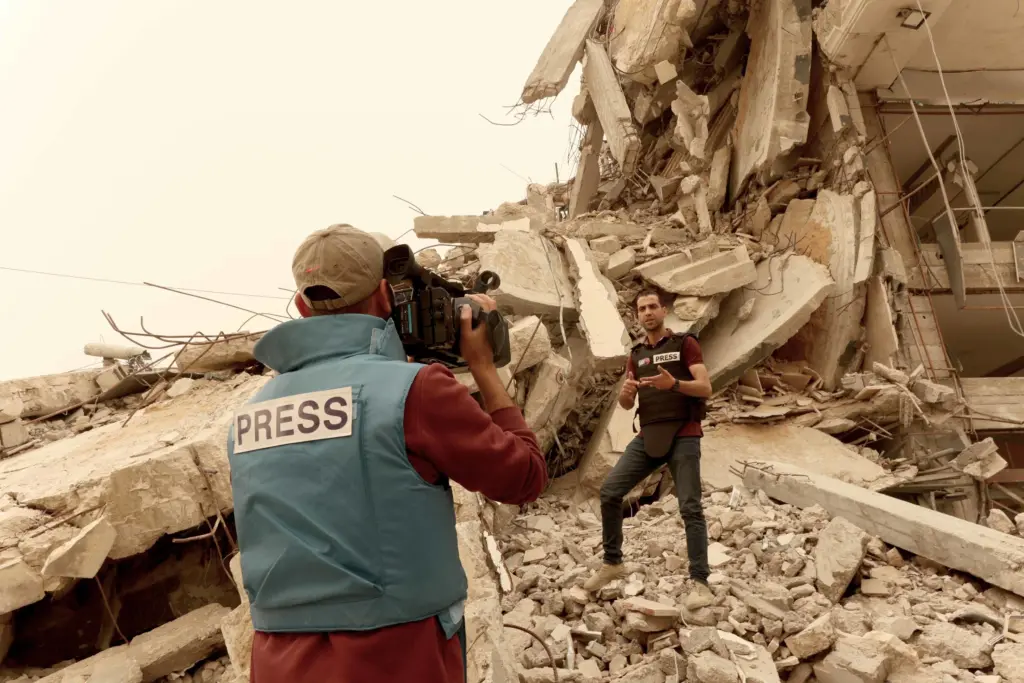
A growing body of testimony from Palestinian journalists released from Israeli detention is providing some of the most detailed evidence yet of alleged systematic torture, with dozens of reporters describing severe physical and psychological abuse during their captivity.
At least fifty-nine Palestinian journalists detained since October 7, 2023 have been interviewed following their release, and all but one reported being subjected to torture, abuse, or other forms of violence while in Israeli custody.
Those accounts describe a consistent pattern of treatment that includes beatings, electric shocks, forced stress positions, prolonged blindfolding, and the denial of food, water, and medical care, alongside detention in overcrowded conditions without access to legal representation.
One journalist, describing his detention at Al-Shifa Medical Complex, said there was not a single part of his body without marks of abuse, including fractures that had not healed, visible scarring from restraints, and injuries consistent with electric shocks.
Psychological torture was also widely reported, with detainees describing repeated attempts to break them mentally through threats against their families.
One former detainee recalled being told that his wife and children had been killed and buried under rubble, and that if he were released, he would have no one left to return to.
Several journalists were forcibly disappeared, with their whereabouts unknown for extended periods, while others were held without charge as part of what has been described as a wider campaign targeting media workers during the war.
Those who have been released describe returning home with lasting physical injuries and deep psychological trauma, while many others remain in detention, leaving their experiences undocumented.
These testimonies are now being cited by press freedom groups, including the Committee to Protect Journalists, as evidence of a systematic pattern of abuse, adding to growing calls for an independent international investigation.
A War Without Precedent for Journalists
The allegations emerge against the backdrop of an unprecedented death toll among journalists in Gaza, where the conflict has become the deadliest on record for media workers.
Estimates suggest that well over 200 journalists have been killed since October 2023, with some counts exceeding 270, the vast majority of them Palestinian reporters working inside the besieged territory.
By 2025, Israel accounted for roughly two-thirds of all journalist killings worldwide, a concentration that press freedom advocates say reflects a collapse in the protections historically afforded to reporters in conflict zones.
Carlos Martínez de la Serna, Program Director at the Committee to Protect Journalists, said the scale of the killings marks the most dangerous period for journalists ever recorded.
Among the most widely recognised cases is Wael Al-Dahdouh of Al Jazeera, who continued reporting after losing multiple members of his family in an Israeli airstrike, including his son Hamza Al-Dahdouh, who was later killed while working as a journalist.
Speaking after the deaths of his family members, Al-Dahdouh said that journalists and their families were being targeted and that there was nowhere safe in Gaza.
Reporters Without Borders Secretary-General Christophe Deloire has warned that the scale and conditions of journalist killings raise serious concerns about whether media workers are being adequately protected under international law.
Allegations of Abuse Extend to Civilians and Children
The testimonies of detained journalists are reinforced by separate allegations of abuse involving civilians, including one of the most disturbing cases to emerge from the conflict.
An 18-month-old Palestinian toddler, Karim Abu Nassar, was reportedly detained alongside his father near the al-Maghazi refugee camp in central Gaza and subjected to physical abuse while in custody.
According to witness accounts and medical findings cited in subsequent reporting, the child sustained injuries consistent with deliberate harm, including burns resembling cigarette marks and a puncture wound consistent with a nail being driven into his leg.
Medical personnel who examined the child stated that the injuries were not accidental and were consistent with intentional abuse.
The alleged abuse reportedly took place in front of the child’s father and was described as part of an attempt to coerce a confession.
The toddler was later released after approximately ten hours in detention, reportedly through the intervention of the International Committee of the Red Cross, while the father remained in custody.
Although the allegations have not been independently verified, they have intensified concerns among human rights organisations.
Amnesty International has stated that if confirmed, such acts would constitute serious violations of international law, including the prohibition on torture, while Human Rights Watch has called for urgent independent investigations.
Targeting of Journalists Spreads Beyond Gaza
As the conflict expands regionally, journalists operating in neighbouring Lebanon have also come under fire, raising concerns that the risks faced by media workers are no longer confined to Gaza.
In southern Lebanon, three journalists, Ali Shoeib, Fatima Ftouni, and Mohammed Ftouni, were killed when an Israeli airstrike struck their vehicle.
Lebanon’s Information Minister Ziad Makary described the attack as a direct strike on journalists and characterised it as a blatant war crime.
The Israeli military stated that one of the individuals targeted was affiliated with Hezbollah but did not provide public evidence and did not explain the deaths of the other journalists.
Separate incidents have also drawn international attention after Russian-affiliated journalists came under fire in the same region.
A missile strike landed near a crew from RT, injuring personnel and destroying equipment, while another strike reportedly wounded journalists working for Russian media.
Russia’s Foreign Minister Sergey Lavrov said the incidents appeared to involve targeted attacks against journalists and called for a full international investigation, warning that the use of precision-guided munitions against clearly marked press crews raised serious concerns.
Growing Pressure for Accountability
Taken together, the record number of journalist killings, the detailed testimonies of torture in detention, allegations involving the abuse of a child, and the expansion of attacks into Lebanon point to what observers describe as a profound erosion of international protections for journalists and civilians.
Israel has consistently denied deliberately targeting journalists, maintaining that its operations are directed at militant groups and conducted in accordance with international law.
However, critics argue that the scale, frequency, and geographic spread of incidents raise serious questions about compliance with those legal standards.
Carlos Martínez de la Serna has warned that when casualties among journalists reach such levels, the issue extends beyond press freedom and becomes a fundamental challenge to the rules governing armed conflict.
For journalists still operating in Gaza, the risks remain constant and severe, particularly given that international media access to the territory remains heavily restricted, leaving local reporters to document the war under extreme conditions.
As one Palestinian journalist put it, they are not only reporting the story but living through it, with many losing their lives in the process.
Meanwhile, many journalists remain in detention, their accounts still untold, while those who have been released continue to carry the physical and psychological scars of their experiences, contributing to a growing body of evidence that is placing increasing pressure on the international community to investigate and respond.