


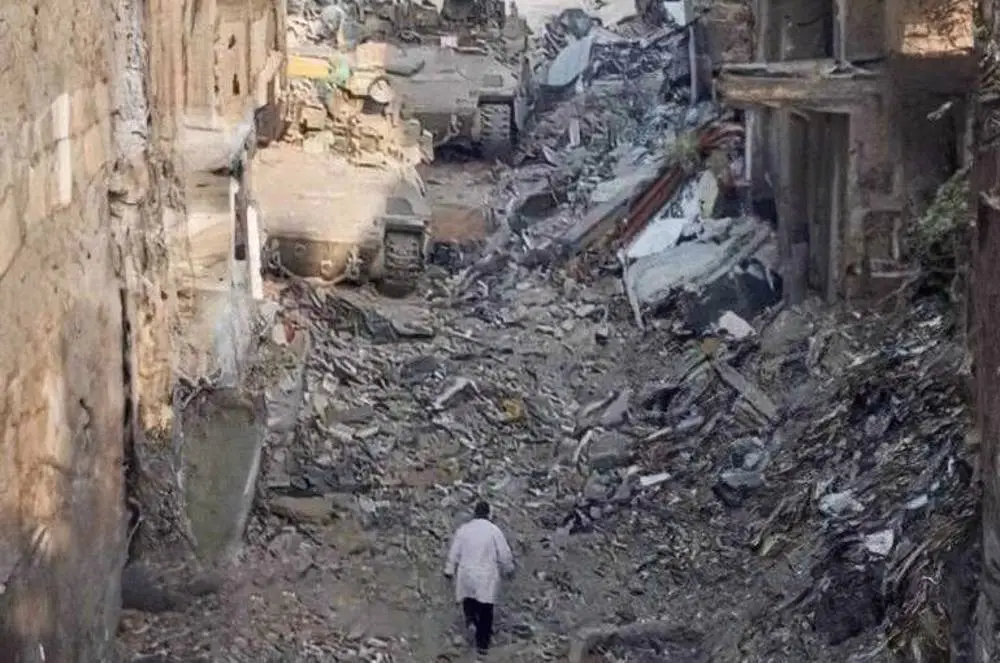
More than a year after his arrest, Dr. Hussam Abu Safiya, the Gaza physician who became a symbol of medical resistance during Israel’s assault on northern Gaza, is now the subject of urgent international concern. United Nations human rights experts warned in March 2026 that he is being subjected to severe torture and held in conditions that threaten his life, with reports indicating that he has been denied essential medical care while in detention. The experts described his imprisonment as “arbitrary” and incompatible with international law, particularly given his status as a civilian doctor.
For those who witnessed the final days of Kamal Adwan Hospital, the warnings come as a continuation of what they experienced on the ground. “We were stressed 24-7,” one nurse recalled. “There was no way to sleep at night.”
A doctor who refused to abandon the north
Dr. Abu Safiya, a pediatric specialist, became acting director of Kamal Adwan Hospital in early 2024 after its previous director was detained in an earlier Israeli raid. At that point, northern Gaza’s healthcare system had already begun to collapse, with hospitals destroyed, evacuated, or rendered non-functional, leaving Kamal Adwan as the last major facility capable of receiving the wounded.
Despite repeated opportunities to leave, he refused. His son later recalled urging him to evacuate, only to be told, “The plan is much bigger than this. The plan is displacement.” His wife described his attachment in more personal terms, saying, “The hospital was his first home and his house was his second.”
From October 2024 onward, the hospital endured an extended siege lasting approximately eighty days. Israeli intelligence officers contacted him directly, ordering him to evacuate. He refused and instead documented conditions inside the hospital, issuing repeated appeals. Standing beside critically injured children, he said, “We are appealing to the world and all international institutions to fulfill their humanitarian role.”
Inside, conditions deteriorated rapidly. Shrapnel entered patient rooms, surgeries were interrupted by nearby explosions, and patients died from injuries that would have been treatable under normal conditions. “Some patients actually died in front of us,” a nurse said. “They would have survived if they’d had surgery.”
The destruction of Kamal Adwan and the targeting of medical care
The experience of Kamal Adwan Hospital reflects a broader pattern in northern Gaza, where infrastructure was systematically degraded and civilians were left without access to essential services. Hundreds of families sought refuge in the hospital, believing it would be protected, yet it remained under constant attack.
On October 25, 2024, Israeli forces raided the hospital, detaining Dr. Abu Safiya and dozens of staff members. According to his wife, during interrogation he was warned directly, “Dr. Hussam, don’t connect with journalists.” She added, “They didn’t want the world to know what was happening in Gaza.”
The following day, he returned to the hospital and discovered that his son Ibrahim had been killed in an airstrike. Witnesses described his reaction in stark terms. “He collapsed. He was crying for six or seven hours. He didn’t stop,” one colleague said.
Yet even then, he continued working. His son later described how “he took his tears with him to the operating room,” after being called away from the funeral to treat patients.
In the weeks that followed, he was himself injured when an explosive device dropped by a quadcopter drone detonated near him inside the hospital. Despite shrapnel wounds to his leg, he continued working, declaring in a recorded message, “I swear this will not stop us from completing our humanitarian mission.”
By December 2024, the hospital was barely functioning. On December 27, Israeli forces launched a final assault. Tanks surrounded the building, snipers took positions, and drones hovered overhead. A witness described the moment a tank opened fire near the entrance, saying, “It started firing forward, firing and turning… and it was pointing at patients.”
That night, all remaining men inside the hospital were detained. They were stripped, blindfolded, and marched under armed guard. “They humiliated us, they hit us,” one detainee said. “They were treating us like we were terrorists.”
Dr. Abu Safiya was among those taken. He has not been free since.
Detention, abuse, and the collapse of legal protections
Dr. Abu Safiya is being held under Israel’s Incarceration of Unlawful Combatants Law, which allows for indefinite detention without formal charge. He was denied access to a lawyer for weeks. When his legal representative finally saw him, he had multiple broken ribs. “The trial is a sham,” his lawyer said, describing hearings that last only minutes and result in automatic extensions of detention.
His treatment raises serious concerns under international humanitarian law. The Fourth Geneva Convention and Additional Protocol I require that medical personnel be respected and protected in all circumstances and prohibit punishment for carrying out medical duties. They also require that detainees be treated humanely and provided with adequate medical care.
United Nations experts have now warned that these standards may be being violated in his case. They report that he is being denied essential medical treatment, while his condition continues to deteriorate.
The repeated targeting of Kamal Adwan Hospital also raises questions under Article 18 of the Fourth Geneva Convention, which prohibits attacks on civilian hospitals. No publicly substantiated evidence has been presented to justify the loss of its protected status.
A case that defines a wider crisis
Dr. Abu Safiya’s case reflects a broader pattern affecting Gaza’s healthcare system. Thousands of Palestinians are currently held under similar detention frameworks, including many healthcare workers. Several have died in custody, while others have reported severe abuse and deprivation.
Kamal Adwan Hospital now lies in ruins. What was once a functioning medical facility has been reduced to a destroyed structure, its staff dispersed or detained. Across Gaza, only a fraction of hospitals remain partially operational.
Despite his detention, Dr. Abu Safiya’s priorities appear unchanged. According to his family, when he is able to speak, his first question is about the hospitals in Gaza. His wife described the emotional strain of those exchanges, saying, “We tell him we are okay… but we are not okay, and he is not okay either.”
The image of him walking toward an Israeli tank in his white coat continues to resonate. For many, it represents a moment in which the protections of international law collided with the realities of war, raising enduring questions about accountability, enforcement, and the limits of those protections in practice.